
A preconstruction estimate that holds from concept through GMP is worth more than the candidate who built it, and most leaders spend the interview admiring the spreadsheet instead of reading the person who built it. The quality of a Preconstruction Manager hire is principally driven by the interviewer. A strong precon leader gets read accurately by a sharp interviewer and missed by a careless one, and the role punishes that carelessness with a budget that drifts, an owner who loses faith, and a field team that inherits a job nobody bought out. The best preconstruction manager interview questions are tools, and a tool works only as well as the hand using it. Leaders who cannot read themselves cannot read candidates, so the discipline of listening belongs to you. I have watched precon hires fail after clean-looking interviews, because the interviewer collected answers and never tested them. This shares a spine with Hire in 4K: the resolution of the decision is set by the resolution of the interviewer.
Interview to the three places this role breaks
A Preconstruction Manager fails in predictable ways, and the questions worth asking come from those failure modes. There are three.
The first is the budget that loses credibility as design evolves. Anyone can produce a number against a finished set. The precon leader has to stand behind one when the drawings are forty percent done and the owner already treats it as a promise. The break is the gap between what got estimated and what gets designed.
The second is the relationship that erodes under value engineering. The owner and the design team do not experience precon as arithmetic. They experience it as a series of moments where someone tells them what they want costs more than they have. A weak precon leader caves and carries the overage in silence, or wins the argument and loses the trust. The break is how cost truth gets delivered.
The third is the handoff that arrives broken. Precon looks successful until operations opens the folder and finds assumptions nobody flagged, scopes nobody bought, and a schedule built on a fantasy. The break is the seam between the phase that sells the job and the phase that builds it.
Interview to those three.
The accountabilities this role carries
Six areas of accountability define the role, each with probes built to read the candidate, not prompt them.
- Conceptual-through-GMP budgeting
- Value engineering and constructability
- Owner and design-team leadership
- Estimating and bid coordination
- Risk and qualifications in early budgets
- Precon-to-operations handoff
Conceptual-through-GMP budgeting
The spine of the role: carrying a number from a napkin sketch to a guaranteed price without it becoming a liability. The skill tested is managing accuracy as information arrives, not accuracy itself.
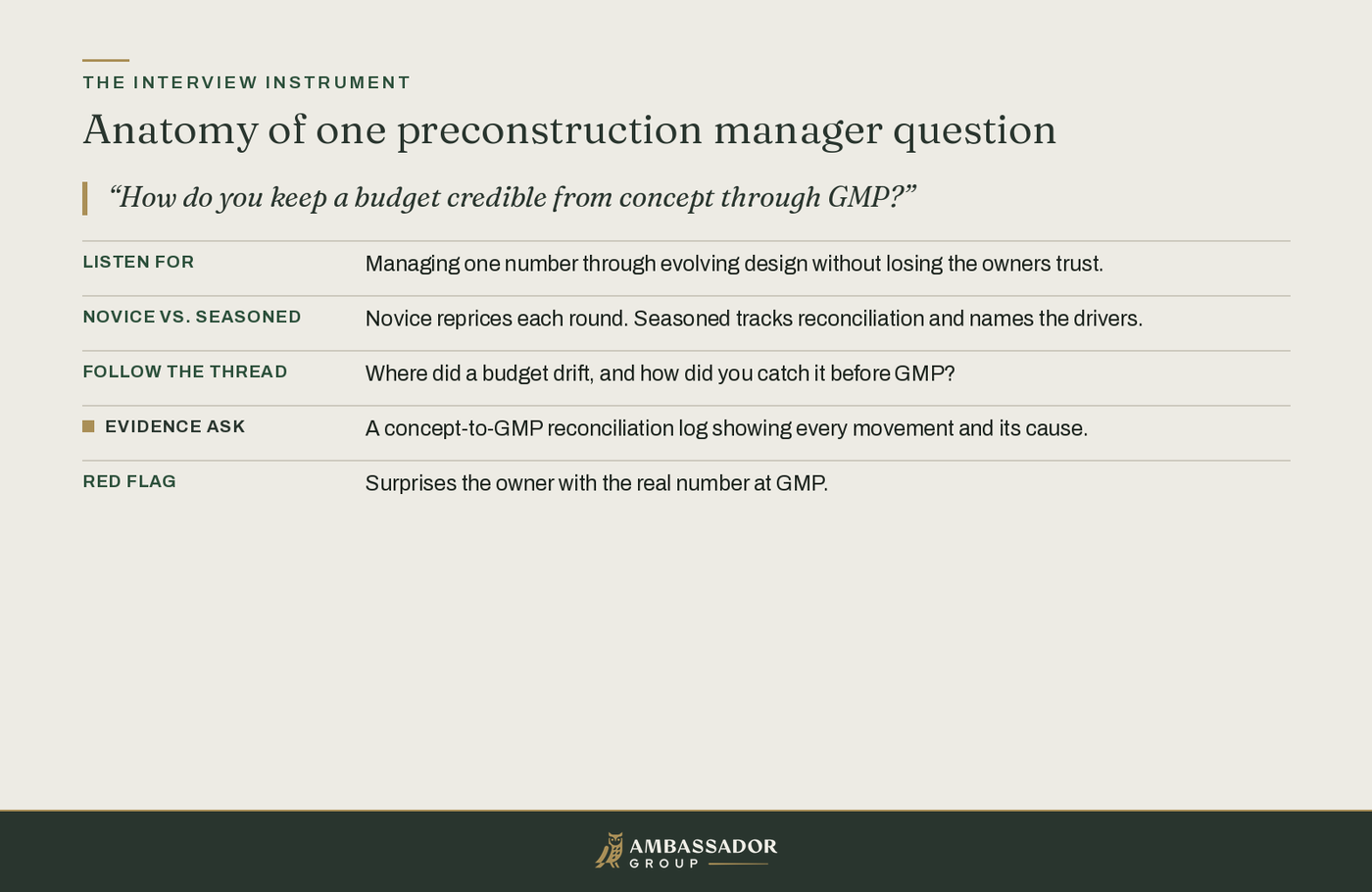
Walk me through a budget you built at concept, when the drawings were maybe a third complete, and how that number held by the time you reached GMP.
- Listening for: a method for budgeting without detail. Listen for benchmarks, historical unit costs, assemblies-based estimating, and allowances sized on purpose rather than guessed.
- Novice versus seasoned: the novice describes the concept number and the GMP number as two separate events. The seasoned candidate describes a continuous line, with a reconciliation at every design milestone that showed the owner exactly what moved and why.
- Follow the thread: if they cite a benchmark, ask what they normalized for (region, escalation, building type). If they mention allowances, ask how they chose which scopes got one versus a hard number. If the number held, ask what they would have done if it had not.
- Evidence ask: the concept-stage basis-of-estimate, the GMP estimate that tracked it forward, and the reconciliation log showing how the number moved between them.
- Red flag: a candidate who says their concept estimates usually land within a couple percent of GMP but cannot explain the reconciliation. Precision claimed without a tracking mechanism does not survive the next job. Equally telling is one who has never had a budget move: either they have not carried a real concept-stage number, or they are editing the story. Push them on a budget that did not hold: how many days passed between seeing the drift and telling the owner, what it cost in trust, and what they changed. Ask to see the cost-tracking log or estimate-versus-design reconciliation where they caught a variance before it compounded.
Value engineering and constructability
Value engineering is where precon creates value or burns trust. The constructability lens separates the precon leader from the estimator: the question is not only what something costs, but whether it can be built as drawn.
Give me a value-engineering exercise where you took real cost out without the owner feeling like they lost the building they wanted. Then describe a constructability problem you flagged during design that would have cost the field if it had reached them.
- Listening for: VE framed as alternatives that preserve design intent, not a list of deletions, and the ability to read a drawing set as a builder rather than a reviewer. Did they bring options with cost and schedule consequences attached, or hand the owner a subtraction? Can they name specific clashes, sequencing impossibilities, or detailing that would have driven RFIs and change orders?
- Novice versus seasoned: the novice describes cutting scope and talks about coordination in the abstract. The seasoned candidate substitutes systems, resequences, or re-details in ways that hold the owner's intent while moving the number, and on constructability names the exact condition (a structural and MEP conflict, an unbuildable connection, a crane or access problem) and what it would have cost in the field.
- Follow the thread: ask which VE idea the owner rejected and why they respected that, how they priced an alternative they had never built before, and what they do when the architect treats VE as an attack on the design. On constructability, ask how they raised it without turning it into a fight and what field experience taught them to see it.
- Evidence ask: a VE log showing each option with projected savings, schedule impact, and the accept-or-reject decision, plus a constructability review markup or comment log on a design set carrying their own annotations.
- Red flag: VE that is entirely cheaper finishes and lower-grade materials degrades the product rather than engineering its value, and an owner remembers it. As telling is a candidate who cannot describe a single constructability catch: the role exists partly to keep buildable problems from reaching the field.
Owner and design-team leadership
This accountability separates the Preconstruction Manager from the Estimator. The estimator can work from the back room. The precon leader sits at the front of it with the owner and the architect, and the budget survives only if the relationship does. This is where the interview becomes a bilateral interview: a client-facing role gets read most accurately by an interviewer willing to be read back.
Tell me about an owner who wanted more building than their budget allowed, and how you ran that. Then walk me through working a design team that is over budget and behind on the information you need to price.
- Listening for: the capacity to hold cost truth and the relationship at once, plus leadership without authority. How did they reframe the owner's choice from constraint to tradeoff and keep the owner in command of it? The precon leader cannot order the design team to move, so how do they create momentum across a table they do not control?
- Novice versus seasoned: the novice delivers bad news bluntly or softens the number to keep the peace, and on the design side waits for drawings and complains about the architect. The seasoned candidate gives the owner a clear menu of consequences and lets the owner own the decision, prices in parallel with design, sets milestone targets, and gives the design team cost feedback early enough to change the drawings rather than after.
- Follow the thread: ask what they did when the owner did not believe the number, how they handled an owner's rep or cost consultant challenging the estimate, what they do when deliverables slip and the GMP date does not, and how they keep an owner confident while the design team is the bottleneck.
- Evidence ask: an owner-facing budget presentation or options memo they personally prepared and delivered, plus a precon schedule or design-assist milestone tracker showing how they paced pricing against design deliverables.
- Red flag: a candidate who describes the owner relationship entirely in terms of being liked, or who frames the design team as the adversary. An owner who trusts you with bad news is worth more than one who enjoys your good news, and the job is to make the design team a partner in hitting the number.
Estimating and bid coordination
The precon leader does not take off every quantity, but they own the integrity of the estimate and the bid process that fills it. The skill is orchestration: getting real, comparable pricing from the trades and knowing when a number is too good to trust.
Walk me through how you run a bid package, from setting the scope splits to leveling the bids that come back.
- Listening for: a disciplined process for scope definition and apples-to-apples comparison. How do they prevent gaps and overlaps between trades, and how do they read a bid that comes in suspiciously low?
- Novice versus seasoned: the novice collects the lowest numbers and adds them up. The seasoned candidate describes scope sheets, a bid tab that levels each trade, and the call they place to a sub whose number signals a missed scope.
- Follow the thread: ask about a low bid that hid a gap, how they decide which scopes to competitively bid versus negotiate, and how they handle a trusted trade partner whose number comes in high.
- Evidence ask: a bid tab or scope matrix from a real package, showing how they normalized bids for comparison and where they carried the adjustments.
- Red flag: a candidate who treats the lowest number as the right number is buying the field's future change orders. Press the West Coast reality too: ask how they fill a scope no good sub will bid, whether they build it from cost data, broaden the trade pool, or price self-perform, and how they qualify that number so it does not read as solid coverage.
Risk and qualifications in early budgets
Early budgets are mostly assumptions, and a precon leader's quality shows in how honestly those assumptions get written down. Qualifications are where a careful estimator protects everyone, and where a careless one plants a change order.
Show me how you write the qualifications and assumptions behind a GMP. What goes in, and what have you learned to never leave out.
- Listening for: a precise instinct for which unstated assumptions become disputes. Listen for clarity on what is included, excluded, and allowanced, and evidence they have been burned by a missing qualification.
- Novice versus seasoned: the novice treats qualifications as boilerplate. The seasoned candidate treats them as the contract's risk map and can name the specific clarification they now always write because of a past fight.
- Follow the thread: ask about a qualification they wish they had written, how they handle an owner who wants every allowance converted to a hard number before design supports it, and how they size and defend a contingency to an owner who wants it gone. Then turn concrete: ask about an early-budget assumption that turned out wrong, the dollar exposure, who absorbed it, and what they changed.
- Evidence ask: a qualifications-and-assumptions page from a GMP they authored, plus a change-order or contingency-draw record tied to an assumption that proved wrong, with their write-up of the cause.
- Red flag: a candidate willing to drop contingency or strip allowances to win the number, which hands the exposure to the field and calls it competitiveness. Equally telling is one who cannot quantify what a past miss cost: not knowing what your errors cost is not managing risk.
Precon-to-operations handoff
The final accountability is the seam. A precon phase succeeds only if operations inherits a buildable, bought-out job with the assumptions visible: the difference between a number that closed and a job that builds.
Walk me through how you hand a job to the operations team. What do the project manager and superintendent receive from you.
- Listening for: a deliberate, documented transfer rather than a folder drop. Listen for a turnover meeting, a written basis of estimate, the buyout status, and the open assumptions the field has to manage.
- Novice versus seasoned: the novice hands over the estimate and moves to the next pursuit. The seasoned candidate describes a structured turnover where the field can challenge the number and understands every allowance, contingency, and qualification before they own it.
- Follow the thread: ask what the superintendent always wants to know that estimators forget to document, how they handle a PM who thinks the budget is wrong, and how they stay involved when a post-turnover buyout comes in over.
- Evidence ask: a project turnover or handoff package, including the buyout log and the basis-of-estimate narrative the operations team received.
- Red flag: a candidate who considers the job done at GMP signing. The seam is where margin disappears, and a precon leader who walks away leaves the field holding their assumptions. Test accountability across the seam directly: ask about a job where the field came back angry about something precon handed them, whether they sat with the field or sent a memo, and what they changed. The strongest precon leaders treat the PM and superintendent as their customers, name what precon genuinely missed alongside what the field misread, and can point to a lessons-learned review that captured the complaint and the change. A candidate who has never had the field come back unhappy has either not handed off real work or is not listening when it does.
What the candidate should be asking you
The interview runs both directions, and a Preconstruction Manager worth hiring is underwriting your company as carefully as you underwrite them. One who takes a job they cannot win will leave inside a year and take their reconciliation discipline with them.
Listen for whether they ask how budgets get won internally: who owns the GMP number when it is wrong, whether the company stands behind precon's contingency or strips it, and how the principal behaves when an owner pushes back. A candidate who asks these is reading your risk culture, the judgment the role demands.
Listen for whether they ask about the operations relationship: whether precon stays involved through buyout, whether the field respects the estimate or resents it, and how turnover works here. A candidate who probes the seam has been burned by a broken handoff before.
Listen for whether they ask about the owners and design teams they would face, and the work in the pipeline. A precon leader who has only run negotiated work with sophisticated owners may struggle in a hard-bid environment, and one who only knows commercial tenant improvement may drown on a complex ground-up project. A candidate who asks nothing about how the company handles cost truth has either not thought about it or does not care.
Do not leave the interview without capturing it
The interview is only as good as what you preserve, and memory is the least reliable instrument in the interview. Write your feedback before the debrief, while the answers are still sharp: the moment you hear another interviewer's read, yours bends toward theirs and the signal is gone.
Tally the risk honestly. For every gap, decide which of three things you will do: fill it (they can grow into the missing piece), engineer around it (the team covers it, and you build the role to account for it), or abandon it (the gap is load-bearing and the role cannot hold without it). A precon leader who cannot reconcile a budget is an abandon. One strong on cost truth but green on owner-facing leadership might be a fill, if you have someone to mentor the relationship.
Name what you did not assess. If you spent the hour on estimating mechanics and never tested how they deliver bad news to an owner, write that down as an open risk rather than letting the strength you saw paper over the question you never asked. The discipline of Hire in 4K is naming blind spots before they become surprises.
Decide against the role, not against the other candidates. The temptation is to rank three people and pick the best. The harder discipline is to ask whether any of them can hold this budget through GMP, lead this owner, and hand this field a job they can build. If none can, keep looking: the cost of admitting that now is a fraction of discovering it at the GMP that does not hold.
Reading the person across the table
The questions on this page will not find you a Preconstruction Manager on their own. They give a sharp leader a way to see one clearly and give a careless one a longer list of things to misread. What separates the two is the attention you bring, the follow-up you chase, and the honesty you hold when the answer is not what you hoped. The same self-awareness that lets a leader be the lightning rod for accountability lets them read the person across the table, and reading that person is the whole job. To see how this role compares to the leadership role it feeds, the Project Executive guide runs the same method against a wider span of accountability.
You already have the questions. What you do with the listening is yours.
The short version.
- What should I interview a preconstruction manager candidate for?
- Interview to the three predictable ways the role breaks: the budget that loses credibility as design evolves, the owner and design-team relationship that erodes under value engineering, and the handoff that arrives broken when operations opens the folder. Six accountabilities cover the role: conceptual-through-GMP budgeting, value engineering and constructability, owner and design-team leadership, estimating and bid coordination, risk and qualifications in early budgets, and the precon-to-operations handoff. This role sits alongside the other construction interview guides.
- How do I test whether a candidate can carry a budget from concept to GMP?
- Ask them to walk through a budget built when drawings were a third complete and how the number held at GMP, then listen for a method: benchmarks, historical unit costs, assemblies-based estimating, and allowances sized on purpose. A novice describes the concept number and GMP number as two separate events; a seasoned candidate describes a continuous line with reconciliation at every design milestone showing the owner exactly what moved and why. Ask for the basis-of-estimate and the reconciliation log as evidence.
- What are the red flags in a preconstruction manager interview?
- Claimed precision without a tracking mechanism, a candidate whose budgets have never moved, VE that is entirely cheaper finishes and lower-grade materials, no constructability catch they can name, treating the lowest bid as the right bid, willingness to drop contingency to win the number, and considering the job done at GMP signing. A candidate who has never had the field come back unhappy has either not handed off real work or is not listening when it happens.
- Why should I ask candidates for documents, not just stories?
- Because artifacts test the answers stories cannot. Useful evidence asks include the concept-stage basis-of-estimate and GMP reconciliation, a VE log with savings and accept-or-reject decisions, an owner-facing options memo they personally delivered, a bid tab or scope matrix showing how they leveled bids, a qualifications page from a GMP they authored, and a turnover package with the buyout log. Precon hires fail after clean-looking interviews when the interviewer collects answers and never tests them.
- What questions should a strong preconstruction candidate ask me?
- A precon leader worth hiring underwrites your company as carefully as you underwrite them. Listen for questions about how budgets get won internally, who owns the GMP number when it is wrong, whether the company stands behind precon's contingency or strips it, whether precon stays involved through buyout, how turnover works, and what owners and design teams they would face. A candidate who asks nothing about how the company handles cost truth has either not thought about it or does not care.


