
This guide is for the person running the interview. If you just need role-specific questions to ask, go to Interview Questions by Role; if you are the one preparing to be interviewed, start with how we represent candidates.
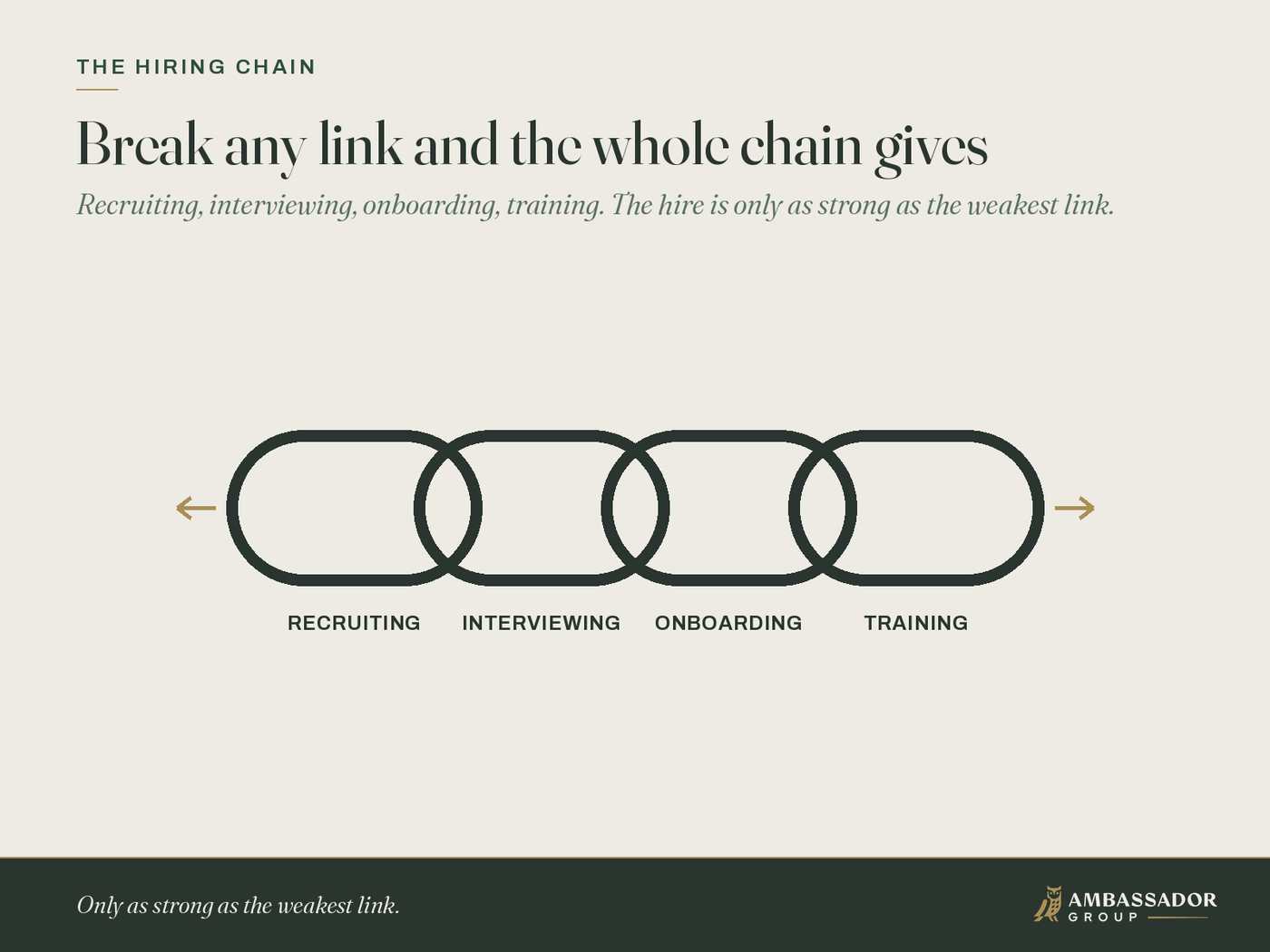
The one-screen version. Interviewing is a separate skill from doing the job, and the quality of a hire is set by the person doing the reading, not the size of the pool. The discipline, in brief:
- Decide what the role has to produce before anyone sits down, and build a two-page punch list from it.
- Ask questions that cannot be answered from a rehearsal, and investigate each answer instead of just noting it.
- Give every interviewer a lane, keep cameras on, and write your own read before you hear anyone else’s.
- Treat the resume, the screening, the job-fit assessment, and the reference call as four separate instruments, and never let one return the verdict alone.
Everything below is how to do each of these well.
The quality of a hire is set before the candidate says a word. It is set by the person on the other side of the table, and that is the part of hiring nobody sells you, because there is no product in it.
The industry sells a deeper pool. Better candidates, more of them, faster. That offer assumes the constraint is supply, and for most construction companies it is not. The same pool produces wildly different outcomes depending on who is doing the reading. Two leaders interview the same superintendent in the same week; one hires a problem and one passes on a problem, and the difference is not the superintendent.
So this is a guide about the reader. What to settle before anyone sits down, how to ask a question that cannot be answered from a rehearsal, how to tell a practiced answer from a true one, when to stop an interview that is already over, and how to weigh the resume, the assessment, and the reference calls that surround the conversation. It is written to be read straight through once and returned to in pieces.
One thing to name first, because it governs everything after it. Interviewing is risk underwriting, not sales. You are not trying to talk anyone into anything. You are trying to price a risk honestly, on both sides, before either party is committed. Every technique below is in service of that, and any technique that serves persuasion instead belongs to a different job.

Interviewing is a separate skill, and you were probably never taught it
Most construction companies assume their leaders already know how to interview. They run nine-figure projects. They read a set of drawings in seconds. They have twenty years in the field. Surely the conversation takes care of itself.
It does not. Being excellent at the work is not the same as being excellent at assessing somebody for it. Technical mastery does not transfer to the interview chair, and neither does instinct about projects, because a project does not sit across from you managing the impression it makes. Nothing about running work prepares you to read a person who has prepared to be read.
That gap is not a character flaw. It is an untrained skill, and untrained skills produce exactly what you would expect: scattered conversations, panels that walk out disagreeing about what they just saw, decisions made on the most confident voice in the debrief. A sloppy read is how a strong resume becomes a bad hire eight months later.
The good news in that framing is the whole reason to keep reading. A skill can be built, and this one compounds. Sharpen how your team reads people and you have not improved one hire; you have improved every hire that team will ever make.
What an interview is for
Ask ten leaders and most will say some version of "to find out if they can do the job." That is a third of it.
An interview is where two parties find out whether the expectations they each hold can carry a long relationship. Both sides are deciding. Both sides own the work of saying what they need. A hire succeeds when it meets the expectations everyone was holding, and fails when those expectations were too high, unspoken, or quietly mismatched and nobody said so out loud.
That reframing has teeth, because it kills the interrogation model. If you treat the hour as an extraction, you will optimize for pressure and learn only how someone performs under pressure while being evaluated by a stranger. If you treat it as a mutual pricing exercise, you will tell the candidate the hard truths about the work, and their reaction to those truths is better evidence than anything they say about themselves.
It also means the interview should inform the candidate as much as it questions them. A candidate who leaves knowing less about the job than you know about them was interviewed badly, and the cost of that lands on you in month four.
The seven levels, novice to master
Fit is not one thing, and interviewing skill is not one thing either. It develops separately along each dimension of fit, and most interviewers are advanced on one or two and novice on the rest. Read the following as a mirror, not a checklist.

Functional fit. Can they do the work?
The verifier treats the resume as a script and asks questions that can be answered yes. The investigator asks for a specific example of the work being done. The craftsman simulates the work and asks how the candidate thinks about the craft, which is the only version that distinguishes a real skill gap from a bad day.
Contextual fit. Can they do it here?
The generalist assumes construction is construction. The describer explains the environment and checks for similar company sizes. The reality-checker runs the anti-sell: describes the ambiguity, the missing resources, the bureaucracy, and watches for the flinch.
Cultural fit. Do they behave like your people behave when nobody is watching?
The novice runs the beer test and hires for likeability, which selects for people like themselves. The competent interviewer recites the values and asks the candidate to comment. The guardian asks high-tension questions and looks for ownership: tell me about delivering bad news to somebody senior to you.
Relational fit. How will they work with these specific humans?
The novice trusts chemistry. The competent interviewer asks about management styles. The architect uses data to find the friction in advance, then raises it directly: this assessment says you run autonomous, your manager runs hands-on, how will you navigate that?
Motivational fit. Does the daily reality of the work feed what drives them?
The salesperson sells the money and the title. The career planner asks about five-year goals. The master asks what work gives energy and what drains it, because a capable person doing draining work leaves regardless of how capable they are.
Developmental fit. Can this role stretch them without breaking them?
The novice needs a body in a role this month. The developer looks for coachability. The scaler asks whether the candidate's growth arc matches the company's, and refuses to grow what the company cannot lead.
Leadership fit. What kind of leadership does this person need, and can you supply it?
The abdicator hunts a self-starter so there is nothing to manage. The manager explains the reporting line. The servant leader is honest about the leadership on offer: I provide very little daily oversight, how will you handle that? Every hire comes with a leadership bill, and pretending otherwise is how a good candidate fails in a role you built for nobody.
The pattern across all seven is the same movement, from verification to simulation. Novices confirm what the page says. Masters build a situation where the truth has to show up.
Hiring is high-calorie work, and the shortcut is a loan
A low-calorie process is just enough thought to move through the motions and just enough structure to call it a process. No real prep, no real debrief, no reflection afterward. Get through it and get back to the work that feels like work.
Hiring is that work. It is the most leveraged decision a leader makes, because everything else runs downstream of who is on the team. The calories that separate an amateur process from a professional one go into a small number of specific places: thinking about what the role demands, preparing both sides, engaging as a person and not a panel, and running an after-action review that turns one outcome into a system upgrade.
Leaders skip this from two directions. The hopeful gambler believes a strong enough candidate will carry the process. The burned skeptic has decided interviewing is a lottery and refuses to fund a lottery ticket. Both end up spending the calories anyway, later, on managing a bad match, rehiring, and repairing the trust of a team that watched it happen.
Interview to the job description
Under pressure, teams default to three heuristics: gut feel, years of experience, and the brand on the resume. Each has a grain of truth in it. None of them tells you how this person will perform your job, your way, under your leadership, on your projects.
Gut feel forms in a controlled hour where the candidate is on their best behavior. Ten years can mean ten years of compounding judgment or one year repeated ten times. Pedigree does not travel, because two firms building identical scopes can differ completely on decision rights, documentation standards, and how they behave when a schedule slips.
The alternative is not exotic. You already invested real work in the job description. Make it operational. Plan the interview, execute to that scope, inspect the result against it, and keep the record. If you finish a cycle and cannot show where the candidate aligned and where they did not, against the document, you did not assess fit. You held meetings.

Build a two-page punch list
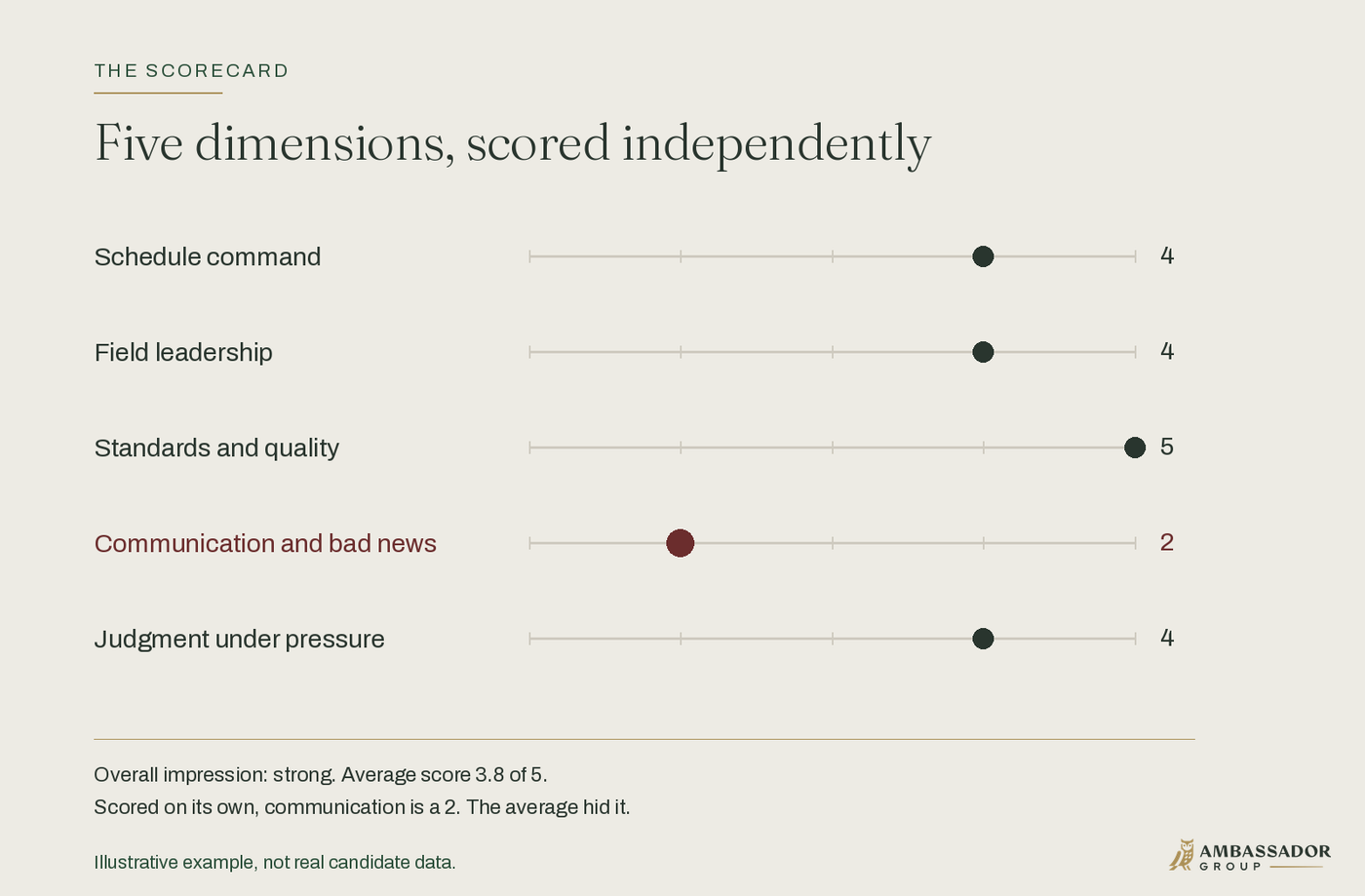
Give every interviewer the same two pages.
Page one turns the accountabilities into evidence you need to see. For a construction leadership role that means pre-task planning and how they use leading indicators; how they build and recover a schedule; change order workflow, contingency, and buyout; submittals, RFIs, daily logs, and closeout; sequencing and constraint tracking; how they deliver bad news to an owner; and how they coach somebody under stress.
Page two asks how your values behave under pressure. Humility becomes "tell me about a miss you owned and what you changed." Excellence becomes "show me artifacts that prove your standard." Ownership becomes "when did you raise a risk early that leadership did not want to hear?"
Then hold the line in both directions. If it is not on the punch list, do not weight it heavily. If it is on the list, do not accept a vague answer.
Give every interviewer a lane
The most common panel failure is five people asking the same four questions. When everyone is responsible for evaluating the whole candidate, nobody is responsible for anything, and the gaps hide in between.
Lanes and interviewer preps are process-design work, and how to design an interview process covers how to assign them against a register of named risks. What matters once you are in the conversation is narrower: know which risk is yours, know what a strong answer to it looks like before you hear one, and do not spend your hour on somebody else's lane because the candidate steered you there.
How many interviews, and how deep
Fewer than you run now, and deeper than you run now.
Depth and speed are not opponents, which is the thing most teams get backwards. A drawn-out process reads as indecision to the exact candidates you want most, and they have other options while your panel schedules its fourth round. Compression comes from removing redundancy, not from removing rigor: get the first conversation inside 24 to 48 hours of the resume landing, stack conversations on one day, keep each one structured to its lane, and give your hiring authority the standing to decide instead of deferring upward.
The count matters less than whether each conversation has a distinct job. Three interviews with three lanes beats five interviews that all cover the same ground.
For the fuller version of this, including the hiring strategy meeting that should precede all of it and how to choose the interview types that fit your specific risks, see how to design an interview process. This guide is about conducting the conversation the process makes room for.
Set expectations out loud, throughout
Expectation setting is not a step near the offer. Weave it through every conversation, and cover the categories most likely to break a match if you leave them unformed.
Start with a clearly defined role, because the most common misunderstanding in hiring is how subtly two people can define the same job differently. Then: why the role is open. The problems already living inside it. What training and onboarding look like in practice. What is broken in the company right now and what fixed would look like. Where the company is going, in careers and revenue and project mix. How communication works here and how fast decisions get made. What the leadership on offer looks like day to day.
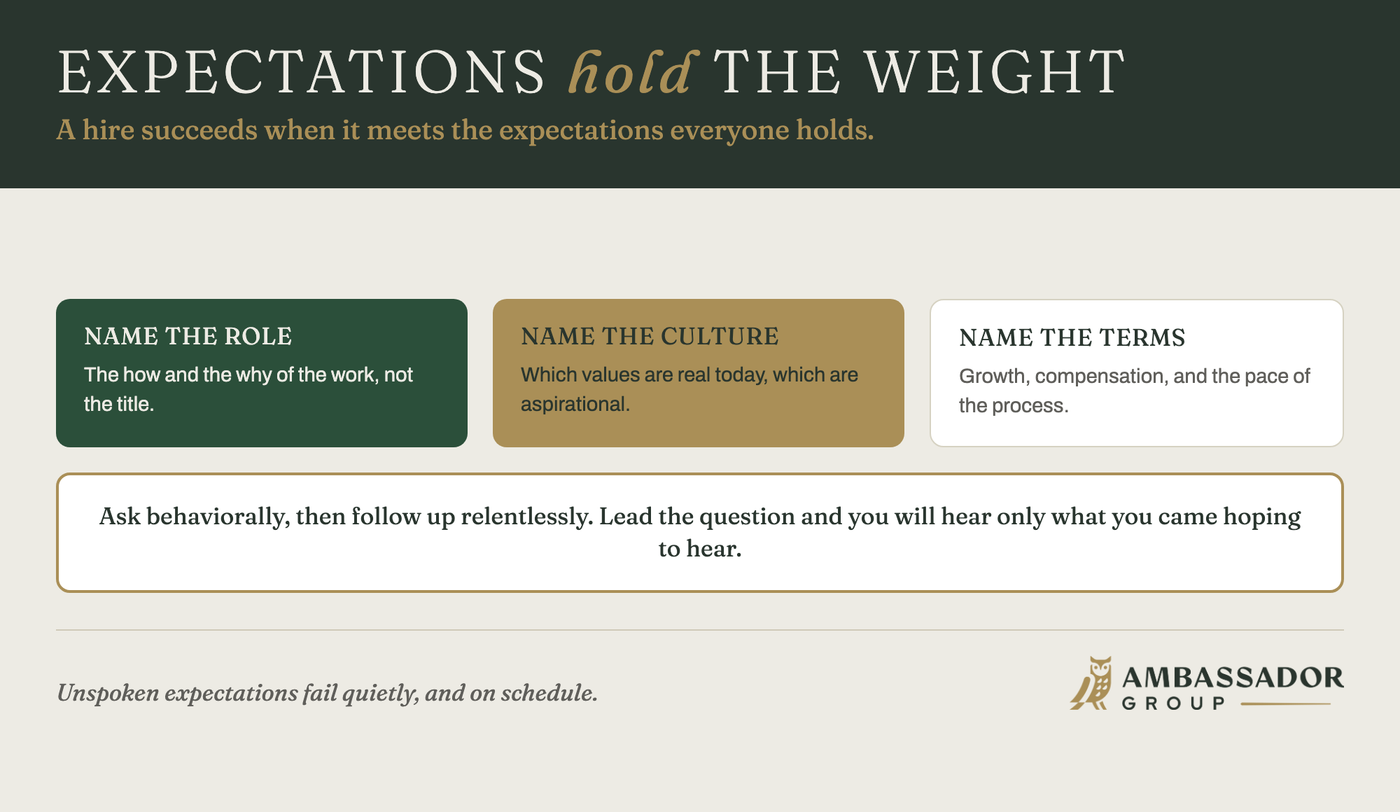
Say the uncomfortable ones plainly. A candidate who hears the hard version and stays is worth more evidence than a candidate who hears the pitch and says yes.
Be warm, quiet, and relentless
Good interviewing looks like the friendliest interrogation you have ever sat in. Not hostile. The purpose is the same as an investigator's, to get to the bottom of a matter, and the technique that gets there is warmth rather than pressure.
Presence. Warm, hospitable, genuinely glad they came. You facilitate without dominating. The candidate talks more than you do, and you are comfortable with that.
Listening. The proof of listening is the quality of the follow-up. Chase the why, always, because why somebody does a thing predicts far more than what they did. Make no assumptions; validate a forming opinion with another question rather than filing it.
Flanking. When an answer comes back shallow or a candidate resists a subject, do not push harder on the same line. Approach it from a new direction. Shallow answers usually survive repetition and rarely survive a flank.
Silence. After an answer, pause. People who can sit with a silence tend to think before speaking. People who rush to fill it are showing you their reflex, and the pause itself often produces the part they were not going to volunteer.
Frankness about yourself. Name your own relevant problems and constraints. It buys honesty at a rate nothing else matches, and it is the behavior you are asking them to model.
Take no half-answers, and give no half-questions.
The three levels of questions
Most interviews never leave level one.
Level one is the stock question. Tell me about yourself. Strengths and weaknesses. Why do you want this job. These are answerable from a rehearsal, and every serious candidate has rehearsed. They produce no evidence, only polish.
Level two is behavioral. Tell me about a time a subcontractor put you behind. This is better, because a candidate cannot fabricate experience they never had without leaving seams. Its limit is that a story can be inflated, and past success in a different context does not transfer automatically.
Level three is situational and work-sample. Here is a schedule with two weeks of slip and a supplier who just moved; walk me through your next move. Here is a set of drawings; plan the next phase. If I called your last superintendent, what would they say your biggest weakness is?
Level three is where the evidence lives, because there is no rehearsal for a problem the candidate has not seen. Ask the questions in that order inside a single subject and you get the claim, the history, and the live demonstration of the same competency, which is how you find out whether they match.
A worked example beats the theory. Take schedule recovery: "Walk me through your last recovery. What slipped, when did you first see it, what options did you weigh, what did you do, and what was the measurable result?" That single prompt produces a claim you can test, a timeline you can probe, and a decision you can compare against how your own people would have handled it.
Investigate, do not observe
A client of ours built a strong plan for a technical hire, including a practical work sample. In the moment, they took a shortcut. Rather than have the candidate complete the sample, they listened to the candidate explain how they would approach it, and the explanation was confident and detailed. They hired.
Within weeks it was clear the candidate could not do the work. What an hour would have caught showed up on the job instead, at full price.
That is observational interviewing: you watch, you listen, you get a feel, and you take the description as proof. It feels efficient and even courteous, and it quietly moves the burden onto the candidate's storytelling ability instead of your verification.
Investigative interviewing takes the verification back. Have them complete an exercise in real time. Have them walk you through an actual deliverable they built. Hand them a situation and change a variable partway through. Design the process so vagueness has nowhere to sit.
The distinction is not politeness versus rigor. It is whether you are assessing what somebody says or what they can do.
Test without running a stress test
You need to know how a person handles disagreement, ambiguity, and people with no power over them. None of that requires making the hour adversarial.
Challenge an opinion. Ask what they believe about construction that most people get wrong, then push back gently: some builders I respect say the opposite, what makes you confident? A strong candidate defends the position with reasoning and stays in the conversation. Watch for the two failure modes, collapse and hostility, because both will show up again on a jobsite.
Hand them ambiguity. A sub misses a deadline and the project is now at risk; what is your next move? The best answers begin by asking you for more information. A confident single answer to an underspecified problem is a warning, not a strength.
Eat a meal. How somebody treats a server predicts how they treat a laborer, a vendor, and a client's assistant. You cannot ask for this and you cannot fake your way past it.
Use silence. Covered above, and it is the cheapest instrument here.
Have them teach you something in five minutes. It surfaces how they organize an explanation, which is most of what leading a crew consists of.
Run a reverse interview. Give them fifteen minutes to interview you about the job. What they ask shows what they researched and what they care about, and the questions a strong candidate asks are frequently the best evidence in the whole process.
Do not go flat
There is a failure mode on your side of the table with a name: greyrocking. Flat affect, no facial expression, a robotic list with no follow-ups, no signal that anyone is listening, nothing offered about the company or the work.
Sometimes it is deliberate, and there are narrow cases where neutrality is the point. Mostly it is unintentional, and it comes from somewhere identifiable: an interviewer who is exhausted, or was never trained and has confused professional with cold, or is walking on legal eggshells, or has no plan for the hour, or has already decided and is running out the clock.
Whatever the cause, the effect on your best candidates is identical. They read it as disinterest and they go somewhere that seemed to want them. You cannot ask for candor while offering none, and the strongest people in your market are the ones who can most afford to walk.
Cut a bad interview short
Politeness says you owe a candidate the full hour. Politeness is wrong, and the belief costs real money.
Ten interviews a year running thirty minutes past the point of decision is five hours, and the mental cost is worse than the clock: you carry the frustration of a doomed conversation into the next one and misjudge somebody good because you are depleted. It does not help the candidate either. Most of them can feel it, and extending the conversation only extends the discomfort.
Call it when you see a non-negotiable skill gap, an obvious lack of preparation, a work-style mismatch you would have to fight every week, or an inability to articulate basic thoughts about their own work. Then exit with respect: thank them specifically, tell them plainly that you do not think the match is there, tell them when they will hear from you, and mean it. Ending early is a professional skill. Ending badly is the thing to avoid.
Cameras on
For a remote conversation, the camera is not a courtesy, it is part of the instrument. Eye contact, expression, and posture carry as much as the answers, and without them both sides are guessing at intent and engagement. Ask for it in the calendar invite so it is settled before anyone joins, and ask again warmly at the start if the camera is off. Say that the background does not matter, because for a candidate taking the call from a truck, it usually is the background they are worried about.
You cannot listen well and write well at the same time
Trying to ask the next question, follow the current answer, and record what was said is three jobs. Do two of them badly and the third suffers most.
Fix it structurally rather than by trying harder. Bring a second interviewer: one leads, one observes and writes. That splits the cognitive load, catches tone and word choice the lead will miss, and gives you two lenses instead of one. Where a second person is not available, lean on the recording your process should already be making, and tell the candidate at the start so you can pay attention instead of taking dictation. Most candidates hear that as respect, because it is.
Then write to a short structured form instead of a wall of prose: what you heard that maps to the punch list, what raised a concern, direct quotes worth keeping, and how they would work with this team. Quotes matter more than paraphrase, because a paraphrase is already an interpretation and you will not be able to recover the original later.
Every interview is a data set
Here is the habit that costs the most and looks the most like diligence.
Six people talk to a candidate over three weeks. That is six sets of notes, a screening call, two reference conversations, an assessment, and whatever got said in the parking lot. Then forty minutes of debrief compresses all of it into a paragraph that one person can hold in their head, and the paragraph is what survives. Everything underneath it sits in inboxes nobody opens again.
The compression protects the decision and destroys the onboarding plan. What gets dropped is exactly the material that did not push toward yes or no: where the candidate hesitated on the third scheduling question, how they described being managed at their last company, the fact that an estimator mentioned twice that written scopes at their old shop were assumed rather than issued. None of that changes a hire or no-hire call much. All of it is the plan for leading the person once they arrive, and a risk nobody named is a risk nobody managed. Six weeks later a manager is discovering gaps in production that three interviewers already documented.
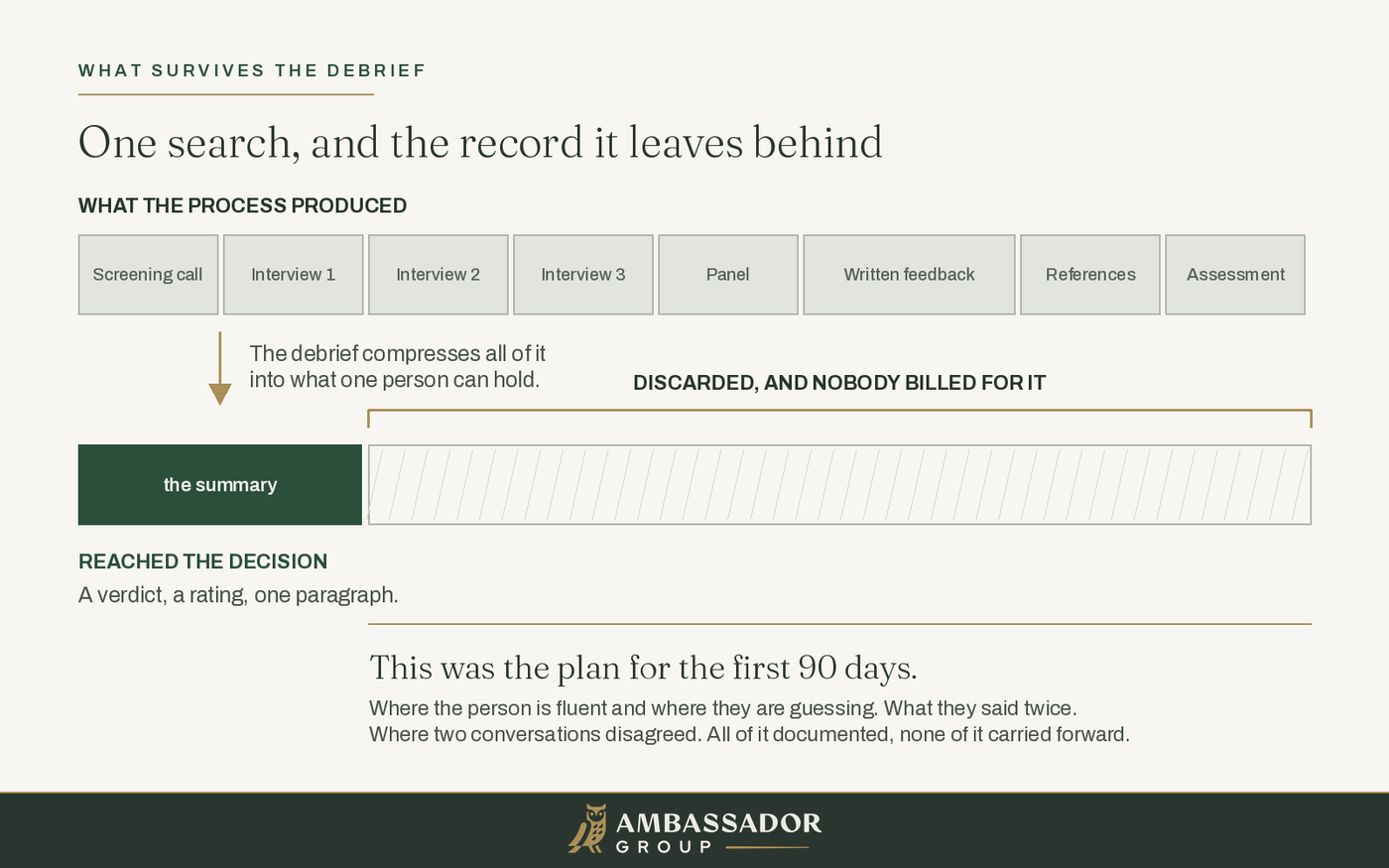
There is a quieter loss too. Divergence only shows up across the whole record. A candidate who says one thing in the screening call and something meaningfully different in the third interview has told you something important, and you can only see it while both conversations are still on the table. Summarize each one separately and the contradiction dissolves into two reasonable notes.
Watch what an underwriter does when a risk gets complicated: they widen the file. More evidence, and a method that lets a large body of it yield one clean decision without anyone holding it all at once. The data set grows and the answer sharpens at the same time. That option is available in hiring and almost nobody takes it, because the reflex is to shrink the record until a single person can cope.
If you want to know what this is costing you, take your last completed search and try to reconstruct it. Find the written feedback, the notes, the transcripts. Then find out what the hiring manager was told. The gap between those two is your compression loss, and reading it once will teach you more about your process than any vendor pitch.
Write your read before you hear anyone else's
One rule protects everything above, and designing the process is where it gets enforced: written feedback before the group discusses the candidate at all.
The reason belongs here, because it is about you in the hour rather than the process around it. Your read is most accurate before it is contaminated, and it starts degrading the moment a more senior or more confident voice offers theirs. Write it down while it is still yours. Then grade yourself over time against how the hire performed, because you cannot improve a read you never scored, and most interviewers have never once checked whether they were right.
The evidence around the conversation
An interview is one instrument. The resume, the assessment, and the reference calls are the others, and each one tells you something the interview cannot while lying in its own particular way. Knowing which lie belongs to which instrument is most of the remaining skill, and the order you read them in decides what you learn.
A candidate is perfect twice in a lifetime: once at birth, once on the resume. Everything in between is messier, and every artifact you receive before the offer has been built to hide the mess.
The resume went through six drafts. The interview answers were practiced in the car. The references were chosen because they would say the right things. None of that makes a candidate dishonest. It makes them human. It also means you are pricing a six-figure decision on polished evidence, and polish conceals exactly what you need to see.
So read every artifact the way an underwriter reads a loan file: as a set of claims to price and probe, not facts to accept. Each instrument tells you something real, and each one lies in its own particular way. Knowing which lie belongs to which instrument is most of the skill, and the order you read them in decides what you learn.
Price them against something specific: the goals this person has to hit in the first year, and the risk that each one goes unmet. Without that list, every instrument returns an impression and you have no way to say which risks you closed.
What the resume can tell you
Some signals on the page are reasonably reliable, as long as you treat them as starting coordinates rather than conclusions.
Trajectory. Has the candidate stayed in one sector or moved across several? Is responsibility compounding over time, project engineer to project manager to construction director, or holding the same altitude for years? Ask about lateral moves and quiet demotions rather than ruling them out. Growth in scope is visible on the page; its cause is not.
Relevant experience at similar scale. A construction leader's resume should show oversight of projects at a comparable size, with fluency in codes, budgets, and safety. The specifics are the tell: scheduling software, a PMP, LEAN exposure. Most readers hunt for those keywords first, and the instinct is sound.
The employment timeline, with caveats. You can see frequent moves, long stretches, and gaps. You cannot see why any of them happened. The dates are facts. The story behind the dates is not on the page. A pattern of eighteen-month stints can signal someone who leaves the moment real accountability arrives, and it can just as easily reflect consulting work or a wave of layoffs. The number is a prompt.
Achievements over duties. A list of responsibilities tells you what someone was assigned. A list of results tells you what they did with it. Look for quantified outcomes: projects finished under budget, schedules pulled forward, costs cut, scope grown. Most resumes catalog the busy work. What you need is the business result the busy work produced.
Communication and care. The writing is your first sample of how someone thinks. In a leadership role, clarity is non-negotiable. Spelling errors, a chaotic layout, dense unbroken paragraphs: these signal rushed effort or genuine difficulty organizing thought. A clean, scannable page signals the opposite. A good standard is that the important highlights should surface on their own in about seven seconds.
Effort aimed at you. A tailored resume stands out because effort is visible. If a candidate speaks your industry's language and connects their experience to the specific job in front of them, you can read their interest level off the page. In construction that usually shows up as hard numbers: budgets managed, square footage built, safety incidents reduced, subcontractors coordinated. Concrete evidence of scale beats adjectives every time.
Read that list again and notice the pattern. Every reliable signal is about what happened, never why.
What the resume can never tell you
This is where most bad hires are born: a leader treats an inference as a fact. Four blanks on the page get filled in by assumption, and the assumption goes unexamined.
Why they left. A short tenure does not mean job hopper. It might mean layoffs, a bad manager, a culture that never fit, a relocation, or a better offer. A long tenure does not mean loyal. It might mean risk aversion, comfort, fear of change, or no better door opening. Both readings are guesses until you ask: what moved you to leave that company, or if I call your last boss, what will they say about why you left?
How well they performed. A listed accomplishment does not prove the candidate drove it. A title does not prove they earned it or executed at that level. Make them show the work: tell me about a project where you directly moved the outcome, and if I call your peers, what will they say about your contribution?
Work ethic, attitude, ownership. No resume reveals whether someone is humble, durable under pressure, or honest about their own mistakes. It will not show you whether they take ownership or hunt for someone to blame. Behavioral questions do that work: tell me about a mistake you made and how you handled it, describe a conflict with a coworker and what you did about it.
Whether they will work well here. Personality, communication style, and values do not survive translation onto a page. Someone can look ideal on paper and grind against your team the first week. What you are listening for later is consistency, humility, and self-awareness: what kind of environment lets you do your best work, and what feedback changed how you operate?
Every reliable signal on a resume tells you what happened. None of them tell you why. The why is the entire job.
The resume lies in both directions
Most leaders guard one direction and leave the other wide open.
Read too optimistically and the polish costs you. A clean resume can mask thin skills or a weak work ethic. An impressive title can sit on top of mediocre execution. A long run at a respected company does not certify a strong performer. I have watched younger project managers submit sleek, buzzword-dense resumes with expensive formatting and well-marketed wins, then watched those skills come up short on the first hard job.
Read too skeptically and you delete the best person in the pile before you ever speak to them. Some of the most respected senior superintendents I have worked with had resumes that were humble to the point of being easy to underestimate: a few quiet lines under each role, no bold claims, no metrics, decades of steady consistency. Walk one of their jobsites or talk to one of their crews and the influence is unmistakable. The page never came close to capturing it.
Underestimating the quiet operator and overrating the polished one are the same mistake. You trusted the marketing instead of underwriting the person.
The part I take real satisfaction in is handing a client a candidate who looks unremarkable on paper and watching them reconsider. It only happens when someone has read past the document, and that work is not infallible. Pretending otherwise is its own dishonesty.
Where the page should make you suspicious
Read with the eye of someone underwriting risk rather than someone being sold.
- Inconsistencies and gaps. A title that does not match the one on LinkedIn, dates that do not line up. Small mismatches are an invitation to dig, not a verdict.
- Achievements too good to be true. When every accomplishment is monumental, or a junior title claims credit for executive-level outcomes, slow down. Inflating scope of responsibility is the most common resume distortion there is.
- Buzzword language. "Results-oriented self-starter" with no example behind it usually means the example does not exist. The cliché is there because the example is not.
- Generic, untailored content. An objective that does not quite fit, goals unrelated to your role. Signs the candidate is applying everywhere and treating your job as one of many.
- Carelessness. If the document someone worked hardest on is full of errors, expect the same from the work you never see.
- Outright lying. The numbers are sobering. One 2024 survey found that 64.2% of employees admitted to misrepresenting skills, experience, or references on a resume at least once, and a majority of hiring managers report having caught a lie on one.
- Predictive-validity traps. Some of the factors leaders weight most heavily, years of education and raw years of experience, are among the weakest predictors of actual performance. Readers carry bias onto the page without noticing it. Decades of callback audit studies have found that identical resumes draw fewer responses when the name on them reads as non-Anglo.
The resume earns a place at the table, never the head of it. Hunt for patterns across the whole document rather than isolated facts you can react to. Let it shape your questions about experience, motivation, and self-awareness. Treat it as the candidate's sales pitch, because that is exactly what it is. Then build the interview to test the claims that matter most, and carry the discrepancies into the reference call, where they get interesting.
One more discipline, and it is about you rather than the candidate: write down your evaluation before you hear your colleagues', so you are not anchored to the loudest voice. And distrust your own confidence in reading anyone from paper. That confidence is precisely what the page was built to exploit.
A screening is not an interview
A recruiter's screening and a company's interview are sequential and complementary. Treat one as a substitute for the other and you will hire someone who looked right on paper and failed in the field.
A screening answers one question: should this conversation even happen? It qualifies on baseline skills and experience, whether the role matches the candidate's career and compensation needs, interest and timing, leadership and environment preferences, and logistics like location, relocation, work authorization, and notice period. That is all it does. It prevents hiring managers from spending time on candidates who would never work out. It is not a deep read on leadership alignment, team dynamics, training gaps, or long-term trajectory.
The company interview is where the hiring decision happens. It moves from "can this person do the job" to "will this person thrive here," and it produces four things a screening cannot: respect and trust between the candidate and your leadership, conceptual agreement on what success in the role looks like, genuine understanding of and appetite for the actual challenges, and an honest accounting of the development gaps and how you will support them.
Companies go wrong in two specific ways when they blur the steps. First, they read a recruiter's qualification as an endorsement, when a recruiter qualifies broadly across many companies and is not assessing fit for one role inside one team. Second, they skip the work of building alignment, which nobody outside the company can do for them. A recruiter cannot manufacture excitement, trust, or commitment. Only the hiring team can, through direct engagement.
So respect the recruiter's role as qualification, run a structured interview that builds alignment on purpose, and close the loop back to the recruiter with real feedback so the sourcing sharpens. If you want the mechanics of the structure itself, that is how to design an interview process.
What a job fit assessment shows that an interview cannot
A resume tells you what someone has done. An interview tells you how they perform under the specific pressure of being interviewed. Neither tells you what it will feel like to work together once the offer is signed, and that gap is where most failed hires live.
A job fit assessment closes it. It measures how a candidate's thinking style, behavioral traits, and interests line up with the real demands of a specific role and the leader they will report to. The instrument we use is the ProfileXT, the PXT.
Experience does not guarantee performance in your environment. A superintendent who thrived under a hands-off owner can stall under one who wants daily detail, and the resume will never say so. The assessment shows how a candidate naturally processes information, absorbs stress, and works alongside other people. Most hires that fail do not fail on skill. They fail on mismatched pace, communication style, or motivation, and those are exactly the blind spots that surface here while the decision is still reversible.
What comes back reads like a playbook: how to lead this person, how to support them, and what it will take to keep them.
The same instrument cuts both ways, which is the point. A candidate gets to see the leadership style of the person they would work under, which hiring almost never offers before day one. They see their own strengths and stress points in plain terms, which sharpens how they describe the conditions under which they do their best work. And instead of hoping the interview happened to ask the right questions, both sides can have a direct, evidence-backed conversation about where they fit and where they will have to work at it.
The PXT starts an honest conversation before day one, so both parties decide with their eyes open.
The information you need in order to predict the relationship is available before the offer goes out. Whether you look at it is the part you control.
Layer the instruments; never let one render a verdict
Most hiring authorities treat a personality assessment like a metal detector at the airport. The candidate either clears the gate or gets pulled aside. Pass or fail.
That instinct is backward, and it tells me more about the leader running the search than about the person being assessed. A leader who wants a verdict from a test would rather outsource judgment than build it.
Layering works because no single instrument prices the whole scope. You run several and add up what each one closed, then ask which risks are still open.
There are many instruments in circulation, each a different lens on behavior and work style.
- Wiley PXT (ProfileXT): cognitive ability, behavioral traits, occupational interests
- VOPS by Scale Architects: how people naturally create value inside an organization
- Kolbe Index: instinctual problem-solving and natural work habits
- DISC: behavior and communication styles
- Myers-Briggs (MBTI): psychological preferences and personality types
- Big Five: openness, conscientiousness, extraversion, agreeableness, neuroticism
- CliftonStrengths: a person's top talents
- Enneagram: the core motivations and fears that drive behavior
- Hogan: traits tied to leadership and workplace performance
- Thomas-Kilmann (TKI): how people handle conflict
- EQ-i: emotional intelligence and interpersonal skill
Each is a two-dimensional slice of a far more complex person. No single assessment captures someone, any more than one X-ray captures a three-dimensional body. Read one report as the whole picture and you are working from a single film.
Stack a few and the picture turns dynamic. PXT surfaces cognitive ability and work style. VOPS shows how someone creates value. Kolbe reveals how they act on instinct. Used together they stop answering the thin question, "are they a good fit," and start opening the real ones: how does this person think, how do they work, how will they sit next to the people already here.
And keep the time dimension in view. You are not the same person you were five years ago, probably not the same person you were last year. Any test taken today is a snapshot.
Assessments guide the decision. The moment you let one make the decision, you have stopped learning anything about the person.
Lean on gut instinct alone and you leave too much to chance. Lean on the assessment as a pass-or-fail gate and you throw away the most useful thing it gives you. Both shortcuts have the same root: a leader looking for something outside themselves to make the call. The instrument sharpens your judgment. It cannot replace it. The sharper your own read on people, the more every one of these tools is worth.
Take the assessment yourself
One change makes the difference. Both the candidate and the hiring manager complete the same assessment and review the results together.
Judging fit from the candidate's results alone is like load-testing one half of a bridge. You have real data and you still do not know whether it holds.
Reading both sides changes what the process produces. The candidate commits with their eyes open, because they understand how their future boss operates, and that makes the yes more durable. It signals respect, because when only the candidate is evaluated the power sits on one side of the table. It raises self-awareness on both sides. And it opens conversations a normal interview never reaches: work styles, decision-making, stress responses, communication habits.
Four moves turn results into that conversation.
Work styles and cognitive processing. "You scored highly in numerical reasoning, so you likely enjoy working with data and logic. Your future manager scored lower here and may prefer broad concepts over detailed analysis. How do you see that playing out between you?" That forces a real exchange about how decisions get made, how much detail belongs in a report, and where friction will show up.
Communication and collaboration. "Your results suggest you are highly independent in decision-making, while your potential boss thrives on collaboration. Have you worked with a leader like that before, and how would you adjust?" A one-sided assessment stamps the candidate "too independent." A bilateral conversation reveals how both people can adapt.
Strengths and likely conflicts. From Kolbe: "Your instinctive problem-solving style is Quick Start, so you like to experiment and iterate. Your future manager runs more Fact Finder and wants detailed analysis before acting. How would you handle a moment when they need more time to decide?" That puts the actual mechanics of how work gets done on the table and sets honest expectations.
Leadership and growth preferences. From VOPS: "Your results suggest you create value by bringing structure and process. Your hiring manager thrives in flexibility. Where could the two of you complement each other, and where will you each need to adjust?" The framing stays on strengths and moves the question from "is this a good fit" to "how do we make this work."
Notice what happens to the questions a leader asks. "Do I like this candidate" becomes "how do we work best together." "Are they a good fit" becomes "what adjustments will help us both succeed." "Will they succeed here" becomes "how can I set them up to succeed."
If you already run assessments and stop at the score, the most useful insight in the file is going untouched.
Thirty unfinished sentences
The instrument is simple and it costs almost nothing. Give the candidate thirty sentence stems and ask them to finish each one quickly, in writing, without overthinking.
- I am proudest of:
- When I fail:
- When I disagree with someone at work:
- When criticized I:
- Company politics is:
- When I don't get results:
- Controlling my emotions is:
- My real ambition is:
The instructions matter as much as the stems. Short answers. Move fast. Do not overthink. Speed is the whole point: a candidate with twenty seconds per stem gives you their first-order response, the one that runs their behavior on a Tuesday afternoon under deadline pressure. A candidate with a week and a thesaurus gives you their brand.
This makes no claim to validated psychometrics. Think of it as a core sample. A geotech crew does not pull a core to pass judgment on the dirt. They pull it to learn what the ground will carry before anyone pours a footing.
Interviews are good at surfacing competence and bad at surfacing disposition. A superintendent can walk you through a schedule recovery in convincing detail and still be someone who goes quiet for three days after criticism. The stems aim at disposition, and they cluster around what sinks hires after the honeymoon.
Ownership. "When I don't get results:" is the sharpest stem on the list. Watch where the sentence goes. "I figure out what I missed" and "the goalposts usually moved" describe two different employees, and both people will interview well.
Failure and criticism. "When I fail:" and "When criticized I:" reveal whether a person metabolizes hard feedback or merely survives it. "I take a day, then I want the details" is a gift. So is "I usually think the criticism says more about the critic," in the other direction.
Conflict. "When I disagree with the majority:" and "When there is conflict I:" tell you whether you are hiring someone who will voice the dissent your team needs or swallow it until it curdles.
Motive. "My real ambition is:" and "Success means:" show you what the person is aiming their career at. If the answer contains nothing your company can offer, no amount of interview charm changes that math.
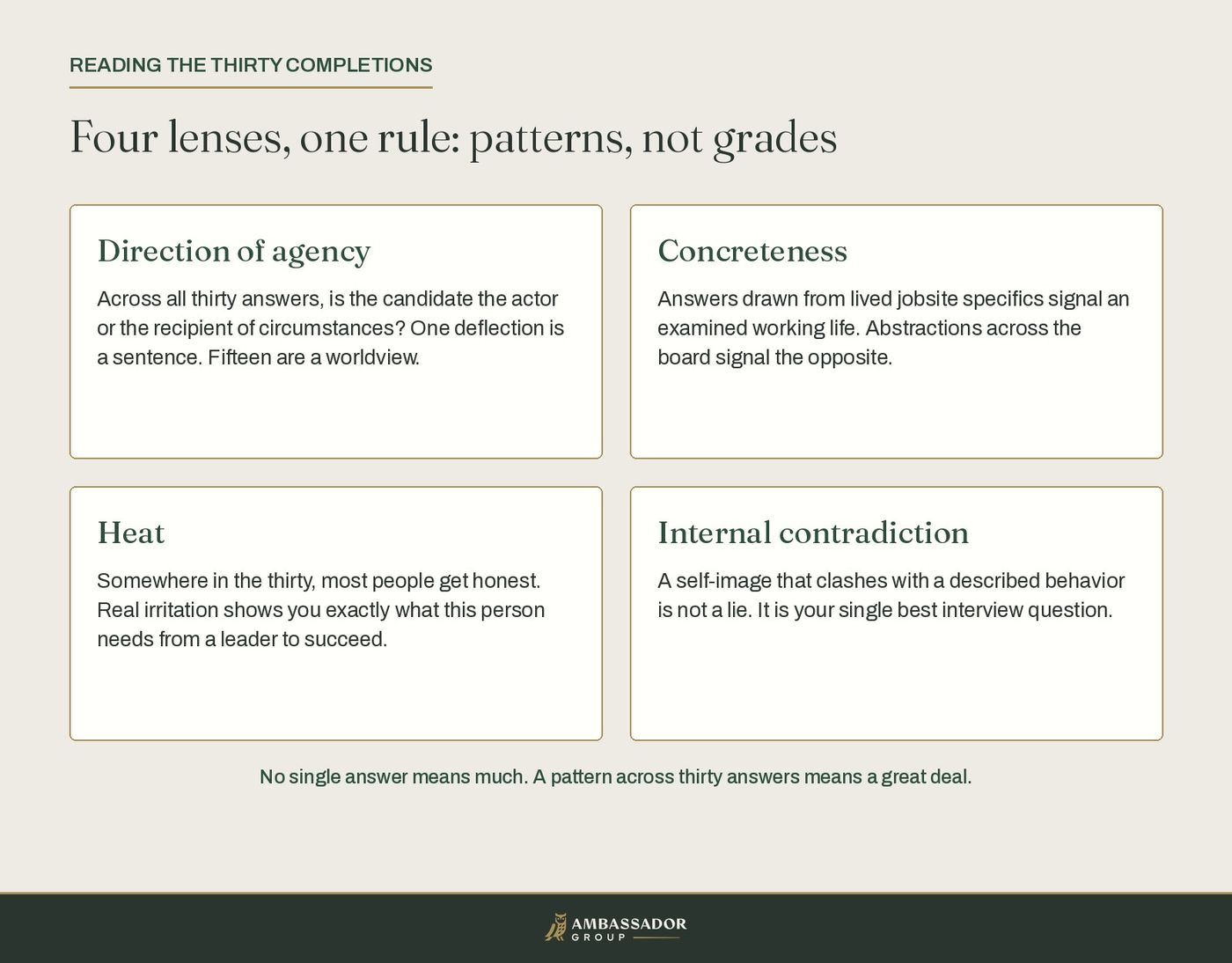
No single answer means much. A pattern across thirty means a great deal, and there are four patterns worth counting.
Direction of agency. Across all thirty, how often is the candidate the actor in their own sentences versus the recipient of circumstances? One deflection tells you nothing. Fifteen tells you how he explains his own results.
Concreteness. "Integrity is: doing what you said on the change order nobody will ever audit" comes from lived experience. "Integrity is: very important" comes from nowhere. Abstract answers across the board suggest someone who has not examined their own working life, which matters if you are hiring them to examine anyone else's.
Heat. Somewhere in the thirty, most people get honest. "I get annoyed when:" and "Company politics is:" carry heat, and heat is information. A flash of real irritation about vague direction, credit-taking, or being micromanaged tells you precisely what this person needs from you in order to succeed.
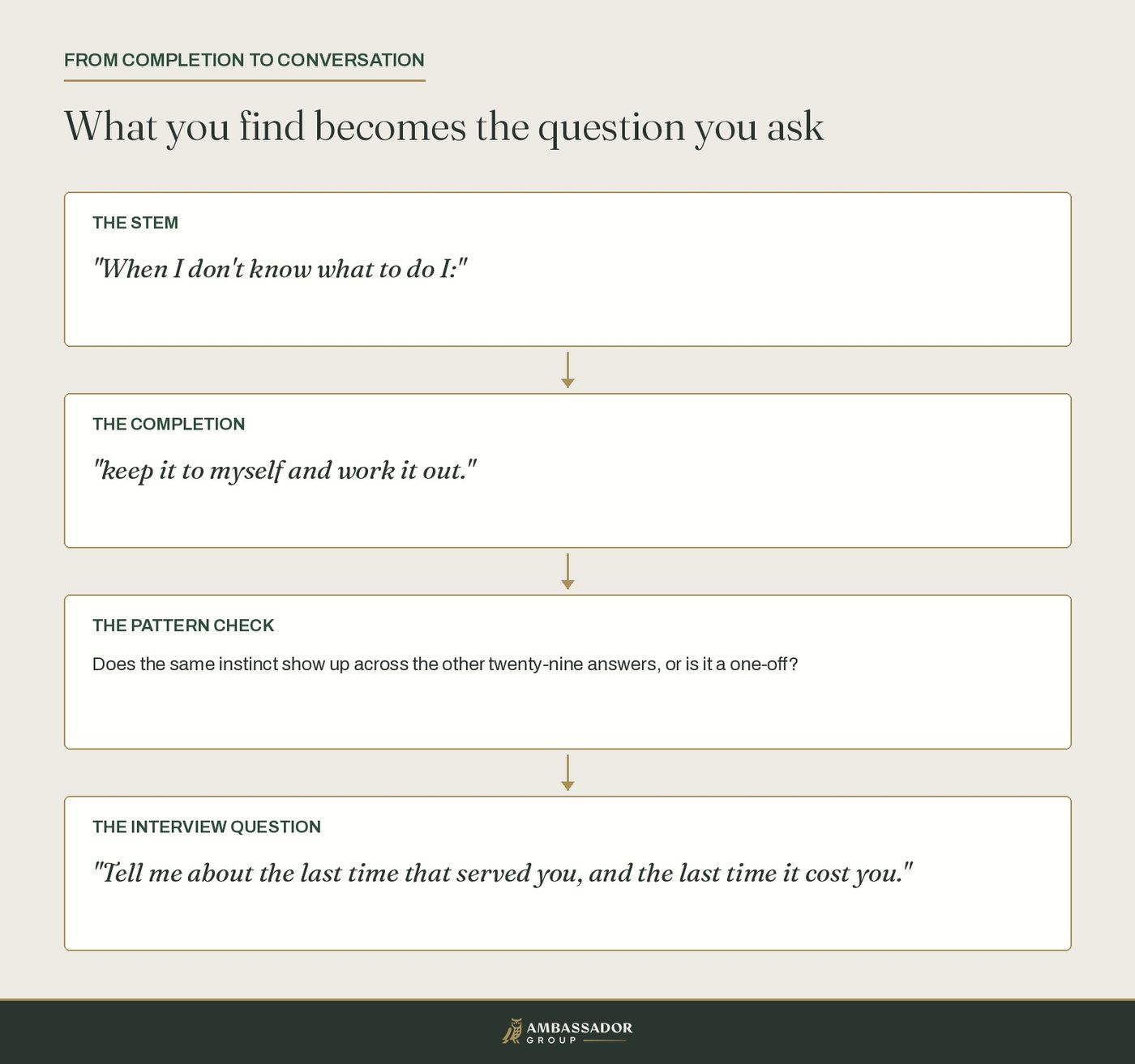
Internal contradiction. "Colleagues think I am: direct" sitting next to "When there is conflict I: avoid it until it's necessary" outlines a person who has not reconciled their self-image with their behavior, and it is the single best interview question you will get out of the exercise.
Everything you find goes one place: into the interview, as a question. "You wrote that when you don't know what to do, you keep it to yourself and work it out. Tell me about the last time that served you, and the last time it cost you." Candidates open up when you ask about what they wrote, because you are quoting them to themselves. It is the rare interview question that cannot be answered with a canned story.
Three rules keep the exercise honest, because it puts you close to how someone thinks.
Tell the candidate what it is and what it is not: this helps us understand how you think, there are no right answers, nobody passes or fails. Then honor that framing. The day a candidate learns they were screened out over one sentence is the day your hiring process becomes a story other candidates hear.
Place it mid-process rather than at the gate. Asking for that level of candor before you have earned any trust produces guarded answers or resentment. After a first conversation it reads as interest. Before one it reads as surveillance.
And complete it yourself before you send it to anyone. Sit with "When criticized I:" and "When I don't get results:" and write your own honest endings. If the answers make you flinch, you have found the reason the exercise works. You cannot read agency, candor, and self-awareness in someone else's sentences if you have never checked for them in your own.
The reference call most people run is theater
The three names your finalist handed you will all say hire this person. The candidate chose them for exactly that reason. Calling all three and collecting the yes gives you the feeling of diligence without the information.
By the time most hiring managers dial, the decision is made. The interviews went well, the team liked him, the offer letter is half drafted. The call exists to confirm a choice and everyone on the line knows it. Dates, titles, a few warm adjectives, done in eleven minutes.
Three forces guarantee that outcome. The candidate curated the list, and nobody volunteers the boss they clashed with. The reference wants to help someone they like. And you want the hire to work, because the role has been open since spring and the backlog is growing. Every incentive on the call points toward yes, so honest signal has to be pulled against that grain.
References still carry signal. The standard questions are what waste it. "What are their strengths and weaknesses" invites a rehearsed answer from a friendly witness.
Two setup moves change what the same witness will tell you.
Move the frame from verdict to fit. Open with something like: "I am trying to set him up to succeed if he takes the job, and that starts with understanding how he works." A reference who thinks you are hunting for a reason to reject will defend the candidate. A reference who believes you are planning for the candidate's success will describe him. Description is what you came for.
Then calibrate the witness before you weigh the testimony. Ask how they worked together and for how long, and what the company and the projects looked like during that stretch. A reference who watched your finalist daily through a brutal hospital job outranks one who shared an office for six months of steady work. Weight everything that follows accordingly.
Reference questions that get honest signal
- "Would you hire him again tomorrow? For what role?" The first half gets a reflexive yes. The second half is the real question. An old boss who would bring a superintendent back "to run one of our smaller jobs" just told you the ceiling as he sees it.
- "Where did he need the most support from you?" Softer than asking for weaknesses and far more concrete. Every strong performer needed support somewhere. A reference who claims otherwise is protecting rather than describing.
- "Tell me about a project that went sideways while he was on it." Every construction career includes one. You are not evaluating the failure. You are listening for what he did on day two of the problem, and whether this account matches the one you heard in the interview.
- "How did he handle the money conversations?" Change orders, buyouts, a sub going under mid-job. Money under pressure is where you find out what a person does, and references get specific fast when you name the situations.
- "How would his crews and subs describe him?" The view from above is the most polished. The view from the field is where leadership either exists or does not.
- "Who else saw his work every day?" The candidate gave you the curated exhibit. This question reaches past it. Get the candidate's permission before making that call, and never touch a current employer.
- "What advice would you give his next manager?" Framed as help rather than judgment. Even protective references answer this one honestly, because answering it well serves the person they are protecting.
Then add the probes the role earns.
Project manager. Ask about a specific buyout or a contested change order. Then ask whether his forecasts moved gradually month to month or all at once near the end. A PM whose bad news arrives early is worth more than one whose numbers hold until they collapse.
Superintendent. Ask how the schedule survived pressure, and whether trades asked to be on his next job. Subs vote with their feet, and his old manager watched them do it.
Estimator. Ask about a bid he missed, high or low, and what changed in his process afterward. An estimator with no miss story has either never been trusted with real work or is not telling you the truth.
The pause before the repeat-hire answer carries more information than the answer. So does faint praise scaled to the role: "showed up every day, solid guy" is a fine reference for a laborer and a warning for an operations director. Watch for answers to questions you did not ask, and for scope that quietly narrows, as in "on that project, he was fine."
One caution. A reference who will confirm only dates and titles is usually following company policy rather than sending a coded message. That is when the question about who else saw his work every day earns its keep. Move to the people who are free to talk.
Stop sign or landing plan
Most of what an honest reference call produces should shape the hire, not stop it.
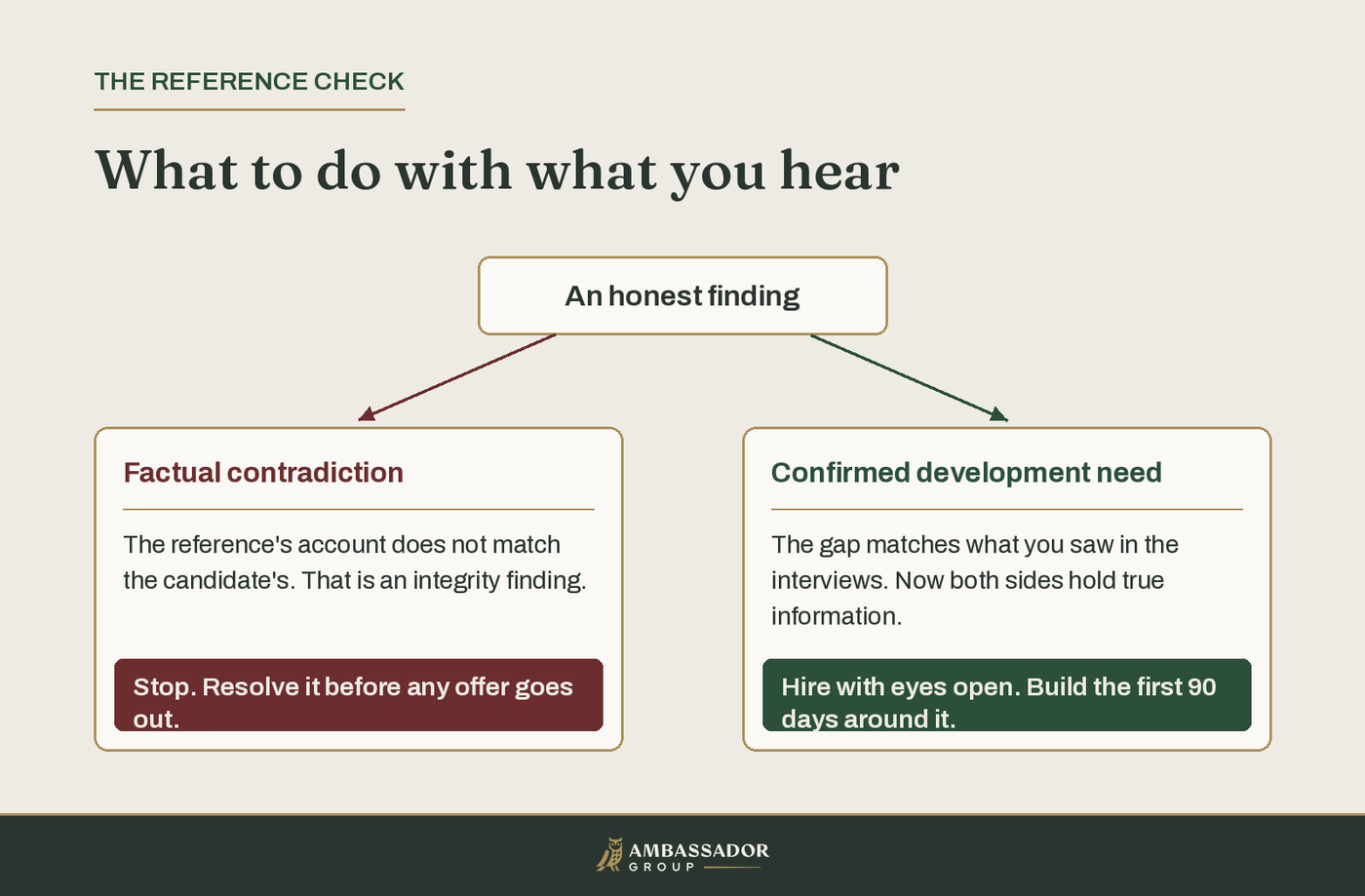
A confirmed development need that matches what you already saw in the interviews is onboarding input, and it belongs in the ratings that set the ramp plan. Build the first ninety days around it and tell your new hire what you are doing and why. That is what a real match looks like, both sides working from true information.
A landing plan is a plan only when three things exist: what will be done, who on your side owns it, and the date you check. "We will build the ramp around it" is a wish, and that wish is what the failed matches have in common. Name the owner and put the date on the calendar before the offer goes out, because once a start date exists, the risk you accepted stops being visible to anyone who did not sit in the debrief.
The stop sign is different in kind. When a reference's factual account contradicts the candidate's account of the same project, the job he claims to have run, or the number he claims to have carried, you no longer have a development finding. You have an integrity finding, and no amount of skill outweighs it.
Two references independently hesitating on the same trait is a pattern. One reference contradicting the resume is a finding you resolve before any offer goes out.
Never run a backdoor reference
You do it because you want the real story. You know candidates only list references who will say good things, so you call someone who knows them off the record. A peer at their current company, or a contact you trust in the industry. It feels like smart diligence.
It is a breach of trust, and it rarely produces better insight.
It breaks confidentiality. Most professionals interview quietly for a reason. Calling around about a candidate who has not told their employer they are looking puts their livelihood at risk. You may think you are being discreet, calling a friend of a friend, but word travels fast. One conversation can unravel months of careful discretion and permanently damage someone's standing where they work now. In an industry this small, where reputation is the whole asset, that is not a trivial mistake.
The feedback is unreliable. Say you do get someone on the phone. How well did they know the person? Distant colleagues, close peers, a short-term collaborator on a bad project? You do not know, and you will not get the context in a five-minute call. Even with good intent, backdoor references produce gossip rather than guidance.
The values may not transfer. You might think a VP of Construction will know what they are talking about. If that person leads with values or expectations that clash with yours, why would their opinion carry weight in your decision? Calling someone you would not hire in order to validate your hiring decision makes no sense.
If you want to learn more about someone, ask them. Ask better interview questions. Have better conversations with the references they gave you. Build enough trust that candidates want to be transparent with you. And if you cannot trust a candidate or the people they chose to vouch for them, you should not be hiring them.
Backdoor references feel clever. They are what a weak process looks like from the inside.
The order you read them in
Each instrument answers a different question and fails in a different way.
The resume tells you what happened and never why, so it sets the questions. The screening tells you whether the conversation should happen at all, and nothing about whether the person should be hired. The assessment tells you how two people will work together, which is invisible to both of the first two, and it becomes worthless the moment you ask it for a verdict. The sentence completion exercise shows you disposition before the polish goes on. The references verify the story the interview produced, and only if you build a call capable of producing an honest answer.
What each one leaves open matters as much as what it tells you. The resume leaves everything open. The screening closes logistics and interest. The interview closes competency and leaves character and motivation where they were. The assessment closes working style. References are the only instrument that reaches loyalty, integrity, and how someone behaved when it cost them something, which is why an order that drops references leaves the risks that end most matches unpriced.
Read them in that order and each one sharpens the next. Read them out of order, or accept any one of them as the answer, and you are back to underwriting on polish.
The candidate wrote the resume. You decide what it is worth.
The short version.
- What can a resume reliably tell you about a candidate?
- Career trajectory and industry experience, technical skills and certifications, the employment timeline with its moves and gaps, and how the candidate presents themselves. Treat all of it as starting coordinates. Every reliable signal is about what happened, never why, so the resume sets up the right questions without answering them.
- Does a short tenure mean a candidate is a job hopper?
- Not necessarily. A short tenure might mean layoffs, a bad manager, a culture that never fit, a relocation, or a better offer, just as a long tenure might mean risk aversion or comfort rather than loyalty. Both readings are guesses until you ask directly.
- What is the difference between a recruiter screening and a company interview?
- A screening answers one question: should this conversation happen? It qualifies on skills, career and compensation fit, interest, timing, and logistics. The company interview is where the hiring decision happens, moving from "can this person do the job" to "will this person thrive here." They are sequential, not interchangeable.
- What is a job fit assessment?
- An instrument that measures how a candidate's thinking style, behavioral traits, and interests line up with the real demands of a specific role and the leader they will report to. A resume shows what someone has done; an interview shows how they perform under interview pressure. Neither shows what working together will feel like once the offer is signed.
- Should I use a personality assessment as a pass/fail filter?
- No. Treating an assessment like a metal detector is backward. The assessment is not the decision; it is the start of a better conversation about how a person thinks, works, and fits alongside the people already on your team. A leader who wants a verdict from a test is outsourcing judgment instead of building it.
- What is a bilateral personality assessment in hiring?
- Both the candidate and the hiring manager complete the same assessment and review the results together. That single change turns the interview from a one-sided judgment into a mutual reading of how each person works, communicates, and decides under pressure.
- What is the sentence completion exercise?
- A written exercise with thirty unfinished sentence stems. The candidate finishes each one quickly, in about twenty seconds, without overthinking. The speed produces first-order responses instead of rehearsed answers, which shows how the person thinks about failure, criticism, conflict, and ownership.
- Why do most reference calls produce nothing?
- The decision is usually made before the call. The candidate curated the list, the reference wants to help someone they like, and you want the hire to work. Every incentive on the call points toward yes, so honest signal has to be pulled against that grain.
- When should a reference check stop an offer?
- When a reference's factual account contradicts the candidate's account of the same project, the job he claims to have run, or the number he claims to have carried. That is an integrity finding, and no amount of skill outweighs it.
- What is a backdoor reference, and why avoid it?
- Calling someone who knows a candidate off the record instead of the references the candidate listed. It breaks confidentiality and can damage a quietly interviewing candidate's standing at their current job, the feedback is unreliable because you rarely know the context, and the source's values may not match yours.


