
I have watched good people, well-intentioned and consummate building professionals, working at revered construction companies, run interviews that mitigate almost no risk and set everyone up for expensive lessons. I have studied this problem with a painful intimacy, as a matchmaker, for more than a decade. What I keep finding is that the quality of a hire is not principally driven by the candidate. It is driven by the leader sitting across the table, and by how clearly that leader can see.
Building skill and interviewing skill are separate disciplines. The skill of seeing a person under pressure and over time is its own practice, and it starts with the leader's own self-awareness, not the candidate's polish.
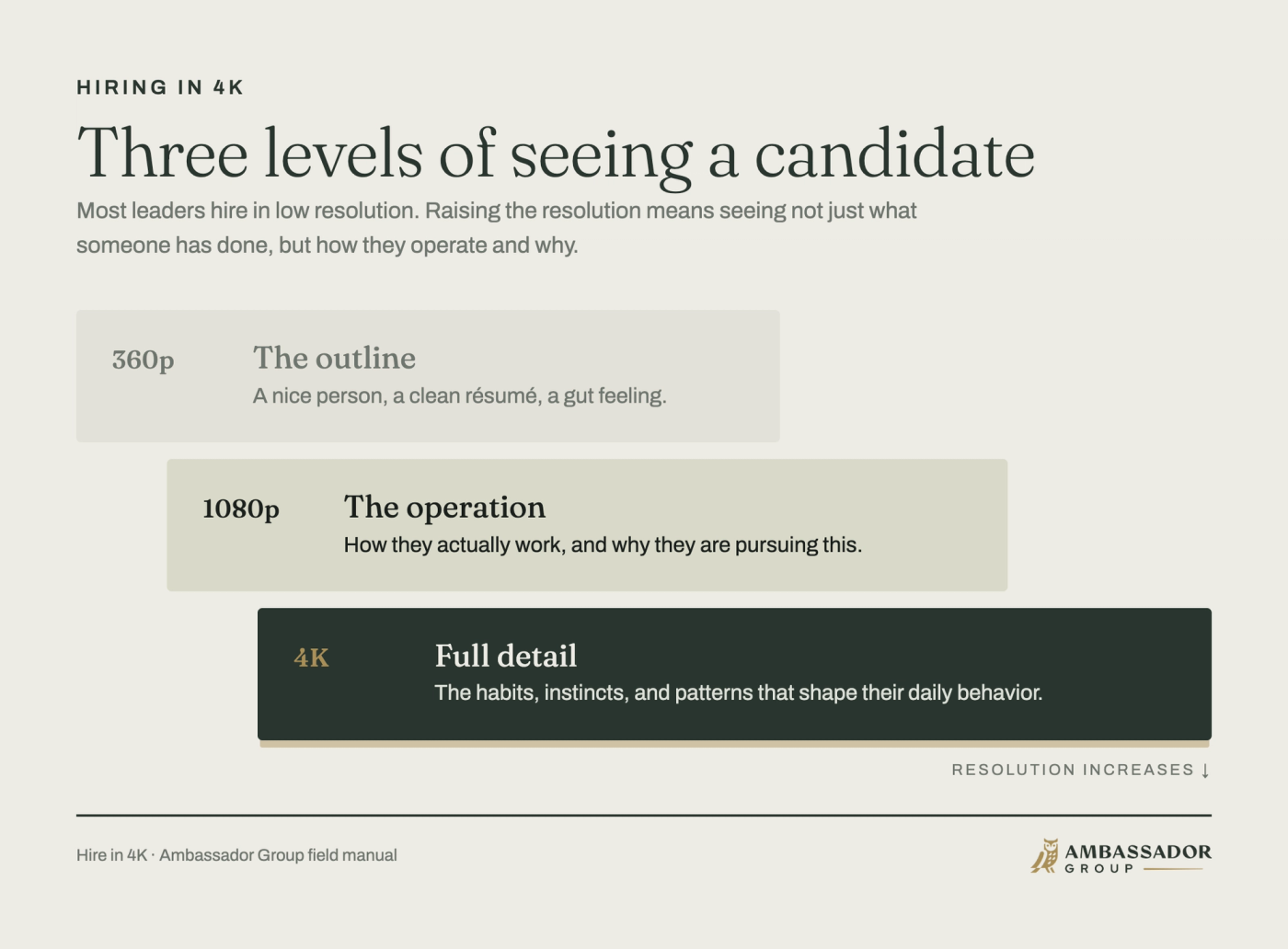
Most leaders hire in low resolution. They see the outlines of a candidate: a nice person, a conversation that doesn't wave too many flags, the résumé, the rehearsed answers, the relevant project experience, a good gut feeling, the LinkedIn shine. They do not see the texture of who that person is when the work gets hard.
Every job comes with pressure. That is why jobs exist, to eat some problem and some complexity. Yet most interviews never explore the pressure at all.
What it means to see in full detail
So how do you interview and hire in high resolution, especially when conventional interviewing is essentially a performance in looking good for a short window of time?
Hiring in 4K means seeing people in full detail.
- Not just what they have done, but how they operate.
- Not just what they want, but why they are pursuing it.
- Not just the skills on paper, but the habits, instincts, and patterns that shape their daily behavior.
It is what happens when a leader stops rushing the process and starts paying attention. What if you interviewed candidates with the precision and accountability you bring to managing projects?
A senior project manager knows not to skip the steps that ensure alignment and risk mitigation on a job. A less experienced PM may forgo those steps with an innocent, but soon-to-be expensive, lack of risk awareness. The same is true of most interview processes.
Haste Kills Clarity
The Overton Window of hiring
In most companies, the Overton Window around hiring (basically what the culture treats as normal) has quietly shifted toward what feels hasty, intuitive, and comfortable. Many leaders believe a confident interviewer and a good gut are enough to make good hiring decisions. That belief only holds in theory.
Under real pressure, when the role is critical, the team is stretched, and timelines are tight, hasty, surface-level hiring collapses. Intuition becomes bias. Charisma gets mistaken for competence. The "we'll know it when we see it" mindset turns into a costly gamble. That gamble often costs millions once you account for the overt and covert costs across the company.
You cannot hire in 4K in a panic. Urgency and desperation are gravel in the cake mix. They ruin the texture of judgment. The moment haste takes over, clarity disappears.
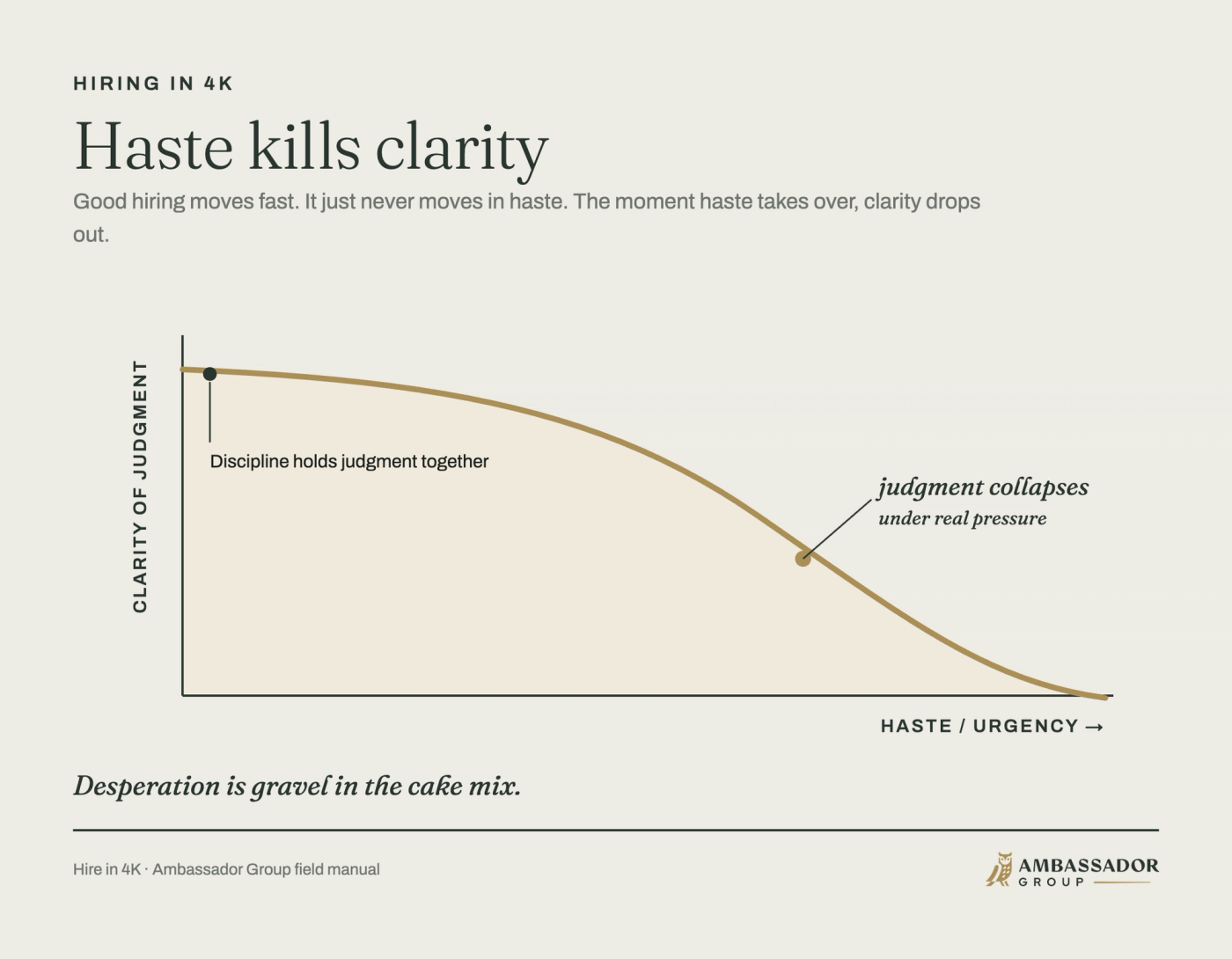
Hiring in 4K does not insist that interviews take forever. You can keep the process moving quickly. It re-centers the conversation around precision, structure, and shared accountability, even when time is tight. It does not reject intuition. It refines intuition with data, contrast, and process.
The Feedback Loop to Build
The black hole of unaccountable hiring
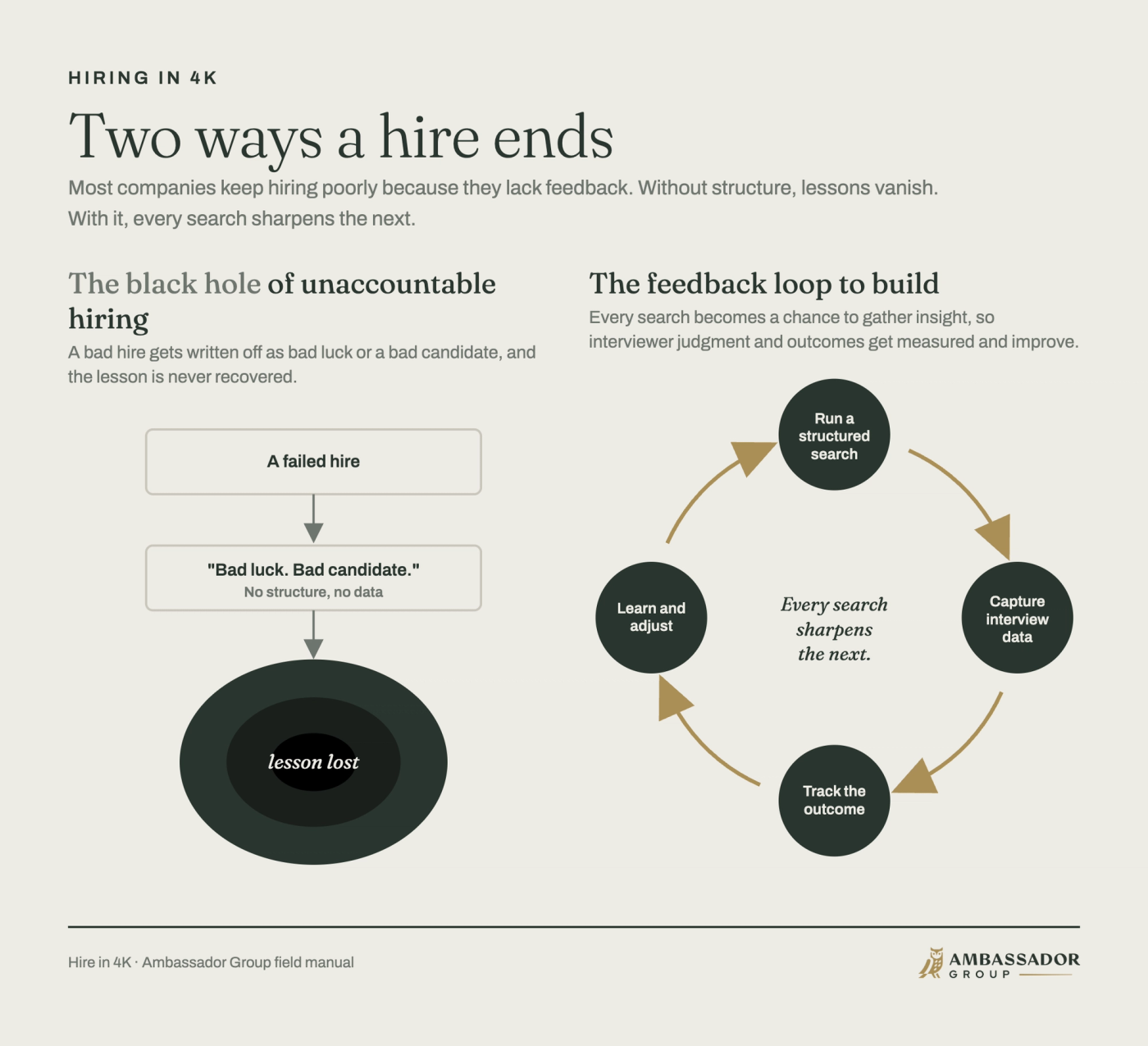
The reason most companies keep hiring poorly is not that they lack good people to choose from. It is that they lack feedback. Tracking how interview quality connects to outcomes, how interviewer opinions align or diverge, and which hiring decisions worked, is not the most obvious work when a firm's focus is on building extraordinary buildings.
Lessons get lost in the black hole of unaccountable hiring. Without structure or data, a bad hire gets written off as bad luck or a bad candidate rather than a system failure. Teams repeat the same mistakes because they have no system-wide visibility into what went wrong or right. Often the candidate gets blamed, and of course no one is around to say otherwise.
It takes a serious leadership commitment to organizational integrity to learn from a painfully failed hire.
Sometimes I hear that only big companies can afford these disciplines. That is not true. They became big companies by adopting them. Even then, you might be surprised by how ad hoc hiring is inside legendary firms.
Hiring in 4K makes improvement easy because interview data collection becomes a discipline. It treats every search as a chance to gather insight: how each interviewer evaluated fit, what data influenced the decision, and what results followed the hire. When hiring becomes measurable, it becomes improvable.
What 4K Hiring Looks Like
The difference between a snapshot and a portrait
Most hiring processes are snapshots: flat, hasty, and filtered. A few conversations, a handful of references, maybe a gut call at the end.
A portrait takes time. It captures nuance: the mix of confidence and humility, the edges of ambition, the way someone handles tension. When leaders commit to painting a portrait instead of snapping a picture, they begin to see the truth behind the résumé. They spot character patterns, relational blind spots, and motivational misalignments that would otherwise stay hidden until it is too late.
Clarity requires contrast
Resolution improves when contrast improves. You cannot see someone clearly until you understand what to look for and what to compare them to. That is why the strongest hiring processes do not rely on one-dimensional interviews. They build contrast through structure:
- Behavioral questions that uncover how candidates think and decide
- Multiple interviewers with defined roles, so each one sees a different angle of the same person
- Personality and cognitive assessments like the ProfileXT that show how someone naturally works, solves problems, and communicates
- Sample work and projects
- References
- Job walks
The more contrast you build into your process, the sharper your image becomes.
Hiring in 4K vs. hiring in 360p
The contrast between the two resolutions shows up at every stage of the process:
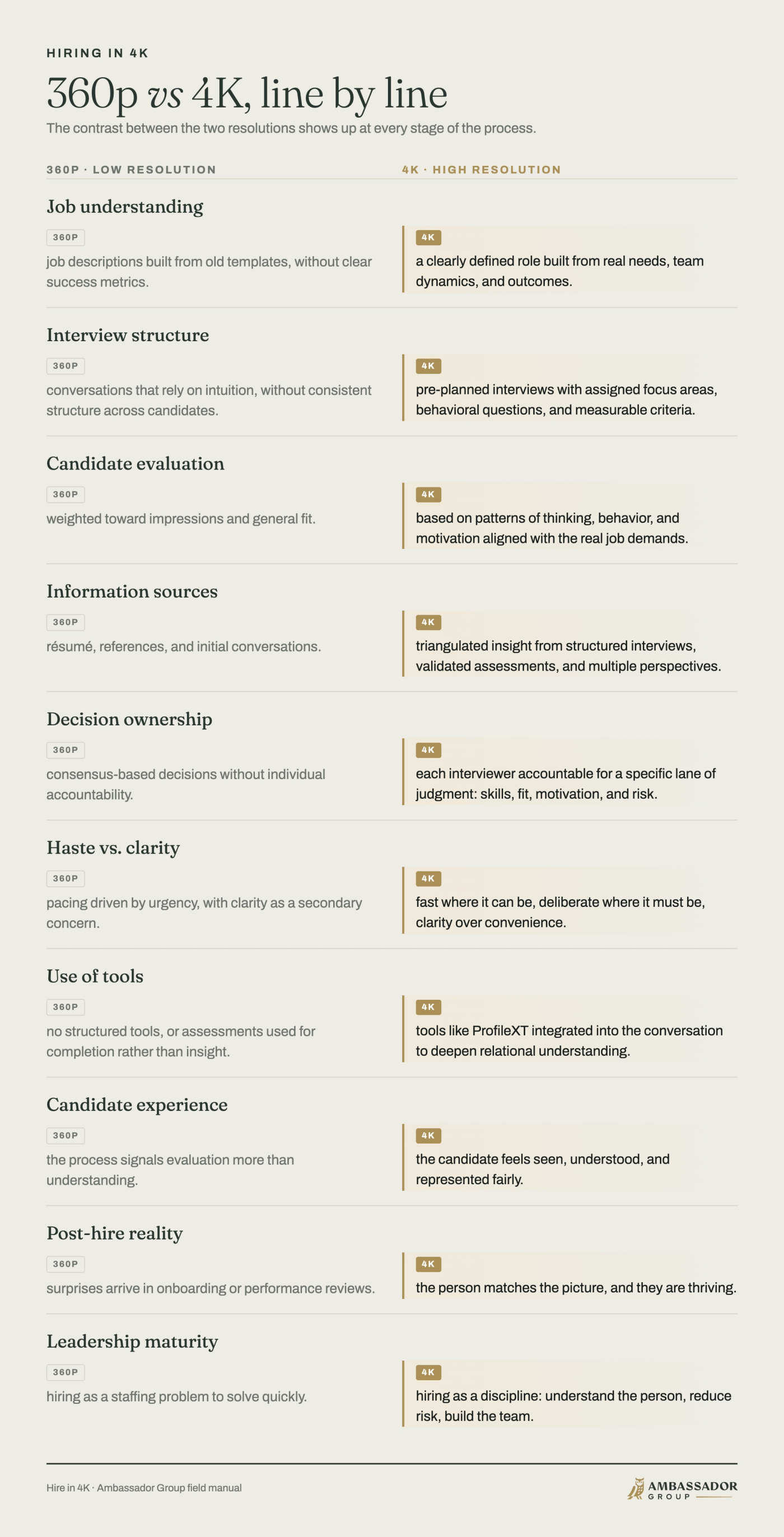
The difference is not cosmetic. It is cultural. Low-resolution hiring feels effortless, but it leads to regret. High-resolution hiring feels more demanding, but it leads to confidence.
How to See Clearly
Hiring in 4K is not only about seeing the candidate. It is about seeing the fit between that person and the role. Every candidate is a unique equation of strengths, growth edges, and environmental needs. The clearer you see those dynamics, the more responsibly you can lead them once hired. Clarity comes with commitment.
4K hiring asks a question too few leaders stop to ask:
What specific kind of leadership investment will this person require to succeed here, and am I prepared to make it?
Some hires need coaching and patience. Others need autonomy and speed. Some thrive under structured feedback. Others wilt under it. No hire should be made until the leadership commitment is as clear as the candidate's potential, because hiring is not just about selection. It is about stewardship.
Seeing competence in action
High-resolution hiring demands evidence. Talking about competence is cheap. Demonstrating it is revealing. That is why 4K hiring includes working assessments and real samples that mirror the job itself. Instead of asking theoretical questions, bring reality into the interview:
- Review actual plans, schedules, or budgets together
- Walk through RFIs, change orders, or contracts and ask how the candidate would approach them
- Present a complex scenario, one with no easy right answer, and watch how they reason, weigh tradeoffs, and exercise judgment
You are not testing for perfection. You are testing for thoughtfulness. For how they think under pressure. For how they balance competing priorities. For how they navigate ambiguity. In construction, as in leadership, clarity does not come from talk. It comes from how people think when the answer is not obvious. The only constant in construction is change.
The disciplines of 4K interviewing
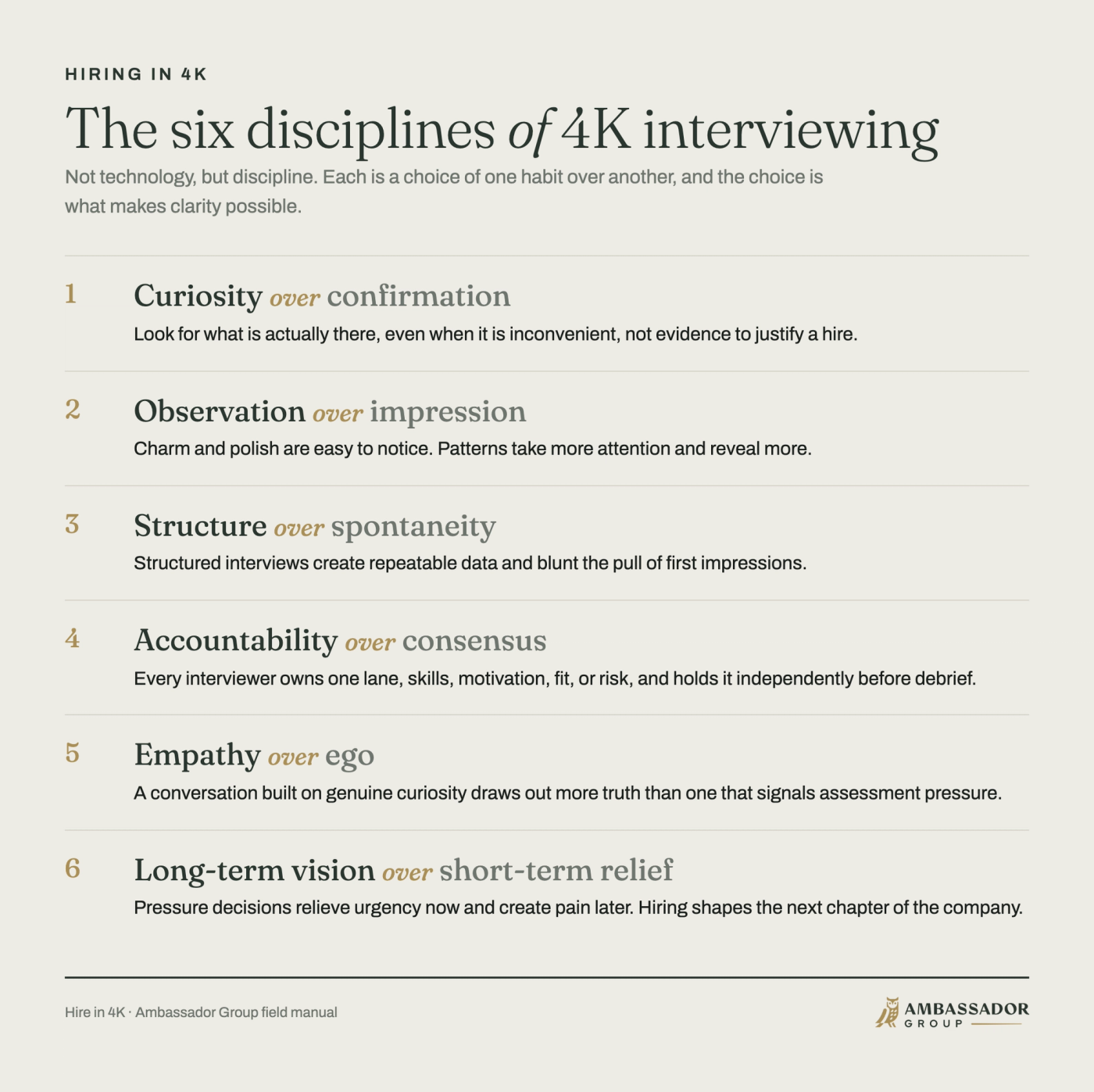
Hiring in 4K is not about technology. It is about discipline. It requires interviewers to adopt beliefs and behaviors that make clarity possible. These are the disciplines that build toward that clarity.
- Curiosity over confirmation. Questions that confirm assumptions deliver shallow data. Questions designed to challenge them reveal truth. The discipline is not looking for evidence to justify a hire, but for what is actually there, even when it is inconvenient.
- Observation over impression. Charm and polish are easy to notice. Patterns take more attention and reveal more. How does the candidate listen? What do they do with feedback? What energizes or frustrates them?
- Structure over spontaneity. Unstructured conversations feel natural but make consistent comparisons difficult. Structured interviews create repeatable data and reduce the influence of first impressions.
- Accountability over consensus. In a 4K process, every interviewer owns a specific lane, such as skills, motivation, cultural alignment, or risk, and must hold that judgment independently before debriefing.
- Empathy over ego. Candidates can sense when they are being evaluated for rejection versus understood as a person. A conversation built on genuine curiosity draws out more truth than one that signals assessment pressure.
- Long-term vision over short-term relief. Decisions made under pressure can relieve urgency now but create pain later. Keep the longer horizon in view: hiring is a chance to shape the next chapter of the company.
These disciplines are not mechanical. They are moral. They come from leaders who believe people deserve to be seen in full focus before they are judged.
These disciplines are also what keep an interview legally clean and free of bias. For the deeper treatment, which questions to ask, the biases that produce the risky ones, and how structure makes warmth defensible, see Ask this, not that.
The technology of human sensitivity
Structured interviewing and behavioral science tools exist not to replace human intuition but to refine it. The point is to let the best of technology help humans with the work only they can do. It is how you move from a hazy first impression to a high-definition understanding. I call it human sensitivity: the ability to see people as whole systems, not just inputs for a project.
Hiring in 4K means combining precision tools with emotional intelligence. It is the intersection of data and discernment. Being perceptive.
Clarity is not omniscience
Even hiring in 4K does not mean you will never be surprised or learn something new about a person. People are living systems, and all of us are still learning about ourselves, if we are honest. But when you study and refine your ability to hire in 4K, you start to understand the kinds of things you will progressively learn about people as they grow. You start predicting where growth, stress, or change will appear. You get better at seeing what will evolve over time, not just what is visible today.
4K hiring does not eliminate surprise. It reduces blindness. No interviewer or matchmaker is all-knowing.
The dimensions of fit
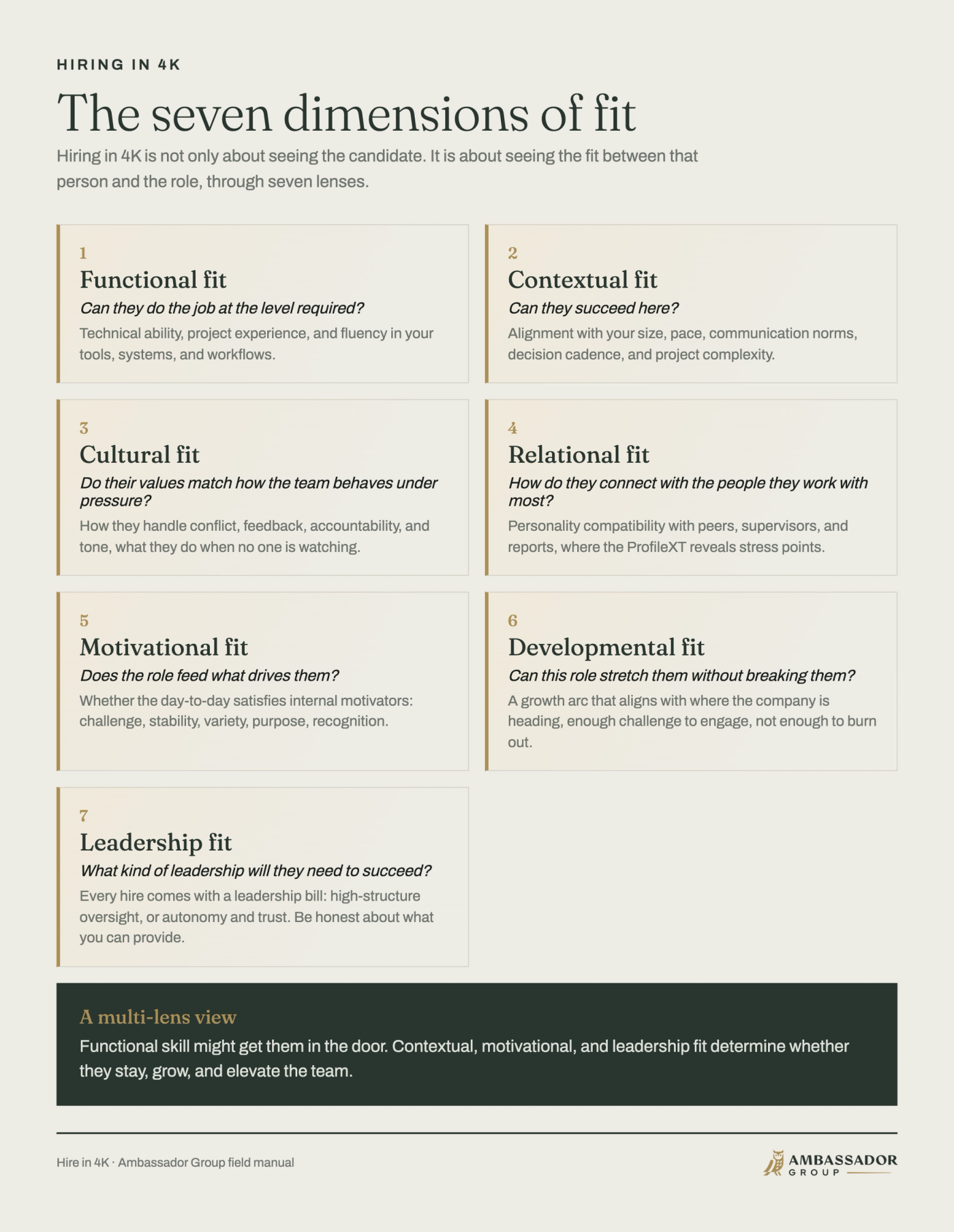
- Functional fit. Can they do the job at the level required? This covers technical ability, project experience, and familiarity with the tools, systems, and workflows your company uses. Functional fit answers the question: can they execute the work with competence and speed?
- Contextual fit. Can they succeed here? Even capable people fail when the context changes. Contextual fit measures alignment with your company's size, pace, communication norms, decision cadence, and project complexity. Someone who thrived in a corporate GC might struggle in a boutique builder, or the reverse.
- Cultural fit. Do their values and working style align with how your team behaves under pressure? This includes how they handle conflict, feedback, humor, accountability, and leadership tone. Culture is what people do when no one is watching. Cultural fit predicts whether they will reinforce or erode that behavior.
- Relational fit. How do they connect with the people they will interact with most? Relational fit looks at personality compatibility with key peers, supervisors, and direct reports. This is where tools like the ProfileXT reveal stress points and communication dynamics that either smooth the gears or grind them.
- Motivational fit. Does the role feed what drives them? Motivational fit is about energy alignment, whether the day-to-day reality of the job satisfies internal motivators like challenge, stability, variety, purpose, or recognition. Misaligned motivation leads to quiet disengagement even in talented people.
- Developmental fit. Can this role stretch them without breaking them? A great hire is not just right for today. They have a growth arc that aligns with where the company is heading. Developmental fit ensures the role offers enough challenge to keep them engaged but not so much pressure that it burns them out.
- Leadership fit. What specific kind of leadership will this person need to succeed? Every hire comes with a leadership bill. Some need high-structure oversight. Others need autonomy and trust. Leadership fit requires awareness and honesty about what style you can consistently provide.
Together, these seven dimensions create a multi-lens view of the candidate. Functional skill might get them in the door, but contextual, motivational, and leadership fit determine whether they will stay, grow, and elevate the team.
Essential ingredients to hiring in 4K
- Discipline, not haste. Clarity needs room to form, not a clock counting down. Rushed decisions blur judgment and amplify bias. Desperation is gravel in the cake mix.
- Defined role clarity. Start with a clear, living understanding of the role's purpose, success metrics, and leadership expectations. You cannot assess alignment without knowing what alignment looks like.
- Structured interview process. Assign interviewer roles, create behavioral questions tied to job realities, and require written reflections after each interview.
- Contrast and multiple perspectives. Use diverse interviewers and structured assessments to see candidates from different angles. Contrast creates clarity.
- Evidence of competence. Ask for real samples of work. Review plans, schedules, RFIs, or contracts together. Present complex, ambiguous scenarios that require thoughtful reasoning, not canned answers.
- Behavioral and cognitive data. Integrate validated tools like ProfileXT to understand how candidates naturally think, decide, and communicate.
- Leadership commitment. Define the investment each candidate will require to succeed, whether coaching, feedback, autonomy, or structure, and confirm you are willing to provide it before hiring.
- Independent accountability. Each interviewer should own a distinct evaluation lane (skills, motivation, cultural alignment, or risk) and submit feedback before debriefing.
- Empathy and human sensitivity. See candidates as people, not transactions. Listen for self-awareness, emotional patterns, and relational fit.
- Feedback loops and measurable learning. Track hiring outcomes, interviewer accuracy, and post-hire success. Every search should make the next one sharper.
The payoff
When you hire in low resolution, the surprises arrive later: during onboarding, in performance reviews, in resignation letters. When you hire in 4K, you trade those surprises for clarity and confidence. The results are quieter. Smoother transitions, stronger retention, faster ramp-ups, fewer "I didn't see that coming" moments.
This is how I hire. When I neglect the process, it feels like I turned off my headlights on a dark and winding road. Very uncomfortable. I know this works, because I have watched the difference between a blurry hire and a fully resolved one play out hundreds of times.
Pick up the lens, and you stop gambling with the most expensive decision your company makes.
If you want the full operating system in your hands, get the free Hire in 4K field manual. Forty-some pages on running a structured search yourself: scorecards, interview rubrics, reference protocols, and the seven dimensions of fit, written for in-house use.
The short version.
- What does hiring in 4K mean?
- It means seeing candidates in full detail: not just what they have done but how they operate, not just what they want but why they pursue it, and the habits and patterns that shape daily behavior. Most leaders hire in low resolution, seeing only the resume, rehearsed answers, and a good gut feeling, and never explore how the person handles the pressure every job exists to absorb.
- What are the seven dimensions of fit in a construction hire?
- Functional (can they do the job), contextual (can they succeed in your company's size and pace), cultural (do their values hold under pressure), relational (how they connect with key peers and reports), motivational (does the role feed what drives them), developmental (can it stretch them without breaking them), and leadership fit (what kind of leadership they need and whether you can provide it). Functional skill gets them in the door; the others determine whether they stay, grow, and elevate the team.
- How do I test real competence instead of interview talk?
- Bring reality into the interview. Review actual plans, schedules, or budgets together, walk through RFIs, change orders, or contracts, and present a complex scenario with no easy right answer. You are not testing for perfection, you are testing for thoughtfulness: how they reason, weigh tradeoffs, and navigate ambiguity.
- Why do companies keep repeating the same hiring mistakes?
- They lack feedback loops. Without structure or data, a bad hire gets written off as bad luck or a bad candidate rather than a system failure, and lessons vanish into the black hole of unaccountable hiring. When interview data collection becomes a discipline, hiring becomes measurable, and what is measurable becomes improvable.
- Does high-resolution hiring mean a slow hiring process?
- No, it re-centers the process on precision, structure, and shared accountability, and it can keep moving quickly. What it cannot survive is panic: urgency and desperation are gravel in the cake mix, ruining the texture of judgment. It does not reject intuition either; it refines intuition with data, contrast, and process.


