
A bad Project Executive hire does not announce itself in the interview. It announces itself eighteen months later, when a client who used to call first now calls last, when a job that should have cleared 8 points lands at 2, and when two of your strongest project managers quietly update their resumes because the person above them cannot be followed. By then the bill has grown past a salary into a portfolio of jobs and the client relationships riding on them.
A leader who cannot see clearly cannot interview clearly, and this role punishes a foggy interviewer faster than most. The questions on this page are inert on their own. A list copied from anywhere will not protect you. What protects you is the discipline of the person holding the list: the willingness to ask the second and third question, to sit in the silence after the first answer, to hear the difference between a rehearsed story and a remembered one. The quality of this hire rests on the interviewer far more than on the candidate. I write this in the first person because I have made the cheap version of this hire and paid the expensive version of the bill.
For the broader discipline of how to run the interview, read Hire in 4K and Seven Levels of Interviewing Mastery alongside this guide. This page is the instrument set.
Interview to the 3 places this role breaks
A Project Executive does not fail at the average. The role fails at its load-bearing points, and there are three of them. Build the interview around these rather than a generic competency grid. The grid tells you the candidate is qualified; the failure point tells you whether they will hold.
The first place it breaks is portfolio margin and the worst job inside it. A PX owns a stack of projects at once, so the fade on a single job is never a single-job problem. The question is whether this person reads margin erosion early across a portfolio, decides which fire to walk into first, and carries the ugliest job on the books to a clean closeout instead of a quiet write-off. A project manager who ran one job to budget can drown the moment the math spreads across five.
The second place it breaks is the client relationship that brings the next job. This role owns retention and growth, not delivery alone. The relationship is the asset. A PX who hands over a flawless building and loses the client has failed at the part of the job that never shows up on the schedule.
The third place it breaks is people. A PX leads project managers and superintendents across jobs, so the work now happens through other people's hands. Holding a PM accountable without taking the job back, developing a superintendent who is not yet ready, and removing one who will not improve: this is the daily labor of the role, and the part most candidates have practiced talking about and least practiced doing.
Every probe below comes off one of these three fracture lines. I am not interviewing to confirm competence. I am interviewing to find where this person breaks, and whether I can live with it.
The accountabilities I am hiring against
Six accountabilities define the role. Each gets its own section, and each carries probes built to the standard above.
- Portfolio profit and loss and risk across multiple jobs.
- Client relationships and business development.
- Project manager and superintendent leadership and development.
- Operational standards held consistently across projects.
- Executive-level recovery on the worst jobs.
- Strategic pursuit and resource decisions.
One argument runs underneath all six: leaders own outcomes. The language of underwriting (what you bet, what you reserved, what you learned) threads through every section, because a PX who cannot underwrite a job or a person is gambling with your portfolio.
Portfolio profit and loss and risk
Walk me through a job in your portfolio that faded on margin. When did you know, and what did the number do after you knew?
- What you are listening for: a specific job, a specific point in time, and a margin slide they can describe with real numbers. The seasoned answer ties the moment of knowing to a leading indicator (labor productivity against budget, an open buyout gap, an RFI backlog stalling the field) rather than to the cost report that confirmed it after the fact.
- Novice tell: the novice knew when accounting told them, and talks about the loss as something that happened to the job. The seasoned candidate knew before the projection moved, because they were reading the field, and can name the week.
- Follow the thread: if they caught it early, ask what they changed and what the change cost. If they caught it late, ask which indicator they were missing and whether they watch it now. If the number recovered, ask exactly how, line by line.
- Evidence ask: ask for a monthly cost-to-complete projection across two or three jobs they owned, redacted, and have them walk the trend on each. The report reveals whether they read these or signed them.
- Red flag: a candidate who cannot name a single job that faded has either never owned real profit and loss or cannot tell the truth about a loss. Both disqualify for a role that exists to own bad outcomes.
How do you decide which of 5 jobs gets your attention on a Monday when all 5 want it?
- What you are listening for: a triage logic that weighs dollars at risk, client temperature, and how reversible the problem is, rather than whichever superintendent shouted loudest. The strong answer treats attention as a scarce resource to allocate, not something spread evenly out of guilt.
- Novice tell: the novice runs to the loudest fire or the favorite project. The seasoned candidate has a method, can name the job they deliberately under-served last month, and can defend why that was right even though it felt wrong.
- Follow the thread: ask for the job they chose not to attend to and what happened to it. Ask how they told the PM who got less of them.
- Evidence ask: ask how they structured a portfolio review cadence, the agenda, the projection dashboard, the standing meeting, that let them allocate attention without living inside every job.
- Red flag: a candidate whose only triage method is personal heroics. It does not scale across a portfolio, and it tells you they will become the bottleneck.
Client relationships and business development
Tell me about a client who gave you the next job, and the specific thing that earned it.
- What you are listening for: a relationship they can trace from delivery to repeat work, with a turning point they can name. The strong answer credits a hard moment handled well, a bad-news conversation, a change they absorbed, a problem they surfaced before the owner found it, rather than a round of golf.
- Novice tell: the novice describes a client who liked them. The seasoned candidate describes a client who trusted them, names the moment trust was built, and can say what they did differently from the person who lost that client before.
- Follow the thread: ask what the next job's margin looked like next to the first, and whether the relationship let them price for value. Ask what they would have lost by handling the hard moment differently.
- Evidence ask: ask for a client account plan, a written pursuit narrative, or the email where they delivered hard news and kept the relationship. A written record of a hard conversation is close to impossible to fake.
- Red flag: every retained client gets credited to price or to the firm's reputation, never to anything the candidate did. That is a delivery manager describing themselves as a relationship owner.
Project manager and superintendent leadership and development
Tell me about a PM or superintendent you developed from not-ready to ready. What did you do, week to week?
- What you are listening for: a developmental arc with specifics. What the person could not do, what the candidate ran as an intervention, and how they knew it worked. The strong answer involves stepping back on purpose and letting the person struggle inside a bounded risk, not rescuing.
- Novice tell: the novice describes mentoring in the abstract, or describes doing the person's job for them and calling it development. The seasoned candidate can name the moment they let the PM own a hard call and what it taught.
- Follow the thread: ask where that person is now. Ask what the candidate stopped doing so the PM could grow. Ask about one who did not make it.
- Evidence ask: ask for a development plan, a written performance review, or the standing agenda of their one-on-ones with a direct report. The cadence of attention is the artifact.
- Red flag: a candidate whose development style is to pull the hard work back onto their own desk. It builds dependence, not capability, and it caps the throughput of every job they touch.
Tell me about a PM or superintendent you had to remove. How long did it take you to act, and why that long?
- What you are listening for: honesty about the lag between knowing and acting, and a sober account of what the waiting cost. The strong answer owns the delay as a real cost to the team and the job, and shows the candidate gave the person a clear, documented chance first.
- Novice tell: the novice either never removed anyone (unlikely at this level, and a tell about whether they truly led) or removed someone with no apparent struggle, which suggests they move people too easily. The seasoned candidate felt the weight, acted anyway, and learned to act sooner.
- Follow the thread: ask what the team's reaction told them. Ask which signal they now watch for earlier. Ask whether they would act faster today.
- Evidence ask: ask how they documented performance before the decision, a written improvement plan, a record of specific conversations. The paper trail separates the deliberate operator from the impulsive one.
- Red flag: a candidate who has never removed anyone and cannot say why, or one who narrates removals with no weight at all. Both are wrong for a role that holds people's livelihoods.
Operational standards across projects
Your jobs run differently from each other right now. How do you get them to run the same way without flattening good superintendents into robots?
- What you are listening for: a real tension being managed, the need for portfolio consistency against the reality that good field leaders have their own methods. The strong answer names a few non-negotiables, safety, how money is tracked, how bad news travels, and leaves craft alone everywhere else.
- Novice tell: the novice wants either total standardization or total autonomy. The seasoned candidate can draw the line between the standards that must be uniform and the craft that should not be, and defend where they drew it.
- Follow the thread: ask for a standard they tried to impose that failed, and why. Ask how they brought a resistant veteran superintendent along.
- Evidence ask: ask for a project startup checklist, a closeout protocol, or a standard operating procedure they authored and rolled across jobs.
- Red flag: a candidate who believes standards enforce themselves once written. The role is the enforcement mechanism, and someone who misses that will preside over drift.
Executive-level recovery on the worst jobs
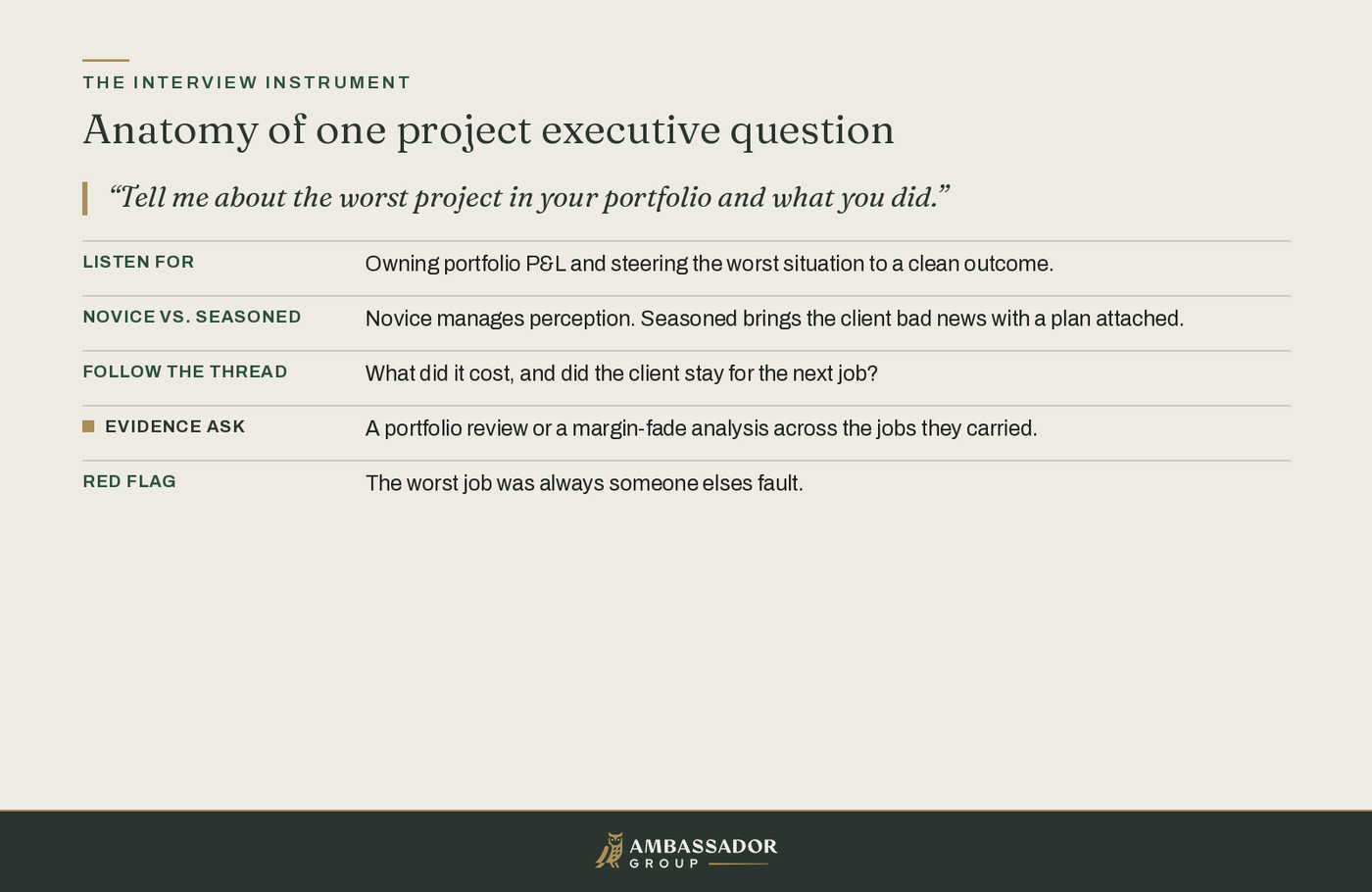
Tell me about the worst job you have ever walked into. Not the one you started. The one you were handed.
- What you are listening for: the instinct to walk toward the fire. The strong answer describes a job already in trouble, a clear-eyed read of how bad it was, a stabilization sequence, and an honest account of the final outcome, including what could not be saved.
- Novice tell: the novice's worst situation is mild, or it is someone else's fault start to finish. The seasoned candidate took ownership of a mess they did not create, can sequence what they did first, second, and third, and can tell you what the recovery cost.
- Follow the thread: ask what they triaged first and why. Ask what they had to tell the client and the owner of the firm. Ask what looking away for another month would have cost.
- Evidence ask: ask for a recovery plan or turnaround schedule, the document where they laid out the path from crisis to stable, with the rebaselined budget and milestones. The structure of that thinking is the whole job.
- Red flag: a candidate who has never been handed a disaster, or who narrates one as a victim of circumstance throughout. This role exists to step into the worst jobs and own them to a clean outcome.
Strategic pursuit and resource decisions
Tell me about a job you recommended not pursuing, or a project you walked away from. What did you see that others did not?
- What you are listening for: the discipline to underwrite a pursuit and decline it. The strong answer weighs the client's payment behavior, schedule risk, the team's capacity, and the margin reality, and was willing to be unpopular by saying no to revenue.
- Novice tell: the novice chases every job because backlog feels like safety. The seasoned candidate can name a pursuit they killed and can articulate the second-order cost they avoided, the burned-out team, the job that would have starved a good client of attention.
- Follow the thread: ask who disagreed and how that conversation went. Ask about one they should have walked away from and did not.
- Evidence ask: ask for a go/no-go analysis or bid/no-bid scorecard they used to make the call. The framework shows whether the decision was reasoned or reflexive.
- Red flag: a candidate who has never declined work and treats all backlog as good backlog. A PX who cannot say no to the wrong job will fill your portfolio with margin-killers and call it growth.
What they should be asking you
The interview runs both ways, and the questions a strong PX asks are as diagnostic as the answers they give. The fit has to be real in both directions, because a PX who takes the role on bad information leaves it, and a mismatch at this level costs you a year. Be the Lightning Rod covers how to invite the hard questions instead of deflecting them.
Listen for whether they ask about the health of the portfolio they would inherit, not just the comp. A candidate who asks which jobs are underwater right now and what the real backlog quality looks like is underwriting the role the way they will underwrite a project. A candidate who asks only about title, bonus structure, and headcount is buying a chair. Listen for whether they ask about the clients: who is loyal, who is at risk, who left and why. Listen for whether they ask about the PMs and superintendents they would lead, by name and by capability, because the person who asks who on this team is not ready and what you have tried is already doing the job in the interview. The questions they do not ask tell you where their attention does not naturally go, and at this level attention is the whole instrument.
Do not leave the interview without capturing it
Write your feedback before the debrief, not after. The debrief launders your memory: a confident colleague's read overwrites your own, and the thing that bothered you in minute forty dissolves into a general impression. Capture it raw first.
Then tally the risk across the three fracture points. For each, decide whether you would fill it (the candidate clearly holds), engineer around it (a deputy or support structure can compensate), or leave the role empty (the gap is load-bearing and unfixable). A PX strong on portfolio margin and people but unable to hold a client line is not an automatic no, but you have to name the engineering you would do and commit to building it. Unwritten compensations never get built.
Name what you did not assess. You will not cover all six accountabilities in one conversation, and pretending you did is how blind spots become hires. Write down the two you under-tested and assign them to the next round or the reference calls. Hire in 4K is the discipline for making sure every dimension gets seen by someone before the decision, not only the ones the candidate steered you toward.
Then decide against the role, not against the field. The question is never whether this is the best candidate you have seen. It is whether this person holds the three places the role breaks. A strong field that all breaks at client growth still earns a no, and the move is to keep the chair empty and keep looking rather than match the least-weak option into a portfolio.
The instrument is in your hands
A Project Executive runs your portfolio when you are not in the interview, which is most of the time. That is the whole weight of the hire: you are choosing whose judgment substitutes for yours across jobs you will never personally touch. No question on this page makes that choice for you. The questions surface the material. Whether this person's underwriting, their client instinct, and their way with people can carry your work is yours to judge, and it sharpens only with the reps. If you are weighing the layer below or above this role, the same discipline applies to the Senior Project Manager and the VP of Construction, and the interviewer is the variable in all three.
Hire the way you would underwrite a job you have to stand behind: slowly, with your eyes open, betting only what you can defend.
The short version.
- Where does a project executive hire usually break?
- At three load-bearing points: portfolio margin and the worst job inside it, the client relationship that brings the next job, and leading people. A PX owns a stack of projects, so fade on one job is never a single-job problem; the role owns client retention and growth, not delivery alone; and the work happens through project managers' and superintendents' hands. Build the interview around these fracture points rather than a generic competency grid, because the grid says a candidate is qualified while the failure points say whether they will hold. The same method runs across the other construction interview guides.
- What is the best question to test a PX candidate's grip on portfolio margin?
- Ask about a job that faded on margin: when did they know, and what did the number do after they knew. The seasoned answer ties the moment of knowing to a leading indicator such as labor productivity against budget, an open buyout gap, or a stalled RFI backlog, rather than the cost report that confirmed it afterward. A candidate who cannot name a single job that faded has either never owned real profit and loss or cannot tell the truth about a loss, and both disqualify.
- How do I evaluate whether a PX can develop and remove people?
- Ask for a PM or superintendent they developed from not-ready to ready, week to week, and for one they had to remove, including how long they waited and why. Strong development involves stepping back on purpose and letting the person struggle inside a bounded risk, not rescuing; a strong removal answer owns the lag between knowing and acting and what the waiting cost. Ask for the artifacts: a development plan, a written review, or the standing one-on-one agenda, since the cadence of attention is the evidence.
- What questions should a strong PX candidate ask in the interview?
- Diagnostic ones about what they would inherit: which jobs are underwater right now, what the real backlog quality looks like, which clients are loyal or at risk and why, and which PMs and superintendents are not ready and what has been tried. A candidate who asks those is underwriting the role the way they will underwrite a project; one who asks only about title, bonus structure, and headcount is buying a chair. The questions they do not ask show where their attention does not naturally go.
- How should I capture and decide after a PX interview?
- Write your feedback before the debrief, because a confident colleague's read overwrites your own. Then tally risk across the three fracture points and decide for each whether to fill it, engineer around it with a deputy or support structure, or keep the role empty because the gap is load-bearing. Name the accountabilities you did not assess and assign them to the next round or reference calls, and decide against the role rather than against the field: a strong slate that all breaks at client growth still earns a no.


