
Most teams blame a bad assistant superintendent hire on the candidate. The resume oversold the field time, the references ran warm, the kid froze the first time a foreman tested him. The harder read is that the quality of this hire was set by the person asking the questions, not the person answering them. A leader who cannot see his own listening clearly cannot see a candidate clearly, and an assistant superintendent interview is where that blind spot does the most damage. The questions below are only as good as the hand holding them. A passive interviewer with a great list still walks out with a confident wrong decision, because the discipline that matters here, pulling the thread when an answer goes thin and hearing the difference between a story lived and a story rehearsed, belongs to the leader and never to the list.
This role raises the stakes on that listening because you are not buying finished mastery. You are buying trajectory. An assistant superintendent works a slice under a lead super: a building, a phase, the punch list, the daily safety walk, the field logs, a portion of the trades. The job is to own that slice reliably, earn respect without the title that compels it, and turn correction into changed behavior fast enough to keep the schedule. None of that shows up cleanly on a resume. It surfaces only when an interviewer knows what to listen for, which is why your own preparation comes first. Read Hire in 4K before you walk in, because the common failure here is the interviewer hearing what he hoped to hear.
Interview to the 3 places this role breaks
A development hire fails in predictable ways, so build the questions backward from those failures instead of from a generic competency grid. There are 3 places an assistant superintendent breaks, and every probe below traces to one of them.
The first is ownership of an assigned slice. A lead super hands off a building or a phase and needs it run without being told twice. A candidate who waits for instruction on every step, or quietly drops a ball and hopes nobody notices, sinks the schedule one small omission at a time. Listen for someone who closes loops on his own.
The second is earning trade respect without title authority. An assistant super cannot fire a foreman and usually cannot sign a change order. He directs men who have swung a hammer since before he could drive, and he does it on credibility alone. A candidate who mistakes the assignment for rank, or who has never once held a hard line with a sub, gets run over by the second week.
The third is coachability, which is the whole reason the role exists. This is a learning chair. The question is not whether the candidate knows everything; it is whether correction sticks. A candidate who hears feedback as an insult, or nods and changes nothing, is a development hire who will not develop. Career fit lives here on both sides too: if this person wants a finished title rather than a teacher, the match is wrong for everyone regardless of talent.
The accountabilities this role owns
Before the probes, name the slice in plain terms. An assistant superintendent at a 25-to-200-person general contractor owns:
- Daily field documentation and reporting
- Quality control and punch execution
- Safety walks and housekeeping
- Sub and delivery coordination on assigned scope
- Learning posture and ownership
- Communication up to the lead super
Each section below takes one accountability and gives you 2 fully instrumented probes. Depth beats a question dump. Ask 2 questions well and follow every thread instead of asking 8 and hearing nothing.
Daily field documentation and reporting
The daily log is the role's lowest-status, highest-consequence task. It is the document a lawyer reads three years later when the delay claim lands. An assistant super who treats it as a chore writes fiction. One who treats it as a record writes evidence.
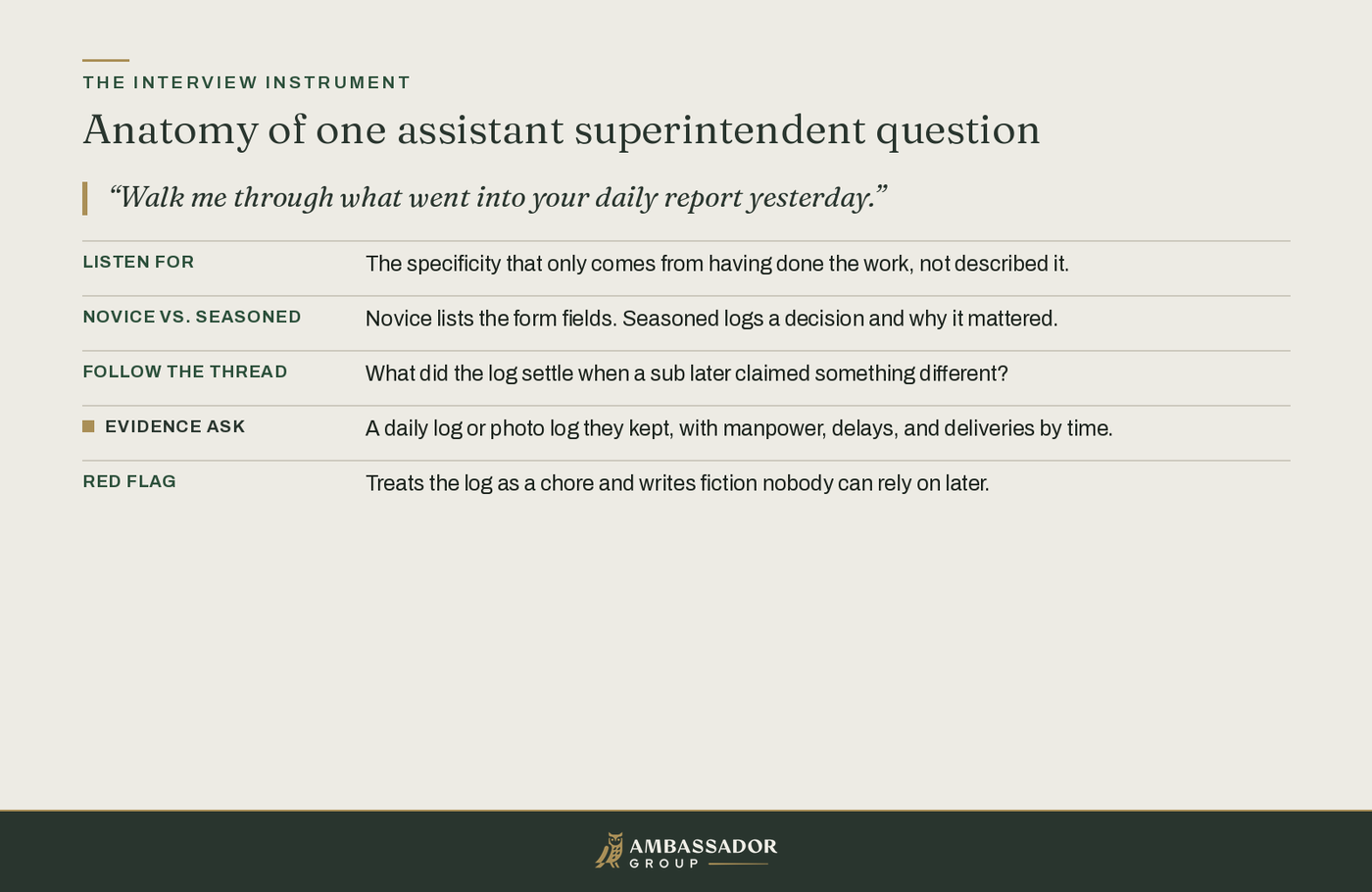
Walk me through what went into your daily report yesterday, weather through manpower through delays.
- What you are listening for: specificity that only comes from having done it. Manpower counts by trade, a delay logged with a cause, a delivery noted with a time. The texture of a real day on a real site.
- Novice tell versus seasoned tell: the novice describes the form fields ("you put the weather, the crews, any issues"). The seasoned candidate describes a decision ("I flagged the drywall crew sitting idle two hours waiting on the inspector, because that gap mattered the second the schedule got questioned").
- Follow the thread: if the answer stays generic, ask what he did when something on site contradicted what a sub later claimed. If he names a dispute, ask whether his log settled it. If he says he photographs, ask what he photographs and why those frames and not others.
- Evidence ask: a redacted daily log or two he personally authored, or dated photo-log entries with his own captions.
- Red flag: he cannot describe a single day in concrete detail, or he treats the log as something the office handles. A candidate who has never owned the record has never owned the slice.
Tell me about a time your documentation protected the project or the company.
- What you are listening for: a sense that the record has a purpose past compliance, plus a specific instance where his notes mattered after the fact.
- Novice tell versus seasoned tell: the novice has never connected a log entry to a consequence. The seasoned candidate names the backcharge avoided, the claim deflected, or the sub conversation that broke his way because the date and the photo existed.
- Follow the thread: ask who read the document and what changed because of it. Ask what he started documenting differently afterward. Ask whether he has ever been burned by something he failed to write down.
- Evidence ask: the email or log thread where his documentation got cited in a dispute, dates and names scrubbed.
- Red flag: he frames documentation purely as covering himself, with no sense that the record protects the trades, the schedule, and the owner. Self-protection is a thin motive for a document everyone relies on.
Quality control and punch execution
Punch is where an assistant super builds a reputation for a sharp eye or earns one for waving things through. It is tedious, it gets confrontational with subs, and it is the most visible proof of whether someone owns quality or just owns a clipboard.
Take me through how you run a punch on your scope, from first walk to sign-off.
- What you are listening for: a method. A real sequence, a way of tracking open items, a standard for what done means, and a way of holding subs to the close-out.
- Novice tell versus seasoned tell: the novice describes pointing at problems. The seasoned candidate describes a system: how he logs items, how he assigns them back to the responsible sub, how he verifies the fix rather than trusting that it got handled.
- Follow the thread: ask how he handles a sub who marks an item complete that is not. Ask what he does when the schedule pressures him to sign off early. Ask how he separates a real defect from an acceptable tolerance.
- Evidence ask: a punch list he managed, ideally one showing open-to-closed tracking with his notes on verification.
- Red flag: he has no method past walking and looking, or he admits he signs off on a sub's say-so to keep the peace. A punch run on trust alone is not a punch.
Describe a defect you caught that others had walked past.
- What you are listening for: the eye. Evidence that he sees what a rushed or untrained person misses, and that he understands why the defect mattered.
- Novice tell versus seasoned tell: the novice names something cosmetic and obvious. The seasoned candidate names something with consequence, a flashing detail, a slope to drain, a compromised fire-rated assembly, and explains the downstream failure it would have caused.
- Follow the thread: ask how he raised it without putting the foreman on the defensive. Ask what it cost to fix then versus later. Ask whether he was ever wrong about a call and what that taught him.
- Evidence ask: a photo of the condition with his markup, or the RFI or deficiency notice that resulted.
- Red flag: he cannot name a single catch, or every catch is cosmetic. A development hire whose eye is still developing is fine. One who thinks he has the eye and does not is the problem.
Safety walks and housekeeping
Safety is the accountability where a young leader's posture shows, because it carries no glory and constant friction. An assistant super who runs a real safety walk makes himself unpopular on purpose, and that willingness predicts how he holds every other line.
Walk me through your safety walk. What stops you, and what do you let go?
- What you are listening for: a genuine eye for hazard and a sense of proportion. Not a memorized OSHA list, but the judgment to tell an imminent danger from a housekeeping item.
- Novice tell versus seasoned tell: the novice recites categories, fall protection, housekeeping, PPE. The seasoned candidate walks an actual site in his head, naming where he looks first and the conditions that have bitten him before.
- Follow the thread: ask about the last time he stopped work or sent someone home. Ask how the foreman reacted and what he did with that reaction. Ask what near miss changed how he walks a site.
- Evidence ask: a safety observation log or a toolbox-talk sign-off sheet he ran, or before-and-after photos of a condition he flagged and got corrected.
- Red flag: he has never stopped work or corrected a senior tradesman over safety. Someone who has only observed and noted, never intervened, has not yet owned the walk.
A foreman you respect tells you a guardrail is fine and you are slowing him down. What happens next?
- What you are listening for: spine without theatrics. The willingness to hold the line on a real hazard, paired with the skill to do it without starting a war.
- Novice tell versus seasoned tell: the novice either caves ("he knows more than me") or goes rigid and quotes the rulebook. The seasoned candidate holds the standard and brings the foreman along, often by making the fix the foreman's own call.
- Follow the thread: ask what he does if the foreman still refuses. Ask when he escalates to the lead super versus handles it himself. Ask whether he has strained a relationship over a safety call and whether it was worth it.
- Evidence ask: hard to document, so push for the specific instance, names withheld, and probe the details until the story carries its own weight.
- Red flag: he would let it go to keep the relationship, or he cannot picture holding a line against someone senior. Both disqualify a role defined by influence without authority.
Sub and delivery coordination on assigned scope
Coordination is where the no-title problem gets real. The assistant super sequences trades and chases deliveries with nothing but credibility and the schedule. How he talks about subs reveals whether he sees partners to align or obstacles to manage.
Tell me about a time two trades collided on your scope and you had to sort the sequence.
- What you are listening for: a working grasp of trade sequence and the social skill to broker it. Evidence he can see the conflict coming and resolve it without running to the lead super for every collision.
- Novice tell versus seasoned tell: the novice escalates on contact or picks a side. The seasoned candidate gets both foremen into the same conversation, finds the sequence that works, and owns the call.
- Follow the thread: ask how he knew the conflict was coming. Ask what he did when a foreman ignored the agreed sequence anyway. Ask how he tracks who is supposed to be where and when.
- Evidence ask: a two-week look-ahead he maintained for his scope, or a marked-up coordination sketch, or the text thread where he brokered the sequence.
- Red flag: every conflict ends in escalation, or he frames subs as adversaries. A coordinator who cannot coordinate without his boss is not yet owning the slice.
A delivery you were counting on did not show. Walk me through your next two hours.
- What you are listening for: ownership under pressure and the resourcefulness to keep the crew productive rather than stand around waiting for a fix from above.
- Novice tell versus seasoned tell: the novice waits and reports the problem. The seasoned candidate works the phones, re-sequences the crew onto productive work, and pushes the slip up the chain with a plan attached, not just a complaint.
- Follow the thread: ask who he called first and why. Ask what he told the crew. Ask how he kept it from repeating on the next delivery.
- Evidence ask: a delivery log or the message thread where he chased the supplier and re-planned the day.
- Red flag: his whole answer is "I told the super." A development hire is allowed to escalate, but the absence of any independent move is the tell that the slice is not really his.
Learning posture and ownership
This is the load-bearing accountability for a development role, and the one most candidates rehearse and fewest live. The question behind every question here is simple: when you correct this person, does anything change?
Tell me about the hardest piece of feedback a superintendent ever gave you, and what you did with it.
- What you are listening for: a specific correction, an unflattering one, with concrete evidence of changed behavior afterward. The arc from sting to adjustment.
- Novice tell versus seasoned tell: the novice offers a humblebrag ("I cared too much") or a vague "I learned to communicate better." The seasoned candidate names a real failing, owns it without flinching, and describes the exact habit he changed.
- Follow the thread: ask how he felt in the moment and what he did with that feeling. Ask what he does differently now. Ask for a second example, because the first can be canned and the second rarely is.
- Evidence ask: harder to document, so push for the before-and-after behavior in granular detail until you can picture the change.
- Red flag: he cannot name a single hard correction, or every piece of feedback he ever got was secretly a compliment. A candidate who has never been genuinely corrected has never been coachable, only untested.
What is something about this trade you got wrong for a long time before you understood it?
- What you are listening for: intellectual honesty and the capacity to hold "I was wrong" without flinching. A real learner has this readily.
- Novice tell versus seasoned tell: the novice deflects to something external or trivial. The seasoned candidate names a genuine misread of how a system or a crew or a sequence works, and explains how the correction reshaped his thinking.
- Follow the thread: ask who or what corrected him. Ask how long he held the wrong model before it broke. Ask what he is probably still wrong about today.
- Evidence ask: none. This is a character probe, and the evidence is the quality and specificity of the self-account.
- Red flag: he cannot name anything he was ever wrong about. In a learning role, certainty reads as a closed door, which is the opposite of what you are hiring for.
Communication up to the lead super
The assistant super is the lead super's eyes on a slice he cannot watch directly. Bad news travels late from a weak communicator, and late bad news is how schedules collapse quietly. How a candidate decides what to surface, and when, reveals his judgment about his own limits.
How do you decide what to bring to your superintendent versus handle yourself?
- What you are listening for: calibrated judgment. Not someone who escalates everything, which is no ownership, and not someone who buries problems to look capable, which is the dangerous one.
- Novice tell versus seasoned tell: the novice has no framework or escalates by reflex. The seasoned candidate has a working line: cost, safety, and schedule impact go up immediately, routine friction he handles and reports in summary.
- Follow the thread: ask about a time he should have escalated sooner and did not. Ask about a time he escalated something he should have handled. Ask how he delivers bad news so it lands clearly.
- Evidence ask: a status update or end-of-week summary he sent his super, showing what he chose to surface.
- Red flag: he hides problems to appear competent, or he has never reflected on the calibration at all. A slice owner who buries bad news is the most expensive kind of bad hire.
Tell me about a time you had to tell your superintendent something he did not want to hear.
- What you are listening for: the nerve to carry bad news up and the skill to do it with a recommendation attached, not just a problem dropped on the desk.
- Novice tell versus seasoned tell: the novice softened it past the point of clarity or sat on it. The seasoned candidate delivered it straight, early, and with a proposed path forward.
- Follow the thread: ask how the super reacted. Ask what he would do differently. Ask whether he has ever been right when his super was wrong, and how he handled that.
- Evidence ask: the message or a detailed recounting of the conversation, with enough specifics to confirm it happened as described.
- Red flag: he has never delivered hard news upward, or he describes managing his boss's emotions instead of giving him the truth. The role exists to be honest eyes, and an editor of reality is no use.
What the candidate should be asking you
A development hire is a two-way bet, and the strongest assistant super candidates interview the role as hard as you interview them. Their questions are diagnostic, and an absence of good ones is itself a finding. The goal is a real match, where the job fits the candidate's trajectory as much as the candidate fits the job. Learn to draw those questions out, as covered in Be the Lightning Rod.
Listen for whether he asks who he would report to and what that superintendent is like as a teacher. A candidate who cares about the quality of his mentor plans to grow. Listen for whether he asks what the path past assistant looks like and on what timeline, because a person betting on a development role should want to know where it develops to. Listen for whether he asks what slice he would own first and how much rope comes with it, since that question separates someone who wants responsibility from someone who wants a title.
When a candidate asks none of this, you have learned something. Either he has not thought about his own growth, or he is taking any job that pays, and neither fits a role whose entire premise is trajectory. The candidate who pushes back on your answers, who asks what happens when he and the lead super disagree, who wants to know how mistakes get handled here, is showing you the coachable-yet-spined posture the job requires. Reward it.
Do not leave the interview without capturing it
The most expensive moment in hiring is the debrief, because that is where the loudest voice overwrites the truest read. Protect against it by writing your assessment before anyone else speaks.
Write your feedback first, alone, before the debrief. Capture the specific moments: where the candidate's answers got concrete and where they got thin, which threads you pulled and what surfaced, the one story that was clearly lived and the one that was clearly rehearsed. Memory bends toward the conclusion you already want. The written record does not.
Then tally the risk on each accountability honestly. For every gap, decide whether you would fill it by hiring and coaching, engineer around it by structuring the role so the gap does not bite, or walk because the gap is a deal-breaker. A development hire is allowed gaps, that is the nature of the role. What it is not allowed is a gap in coachability or in the willingness to hold a line, because those are the two things you cannot coach into someone who lacks them.
Name what you did not assess. One interview cannot test everything, and pretending it did is how blind spots become bad hires. If you never saw him under real time pressure, write that down. If you never tested whether he can hold a hard line with someone senior, write that down, and make the reference call or the next conversation earn it.
Then decide against the role as it is, not the role you wish you were filling. Writing it down before the debrief is the difference between a decision and a rationalization, and the full method lives in Hire in 4K.
The listening is yours
Every probe above assesses nothing on its own. You do the assessing, and the quality of this assistant superintendent hire will track the quality of your listening far more than the quality of your list. That is the uncomfortable part and the freeing part at once: the variable you most control is yourself. The same discipline scales to the roles around this one, whether you are hiring the superintendent who will mentor this person or the project engineer who works the same slice from the office side, and the longer climb is mapped in the Seven Levels of Interviewing Mastery.
Sharpen the listener, and the right hire becomes visible on his own. You already know whose listening sets the ceiling on this hire. The only question is whether you will hold yourself to it.
The short version.
- What should I look for when hiring an assistant superintendent?
- Trajectory, not finished mastery. The role is to own an assigned slice under a lead super, earn respect from the trades without title authority, and turn correction into changed behavior fast enough to keep the schedule. Interview to the three places the role breaks: ownership of the slice, earning trade respect on credibility alone, and coachability.
- What does an assistant superintendent do day to day?
- At a 25-to-200-person general contractor, the assistant superintendent owns daily field documentation and reporting, quality control and punch execution, safety walks and housekeeping, sub and delivery coordination on assigned scope, and communication up to the lead super. The job is running that slice reliably without being told twice.
- How do I test whether a young field leader is coachable?
- Ask for the hardest piece of feedback a superintendent ever gave them and what they did with it. The seasoned candidate names a real failing, owns it without flinching, and describes the exact habit that changed; the novice offers a humblebrag or a vague "I learned to communicate better." Then ask for a second example, because the first can be canned and the second rarely is.
- Why do daily logs matter so much in an assistant superintendent interview?
- The daily log is the role's lowest-status, highest-consequence task: it is the document a lawyer reads three years later when a delay claim lands. An assistant super who treats it as a chore writes fiction, while one who treats it as a record writes evidence, so ask them to walk through yesterday's report and listen for texture like manpower counts by trade and delays logged with causes.
- What questions should a strong assistant superintendent candidate ask me?
- Who they would report to and what that superintendent is like as a teacher, what the path past assistant looks like and on what timeline, and what slice they would own first and how much rope comes with it. A candidate who asks none of that either has not thought about growth or is taking any job that pays, and neither fits a role whose whole premise is trajectory.


