
The debrief runs twenty minutes and everyone leaves happy. Sharp candidate, real command of the work, three interviewers landing on one word: strong. The offer goes out that afternoon.
Ask any of them what the candidate proved and the table goes quiet. Not because the candidate was weak, but because nobody had said, before the first interview, what this person had to accomplish fourteen months out. There was no target, so "strong" won by default.
That is the moment a bad hire begins. Not in the interview, and not in the candidate. In a target nobody set.
Hiring is where a leader's judgment becomes visible, and the confident debrief is where it goes blind.
Fit is not a part you can pull off a shelf
The reason the target goes unset is that most leaders believe they are shopping rather than deciding. "Just bring me people who fit us." Some version of that line shows up on most of my first calls, and it always lands the same way: as a request to ship a part. Pull the candidate who fits, the way you would pull a stud already cut to length.
People are not inventory, and fit is not a property a candidate carries into the building. Fit is what happens between a person and the place they land, and most of it cannot be seen until after they arrive. The leader asking me to find someone who fits is asking me to predict the back half of a story whose front half he controls.
When people say fit, they usually mean one of four different things and rarely say which. Can this person do the job. Do their values line up with how the company operates in practice. Will they work well with the people they sit next to. Will they survive their specific manager.
Four separate questions with four separate answers, and a candidate can pass three and fail the one that ends up mattering most. Two of the four live almost entirely on your side of the table. A values match depends on what your values are in practice, not on the wall. A team match depends on the team you already built. A manager match depends on how you lead. You are asking me to find someone who fits a thing only you can see clearly, and the leader who insists hardest on fit is often the one who has never said out loud what his company is like to work inside.
Left undefined, fit becomes a polite word for "reminds me of me." Patty McCord, who ran people at Netflix, has argued that culture fit usually means hiring someone you would enjoy a beer with, which has close to nothing to do with whether they can do the work. The people we enjoy tend to share our background, so hiring for that feeling quietly builds a team of the same person, comfortable and no longer improving. Facebook banned the phrase from interview feedback and required interviewers to cite specific evidence against defined values, because "I just liked him" opens the door to bias and closes it on anyone unfamiliar. That is the deeper cost of treating people like inventory, and it is why overvaluing cultural fit costs companies the talent they need. The companies that worked this out stopped asking who fits the mold and started asking who shares the mission while bringing something the team is missing. Harder question. Right one.

Prediction is a hypothesis, not a verdict
Everything you do before a hire is forecasting. Resumes, structured interviews, work samples, reference calls, a values conversation. These are instruments for an educated guess about how someone will behave across months nobody has lived yet.
A good guess beats a bad one. A structured interview anchored in job-relevant behavior beats the chatty version that drifts into "did I like him," and untrained managers running unstructured interviews mostly confirm their own reflection. Even the disciplined version is a hypothesis. You are deciding from a few hours of evidence how a person will hold up across a few years of reality.
The verdict arrives later, on the job, with the clarity you never had in the interview. Onboarding either pulls a borderline hire into full integration or exposes that the values you sold are not the values you live. Performance shows you what an interview could only gesture at. Hindsight is honest in a way prediction cannot be, because by then the person is real and so is the place.
Hold the two side by side and the trap is obvious. Before the hire you have high confidence and thin evidence. After the hire you have thick evidence and sunk cost. The leader who "just knew" is often the slowest to admit a misfit, because admitting it means admitting the guess was his.
Ambiguity is deferred risk
That gap between confidence and evidence is where ambiguity lives, and ambiguity in hiring usually wears the costume of confidence. The interview team walks out, someone says "I liked them," another nods, and the decision feels finished. Nobody is forced to articulate specifics. Nobody presses for evidence. Because ambiguity is comfortable, the team accepts it as progress.
It is not progress. It is deferred risk. Comfort with it is like crossing a busy street without looking. You might make it across a few times. It might start to feel normal. That comfort is one near miss away from a consequence you will be explaining to an owner.
Why it thrives
Most interview teams are busy running projects, clients, and budgets, so interviewing feels like an interruption rather than a discipline. In that gap, shorthand judgments take over: gut feel, likability, the absence of red flags.
Ambiguity also flatters. If I am a seasoned leader, it is tempting to believe my instinct alone is reliable enough to skip structured analysis. Saying "they'll do fine" costs nothing today and may cost a great deal in eleven months. Being too busy to interview well is itself a strategy, just not one anyone would defend out loud.

The deeper problem is that leaders comfortable with ambiguity rarely track their own interviewing statistics. They cannot tell you what percentage of their gut calls became regrettable hires, how many people left inside a year, or how long it takes their team to fill a critical role. Without data there is no mirror, so the imprecision never becomes visible. A line often attributed to W. Edwards Deming puts it well enough: without data, you are just another person with an opinion.
The six-month myth
Most leaders will tell you they do not really know whether a hire worked out until six months in. The belief is so common it passes for truth. It is a symptom.
When interviews are vague, onboarding becomes an experiment. The company learns who it hired only once the person is embedded. That is why the first six months feel like fog. What a leader is really saying is this: our interviewing is weak enough that we hire on hope and keep interviewing for fit while the person is on payroll.
The proof shows up fast. The new hire asks what to prioritize and gets different answers from different leaders. Tasks expose skills never tested beyond a verbal yes. Competence turns out to be sufficient, and the way the person operates still creates drag. Leaders start saying "they just need more time." Coworkers hesitate to delegate. Performance conversations stay at "step it up" without a measurable target.
When interviews are ambiguous, onboarding becomes discovery instead of confirmation, and the team spends half a year working out who it hired.
Why interviewers resist looking
If this is so expensive, why does it persist. Admitting weakness in interviewing feels like admitting weakness in leadership. Years of management get mistaken for mastery of interviewing, and repetition substitutes for reflection. Vague feedback is unchallengeable, so "I didn't feel good about them" keeps ego safe, and if interviewing is a skill it can be measured, which means interviewers can be held responsible for bad hires. Most have never been trained, so they do not know what good looks like. And because the pain arrives months later, nobody feels urgency today.
Interviewing is one of the few leadership disciplines where failure hides in plain sight long enough for the trail to go cold. Which is why the blame cycle is so reliable. Leaders complain about the people they hired, deflect toward the candidate or the interviewers or the recruiter, then make another hire with the same process. Some hire a recruiter expecting outside help to replace the discipline they resisted internally. No recruiter can compensate for a leadership team that will not own its own interviewing.
Underwriting, not sales
Most of the construction leaders I meet run hiring the way they run sales: build rapport, create momentum, get to yes. The instincts that built your client relationships will produce your worst hires.
The vocabulary gives it away. You close a candidate. You overcome objections. You sell the opportunity. You push for a decision before the candidate has had time to think it over. That vocabulary rewards charisma, enthusiasm, and the performance of competence, all of which are easy to manufacture under pressure to impress. The candidate who is deliberate, who asks hard questions back, gets scored down for lack of excitement. The one who mirrors your energy and agrees with everything gets scored up.
A process built to manufacture a yes cannot tell you whether the yes is correct.
Think of the project manager search that felt easy. Firm handshake, war stories about saving a job that had gone sideways, quick agreement about how the team should run. Three weeks later the offer went out. Eleven months after that, the same leader was explaining to an owner why the schedule had slipped, why two superintendents had quietly started routing around the new PM, and why the role was open again. Nothing in that interview tested whether the candidate could run the work. It tested whether he was pleasant to talk to. He was. That was never the question.
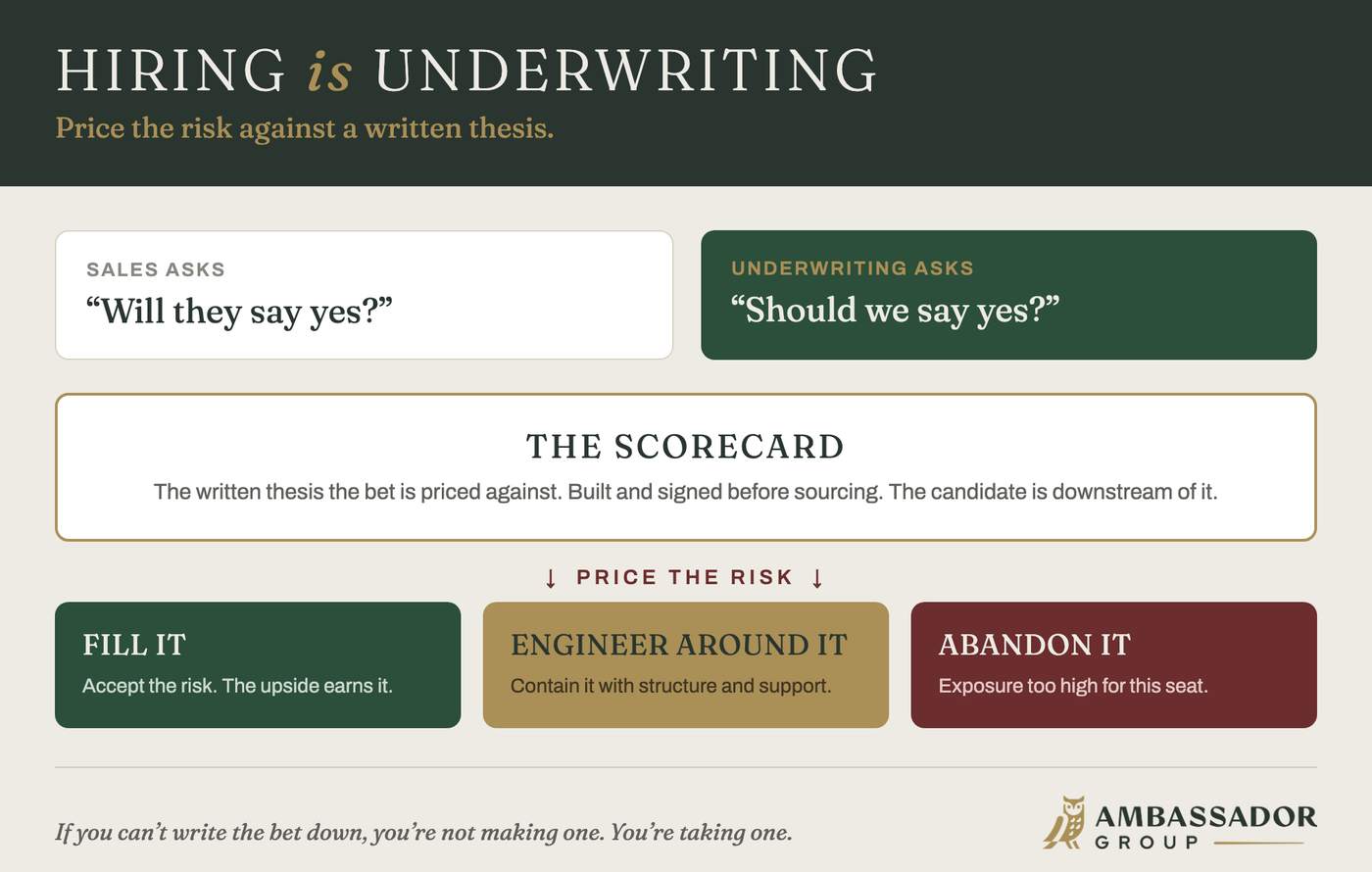
Sales optimizes for yes. Underwriting asks whether yes is the right answer. An underwriter prices the risk that the bet pays off, then decides whether to take it. Every hire is a six-figure bet on future performance, and the quality of that bet is not set by the candidate who walks in. It is set by whoever decides to let them in. That is your job. Not the recruiter's. Not HR's.
Pricing the risk does not mean eliminating it. No hire is risk-free, and waiting for the one that is becomes its own failure. Once you have named a risk honestly you have three legitimate moves: fill it with training, engineer around it with structure, or walk away. What is not legitimate is leaving the risk unnamed and then discovering it at month eleven, after it has done its damage.
Every candidate arrives with a backpack
You would never pour a foundation without checking the soil. You need to know what is under the dirt. Solid rock, loose sand, a clay layer waiting to slide down the hill. If the ground is unstable you do not panic, you make a choice: walk away, or engineer around it. Build without looking and that is when buildings and fortunes disappear into the ground.
The person holding the auger is not the candidate. The soil test measures your judgment, and your judgment is only as good as your self-awareness. Most leaders skip the test and then blame the ground.
Most leaders are also looking for a perfect candidate at zero risk, which is a fairy tale. Nobody is perfect, including you, and the only hiring authority who sees himself as the flawless candidate is the one missing the self-awareness to know better. Every person you hire arrives with a backpack full of risk. We call the contents Risk Units.
Risk is not always a statement that the candidate is bad. Often it comes from how they meet your specific world. A Ferrari is an excellent car. Drive it onto a muddy jobsite and it becomes a liability. The car did not change.
Risk is a chemical reaction. It happens when a specific person meets a specific team, a specific leader, a specific project.
Most interviews never look for it. You sell the company, they sell their resume, everyone smiles and shakes hands. Call that interview veneer: it looks nice and scratches easily. The omission is rarely deliberate. Construction companies specialize in building, not interviewing, and nobody trained them to run a site survey on a person. That is what an interview is for. We run ours against the Seven Dimensions of Fit, which are the seven places a match holds or fails: functional, contextual, cultural, relational, motivational, developmental, and leadership. Most companies screen the first one and let the other six decide the outcome.

The Risk Units are fixed. They are in the backpack whether or not you look. Skip the discovery work and the risk does not go away, it waits, usually until you are busy and a date is looming. Then the sinkhole opens as a team conflict, a safety incident, or a leader who is drowning, and now you are paying to fix it on a finished building instead of on the drawing board. The bill runs well past a wasted salary: liability when a safety rule gets ignored, damage to your name when a project goes sideways, real revenue lost when morale drops and good people leave.
Ten hours of interviewing now, or ten weeks of repair later. The risk is real either way, and the only thing you control is whether you saw it coming.
Write the goals; the risks are their inverse
The mechanical part is the part almost nobody does.
You never write a risk list. You write a goal list, because a hiring risk is only the inverse of a goal. State the outcome precisely and you already know the failure. "Hold the fourteen-month schedule on the medical office build" inverts to "the schedule slips," which you can test. "Keep the best trade partners bidding your work" inverts to "the good subs walk." You author the goal. The risk is that goal, unmet. The rigor moves upstream, to the definition of good, where few teams spend it.
A vague goal breaks the whole mechanism. "Strong leader" inverts to "not a strong leader," which no question, work sample, or reference can test. The risk stays open the entire process and then gets closed anyway, on a feeling. That is worse than a weak signal. You do not end up a little less certain. You end up certain and wrong.
Goal count is a budget rather than a wish list. Every goal is a promise to spend scarce interview hours retiring its inverse. Name twelve and you will close most of them on nothing, because the time to close them honestly never existed. Five to seven is roughly the risk surface a normal interview loop can cover. Spend it on the outcomes that would sink the hire.
The scorecard is the written thesis
In financial underwriting the criteria exist before the application arrives. Income ratios, collateral thresholds, default history. The loan is measured against a standard written in advance, not a feeling assembled after the fact.
The scorecard is the hiring equivalent: the written thesis your bet is priced against, built before sourcing begins. One worth the name answers four questions.
- What outcomes must this person produce in the first 30, 60, and 90 days, and across year one?
- Which competencies, developed and latent, are genuinely non-negotiable for those outcomes?
- What are the two or three deal-breakers that disqualify regardless of other strengths?
- What specific behavioral evidence, visible in history and in the interview, counts as proof for or against each competency?
One page. Signed by the decision-maker before sourcing begins, shared with every interviewer so the whole panel runs the same investigation.
Skip it and the search has no thesis. Sourcing drifts toward "someone good." Interviewers measure candidates against private assumptions the panel never aligned on. The debrief becomes a collision of impressions. The final call rests on a feeling nobody can articulate or defend, and accountability has nothing to attach to.
If you cannot write the bet down, you are not making one. You are taking one.
The scorecard is not a recruiter deliverable. A recruiter can facilitate the conversation that builds it, ask sharp questions, expose buried assumptions, and push back on criteria too vague to measure. The hiring authority authors and signs it, because the scorecard describes the decision that leader is prepared to defend.
That distinction matters more than it sounds. An HR-generated job description records what the company would like. A decision-maker's scorecard records what the decision-maker will require as evidence before writing an offer. Those are usually different documents, and only one of them underwrites anything. Turning those outcomes into a document a candidate can read is a separate discipline with its own rules, covered in how to write a job description.
The candidate sits downstream of all of it. A candidate can only respond to the quality of the process they are put through. No candidate can rescue a search that runs without a thesis.
Three states of a hiring risk
Every hiring risk sits in one of three states.
Open. Not retired, and you know it. Uncomfortable but safe, because you can see it.
Closed with evidence. You can point to the transcript line, the work sample, the reference answer that put it down.
Falsely closed. You feel it is handled and there is nothing behind the feeling.
The third one is the killer, because from the inside it feels exactly like the second. The only way to tell them apart is to ask, before the offer: what retired this, and can you show me? The bad hires I have watched did not come from risks nobody saw. They came from risks everybody was sure they had handled.
Fill it, engineer around it, or walk
Once you find a risk, and you always find risk, you have three moves.
Fill it
A candidate matches how you work. Hard-working, honest, and has never touched your project management software. That is a Risk Unit, and it is a functional one. A shallow sinkhole. Pay for a training class in their first week. A little money and time up front, and the risk is gone.
Engineer around it
You find a project manager who is a brilliant builder and knows code better than anyone, who is also disorganized and allergic to paperwork. That is contextual risk. Put them somewhere that demands perfect filing and they will fail. Pair them with a project engineer who loves the detail and build a support structure to carry that weight. You are accepting the risk with a plan attached.
Walk away
Sometimes the hole is too deep. A candidate who needs constant praise and direction, working for a busy leader who expects people to figure it out. That is a leadership fit problem. You cannot train it out and you cannot easily engineer around it. Hire them and you will be frustrated every day. The ground is too unstable, and the smart move is to walk.
A named risk that still went bad
The case that complicates all of this, with details changed to protect the people in it.
A general contractor had bet hard on technology: project software, field data, the apparatus a modern job runs on. The role lived inside that apparatus. In the first interview the candidate said it himself, unprompted: he was weak with the technology. He told the truth about himself, which is rare.
So the risk was named. Sharp, not inferred. Written down and shown to the client. By the standard of the confident debrief, already a better process than most.
The hire failed anyway, on that exact risk.
That should stop you, because it breaks the comforting story that naming the risk is the win. Naming was the easy part.
Accepted is not managed
The risk was named, then accepted. Accepting risk is legitimate. Carrying it on purpose is the job. But acceptance has two parts and this team had neither.
A mitigation would have been concrete: a named mentor, ninety days of paired setup work, a training budget. A tripwire would have been boring and specific: by day forty-five he runs a full project setup in the software unassisted, or the team acts. What they had was "we'll manage it," which is not acceptance. It is hope.
A named risk with a mitigation and a tripwire is a bet you can lose intelligently, hedged, with an alarm that trips while there is still time. A named risk with neither is a documented way to be surprised later. They kept the documentation and skipped the discipline.
Salience is the missing discipline
Ask why the mitigation and the tripwire never got set and the answer is not carelessness. The risk was written down. It lived in a long shared document, one paragraph among many, weighted the same as a note about scheduling a second interview. Nothing about where it sat made it hard to walk past, so the team walked past it.
Naming a risk where nobody can see it is barely better than not naming it. This search did not fail on identification. It failed because identification was treated as the finish line, and the one risk that would end the hire never got the weight to force a plan. You cannot act on a truth you cannot see.
Was it a defensible bet that lost, or a rationalization on the way to yes? Both, and the two are harder to separate in the moment than anyone admits. There was a real case for the person; there usually is. There was also a pull toward yes: a long search, a good overall picture, and a named risk with no forcing mechanism is exactly the kind of risk a team talks itself past. A team that wants yes is the team that skips the tripwire.
What an interview cannot reach
Not every hiring risk is the inverse of a goal, and pretending otherwise is its own dishonesty. Whether a person is honest. Whether the motivation they show survives a hard Tuesday in month nine. Whether they leave the day their employer counters. Whether something nobody could foresee goes wrong at all.
None of these fall out of the job description, because they are about the person under the work rather than the work. They get retired elsewhere: references, assessments, a candidate debrief that reaches past competence into intent. An interview alone never closes the file. A whole class of risk is invisible to it by design.
For that class the play is the same every time, whatever the specific risk. Find a detection lever you can run before the offer. Add a pressure test that stresses the story rather than accepting it. Set a post-hire tripwire you monitor across the first 30 to 180 days.
Three worked examples, so the pattern is concrete.
Truth-shaping. Detection: cross-check facts between interviewers on dates, project values, budgets, and margins, and require artifacts such as W-2s, pay stubs, schedules, and change order logs. Pressure test: a timed written case that forces math and document recall, plus three regretted decisions with exact numbers. Tripwire: inconsistent metrics in weekly reports, shifting stories, missing backup.
Ethical flexibility. Detection: work through their change orders, pay applications, safety decisions, and documentation rigor in detail. Pressure test: "a client pressures you to hide a variance to get a change order approved, walk me through your steps." Tripwire: missing paper trails, "everyone does it" rationalizations, weak controls.
Weaponized competence. Detection: "show me the last system you documented in order to make yourself replaceable." Pressure test: hand them a process to document for handoff and score clarity and completeness. Tripwire: missing SOPs, single-threaded knowledge, an "ask me" bottleneck forming around one person.
Twenty-one of these categories show up repeatedly in construction hiring, from substance abuse and volatility to burnout dressed as adrenaline and chronic disorganization hidden by a great assistant. Each one gets the same three-part treatment.
The full library, with the detection levers, pressure tests, and tripwires for every category, plus twenty-five integrity and stress-test interview questions and a reference script built to produce numbers instead of adjectives, is a working document rather than an essay.
At the system level, a handful of moves cut risk more than any single question. A structured, lane-based interview strategy tied to real accountabilities. Role simulations that let you watch thinking under pressure. References triangulated across peers, direct reports, and trade partners. A bilateral assessment with a facilitated alignment conversation. Red-teaming the hire before the offer goes out. An offer that carries a 30-60-90 scorecard with leading indicators. Dual-sided check-ins through the first twelve months. Standardized, compliant testing so the process applies evenly to everyone. And questions that get past surface-level answers, because a good structure asked badly produces the same fog as no structure at all.
Three risks no candidate can fix
There is a dangerous assumption in construction hiring: if we find a good person, the rest will work itself out.
It sounds reasonable. Recruiting is expensive and good candidates are scarce, so why not believe that securing the right person solves the problem. Because plenty of hires fail while the candidate is capable, experienced, and well-intentioned. Some risks live upstream of recruiting, and if they go unaddressed the strongest hire available cannot win. Then we hear "no one wants to work anymore," which externalizes the blame for something the candidate had nothing to do with.
Leadership impact. Even the most self-managing construction professional calibrates around the tone and expectations their leader sets. Leadership that is inconsistent, unclear, or unreachable creates decision bottlenecks and second-guessing. Authoritarian leadership caps initiative. Hands-off to the point of neglect breeds disengagement. A candidate brings capability; a candidate cannot rewrite the operating style at the top. That is a leadership development project, not a recruiting project. Kouzes and Posner make the point in The Leadership Challenge: the climate a leader creates decides whether people show up guarded or committed. B-level leaders do not reliably retain A-level talent, which is why a disengaged key leader is the risk that controls every other hiring risk.
Culture. The day-to-day experience of working at your company will overpower the resume you hired. Culture is the net sum of what your team tolerates and celebrates. If your jobsite norms reward cutting corners, tolerate toxic behavior, or grind people down without recognition, those forces outlast any single hire's enthusiasm. High performers adapt to the dominant environment in order to survive, so when the culture rewards the wrong things, good candidates either change for the worse or leave. This is a shared habit problem, not a sourcing problem.
System and role design. Undefined scopes, conflicting responsibilities, and missing decision authority are quiet killers of performance. The candidate may have the skills, but if they do not know what success looks like, or the processes are chaotic enough to block execution, they will burn out. Good candidates can improvise for a while. Without system clarity you are paying a premium for someone to guess. Drucker had the line: there is nothing so useless as doing efficiently that which should not be done at all.
When leaders tell us a hire did not work out, the autopsy often finds the candidate was not the problem. The right person was matched to the role, and leadership impact, cultural forces, or role design made the role impossible to succeed in. The competitive advantage is not only finding good candidates. It is making sure they can win once they arrive.
Your gut is a signal, not an instruction
None of this asks you to switch off your instincts, and a version of the argument that did would be wrong.
A strong reaction you cannot yet explain is your brain processing patterns and past experience at speed. Those instincts are not magic; they come from cues you have absorbed over years, and they are shaped by wisdom and bias in the same motion. Experience helps you spot a real red flag. It also produces snap judgments about how much a candidate reminds you of someone you liked, or did not.
Your gut earns its keep when you sense a candidate is dodging a question, when energy and attitude do not match what the work requires, when you pick up signs of dishonesty or a refusal to own outcomes. It costs you when a candidate feels familiar, when you discount someone for a personality difference that does not touch job performance, when a strong first impression papers over a gap in experience, or when you read confidence as competence and quiet as weakness.
The difference between a legitimate concern and bias in disguise is usually visible if you look for it. Legitimate concerns tie to observable behavior: vague or shifting answers, little curiosity about the work, blame directed at every past employer, no clear examples of results they produced. Bias in disguise sounds different: they were less friendly than I expected, their communication style is unlike mine, they took a second to think before answering, their work history looks unlike our past hires.
So treat the feeling as the start of an investigation. Name what specifically gives you pause and whether it is behavioral, stylistic, or a skill gap. Check yourself: am I reacting to something job-relevant, would I feel this way about a candidate from a different background, am I extending the same grace I extended the last three people. Then go get evidence. Point to the moment in the interview that supports the reaction, or ask the question that tests it directly. Then say it out loud to your panel: I have a strong instinct here and I want it reality-checked.
Trust your gut when you have real experience with the situation and can articulate the concern, when the same flag appears across multiple interviews, or when the issue is a genuine deal-breaker. Question it when it rests on a first impression with nothing behind it, when the candidate feels comfortable and familiar, or when you cannot say why you feel what you feel.
Train your instincts. Do not obey them.
Checking your own calls
None of this compounds on its own. Discipline in one search dies with that search unless something carries the lesson forward, and the mechanism is dull. Once a hire has been on the job long enough to tell, go back to the risk calls and check them against what happened. This interviewer said the schedule risk was retired. Was it?
Over enough hires, some people prove reliably right about the risks they claim to close and some prove reliably confident and wrong. You cannot tell which until you look, and almost nobody looks.
One guardrail on that review. Judge an interviewer on whether they were right, never on how much risk they claimed to retire or how sure they sounded. Reward confidence or volume and you teach people to manufacture both, which is the exact behavior that caused the problem. Reward being right and the people who are right get more say over time. That is the only kind of improvement that lasts.
Two objections come up whenever I lay this out.
The first is that top candidates need to be sold on the role. Courting a candidate and underwriting the decision are separate acts and they do not interfere with each other. A well-run search is itself an expression of how you operate. It signals that you take decisions seriously, that you respect the candidate's time, and that you require real evidence before you commit. The candidates worth having read that as a green flag.
The second is that scorecards are bureaucracy. You write drawings before you break ground. You order a soil test before you pour a foundation. You would never commit to a six-figure build because the site looked about right and the conversation went well. The same leader who would never start a build without a scope has normalized starting a search without one.
The scorecard is one page. It is the cheapest thing you buy all year when the match holds, and the most expensive thing you skipped when it comes apart at month eleven.
So the confident debrief was never a story about a candidate. It was a story about a target nobody set, told as a story about a candidate. The false confidence, the risk closed on a feeling, the bet accepted with no hedge, all of it traces back to a leader who never did the upstream work of saying what this hire must accomplish and what each of those things would look like failing.
The fix is not a better candidate. It is a leader who owns the target before anyone walks through the door. That work is unglamorous and it is entirely yours.
Before your next search begins, finish this sentence: "We are betting that this person will ______ within twelve months." If you cannot finish it, the search is not ready to run.
You already know whether your last search had real goals or a feeling you called strong. Whether the next one is different is the only part still open.
The short version.
- Can you screen for culture fit before you hire?
- Only as a forecast. Fit is not a stable trait a candidate carries into the interview; it happens between a person and the environment they land in, and most of it cannot be seen until after they arrive. Resumes, structured interviews, work samples, and reference calls are instruments for an educated guess. Treat the result as a hypothesis, not a verdict.
- What is hiring risk?
- The inverse of a hiring goal. Every outcome you require of a hire implies a failure, which is that goal unmet. If you cannot state the goal precisely, you cannot state the risk, and you cannot test for it in an interview.
- How many goals should a hiring scorecard have?
- Five to seven. Every goal is a promise to spend scarce interview hours gathering evidence against its inverse. Past seven, most goals get closed on impression rather than evidence, because the time to close them honestly does not exist.
- What does it mean to accept a hiring risk?
- Carrying a known risk on purpose with two things attached: a mitigation that reduces it, and a tripwire that tells you in advance when to act. A named risk with neither is not accepted. It is hoped away.
- What are my options when an interview surfaces a real risk?
- Three. Fill it, when the gap is functional and training closes it. Engineer around it, when structure and support can carry the weight. Or walk away, when the problem is leadership fit and no amount of training or structure will change the outcome.
- Why do good hires fail when the candidate was strong?
- Because some risks live upstream of recruiting. A capable, experienced, well-intentioned hire cannot rewrite the operating style at the top, outlast a culture that rewards the wrong things, or succeed in a role with no clarity or decision authority. Recruiting can match the right person to the role and leadership can still make the role impossible.
- Can an interview retire every hiring risk?
- No. Honesty, motivation, and the odds a candidate leaves for a counteroffer do not fall out of the job description, so they are not the inverse of any stated goal. They get retired by reference checks, assessments, and a candidate debrief. An interview alone never closes the file.


