
A site superintendent can hide a bad hire for a while. A general superintendent cannot, because the damage compounds across every job at once. Put the wrong person in this role and you get 4 crews running 4 different field standards, supers who never grow because nobody is developing them, and a troubled job that gets quietly worse because the person sent to stabilize it took the wheel instead. The stakes run portfolio-wide, and that is why most general superintendent interview questions fail. They test whether the candidate can run a job, when the job is running the people who run the jobs.
Here is the part most leaders skip past. The quality of this hire is principally driven by the person asking the questions, not the person answering them. A strong general superintendent can be read by a sharp interviewer and missed entirely by a dull one. The questions on this page are instruments that measure nothing on their own. The listening, the willingness to follow a thread until the real shape of a person shows, belongs to the leader in the interview. A leader who cannot see himself clearly will not see this candidate clearly, and he will blame the field when the failure happened across the table. Sharpen how you read, and the field takes care of itself for years.
Interview to the three places this role breaks
Most interview guides hand you a pile of questions sorted by topic. That is a parts list, not a diagnosis. A general superintendent fails in a small number of predictable ways, and the interview should be built backward from those failure modes.
The first is manpower. This role lives or dies on allocating scarce field labor across competing jobs and matching the right super to the right project. A candidate who has only ever staffed one job at a time has never made the trade that defines the role: starving a healthy job to save a sick one, and owning the consequence on both.
The second is the standard at a distance. A general superintendent holds one field standard across sites he cannot personally walk every day, which means developing supers and building systems that carry quality when he is not there. The failure mode is a leader whose jobs are only as good as the rooms he is standing in.
The third is the rescue. Sooner or later this person parachutes into a troubled job and has to stabilize it without taking over and without undermining the site super who is still going to be there next month. The failure mode is the leader who fixes the job and burns the person running it.
Build the questions from those 3 breaks and the interview stops being a quiz.
The accountabilities this role carries
Before the probes, name the territory. A general superintendent at a contractor this size owns 6 things, and each gets its own section below.
- Field leadership development: growing supers, not just supervising them.
- Manpower and resource allocation across projects.
- Field operations standards and systems that hold without daily presence.
- Safety program ownership across every active site.
- Schedule oversight and recovery across the portfolio.
- Field and office coordination.
A leader who knows how to read 3 questions cold will out-hire a leader armed with 90 he cannot interpret.
Field leadership development
This accountability separates a general superintendent from a senior superintendent with a bigger title. Growing other field leaders is also the easiest thing to fake with secondhand language about mentorship.
Tell me about a superintendent who was struggling, and walk me through exactly what you did over the next 90 days
- Listening for: a specific person, a diagnosis of whether the problem was competence, will, or fit, and a developmental sequence that escalates. The skilled answer treats the super as a project with a punch list.
- Novice versus seasoned: the novice describes what he told the super to do. The seasoned candidate describes what he changed in how he showed up. Ride-alongs, a standing one-on-one, handing the super a stretch task and then resisting the urge to take it back.
- Follow the thread: How did you know it was working before the numbers moved? What did you stop doing for him that you used to do?
- Evidence ask: a written development plan or coaching note for a specific super, even a photo of a whiteboard or a text thread. The artifact proves the work was structured, not just felt.
- Red flag: every struggling super in the telling eventually got cut. A general superintendent who only knows how to remove people has never developed one.
How do you decide a super is ready to run a bigger or more complex job
- Listening for: an explicit readiness model. Schedule literacy, owner-facing composure, the ability to hold a subcontractor accountable without you in the interview. The answer should sound like a rubric he uses.
- Novice versus seasoned: the novice says he just knows, or points only to years of experience. The seasoned candidate names the specific failure he watches for and how he pressure-tests for it before the stakes are real.
- Follow the thread: When did you get this wrong, and what did it cost? How do you stretch a super without setting him up to drown?
- Evidence ask: his bench plan, a list or a mental map of who is ready now, ready in a year, and capped. If he has never built one, ask him to sketch it on the spot.
Manpower and resource allocation across projects
This is the math problem at the center of the role, where a single-job background shows fastest. The candidate is allocating a fixed pool of skilled hands across jobs that all believe they are the priority.
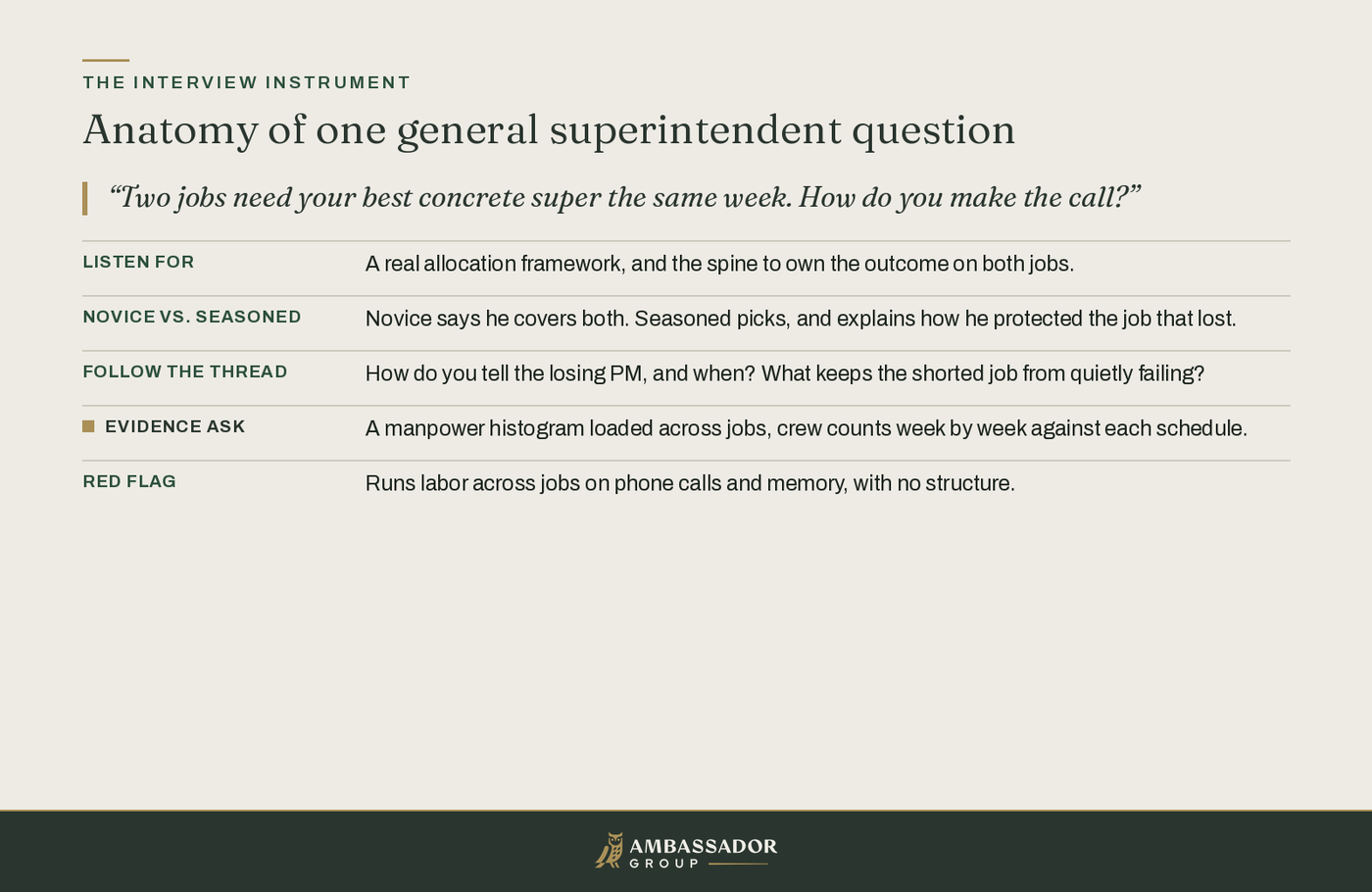
2 jobs need your best concrete super the same week. Walk me through how you make that call
- Listening for: a real decision framework. Schedule float, the risk profile of each pour, who is on the bench to backfill, which client relationship absorbs the hit. The skilled answer makes the trade out loud and owns both outcomes.
- Novice versus seasoned: the novice tries to make the conflict disappear and says he would cover both. The seasoned candidate accepts the constraint, picks, and explains how he protected the job that lost.
- Follow the thread: How do you tell the project manager on the losing job, and when? What do you put in place so the shorted job does not quietly fail? When did a call like this go wrong, and what did you learn?
- Evidence ask: a manpower histogram or labor-loading forecast he maintains across jobs, plotting crew counts week by week against each schedule. This is the single most revealing artifact in the interview. You cannot run the role without one, and you cannot fake one you never built.
- Red flag: he does not track labor across jobs in any structured way and runs it all on phone calls and memory. At this scale that leaves him blind.
How do you forecast a manpower crunch before it lands on you
- Listening for: a forward-looking rhythm. Reading the schedule 4 to 8 weeks out, watching for stacked milestones across the portfolio, moving people before the crisis instead of after.
- Novice versus seasoned: the novice is reactive and proud of how fast he scrambles. The seasoned candidate is bored by his own crises because he saw them coming.
- Follow the thread: What signals tell you a crunch is forming? When do you go to the executive team for more bodies versus solving it inside the current crew?
- Evidence ask: a 6-week look-ahead that spans multiple jobs, or a staffing projection he brought to a leadership meeting.
Field operations standards and systems
A general superintendent's real product is consistency across sites he cannot watch. This is where you find out whether he leads through presence or through systems, because only one of those scales.
What does our field standard mean specifically, and how do you make it hold on a job you only visit twice a week
- Listening for: a concrete standard, not a values poster. Layout tolerances, daily huddle format, how a deficiency gets caught and closed, what a properly mobilized site looks like. Then the mechanism that carries it in his absence.
- Novice versus seasoned: the novice equates the standard with his own eyes on the work. The seasoned candidate has built checklists, cadences, and a crew that self-polices.
- Follow the thread: How do you catch a job drifting before the owner does? How do you correct a site without humiliating the super in front of his crew?
- Evidence ask: a quality or pre-installation checklist, a daily-report standard, or a site-mobilization plan he authored or rebuilt. The document tells you whether the standard lives outside his own head.
Give me an example of a field problem that kept recurring across jobs, and what you built so it stopped
- Listening for: systems thinking. He saw a pattern, not just an incident, and he changed a process so the next super inherited the fix instead of relearning the lesson.
- Novice versus seasoned: the novice solves the same problem repeatedly and calls it diligence. The seasoned candidate is embarrassed it recurred even once and built something to retire it.
- Follow the thread: How did you get the other supers to adopt it? What did you have to give up to make the new way stick? How do you know it is still being followed now?
- Evidence ask: the actual procedure, template, or toolbox training he created in response.
Safety program ownership across sites
At this scale safety is a leadership signal that radiates from the field's top job. A general superintendent who treats it as compliance theater produces supers who do the same.
Walk me through a near-miss or incident where you owned the response across the company, not just the job it happened on
- Listening for: ownership that travels. He investigated honestly, found the system gap, and pushed the lesson to every site instead of containing it to one.
- Novice versus seasoned: the novice manages the paperwork and the optics. The seasoned candidate is visibly changed by the event and can tell you what is different on every job because of it.
- Follow the thread: What did you change company-wide afterward? How do you keep safety from becoming background noise the supers tune out?
- Evidence ask: a toolbox-talk series, a corrected JHA, or a stand-down he led. Look for whether the lesson reached jobs that were nowhere near the incident.
- Red flag: he describes a serious incident purely in terms of how he kept it from escalating into a claim. That answer belongs to a liability manager, when the role needs a field leader.
Schedule oversight and recovery across the portfolio
A site super recovers one schedule. A general superintendent triages several at once and decides which slip is survivable and which threatens the relationship or the year.
A job in your portfolio is 3 weeks behind and the owner is losing confidence. You did not build the schedule. What do you do
- Listening for: the rescue without the takeover. He gets into the real critical path, works alongside the site super, and rebuilds owner confidence without making the super look incompetent.
- Novice versus seasoned: the novice takes over, fixes the slip, and leaves a super who learned nothing and lost face. The seasoned candidate stabilizes through the super, so the super is stronger when he leaves than when he arrived.
- Follow the thread: How did you tell the difference between a super who needs help and one who needs replacing? What did you say to the owner, and what did you refuse to promise? How did you hand the job back?
- Evidence ask: a recovery schedule or pull-plan he drove, and how he sequenced it with the trades. Ask who built it. The right answer is that the super built it and he pushed.
- Red flag: his stabilization story has no version where the site super grows. If every rescue ends with him as the hero and the super as a bystander, he will burn through your field leaders.
How do you keep a real read on schedule health across several jobs without living in the field full time
- Listening for: a portfolio view he carries on paper or in his head. Leading indicators over lagging ones, and which jobs he worries about before the slip shows in the numbers.
- Novice versus seasoned: the novice knows the status of whichever job he visited last. The seasoned candidate can rank every active job by risk and name the early warning sign on each.
- Follow the thread: What is your tell that a job is about to slip before the schedule says so? How do you decide where to spend your own hours each week?
- Evidence ask: a portfolio status format, even a simple red-yellow-green he maintains across active jobs.
Field and office coordination
This role is the hinge between the field and the office. A general superintendent who only speaks field fights project management instead of partnering with it, and the friction costs more than any single job.
Tell me about a real fight between the field and project management, and how you handled your part of it
- Listening for: a leader who can hold the field's reality and the office's constraints at once. He defends his supers without making project managers the enemy, and he fixes the system that produced the friction.
- Novice versus seasoned: the novice tells a story where the office was wrong and the field was right. The seasoned candidate owns where the field contributed and argues the project manager's side fairly.
- Follow the thread: What did you change so that fight stopped repeating? How do you bring a manpower or schedule problem to the executive team without it sounding like an excuse?
- Evidence ask: how he runs his field leadership meeting or his handoff with operations. Ask for the cadence and the agenda, not a feeling.
What the candidate should be asking you
A general superintendent worth hiring is interviewing you just as hard. This is a bilateral interview, and the right candidate knows that taking this role into a company that will not back him is a career mistake. His questions reveal the role he knows how to fill.
The strong ones ask about authority. Do I own manpower decisions or only recommend them. Can I move a super off a job, or does that take 3 approvals. They ask because they have been burned by accountability without authority, the fastest way to break a general superintendent.
They ask about the bench, because a candidate already thinking about who is ready to grow and where the gaps are is thinking about development, the part of the job easiest to neglect and most expensive to lose. They ask pointedly about field and office, because they want to know whether they are walking into a partnership or a turf war.
A candidate who asks only about pay, truck, and title sees a bigger version of the job he already has. A candidate who asks how you measure a general superintendent and how decisions get made understands the role. The job has to fit the candidate as honestly as the candidate fits the job, because a mismatch you talked someone into surfaces on a job site at the worst possible time.
Do not leave the interview without capturing it
The interview is only half the instrument. The other half is the 20 minutes after the candidate leaves, and most leaders waste it.
Write your feedback before the debrief, not during it. The moment you hear another interviewer's read, yours contaminates. Capture your own assessment in writing first, while the moments are still sharp, then compare. This is the discipline behind Hire in 4K. The resolution of your read collapses the longer you wait and the more you let the debrief average itself out.
Then tally the risk honestly. For each gap you found, decide which of 3 things you will do: close it through development, build around it with the team you already have, or treat it as disqualifying. Naming the choice forces a decision instead of a hope that the gap closes on its own.
Name what you did not assess. If you never got a clean read on how this person develops supers, write that down as an open question, not a passing grade. Ground you never tested is not ground you can stand on.
Decide against the role, not against the other candidates. The question is never whether this person beats the last 3 you saw. It is whether he can carry the 3 places this role breaks. A weak field makes a mediocre candidate look strong.
The read belongs to you
A general superintendent will shape your field for years, across every job, in rooms you will never stand in. The instruments on this page will not make the call for you. They surface the signal. Reading it is the work, and the work belongs to the leader who runs the interview.
Sharpen that read and everything downstream gets easier, which is the argument behind the seven levels of interviewing mastery and behind learning to be the lightning rod who draws out what a candidate would never volunteer. The same discipline reads the site superintendents under him and the director of construction above him. One lens, sharpened, works up and down the field org.
The candidate can only show you what you know how to see. You already decide which of those it will be.
The short version.
- Where does the general superintendent role break?
- Three places. Manpower, meaning allocating scarce field labor across competing jobs. The standard at a distance, meaning holding one field standard across sites he cannot walk every day. And the rescue, meaning stabilizing a troubled job without taking it over from the site super.
- What is the most revealing artifact to ask a general superintendent for?
- A manpower histogram or labor-loading forecast maintained across jobs, plotting crew counts week by week against each schedule. You cannot run the role without one, and you cannot fake one you never built.
- How does this differ from interviewing a site superintendent?
- A site superintendent runs one job and recovers one schedule. A general superintendent runs the people who run the jobs, triages several schedules at once, and decides which slip is survivable. Questions built for a single job never test that trade.
- What should a strong candidate be asking you?
- About authority, meaning whether they own manpower decisions or only recommend them. About the bench, meaning who is ready to grow. And about how field and office work together. A candidate who asks only about pay, truck, and title sees a bigger version of the job he already has.
- What should you do in the twenty minutes after the candidate leaves?
- Write your feedback before the debrief. Tally each gap as something you will close through development, build around, or treat as disqualifying. Name what you did not assess. And decide against the role rather than against the other candidates you happened to see.


