
A submittal logged a day late. A long-lead item released against a superseded revision. A cost code that drifts a few hundred dollars a week. None of those sink a project alone, and all of them together do. The assistant project manager stands closer to those small misses than anyone, and is best positioned to catch them before they compound. That is why most assistant project manager interview questions miss the role: they test whether the candidate can recite the submittal process, never whether this person would have flagged the submittal that bites in four months.
Here is the part to sit with before you write a single question. The quality of this hire is driven principally by you, not by the candidate who walks in. A leader who cannot see their own blind spots cannot see a candidate's, and this role punishes that blindness more than most, because the signal here is quiet by design. It lives in follow-through, in what got flagged versus swallowed, in the gap between an APM who maintains a log and one who reads it. The questions below are instruments. The discipline of listening is yours.
Interview to the three places this role breaks
A job description lists everything an APM touches. An interview cannot test all of it, and trying to is how you end up testing nothing. Build the conversation around the few places the role genuinely breaks.
- Rigor and follow-through collapse. Submittals, RFIs, and buyout are a chain of small commitments, and the APM either closes each loop or lets one slip. A dropped loop is invisible on Tuesday and structural by August. You want someone who treats a log as a live instrument, not a parking lot for line items.
- Escalation judgment fails. The APM sees a hundred issues a week and cannot carry all hundred to the PM. The value is knowing which two matter. The APM who escalates everything buries the PM. The one who escalates nothing buries the project.
- Trajectory stalls. This is a feeder role. You are hiring less for who this person is at the document level today than for whether they grow toward the PM role, take correction without flinching, and understand why the machinery matters.
If a question does not help you predict behavior at one of those breaking points, it is conversation, not assessment.
The accountabilities of the role
Where the project manager owns the budget, the schedule, and the owner relationship, the APM owns the document and cost machinery that feeds all three. That distinction is the reason this role exists, and what you hire against:
- Submittals and RFI management
- Procurement and buyout support
- Cost tracking and reporting inputs
- Document control and project setup
- Communication and coordination support
- Learning posture toward the PM role
What follows is a few probes per accountability, each with what to listen for, how to read a seasoned answer against a rehearsed one, where to push, and the evidence to ask for.
Submittals and RFI management
The spine of the role. The APM who runs submittals and RFIs with rigor protects the schedule months before anyone feels the protection. The one who runs them as data entry creates untraceable failures.
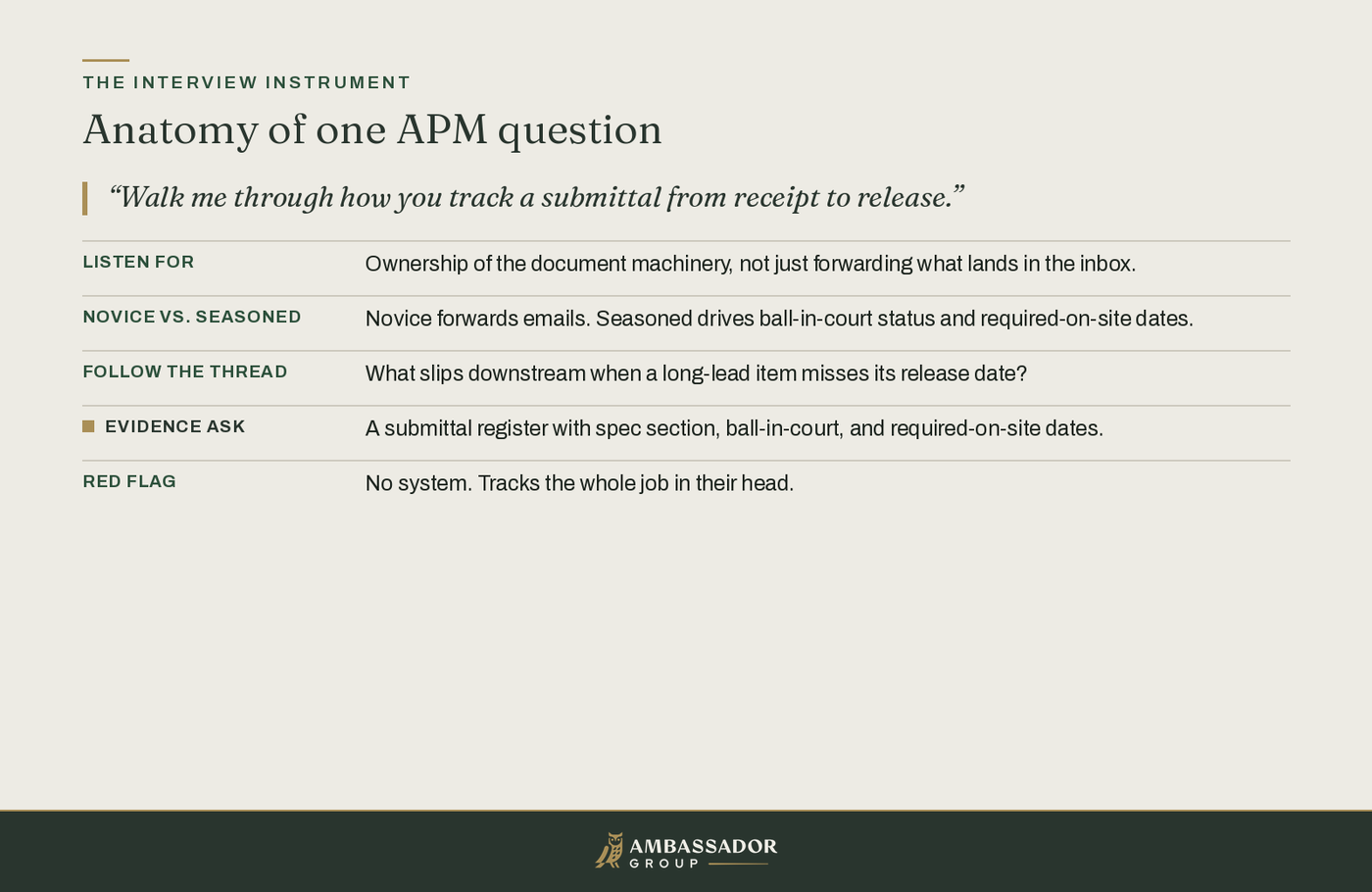
"Walk me through a submittal you knew was going to be a problem before anyone else did."
- What you are listening for: anticipation. A real APM reads a submittal register for long-lead risk, sequencing conflicts, and the item about to sit in the architect's court past the date the field needs it.
- Novice tell vs. seasoned tell: the novice recites the workflow start to finish. The seasoned APM goes straight to the specific item, names why it worried them, and says what they did about it.
- Follow-the-thread: ask how many days of float they thought it would cost and how they knew, who they told, where in the review cycle, and what they would do differently now.
- Evidence ask: their submittal log, redacted. You want spec section, ball-in-court, required-on-site date backed out from the schedule, and revision number, not just a date received.
- Red flag: if they cannot surface one item they worried about, they have been processing paper, not reading it. Disqualifying for the rigor this role requires.
"Tell me about an RFI that got a fast, clean answer, and one that dragged."
- What you are listening for: the difference between an RFI that isolates a question and one that starts a back-and-forth. The good ones name the conflict, attach the right detail and a sketch, and propose a path so the design team answers in one pass.
- Novice tell vs. seasoned tell: the novice talks volume, how many RFIs they pushed. The seasoned APM talks quality, framing the question so the architect could close it without a second round.
- Follow-the-thread: for the slow one, ask what made it drag, the question or the recipient, and how they kept the field from building it wrong while the answer was outstanding.
- Evidence ask: the text of one RFI they are proud of and one that taught them something, redacted, plus how the days-open and cost-impact columns in their RFI log were filled.
Procurement and buyout support
Buyout is where a small miss becomes a six-figure miss. The APM helps the PM turn the estimate into committed subcontracts and purchase orders, and matching scope to the right revision is where the money is protected.
"Describe a buyout where the scope you were tracking did not match what got bought."
- What you are listening for: scope-gap awareness. Did they catch a missing inclusion, a wrong revision, or a quantity that did not tie back to the estimate, before the commitment went out or after?
- Novice tell vs. seasoned tell: the novice describes buyout as collecting quotes and picking the low number. The seasoned APM describes scope leveling, comparing what each subcontractor included against the drawings and specs and finding the gap nobody else saw.
- Follow-the-thread: ask how they caught it, what the miss would have cost, and what they changed in how they level scope after that.
- Evidence ask: a bid tab or scope-comparison sheet showing inclusions and exclusions across bidders, a buyout log tracking committed value against the estimate by cost code, and a long-lead tracking log with release-by dates backed out from need dates.
- Red flag: an APM who has never caught a scope gap either has not done real buyout work or was not reading the documents against the proposals. The same goes for one who tracks long-lead items by memory rather than a log tied to the schedule: switchgear, structural steel, elevators, and long-lead mechanical units surprise the job only when nobody is watching the release dates.
Cost tracking and reporting inputs
The APM feeds the cost machinery: committed costs, the change order log, the inputs that roll up into the PM's monthly cost report and cost-to-complete. Bad inputs, and the PM forecasts the job on numbers that lie.
"Walk me through how a change moves from a field condition to a number in the cost report."
- What you are listening for: command of the full path, from a condition in the field, through the PCO and pricing, to committed cost or an owner change order, and where it usually breaks.
- Novice tell vs. seasoned tell: the novice describes change orders abstractly. The seasoned APM names the failure point: the field change built before the paperwork caught up, the PCO that sat unpriced, the work that was real but uncommitted and ate the contingency.
- Follow-the-thread: ask where changes go sideways, how they keep unapproved work from quietly becoming committed cost, and who they tell when a number moves the wrong way.
- Evidence ask: a change order or PCO log showing status, pricing, owner-approval state, and the tie to a budget line, plus a cost-to-complete worksheet or contingency log where a trend was the story, not just the total.
- Red flag: an APM who cannot connect a field condition to a line in the cost report does not yet understand what their inputs are for. Watch too for one who has only ever reported good news: the role owns input accuracy, and accuracy sometimes means flagging a cost creep or a shrinking contingency the PM hoped was not real, early enough to land as help rather than alarm.
Document control and project setup
The APM owns the document machinery: current sets, the drawing log, revision tracking, project setup at the start. When document control fails, the field builds the wrong thing and no one knows until it is in place.
"How do you set up a job so the field is never building off a superseded drawing?"
- What you are listening for: a setup discipline. The strong APM installs current-set control, a drawing log, and revision tracking at the start, and can tell you how ASIs, bulletins, and RFI-driven revisions get logged and pushed.
- Novice tell vs. seasoned tell: the novice treats document control as filing. The seasoned APM treats the current set as the field's source of truth and confirms the latest revision is the only one in anyone's hands, in Procore or whatever the job runs on.
- Follow-the-thread: ask how they transmit a revision so they know the field is using it, whether they ever caught someone building off an old set, and how they check the as-builts keep pace.
- Evidence ask: a drawing log showing current revision by sheet and transmittal dates, plus the project setup or kickoff checklist they stand up in the first two weeks: contact directory, submittal register seeded from the spec, file structure, procurement log, and cost codes loaded.
- Red flag: an APM who has watched the field build off a superseded drawing and shrugs it off as someone else's mistake does not own the document role. The same goes for one who waits to be told what to set up rather than carrying a kickoff checklist in their head: the setup they skip becomes the PM's fires in month two.
Communication and coordination support
The APM sits between the PM, the field, the subcontractors, and the design team. Most of the value is keeping the right people informed without becoming a bottleneck or a noise machine.
"How do you decide what goes in front of the PM, and what you handle without them?"
- What you are listening for: the escalation instinct that defines this role, the single most repeated judgment an APM makes. When they sit between the PM and a sub who disagree, the strong APM relays accurately, knows what is theirs to resolve versus the PM's, and does not freelance commitments above their authority.
- Novice tell vs. seasoned tell: the novice has no filter, everything is either escalated or buried, or they become a passive message-passer. The seasoned APM has a working rule for what crosses the line, usually cost, schedule, relationship, or safety, and can articulate it.
- Follow-the-thread: ask for something they escalated that mattered and something they sat on that they were right to sit on, whether they ever sat on something they should have raised, and what it taught them about the line.
- Evidence ask: a weekly report or PM update they prepared, a set of OAC or subcontractor meeting minutes, or an action-item log showing how they decided what made the summary versus what stayed in the log.
- Red flag: the APM who escalates everything has not learned to filter, and the one who never escalates has not learned what matters. Either, unaddressed, becomes a problem you manage personally.
Learning posture toward the PM role
A feeder role, so the hire is principally a bet on trajectory. The APM who is curious about why the machinery works the way it does, and who takes correction without flinching, grows into a PM. The one who runs the tasks and stops thinking does not.
"What is something a PM does that you do not yet fully understand, and how are you closing that gap?"
- What you are listening for: self-aware ambition. The strong candidate names a specific PM skill they are reaching for, such as cost forecasting, owner relationships, schedule logic, or risk calls, and shows they are working on it.
- Novice tell vs. seasoned tell: the novice says they want to be a PM but cannot name what that takes. The seasoned APM names a specific capability and says exactly how they are building it.
- Follow-the-thread: ask who is teaching them, what they got wrong recently and changed, and what would tell them they were ready for a PM's responsibility.
- Evidence ask: what they have read, watched, shadowed, or asked for that nobody assigned. The unassigned learning is the signal.
- Red flag: a candidate who frames every past mistake as someone else's fault is not coachable, and an uncoachable APM never becomes a PM worth having.
"Tell me about a piece of correction that stung, and what you did with it."
- What you are listening for: how they handle being wrong. Trajectory toward the PM role runs through the ability to take a hard note and convert it into changed behavior.
- Novice tell vs. seasoned tell: the novice deflects, minimizes, or cannot recall any correction at all. The seasoned candidate tells the story plainly, owns their part, and shows you the behavior that changed.
- Follow-the-thread: ask how they felt in the moment and how they acted, what specifically changed in how they work, and whether the person who gave the note would agree they changed.
What the candidate should be asking you
The interview runs both directions. An APM who never grows here, or who is starved of the mentorship a feeder role demands, is a poor match even if they read every probe above clean. Their questions tell you whether they understand that.
Listen for whether they ask about the PM they will support and how that person teaches, because an APM who asks who they will learn from is thinking about trajectory. Listen for whether they ask what the path to PM looks like here, on what timeline, against what bar, which is not entitlement but the right question for a feeder role. Listen for whether they ask how the company runs the document and cost machinery, because the APM who cares about the system is the one who improves it.
The candidate who asks nothing about growth, mentorship, or the road to PM sees this as a job rather than a step. Answering honestly also makes sure the job fits the candidate as much as the candidate fits the job. The match that lasts is the one where both sides saw clearly.
Do not leave the interview without capturing it
Memory is the enemy of a good hiring decision, and on this role the tells are subtle enough to fade fastest. By the third candidate, the first is a blur and the most recent feels strongest simply because they are recent. The fix is mechanical.
- Write your assessment before you talk to anyone. Each interviewer writes their read against the six accountabilities before the debrief. Written-first feedback kills groupthink: the loudest voice cannot anchor a number already on paper.
- Tally the risk, do not average a vibe. For every gap, decide: fill it with mentorship, engineer around it by pairing this person with a strong PM, or decline because the gap is in the rigor or coachability the role cannot survive without. A gap you did not classify, you rediscover painfully in month three.
- Name what you did not assess. Maybe you never got a real read on how they handle conflict with a difficult subcontractor. Write that down as an open question, not a silent assumption: a column full of did-not-assess tells you what the reference call has to cover.
- Decide against the role, not against the other candidates. The bar is whether this person can run the document and cost machinery with rigor and grow toward PM, not whether they are the best of three who may all be wrong.
This is the same discipline behind Hire in 4K, the working manual that turns a search into a scorecard, a structured interview, and a reference call instead of a gut call. This guide is the field application of it.
Read the candidate, then read yourself
The hardest part of hiring an APM is not finding good questions. It is hearing the answers clearly enough to act on them. A quick read hears a clean process description and checks the box. A more probing approach notices it never touched a single real item, a single real number, a single real mistake. The Seven Levels of Interviewing Mastery is the climb from the first to the second, and it is the variable in this interview you most directly control.
The harder discipline is staying the kind of leader a strong APM wants to be read by. Your bearing determines whether the candidate gives you the real answer or the rehearsed one. To Be the Lightning Rod is to draw out the truth instead of the performance. If you are hiring above this role, the Construction Project Manager interview questions guide reads the role this APM is climbing toward, and the Project Engineer interview questions guide reads the parallel technical track.
A weak APM hire does not announce itself for 90 days, and by then the missed loops are compounding into your cost report and your schedule. The interview is the cheapest place you will ever catch it. The candidate will show you who they are. Whether you see it is the only question that was yours to answer.
The short version.
- What should I focus on when interviewing an assistant project manager?
- The three areas where the role breaks: rigor and follow-through on submittals, RFIs, and buyout; escalation judgment, knowing which two of a hundred weekly issues belong in front of the PM; and trajectory, whether the person grows toward the PM role and takes correction without flinching. If a question does not help predict behavior at one of those breaking points, it is conversation, not assessment.
- What does an assistant project manager own on a construction project?
- Where the project manager owns the budget, the schedule, and the owner relationship, the APM owns the document and cost machinery that feeds all three: submittals and RFI management, procurement and buyout support, cost tracking and reporting inputs, document control and project setup, and coordination support between the PM, the field, subs, and the design team.
- How can I tell a seasoned APM answer from a rehearsed one?
- The novice recites workflow; the seasoned APM goes straight to a specific item with real numbers and a real mistake. Ask for a submittal they knew would be a problem before anyone else did: the strong candidate names the item, why it worried them, and what they did, while the weak one describes the process start to finish without touching a single real example.
- What evidence should I ask an APM candidate to bring?
- Redacted work product: a submittal log with spec section, ball-in-court, and required-on-site dates backed out from the schedule; an RFI they are proud of and one that taught them something; a bid tab or scope-comparison sheet; a change order log showing status and budget ties; and a drawing log with current revisions and transmittal dates. The artifacts show whether they read their logs or just maintain them.
- How should the interview team capture feedback on APM candidates?
- Each interviewer writes their assessment against the six accountabilities before the debrief, because written-first feedback kills groupthink and the loudest voice cannot anchor a number already on paper. Then classify every gap as fill with mentorship, engineer around, or decline; name what you did not assess so the reference call can cover it; and decide against the role, not against the other candidates.


