
A scope gap the size of a fire-sprinkler system does not announce itself on bid day. It hides in the white space between two drawing sheets, gets carried into the number at zero dollars, and surfaces 9 months later as a change order the owner refuses to sign. The estimator who priced that job is rarely the one who catches the miss in the interview. The interviewer is. Most of the value in any set of construction estimator interview questions sits on your side of the table, not the candidate's. A strong estimator gets read by a sharp interviewer and missed by a dull one. The discipline of listening through these questions belongs to you.
I have watched two interviewers run the same candidate an hour apart and reach opposite verdicts. The candidate did not change. The reading did. Hiring an estimator is an underwriting decision: you are pricing a person against an uncertain future, the same way the estimator prices a building against incomplete documents. If you cannot sit inside ambiguity and qualify what you do not know, you will struggle to read someone whose whole job is doing exactly that. Hire in 4K makes the case that resolution is something the interviewer supplies. This guide raises yours for one role.
Interview to the 3 places this role breaks down
An estimator does not fail on arithmetic. Spreadsheets add correctly. The role breaks down in 3 specific places, and every probe that follows is derived from one of them.
The first is judgment under incomplete documents. Bid sets are never finished. The estimator who treats a 60-percent design set as if it were 100 percent is pricing a fantasy. The one who refuses to price anything until everything resolves never gets a number out the door. The hire works the narrow band between those two failures: pricing the unknown, then qualifying the risk in writing so the company knows exactly what it bought.
The second is scope coverage. Every line of work either lands in someone's number or in the gap between numbers, and the gap is where margin dies. A missed scope is a reading failure, the failure to walk the documents the way a framer walks a wall hunting the stud that is not there. The cost stays invisible until operations finds it.
The third is sub coverage and leveling under bid-day pressure. The number is only as good as the subs standing behind it, and on bid day half of them come in late, incomplete, or carrying scope you never asked them to carry. Bringing two unlike bids onto common ground while the clock runs and a sub tries to slip an exclusion past you is the moment the role is truly tested.
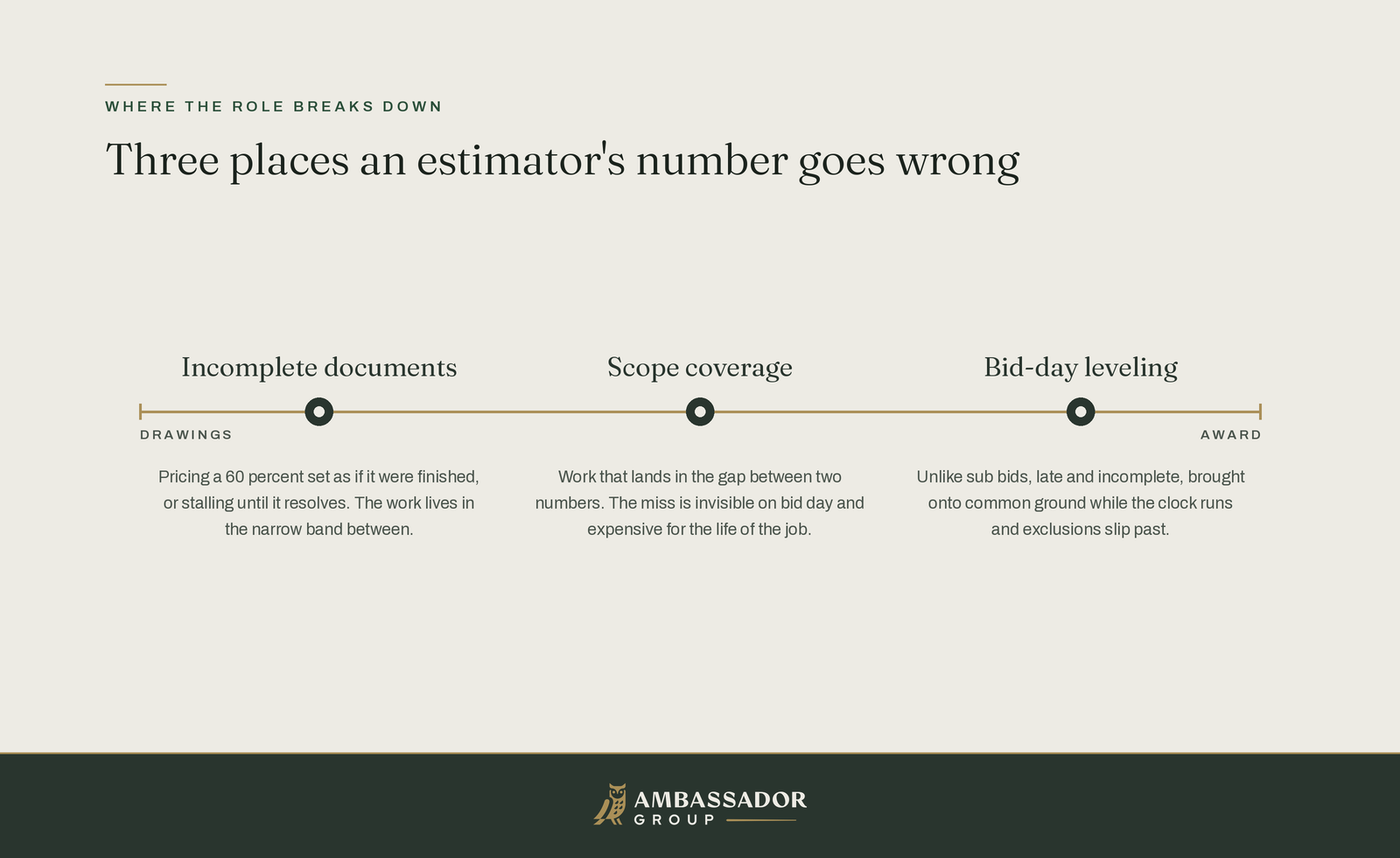
Read for these three. Everything else is secondary.
The accountabilities this guide measures against
Six accountabilities define the role. Each gets its own section below, with instrumented probes underneath.
- Quantity takeoff and pricing accuracy
- Scope coverage and gap identification
- Subcontractor solicitation and bid leveling
- Risk, qualifications, and assumptions
- Bid assembly and strategy
- Handoff from preconstruction to operations
The probes are few and deep on purpose. A short list you know how to read beats a long list you read shallowly. Seven Levels of Interviewing Mastery lays out why the depth of the listening, not the count of the questions, separates a real interview from an interrogation.
Quantity takeoff and pricing accuracy
This is the floor of the role. Anyone can pull quantities. The question is whether the candidate knows when the quantity is the easy part and the unit price is the trap.
Walk me through a takeoff where your quantities were right but your number was still wrong.
- What you are listening for: the separation of quantity from cost. A seasoned estimator knows that 4,000 yards of concrete is a fact, and that the price of placing it in a downtown core with a single pump and a night pour is a judgment. The story should land on the judgment.
- Novice tell vs. seasoned tell: the novice describes a formula error or a units mistake and treats the lesson as proofread more carefully. The seasoned estimator describes a productivity assumption, a crew size, an access constraint, or a market condition the quantity could not see.
- Follow the thread: if they cite a labor productivity miss, ask how they set the rate now and what they cross-check it against. If they blame a supplier price, ask whether they had locked it or assumed it.
- Evidence ask: a takeoff workbook from a real bid, with the quantity columns and the unit-price build-up both visible. Ask them to show where a unit price came from, not where a quantity came from.
- Red flag: an estimator who cannot name a single time their number was wrong has either never owned a number or cannot look at their own losses. Both disqualify a candidate for a role defined by owning the number.
How do you price a scope when the drawings show a detail one way and the specifications call it another?
- What you are listening for: a default behavior under contradiction. Drawings and specifications disagree constantly. I want to hear whether the candidate prices the more expensive condition, prices the cheaper one and qualifies it, or stops and writes a request for information. There is no single right answer. There is a right reasoning.
- Novice tell vs. seasoned tell: the novice picks one and moves on without a trace. The seasoned estimator tells you which they priced, why, and where they wrote it down so the contradiction travels with the bid instead of disappearing into it.
- Follow the thread: ask what they do when there is no time to resolve it before the bid, and how they decide between pricing high and qualifying low.
- Evidence ask: an RFI log or a bid-day assumptions sheet showing a real document conflict they flagged and how they carried it into the number.
Scope coverage and gap identification
This is where margin is won or lost before a shovel moves. The gap is invisible on bid day and expensive forever after.
Tell me about a scope you missed and what it cost.
- What you are listening for: ownership without flinching, and a system that came out of the miss. Every honest estimator has missed a scope. The tell is what changed afterward.
- Novice tell vs. seasoned tell: the novice describes the miss as bad luck, an architect's fault, a sub who should have caught it. The seasoned estimator describes the miss as theirs, then describes the checklist line, the bid-form change, or the trade-by-trade review step that exists now because of it.
- Follow the thread: ask where in the documents the missed scope was hiding, whether in a general note, on a civil sheet, or in a specification division they did not open. Ask what their coverage looks like for the trades that fall between two subs, like flashing, blocking, or final clean.
- Evidence ask: a scope checklist or trade-coverage matrix they use, not one they could describe. Ask whether it is a living document or a form they inherited.
- Red flag: a candidate who claims they have never missed a scope. They are either inexperienced or unwilling to audit themselves, and the role depends on the audit.
How do you make sure every trade is covered when no single sub owns the whole building?
- What you are listening for: a coverage method rather than a hope. The dangerous scopes are the orphan scopes, the work every trade assumes someone else is carrying. I want to hear how the candidate hunts the orphans.
- Novice tell vs. seasoned tell: the novice covers the obvious divisions and trusts the subs to flag what is theirs. The seasoned estimator walks the building system by system and names the seams where two trades meet and neither claims the joint.
- Follow the thread: ask them to name 3 scopes that commonly fall into the gap on the project type you build. If they cannot, the coverage instinct is not there. Ask how they handle a sub who excludes a scope at the last minute that they assumed was carried.
- Evidence ask: a completed bid tab showing scope-by-scope coverage with the exclusions column filled in, so you can see whether the gaps were tracked or merely hoped away.
Subcontractor solicitation and bid leveling
The number rests on the subs. Leveling under pressure is the discipline that separates an estimator from a spreadsheet operator.
Two electrical bids come in 22 percent apart an hour before the deadline. Walk me through the next 60 minutes.
- What you are listening for: a leveling instinct that treats the spread as information, not noise. A 22-percent gap means one sub is missing scope, carrying a different alternate, or quoting a different drawing set. The candidate should want to know which before they touch the number.
- Novice tell vs. seasoned tell: the novice takes the low number because it helps the bid, or splits the difference. The seasoned estimator calls the low bidder first to find what they left out, because a low number that wins the job on a missed scope loses the margin during the build.
- Follow the thread: ask what they do if they cannot reach the low bidder before the deadline, and how they decide between carrying the low number with a qualification or carrying a higher number they trust. Ask what they would tell the project executive about the risk they just took.
- Evidence ask: a bid-leveling spreadsheet or sub comparison from a real bid day, with the line-by-line normalization visible, where they brought two unlike bids onto common ground.
- Red flag: an estimator who reflexively takes the low number to make the bid more competitive, with no instinct to verify coverage first, is carrying the company's risk without seeing it.
How do you get real coverage on a hard-to-bid trade when only one sub will quote it?
- What you are listening for: resourcefulness and risk-naming. Single-source coverage is a real condition in tight markets and on specialty scopes. I want to hear whether the candidate builds a competing check, prices the scope themselves, or names the exposure to leadership.
- Novice tell vs. seasoned tell: the novice carries the one number and says nothing. The seasoned estimator builds a self-perform check estimate, pulls historical unit cost, or calls a relationship in another market, then flags that the scope sits on a single quote.
- Follow the thread: ask how they price a scope with zero sub interest, and what they do when the single sub knows they are the only quote available and prices accordingly.
- Evidence ask: a historical unit-cost database or a self-perform check estimate they keep for exactly this situation.
Risk, qualifications, and assumptions
This is the role's accountability for telling the truth. The qualifications page is where an estimator states plainly what the number does and does not include.
Show me how you write the assumptions and qualifications that go out with a bid.
- What you are listening for: precision as a habit. The qualifications page is the most underread and most important document in a bid. A vague qualification protects no one. A precise one is the difference between a clean change order and a fight.
- Novice tell vs. seasoned tell: the novice treats qualifications as boilerplate copied from the last bid. The seasoned estimator writes them fresh to the gaps in the specific set, naming the drawing date priced, the alternates carried, the allowances included, and the scopes explicitly excluded.
- Follow the thread: ask for a qualification they wrote that later protected the company on a change order, and for one that was too vague and cost them. Ask how they decide what rises to a written assumption versus an internal note.
- Evidence ask: an actual qualifications and assumptions page from a submitted bid. Read it for specificity. Generic language is the tell.
- Red flag: a candidate who does not write qualifications, or who treats them as the estimating manager's job, does not understand that the qualifications page is where the number gets honest.
How do you price a known unknown, like undocumented soil conditions or a long-lead item with a volatile price?
- What you are listening for: a method for carrying risk in the number rather than pretending it away. The role is defined by pricing the unknown. I want to hear allowances, contingencies, escalation logic, and where they draw the line between estimating the risk and qualifying it out.
- Novice tell vs. seasoned tell: the novice ignores the risk or pads the whole number to cover it, which makes the bid uncompetitive and hides the exposure. The seasoned estimator isolates the risk, prices it as a named allowance or contingency, and makes the carry visible to leadership.
- Follow the thread: ask how they set an escalation rate on steel or switchgear today, and how they decide between an allowance and an exclusion. Ask what they do when leadership wants to strip the contingency to win the job.
- Evidence ask: an estimate showing named allowances and contingency lines with the basis written next to each, so you can see whether the risk was reasoned or guessed.
Bid assembly and strategy
Assembly is where the estimate becomes a bid. General conditions, markup, and the final strategic call live here, and so does the candidate's relationship with the people above them.
Walk me through how you build general conditions and decide on markup for a bid.
- What you are listening for: the join between detail and judgment. General conditions are a detailed buildout, project duration times monthly cost. Markup is a strategic read on the market, the competition, and the company's appetite for the work. A strong estimator does both and keeps them separate.
- Novice tell vs. seasoned tell: the novice applies a standard percentage to everything and calls it done. The seasoned estimator builds general conditions from the schedule and staffing plan, then treats markup as a deliberate recommendation rather than a default.
- Follow the thread: ask how their general conditions change on a fast-track schedule, and who owns the final markup call. Ask about a bid where they argued for a different number than the one leadership wanted.
- Evidence ask: a general conditions estimate built line by line, and a bid summary sheet showing how the final number assembled from direct cost, general conditions, and markup.
Tell me about a bid you recommended walking away from.
- What you are listening for: strategic spine. An estimator who has never recommended a no-bid either has not been trusted with the judgment or does not exercise it. The strongest estimators protect the company from the wrong work as actively as they pursue the right work.
- Novice tell vs. seasoned tell: the novice bids everything because bidding is the job. The seasoned estimator can name a project they steered the company away from, on scope risk, schedule risk, a bad owner, or a fee that did not cover the exposure, and can explain the reasoning to leadership.
- Follow the thread: ask what signal made them want to walk, how they made the case, and what happened when they were overruled.
- Evidence ask: a go/no-go memo or bid-or-no-bid analysis, showing the factors they weighed and the recommendation they made.
Handoff from preconstruction to operations
The estimate is not finished when the bid is submitted. It is finished when the project team can build from it without re-estimating the job. The handoff is where a good number becomes a buildable budget, or becomes a fight.
How do you hand a winning bid to the project team so they can build from it?
- What you are listening for: an understanding that the estimator owes operations a usable budget, not a pile of spreadsheets. The buyout targets, the assumptions, the carried risks, and the leveling logic all have to survive the handoff, or the project starts blind.
- Novice tell vs. seasoned tell: the novice emails the spreadsheet and moves to the next bid. The seasoned estimator runs a turnover meeting, walks the project manager through the assumptions and the exposures, and stays available when buyout reveals what the estimate assumed.
- Follow the thread: ask what they include in a turnover package, and how they handle it when the project manager finds the estimate was light on a scope. Ask whether operations trusts their numbers, and how they know.
- Evidence ask: a turnover or handoff package, or a buyout log, showing how the estimate was translated into a budget the field could use.
- Red flag: an estimator who considers the job done at submission, and treats the gap between estimate and buyout as someone else's problem, will leave operations to absorb every assumption they never wrote down.
What the candidate should be asking you
The interview runs in both directions, and the questions a candidate asks are as diagnostic as the answers they give. The match has to fit the estimator as much as the estimator fits the role, and a strong one is reading you for whether this is a place their judgment gets trusted or second-guessed.
Listen for whether they ask how bid decisions get made and who owns the final markup. An estimator who asks this is checking whether they will be a number-builder or a trusted advisor, and the answer tells them how much of the role is real. Listen for whether they ask what happens when a job they priced loses money. A company that hunts for someone to blame trains its estimators to pad and hide; a company that runs an honest post-mortem trains them to learn. Listen for whether they ask if the field respects the estimate or works around it. That question comes from someone who has been burned by a handoff.
A candidate who asks nothing about how the company treats a loss, or how decisions get made above them, is either not thinking about the role seriously or has decided the answer does not matter. The estimators worth hiring are underwriting you while you underwrite them.
Do not leave the interview without capturing it
The reading decays the moment the candidate walks out, and it decays fastest right before the debrief, when other people's impressions start to overwrite your own.
Write your feedback before you talk to anyone. The debrief contaminates by design: the loudest voice in the debrief reshapes everyone else's memory. Capture your own read first, in writing, with the specific moments that moved you, so you are defending evidence rather than a feeling.
Tally the risk honestly. For every gap you found, decide which of 3 things you will do with it: fill it through onboarding and mentorship, engineer around it by pairing the estimator with a strength elsewhere on the team, or pass on the candidate because the gap sits on the core of the role. A missing scope-coverage instinct is a core gap. A thin general-conditions habit is a fillable one. Name which is which.
Name what you did not assess. No single interview covers all 6 accountabilities at depth. Write down the ones you did not reach, so the next conversation targets them instead of re-running ground you already covered.
And decide against the role, not against the other candidates. The comparison that matters is the candidate against the real demands of the work, not against the people who happened to apply this month. Hire in 4K is built around this discipline: a clear-resolution picture of one person against the job, captured before the noise sets in.
Raise your own reading
The questions on this page are fixed. What you hear through them is not. Two interviewers will run these exact probes and walk away with different candidates, because the instrument is only as good as the hand that holds it. The estimator prices the building the documents do not fully describe. Your job in the interview is the same discipline pointed at a person: read what is there, qualify what is not, and own the number you carry out. Be the Lightning Rod is the posture that gets a candidate to show you their real reasoning instead of their rehearsed answers, and it turns a list of questions into a reading. If this role sits above an estimating department rather than inside one, the same discipline scales up through the Senior Estimator and Preconstruction Manager conversations.
What you draw out of a candidate depends on the questions you bring and how closely you listen.
The short version.
- What should construction estimator interview questions test for?
- The three points where the role breaks down: judgment under incomplete documents, scope coverage, and subcontractor coverage with bid leveling under pressure. Estimators do not fail on arithmetic, spreadsheets add correctly, so probe how they price the unknown, hunt scope gaps, and level unlike sub bids.
- What is a red flag when interviewing an estimator?
- A candidate who cannot name a time their number was wrong, or who claims they have never missed a scope. They are either inexperienced or unwilling to audit themselves, and the role depends on that audit; reflexively taking the low sub bid without verifying coverage is another disqualifier.
- How should an estimator handle two sub bids that are 22 percent apart?
- By treating the spread as information, not noise. A gap that size means one sub is missing scope, carrying a different alternate, or quoting a different drawing set, so the seasoned move is calling the low bidder first to find what they left out; a low number that wins on a missed scope loses the margin during the build.
- What evidence should I ask an estimator candidate to show?
- Real artifacts from real bids: a takeoff workbook with the unit-price build-up visible, a living scope checklist or trade-coverage matrix, a bid-leveling spreadsheet with line-by-line normalization, a qualifications page you can read for specificity, a go/no-go memo, and a turnover package operations could build from.
- What should interviewers do immediately after an estimator interview?
- Write your feedback before talking to anyone, because the debrief contaminates: the loudest voice reshapes everyone's memory. Then tally each gap as fillable, engineerable around, or disqualifying, name the accountabilities you never assessed, and decide the candidate against the real demands of the role rather than against whoever else applied this month.


