
Most of the conversation about hiring a Director of Construction gets the variable wrong. People debate the candidate: the resume, the square footage, the logo history. The quality of this hire sits mostly on the other side of the table, with the person asking the questions. A strong Director can be read by a sharp interviewer and missed entirely by a dull one. I have watched a capable function-builder walk out of one interview as a no and a weaker operator walk out of the next as a yes, and the candidates were not the reason. Leaders who cannot see themselves clearly cannot see this candidate clearly. That is why most director of construction interview questions fail: they are written to be answered, not to be read.
The questions below are instruments. The discipline of using them belongs to you. Hire on charisma and you spend the next 18 months learning that the person who ran great jobs cannot build the system that runs great jobs.
What this role is, and what it is not
A Director of Construction owns the construction and operations function across the whole company: the standards, the staffing model, the process, the development of field and PM leadership, and often an operational P&L. This is a function-builder, not a single-portfolio operator.
That distinction is the whole interview. A Project Executive owns a book of jobs and answers for their margin. A VP of Construction sits higher, on strategy and the executive team. The Director sits in the middle and builds the machine: the clean job three years from now exists because the Director built the standard, the bench, and the accountability behind it. Interview a Director like a Project Executive and you hire an operator who cannot reproduce themselves, which is the one thing this role exists to do.
Interview to the 3 places this role breaks
A Project Executive who stumbles loses a job or a margin point. A Director who stumbles loses the system, and the failure shows up everywhere at once, six months after the mistake. This role breaks in 3 places, and the interview has to be built around them.
It breaks at the operating system. The hardest thing this person does is build standards, a staffing model, and a process that scale past their personal involvement. Most strong operators are personally excellent and have never made excellence reproducible.
It breaks at leadership at the org level. A Director develops field and PM leadership across the whole company, on a cadence, with a bench behind them. The operator who can only develop people who remind them of their younger self does not scale.
It breaks at owning outcomes without holding the wheel. This person owns operational results and often a P&L without managing every job. Get it wrong one way and they micromanage the org into depending on them. Get it wrong the other and they preside over a slow margin fade they never saw coming.
Every probe below comes out of one of these 3 fracture lines. The structure borrows from Hire in 4K: you are not collecting answers, you are resolving the candidate into high enough definition that the cracks show before they cost you.
The 6 accountabilities
This role carries 6 core accountabilities. The sections below turn each into a small number of instrumented probes. A handful of questions you can read beats a hundred you cannot.
- Operational standards and systems
- Staffing and leadership development
- Operational P&L and risk
- Process and technology for delivery
- Executive and ownership alignment
- Culture and accountability across operations
Operational standards and systems
The load-bearing wall of the role. A Director who cannot codify how the company builds spends the tenure as the most expensive project manager on the payroll.
Walk me through a standard you built that the company still runs without you in the interview.
- What you are listening for: A specific artifact, not a philosophy. They name the standard, why it existed, who resisted it, and how they know it is still alive.
- Novice tell vs. seasoned tell: The novice enforces a standard by personally checking. The seasoned operator describes one others now enforce on each other, and names the moment someone below them corrected a peer unprompted.
- Follow the thread: Ask what it replaced, who fought it, and how it survived their last vacation.
- Evidence ask: The actual document. A project-startup checklist, a quality-milestone inspection template, a preconstruction-to-operations handoff protocol, or a closeout and warranty-turnover standard a superintendent could follow without them present.
- Red flag: The standard lives only in their head. If "where is it written" gets "I know it when I see it," they are the system, and you can only borrow a system until it leaves.
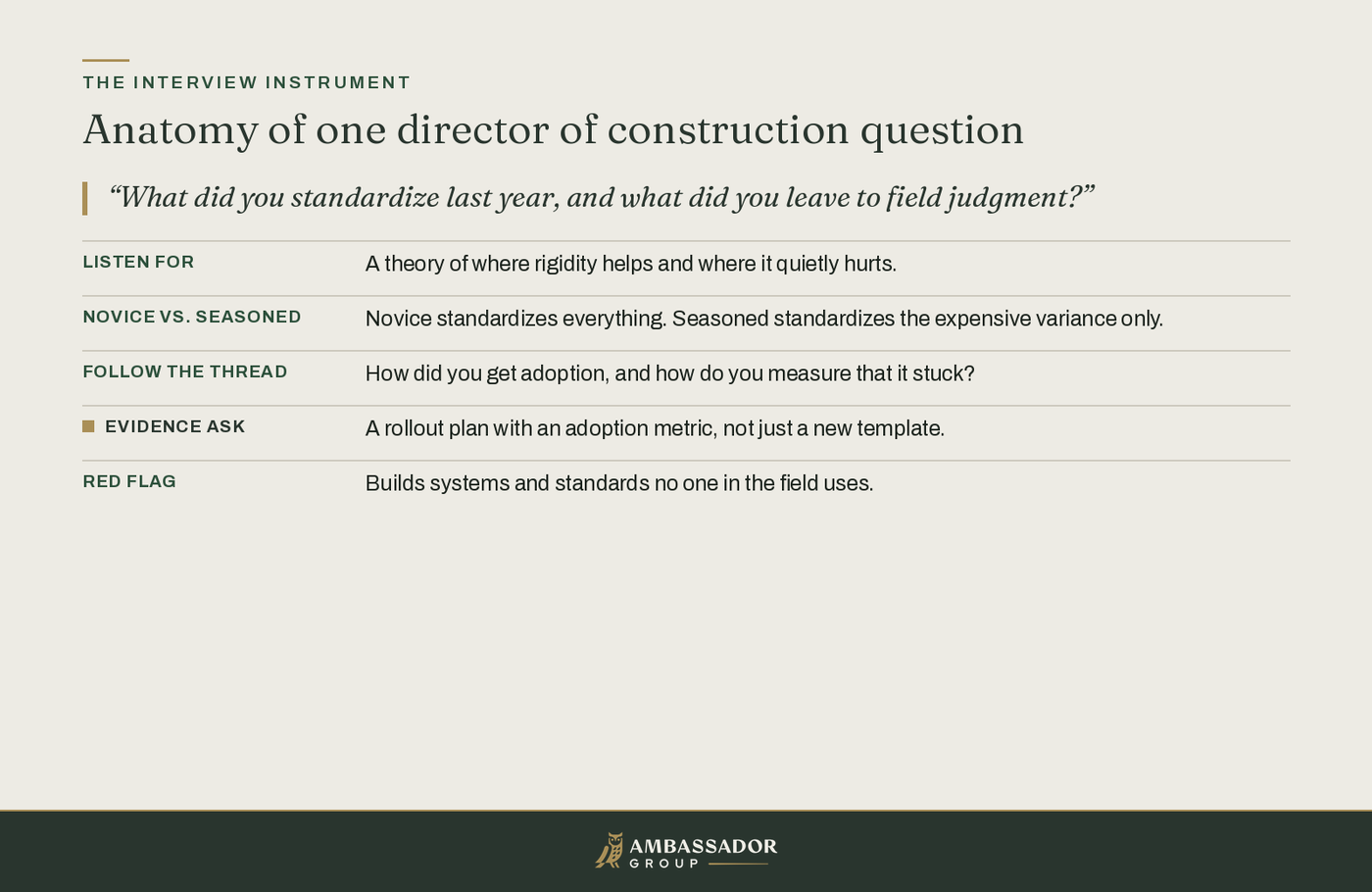
How do you decide what to standardize and what to leave to judgment in the field?
- What you are listening for: A theory of where rigidity helps and where it hurts. Good Directors standardize what is expensive when it varies and leave room where field conditions demand it.
- Novice tell vs. seasoned tell: The novice standardizes everything, strangling their best supers, or nothing, leaving no system. The seasoned operator locks down precisely where variance is most dangerous: safety, money handling, change-order discipline, quality gates, closeout.
- Follow the thread: Ask for one thing they left to field judgment, and one thing they later mandated after it bit them.
- Evidence ask: A delivery-process map or a decision-rights matrix (a RACI or delegation-of-authority schedule) showing what is mandated versus delegated, and where buyout and change-order thresholds sit.
- Red flag: They cannot name one thing left to field judgment. A Director who signs off on everything runs a function that stops the day they board a plane.
Staffing and leadership development
A Director is judged less on the people they manage than on the people their people become. This accountability compounds over years.
Tell me about a superintendent or PM you developed who was not obviously going to make it.
- What you are listening for: Evidence they can build leaders who do not already look finished: a real read of the weakness, a specific intervention, and an honest account of how it turned out.
- Novice tell vs. seasoned tell: The novice names a natural talent they got out of the way of. The seasoned developer names the exact gap (cannot hold a sub accountable, drowns in field detail and loses the schedule, freezes when the job slips) and the reps they ran that person through.
- Follow the thread: Ask how they diagnosed the gap before intervening, what did not work, and where that person is now.
- Evidence ask: A written development plan or coaching cadence they ran, gap named and milestones dated. Not a canned annual-review form, a real plan for a real person.
- Red flag: Every development story is a promotion story with no friction. Real development is mostly the hard middle. Remember only the wins and you watched those careers rather than building them.
What does your staffing model look like when you have more work than people?
- What you are listening for: A structured way of thinking about capacity, not heroics: which jobs get the strong supers, how the bench is protected, and when they tell ownership a job cannot be staffed without breaking someone.
- Novice tell vs. seasoned tell: The novice spreads their best people thinner. The seasoned Director protects A players from burnout and treats "we cannot staff this one well" as a real answer the company sometimes has to give.
- Follow the thread: Ask about a time they told ownership a job could not be staffed properly, and what happened the time they did not.
- Evidence ask: A staffing matrix or capacity plan mapping named supers and PMs to projects across a season, with the bench and the planned gaps visible, not a headcount number.
- Red flag: The model is "we find a way." A Director with no written view of who is on what is staffing by memory, and memory fails first when the backlog grows faster than the bench.
Operational P&L and risk
This is where the role separates from a senior project role. The Director owns the number across the portfolio without touching every job that produces it.
How do you know a job is going sideways before the numbers tell you?
- What you are listening for: Leading indicators, not lagging ones. The good Director reads the early signals: a super who stops returning calls, RFIs piling up, a three-week look-ahead that quietly stopped updating, a sub asking for money ahead of the work.
- Novice tell vs. seasoned tell: The novice watches the monthly cost-to-complete. The seasoned operator names their early tells without thinking, because each one cost them once.
- Follow the thread: Ask for the earliest signal they trust, a time the numbers looked fine and their read did not and they were right, and a time their read was wrong.
- Evidence ask: A monthly project-review format or portfolio dashboard tracking leading indicators across jobs: schedule variance, RFI aging, and pending change-order exposure, beyond cost-to-complete and billings.
- Red flag: Their entire risk read is the financial report. A Director whose only instrument is the lagging number owns every loss after it locks in, and calls it a bad market.
Walk me through a margin fade you owned across the portfolio and what you changed because of it.
- What you are listening for: Ownership of a systemic loss, not one bad job. The answer traces the fade to a pattern, names the structural cause, and describes the change that stopped it recurring.
- Novice tell vs. seasoned tell: The novice blames the outside: a soft market, a difficult client, a bad estimate handed down. The seasoned operator finds their own fingerprints on it even when the external cause was real.
- Follow the thread: Ask whether it was one job or a pattern, what in the estimating-to-operations handoff let it through, and how they would catch it 60 days earlier now.
- Evidence ask: A buyout-to-closeout margin analysis, a fade tracker, or a lessons-learned writeup that changed the estimate handoff or the buyout process, with the change adopted on the next jobs.
- Red flag: Every fade belongs to someone upstream. A Director who has never found a fade that traced back to their own system has never looked hard at the portfolio they owned.
Process and technology for delivery
The Director owns how the work moves, not only whether it gets done. The process and the tools that carry it (the project management platform, the scheduling system, the field reporting) are theirs to build, choose, and retire.
Tell me about a process or system you rolled out across the field, and what adoption looked like.
- What you are listening for: A realistic account of change in a field organization, where good ideas die of low adoption. The honest answer carries the resistance, the months of half-use, and what made the new way stick.
- Novice tell vs. seasoned tell: The novice describes a launch event: training happened, the platform went live, done. The seasoned operator describes the long tail, the supers who kept their own spreadsheet, and the thing that finally turned them.
- Follow the thread: Ask what share of the field used it 6 months in, who the holdouts were, and about a tool they killed because adoption never came.
- Evidence ask: A rollout plan with an adoption metric attached (logins, percent of jobs on the new system, daily-log compliance), or a retrospective on a tool that did or did not take.
- Red flag: Every rollout was a clean success. Field adoption is never clean. A Director who remembers only frictionless launches has either never owned one or never measured one.
When you joined a company with a broken delivery process, what did you fix first, and how did you sequence the rest?
- What you are listening for: Triage judgment. A broken function has 20 things wrong with it. The good Director fixes the one that is bleeding, stabilizes, and sequences the rest.
- Novice tell vs. seasoned tell: The novice fixes everything at once and swamps an organization already underwater. The seasoned operator stops the bleeding, earns credibility with one visible win, then spends it on the harder structural fixes.
- Follow the thread: Ask what they left broken at first and why, how they decided the sequence, and what they would order differently now.
- Evidence ask: A 90-day or first-year operating plan from a prior role, showing what they tackled in what order and what they deliberately deferred.
- Red flag: The sequence is "I fixed it all." A Director who cannot name what they left broken on purpose does not understand that a field organization absorbs only so much change at once.
Executive and ownership alignment
A Director sits between the field and the ownership of the company. Misalignment here is quiet and expensive, because both sides assume they agree until a job or a number proves they did not.
Tell me about a time you and ownership disagreed about how to run the construction function.
- What you are listening for: The ability to hold a position with the people who sign their check in a way that builds the relationship rather than spending it down.
- Novice tell vs. seasoned tell: The novice folded and resents it, or fought to win and burned trust. The seasoned operator made the case in terms ownership cared about (money, risk, reputation) and either moved them or understood why they chose differently.
- Follow the thread: Ask what the disagreement would have cost if they lost it, how they raised it without putting the owner on the defensive, and what they do when overruled on a call they believe is wrong.
- Evidence ask: This one resists documentation, so ask for the story in full and a reference who watched it happen. The texture of how they describe managing up is the evidence.
- Red flag: They have never disagreed with ownership, or describe every owner as an obstacle. The first is a yes-person, dangerous in a Director. The second cannot operate inside the constraint that an owner exists, which is fatal here.
How do you translate field reality up to ownership without either sugarcoating it or setting off alarms?
- What you are listening for: A communication discipline. The good Director knows the difference between a problem they are handling and one that needs the owner's hand.
- Novice tell vs. seasoned tell: The novice floods ownership with every fire, training them to panic, or hides problems until they explode. The seasoned operator runs a cadence, escalates on a clear threshold, and ownership trusts their read.
- Follow the thread: Ask what their standing report to ownership looks like and how often it runs, and for the last problem they escalated versus the last one they handled without escalating.
- Evidence ask: A monthly operations report or executive dashboard they used, surfacing portfolio risk on a regular cadence rather than only when a job is already on fire.
- Red flag: No cadence, only crisis updates. A Director who reaches ownership only when something is burning has trained the owners to read silence as safety, so the first real signal is the fire.
Culture and accountability across operations
The Director sets the temperature of the construction organization. Accountability that holds when they are watching is supervision. Accountability that holds when they are not is culture, and culture is the deliverable here.
How do you hold a superintendent accountable for a standard when you were not on the job to see the miss?
- What you are listening for: A model of accountability that scales past line of sight, the only kind that matters in this role. It balances clear expectations, visible consequences, and the relationship that makes a hard conversation land.
- Novice tell vs. seasoned tell: The novice catches misses by being there. The seasoned operator builds accountability into the system, so the miss surfaces on its own, and into the relationship, so the conversation makes the person better rather than defensive.
- Follow the thread: Ask about the hardest accountability conversation they have had with a strong performer, a standard they let slide and what it cost, and how they handle a respected veteran who quietly stopped meeting the bar.
- Evidence ask: This one resists a document, so press on the specific conversation: what they said, how the person took it, what changed. The detail tells you whether it happened or got rehearsed.
- Red flag: Accountability and being liked are in conflict for them, and they choose being liked. A Director who cannot hold a strong performer to a standard lets the best people set the floor, and the floor sinks.
What did the last field organization you ran say it was like to work for you, in their words, not yours?
- What you are listening for: Self-awareness about the culture they create, set against the one they intend. The revealing answer describes how the field would honestly describe working for them, including the parts that do not flatter.
- Novice tell vs. seasoned tell: The novice describes the culture they wanted. The seasoned operator describes the one they got, names the gap, and owns their part in it. That gap is where this whole hire lives.
- Follow the thread: Ask what their field would say frustrated them, and what working for them was like on the best day and the worst.
- Evidence ask: An engagement survey, a 360 review, or named references from people who reported to them. The willingness to offer up-the-chain and down-the-chain references says as much as the references do.
- Red flag: The answer is the culture they wanted, delivered as fact, with no gap in it. A Director who cannot name one thing the field found hard about working for them has never asked.
What they should be asking you
The interview runs both ways, and a Director worth hiring is reading your company as hard as you are reading them. A strong operator is deciding whether your role is one they can win in. If only one side is being evaluated, the other is being sold, and a candidate you sold leaves the first time the job gets hard. Listen for what they ask. The questions reveal more than the answers.
- They ask about authority and decision rights. A serious Director wants to know what they own before they say yes: hiring and firing in the field, buyout approval, the line where their call ends and ownership's begins. A candidate who does not ask has either never run a real function or does not plan to.
- They ask about the gap between the org chart and reality. Strong operators know the drawn reporting lines and the real ones differ. When they probe who decides staffing, money, and standards today, they are checking whether the role has teeth or only a title.
- They ask why the role is open. The Director who asks what happened to the last person, or why the function needs building now, is running their own diligence. They are underwriting you, which is the instinct you want in someone who will underwrite your jobs.
- They ask about ownership's tolerance for change. A function-builder needs to know how much rope they have. When they ask how much process pain ownership will absorb to get a system, they understand what the job requires.
A candidate content to be evaluated and never evaluating back is telling you something. A Director who will not probe you will not probe a job going sideways either. For the deeper mechanics, Seven Levels of Interviewing Mastery is the longer treatment: the candidate's questions are a window into how they will run your function, and most interviewers waste the view by talking instead of watching.
Capture the interview before you debrief
The worst move after a real interview is walking into the group debrief with nothing written down. Memory launders the interview. By the time you are in the interview with the team, the sharp impression has softened into a vibe, and the vibe is wrong as often as it is right. Capture it first, alone.
- Write your verdict before you hear anyone else's. The first opinion spoken anchors the debrief, and a strong voice pulls a weaker read along. Write your call down before the conversation contaminates it, then bring the written version, not the remembered one.
- Tally the risk, then decide what to do with it. Every candidate has a gap. The question is what you do with the one you found: fill it with a hire below them or a peer, engineer around it by reshaping the role, or walk away because the gap is in the load-bearing wall and cannot be propped.
- Name what you did not test. You did not cover everything. Write down what you still do not know, so the next round or the references can close it. The interview that pretends it covered everything misses the thing that matters.
- Decide against the role, not against the other candidates. The trap is grading on a curve: this one is best of the three, so this one wins. Wrong frame. The question is whether this person clears the bar this role requires. The best of a weak field is still a bad hire, and if no one clears it, that is an answer too.
Hire in 4K is the discipline for this part: resolving the candidate into high enough definition that you decide on evidence, not impression. The capture step is where that definition either holds or blurs.
The instrument is only as good as the hand that holds it
A questionnaire does not hire a Director of Construction. A leader does. Every probe in this guide can be read well or wasted, and the difference is never the candidate. It is whether the person across the table knows what a real answer sounds like, knows when to pull the thread, and knows the difference between someone who has built a system and someone who has only ever been one.
That skill is yours to build. The candidate cannot make you a better interviewer, and a strong one will quietly expose how good or how dull you are at this. The read you bring to a Project Executive or a VP of Construction conversation is the same instrument pointed at a different role. Sharpening it is the work, and Be the Lightning Rod is about exactly that: becoming the kind of leader whose presence in the interview makes the truth come out.
The questions are written. Whether they find anything depends on who is listening, and that part has always been up to you.
The short version.
- What does a Director of Construction do that a Project Executive does not?
- The Director owns the construction function across the whole company: the standards, the staffing model, the process, the development of field and PM leadership, and often an operational P&L. A Project Executive owns a book of jobs and answers for their margin; the Director builds the machine that makes clean jobs reproducible. Interview a Director like a Project Executive and you hire an operator who cannot reproduce themselves, which is the one thing this role exists to do.
- Where does the Director of Construction role break?
- In three spots: the operating system, because most strong operators are personally excellent but have never made excellence reproducible; leadership at the org level, because the operator who can only develop people who remind them of their younger self does not scale; and owning outcomes without holding the wheel, because a Director either micromanages the org into dependence or presides over a slow margin fade they never saw coming. Every interview probe should come out of one of these fracture lines.
- How do I test whether a candidate can build systems rather than just run jobs?
- Ask them to walk through a standard they built that the company still runs without them, and ask how they decide what to standardize versus leave to field judgment. The seasoned answer names the artifact, who resisted it, and the moment someone below them enforced it unprompted, and locks down where variance is most dangerous: safety, money handling, change orders, quality gates, closeout. If "where is it written" gets "I know it when I see it," they are the system, and you can only borrow a system until it leaves.
- How do strong Directors spot a job going sideways before the numbers show it?
- Through leading indicators, not lagging ones: a super who stops returning calls, RFIs piling up, a three-week look-ahead that quietly stopped updating, a sub asking for money ahead of the work. The seasoned operator names these tells without thinking because each one cost them once. A Director whose only instrument is the monthly financial report owns every loss after it locks in.
- What questions should a Director of Construction candidate ask in the interview?
- About authority and decision rights, the gap between the org chart and reality, why the role is open, and how much process pain ownership will absorb to get a system. A serious function-builder wants to know what they own before saying yes, and asking what happened to the last person is the candidate underwriting you, which is the instinct you want in someone who will underwrite your jobs. A candidate content to be evaluated without evaluating back will not probe a job going sideways either.


