
The operator across the table has run a portfolio you will never fully see in 90 minutes. He has walked jobs that went sideways, moved people out who deserved it and a few who did not, and made market calls that either built the company or quietly bled it. None of that is legible by accident. The most useful vp of construction interview questions are not clever traps. They are instruments, built backward from the few places this role breaks, and an instrument reads only as well as its operator.
Here is the part most leaders skip past. The quality of this hire is principally driven by the person asking the questions, not the person answering them. A VP who can carry a 25-to-200-person general contractor can be read by a sharp interviewer and missed by a dull one, and so can one who was promoted past his depth and learned to narrate it well. The difference rarely shows itself to a passive interviewer. It surfaces when someone follows the thread past the rehearsed answer, asks for the artifact, and watches what the operator reaches for first. A leader who cannot see himself clearly will not see this operator clearly, and he will blame the market when the failure happened across the table.
That argument runs underneath every probe below. Hire in 4K is the resolution this role demands, because a VP miss is the most expensive hire a contractor this size ever makes.
Interview to the three places this role breaks
A director of construction runs delivery. A VP owns the delivery organization and answers to ownership for what the whole house produces. That gap is where the interview should concentrate, because it is where the role fails when it fails.
The first is judgment about what work the company should take. A VP shapes the portfolio: which markets, which clients, which risk profiles, which jobs to walk away from. A wrong instinct here does not surface for 18 months, and by then it is a backlog problem, a bonding problem, or a cash problem.
The second is the operations leadership team. A VP does not run projects. He builds and leads the people who run the people who run projects. The failure mode is a leader still secretly the best project executive in the building who cannot stop proving it.
The third is company-wide ownership: the P&L, the risk, and the culture that produces both. A director owns his jobs. A VP owns the number, the surety relationship, the safety record, and the answer to ownership when any of those goes wrong. The tell is whether he reaches for the result or for the explanation.
Build the questions from those three breaks and the interview stops being a quiz. The six sections below map the role: operational strategy, leadership-team building, company-wide P&L and risk, operating systems at scale, ownership alignment, and culture. A leader who can read three questions cold will out-hire one armed with 40 he cannot interpret.
Operational strategy and market or portfolio decisions
This separates the role from every role below it. A director optimizes the work in front of him. A VP decides what work should be in front of the company at all.
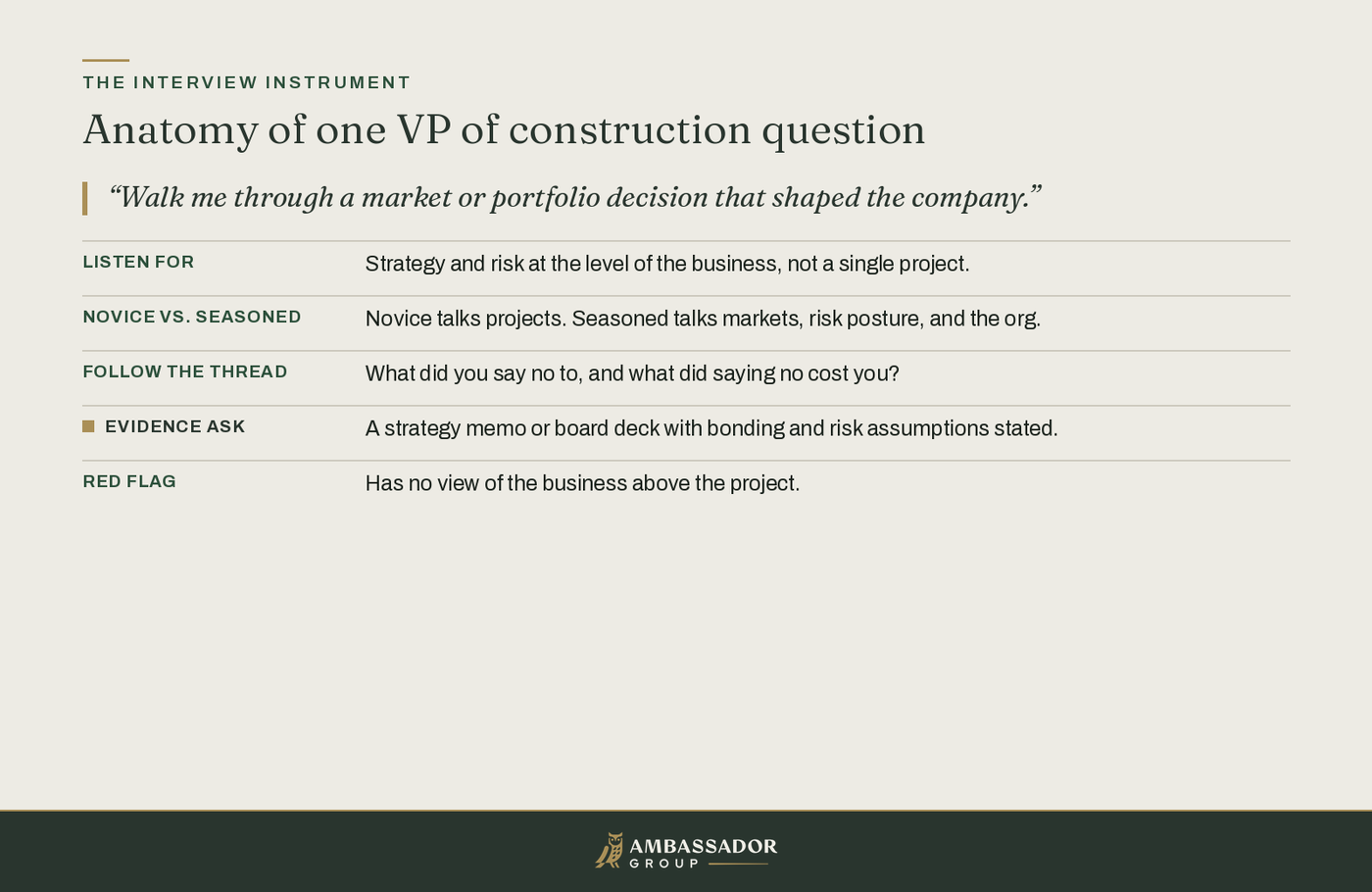
Walk me through a market or sector you chose to enter, and one you chose to exit. What did the data look like before you were sure?
- What you are listening for: a decision made before the trend was obvious, with a thesis attached, not a reaction to a market that had already turned.
- Novice tell versus seasoned tell: the novice followed demand, multifamily was hot so he leaned in. The seasoned operator describes a portfolio thesis, the leading indicators he watched, and the cost of being early or late.
- Follow the thread: If he entered, ask what he staffed and bonded against before the first award. If he exited, ask who he moved out and how he protected the backlog on the way down. If the answer stays abstract, ask for the quarter the call was made and what the pipeline looked like then.
- Evidence ask: the strategy memo or pursuit plan he brought to ownership for that shift, with the staffing and bonding assumptions in it. A real one names the leading indicators and the date.
- Red flag: every market move was a response to a client already asking. That is a director who books work, not a VP who shapes the portfolio.
Tell me about the largest pursuit you killed. Who wanted it, and what did saying no cost you internally?
- What you are listening for: the discipline to decline revenue, and the political weight of doing it inside a company hungry for backlog.
- Novice tell versus seasoned tell: the novice has never killed a real pursuit, or killed only the obvious losers. The seasoned operator names a job that looked good on paper, the risk invisible to the people pushing it, and the conversation with the person who wanted it badly.
- Follow the thread: Ask what the gross margin looked like on paper versus his adjusted read. Ask whether the job later went to a competitor and what happened to it. Ask how ownership reacted to the no.
- Evidence ask: the go or no-go scoring sheet he runs against a pursuit, with a real opportunity scored on it. Look for a risk-adjusted margin, a bonding and cash-draw line, and a client-credit check, not a gut call written up later.
- Red flag: he cannot name a single pursuit he killed for risk reasons. A VP who chases everything is a backlog liability with a title.
Operations leadership-team building
A VP who is still the best project executive in the building has not made the jump. The role is about building the people who build the work.
Describe the operations leadership team you inherited versus the one you built. Who did you move up, who did you move out, and how long did each take?
- What you are listening for: deliberate team construction over time, with a clear read on who could grow into the next level and who could not.
- Novice tell versus seasoned tell: the novice describes the team as a roster he managed. The seasoned operator describes a structure he designed, with named gaps and a sequence to how he filled them.
- Follow the thread: Ask about the hardest person to move out and why it took so long. Ask who he promoted who later struggled, and what he missed. Ask how he covered the work while a key role sat open.
- Evidence ask: the operations org chart from the day he started next to the one 18 months later, plus the succession plan for his direct reports. The charts read the work; the plan reads the foresight.
- Red flag: every name on the team is someone he hired and nobody was ever moved out. Either the inherited team was perfect, which is not real, or he avoids the hardest part of the job. A leader whose only fix for a failing project executive is to run the job himself is a director who got a VP title.
Company-wide P&L and risk
A director owns job margin. A VP owns the company number, the surety relationship, and the conversation with ownership when the number is wrong.
Walk me through a year your operation missed its number. What was the gap, when did you know, and what did you tell ownership?
- What you are listening for: ownership of a company-level miss, early visibility into it, and an honest account to the people who answer for the company.
- Novice tell versus seasoned tell: the novice attributes the miss to the market, a bad client, or a single project. The seasoned operator decomposes the gap, names the part that was his call, and tells you when he raised the flag versus when he should have.
- Follow the thread: Ask how the miss showed up in work-in-progress versus in cash. Ask what he changed structurally so the same gap could not hide again. Ask how far in advance ownership knew.
- Evidence ask: a portfolio WIP schedule with a margin-fade column, and his commentary on the jobs that faded. This is the most revealing financial artifact in the interview. You cannot fake a fade analysis you never ran.
- Red flag: the miss was always somebody else's project. A VP who never owns the number in the interview with ownership is not carrying the role.
How do you read company-wide risk that has not shown up in the financials yet? Give me a specific time you saw it before the numbers did.
- What you are listening for: a working model of leading risk indicators across the portfolio, not a backward read of closed jobs.
- Novice tell versus seasoned tell: the novice reviews financials monthly. The seasoned operator watches schedule slippage, change-order aging, under-billings, key-person concentration, and client payment behavior, and can name the time those signals moved first.
- Follow the thread: Ask which single indicator he trusts most and which has fooled him. Ask how he handles a job that looks fine on paper but feels wrong. Ask what he does when the field and the financials disagree.
- Evidence ask: the operations risk review he runs, its agenda and metrics, including the under-billings and change-order-aging lines. A monthly portfolio risk meeting with a fixed metric set is the artifact; a feeling is not.
- Red flag: risk is something he reviews after the fact in the monthly financials. At this scale that is reading the autopsy and calling it a checkup.
Operating systems and standards at scale
At 25 people, a VP can hold the standard in his head. At 200, the standard has to live in systems, or it does not exist.
What operating system do your projects run on, and which part of it did you build versus inherit?
- What you are listening for: a real, used set of standards, the preconstruction handoff, buyout, schedule, and cost reporting, and which parts he authored.
- Novice tell versus seasoned tell: the novice describes the software. The seasoned operator describes the process the software serves, where it breaks under volume, and which gate he added because something burned him once.
- Follow the thread: Ask which standard gets skipped when teams are slammed, and what that costs. Ask how he knows a new PX is following the system versus performing compliance. Ask what he would tear out if he joined here.
- Evidence ask: the preconstruction-to-operations handoff document or the stage-gate checklist he standardized, the one a new PX is handed on day one. Look for his own judgment built into the gates, not a vendor's defaults.
- Red flag: the system is a vendor's template with none of his judgment in it, or it holds only when he personally walks the jobs. Either way the standard lives in his head, and a standard in one head caps the company at the size of one calendar.
Ownership and board alignment
This is the role's upward face. A VP translates between the field and the people who own the risk, and earns the trust that lets operations run without ownership in the weeds.
Describe a time you disagreed with ownership on a major operational call. How did you handle it, and what happened?
- What you are listening for: the spine to push back on the people who sign his check, with the judgment to do it in a way that builds trust rather than spends it.
- Novice tell versus seasoned tell: the novice always deferred or framed every disagreement as a heroic stand. The seasoned operator describes a real difference, the case he made, and a willingness to commit once the call was made even when it went against him.
- Follow the thread: Ask how he rebuilt alignment after losing. Ask what he changed in how ownership sees operations afterward, the reporting or rhythm he built to make field reality legible. Ask what he refused to soften in a bad quarter.
- Evidence ask: the board presentation he built for a contested decision, plus the monthly operations report he designed for ownership. Look for a recommendation with the downside named and a tight metric set ownership can act on, not a sales deck or a data dump.
- Red flag: he has never disagreed with ownership, every disagreement ended with him being right, or the answer is that ownership simply needed to trust him more. Trust is earned through what he showed them, not granted in advance.
Culture and talent strategy
A VP owns the culture that produces the results, which means owning how the company hires, keeps, and develops the people who build the work.
What is the operational culture you are known for building, and how would your last team describe what it cost to work for you?
- What you are listening for: a deliberate, namable culture and an honest read on its tradeoffs, including who it did not fit.
- Novice tell versus seasoned tell: the novice describes culture as values on a wall. The seasoned operator names the behaviors he rewarded and punished, and what his standard cost the people who could not meet it.
- Follow the thread: Ask who thrives under him and who washes out. Ask about a strong performer who left because of the culture he built. Ask what he would do differently with the team he just left.
- Evidence ask: the turnover and retention numbers for his operations group, year over year, with his read on which exits were healthy and which were losses.
- Red flag: the culture answer is entirely positive with no named cost. Every real culture excludes someone, and a leader who cannot name who is not watching.
- Bench follow-up: ask how he engineers key-person risk down so the company is not exposed when a superintendent or project executive leaves. The seasoned operator decided who his successors were before he needed them and can show you a bench-strength map, who is ready now, ready in a year, and capped. The leader who waits for things to slow down leaves the company one resignation from a hole.
What the candidate should be asking you
A VP-caliber operator is interviewing you as hard as you are interviewing him, because the role only works if the fit runs both ways. This is a bilateral interview, and a leader who takes this role into a company that will not hand over operational authority fails. A sharp operator knows it, so listen to his questions as closely as his answers.
The strong ones ask about the real boundary of the role: what decisions ownership reserves, and where the line sits between the VP and the founder who has run operations by instinct for 20 years. They ask about the financials they would inherit, the bonding capacity, the backlog quality, and the jobs everyone is quietly worried about. They ask why the role is open and listen for whether the last person was set up to fail. They ask what authority comes with the accountability, because they have seen the version of this job that carries all the blame and none of the control.
An operator who asks only about pay and title has not thought about whether the role is survivable. One who asks where the bodies are buried has run a real operation and knows every company has them. The aim is not to test the candidate. It is to confirm the job fits the person you are about to ask to own your company's delivery, because a fit that runs one direction breaks under load at the worst possible time.
Do not leave the interview without capturing it
The interview is only half the instrument. The other half is what you do in the 20 minutes after the operator leaves, and most leaders waste it.
Write your feedback before the debrief. The moment you hear another interviewer's read, yours contaminates, and memory bends toward the loudest voice in the interview. Capture your own assessment first, while the moments are still sharp, then compare. This is the discipline behind Hire in 4K. The resolution of your read collapses the longer you wait.
Then tally the risk honestly. For each gap, decide which of three things you will do: close it through onboarding or a strong number two, engineer around it by restructuring the role so the gap carries no load, or treat it as disqualifying. A VP hire has too much surface area to hope a gap closes on its own.
Name what you did not assess. Ninety minutes cannot cover six accountabilities at depth. Be explicit about which ones you probed and which you took on faith, so the next conversation closes the real holes instead of re-running the comfortable ones.
Decide against the role, not against the other candidates. The question is never whether this person beats the other two in the pipeline. It is whether he can carry this role at this company. A field of three mediocre options does not make the strongest of them a yes, and that comparison is how a leader argues himself into the wrong hire.
The read belongs to you
A VP of Construction will shape your company's delivery for years, in rooms you will never stand in and on calls you will never hear. The instruments on this page will not make the call for you. They surface the signal. Reading it is the work, and it belongs to the leader who runs the interview.
Sharpen that read and everything downstream gets easier, which is the argument behind the seven levels of interviewing mastery and behind learning to be the lightning rod who draws out what an operator would never volunteer. The same lens that reads a VP reads the project executives and the directors of construction under him.
The operator can only show you what you know how to see. You decide which of those it will be.
The short version.
- What should VP of construction interview questions focus on?
- The three areas where the role breaks: judgment about what work the company should take, building the operations leadership team, and company-wide ownership of the P&L, risk, and culture. Build questions backward from those breaks and the interview stops being a quiz. A leader who can read three questions cold will out-hire one armed with forty they cannot interpret.
- How is a VP of construction different from a director of construction?
- A director runs delivery and owns his jobs; a VP owns the delivery organization and answers to ownership for what the whole house produces. That means shaping the portfolio, building the people who lead the people who run projects, and owning the company number, the surety relationship, and the safety record. The tell is whether the candidate reaches for the result or for the explanation.
- What evidence should I ask a VP of construction candidate to show?
- Ask for artifacts, not stories: the strategy memo behind a market shift, a go-or-no-go scoring sheet with a real pursuit on it, the org chart from day one next to the one 18 months later, a portfolio WIP schedule with a margin-fade column and their commentary, and the board presentation from a contested decision. The WIP fade analysis is the most revealing financial artifact in the interview because you cannot fake one you never ran.
- What are the red flags when interviewing a VP of construction?
- A candidate who never killed a pursuit for risk reasons, whose every market move was a response to a client already asking, whose misses were always somebody else's project, or who never moved anyone out of an inherited team. Another is a culture answer that is entirely positive: every real culture excludes someone, and a leader who cannot name who is not watching.
- What questions should a strong VP candidate ask the interviewer?
- Strong operators ask about the real boundary of the role: which decisions ownership reserves, the financials and bonding capacity they would inherit, the backlog quality, why the role is open, and what authority comes with the accountability. An operator who asks only about pay and title has not thought about whether the role is survivable. The fit has to run both ways, because a fit that runs one direction breaks under load.


