
I have watched a construction project manager interview go sideways in the first 10 minutes, and the candidate never said a wrong word. The interviewer did all the damage: lobbing soft questions, accepting the first clean answer, nodding at fluency he mistook for competence. The quality of this hire is set by the person asking the questions, not the person answering them. A leader who cannot see his own habits in the interview cannot see the candidate clearly through them, and no candidate can fix that for him. The questions below are instruments. The discipline of listening through them belongs to the leader, who owns the outcome of a hire the way a PM owns the outcome of a job: completely, with no one to blame when it goes wrong.
This is the underwriting role in your office. The PM owns the project commercial and delivery outcome from the desk: budget, schedule, contracts, the client relationship, and the field-office partnership with the superintendent. The PM owns the plan and the money. The super owns the deck. You are pricing a risk you will carry for 2 or 3 years across several million dollars of work, and the only protection you get is the quality of your own attention in the interview. Hire in 4K is the standard. Most interviewers operate at a fraction of it.
Interview to the three seams where this role breaks
A good PM rarely fails at the things the job description lists. They fail at the seams. Build your questions out of those, not the bullet points.
The first seam is margin against relationship. The PM has to protect the number and protect the client in the same conversation, often the same sentence. A weak PM picks one: the contractor the client resents because every email is a change order, or the friend who gives away margin to stay liked. You are listening for someone who holds both.
The second seam is schedule consequence without schedule ownership. The superintendent runs the means, methods, and sequence in the field. The PM owns the commercial consequence of that schedule: the notices, the time extensions, the float, the liquidated-damages exposure. The failure mode is a PM who abdicates the schedule ("that is the super's deck") or grabs the clipboard and runs the field, leaving the commercial protection unwritten.
The third seam is the field-office partnership itself. The PM and super are a 2-person leadership team with no org chart to settle disputes. The PM who micromanages the field loses the super. The PM who abdicates loses the job. You are hiring for the narrow band between those two failures.
Every probe that follows comes out of one of these seams. A question that does not pressure-test a seam is conversation rather than assessment, and the difference between the two is the whole of Seven Levels of Interviewing Mastery.
The six accountabilities
Run the interview across these, one section each. Depth beats breadth: two real probes per accountability, fully worked, beats a question dump every time.
- Team leadership and people management
- Safety and risk management
- Schedule management and project planning
- Quality assurance and delivery standards
- Client and stakeholder relationships
- Contracts, cost control, and project financials
Team leadership and people management
The PM leads without much formal authority. The super does not report to them, and neither do the trades. They lead through clarity, sequencing, and the relationship. Watch how they talk about the people they cannot command.
Tell me about a superintendent you struggled to work with, and what you did about it.
- What you are listening for: ownership of the relationship as a deliverable they build, not a personality they were assigned.
- Novice tell vs. seasoned tell: the novice describes the super as the problem and themselves as the reasonable party. The seasoned PM names a specific adjustment to their own behavior: the cadence they changed, what they stopped escalating, where they gave ground on means and methods to keep authority over the commercial decisions.
- Follow-the-thread: If they blame the super, ask what the super would say about them. If they describe a fix, ask whether it held 3 months later.
- Evidence ask: an actual weekly project-meeting agenda or set of minutes they ran, showing who owned which line and how field and office issues were separated.
- Red flag: they cannot name one thing they did wrong in a strained partnership. A PM who was never part of the problem never owned the relationship.
How do you set expectations with a subcontractor who is behind, without burning the relationship you need for the next 6 months?
- What you are listening for: graduated pressure. The good answer has steps: the documented conversation, the recovery plan, the written notice, then the contractual remedy. They escalate on paper while keeping the relationship intact on the phone.
- Novice tell vs. seasoned tell: the novice goes straight to "I hold them to the contract" or straight to "I work with them." The seasoned PM does both in sequence and knows which order protects the job.
- Follow-the-thread: Ask what they document and when. Ask what they do when the sub is also their best concrete crew, needed on the next 3 jobs.
- Evidence ask: a notice to cure or a backcharge letter they wrote, names redacted.
- Red flag: every answer is relationship, no paper. Managing subs on goodwill alone leaves you exposed the day goodwill runs out.
Safety and risk management
The PM does not run the site safety program day to day. They own the commercial risk safety failures create: the insurance posture, the subcontractor qualification, the indemnity language, the documentation that protects you when something goes wrong.
Walk me through how you qualify a subcontractor's safety and insurance before they set foot on your site.
- What you are listening for: a real process. Certificates of insurance checked against the contract, additional-insured endorsements, EMR thresholds, a prequalification step before award rather than after the sub is mobilized.
- Novice tell vs. seasoned tell: the novice treats this as the office manager's paperwork. The seasoned PM owns it as their own risk exposure and can name the last time a COI gap nearly cost them.
- Follow-the-thread: Ask what they do when a critical sub's insurance lapses mid-project. Ask whether they ever stopped a sub over a documentation gap.
- Evidence ask: a subcontractor prequalification form or a certificate-of-insurance tracking log they maintained.
- Red flag: they have never read an indemnity clause and assume insurance is handled elsewhere. That is an uninsured risk in a PM's chair.
Describe a project where something went wrong on site that created liability exposure, and what you did from the office.
- What you are listening for: a fast, documented, contract-aware response. They preserve the record, notify the right parties, loop in the carrier and counsel when warranted, and protect the firm without losing the human reality of it.
- Novice tell vs. seasoned tell: the novice tells you the super handled it. The seasoned PM tells you exactly what they documented in the first 48 hours and why.
- Follow-the-thread: Ask what they wrote down and when. Ask how they balanced caring for the people involved against protecting the firm.
- Evidence ask: an incident report or the contemporaneous field notes captured at the time.
- Red flag: they treat liability as the field's problem, or they describe massaging a record.
Schedule management and project planning
The seam where PMs most often abdicate or overreach. The super owns the sequence; the PM owns the commercial machine around it: the baseline, the float, the notices, the time impact.
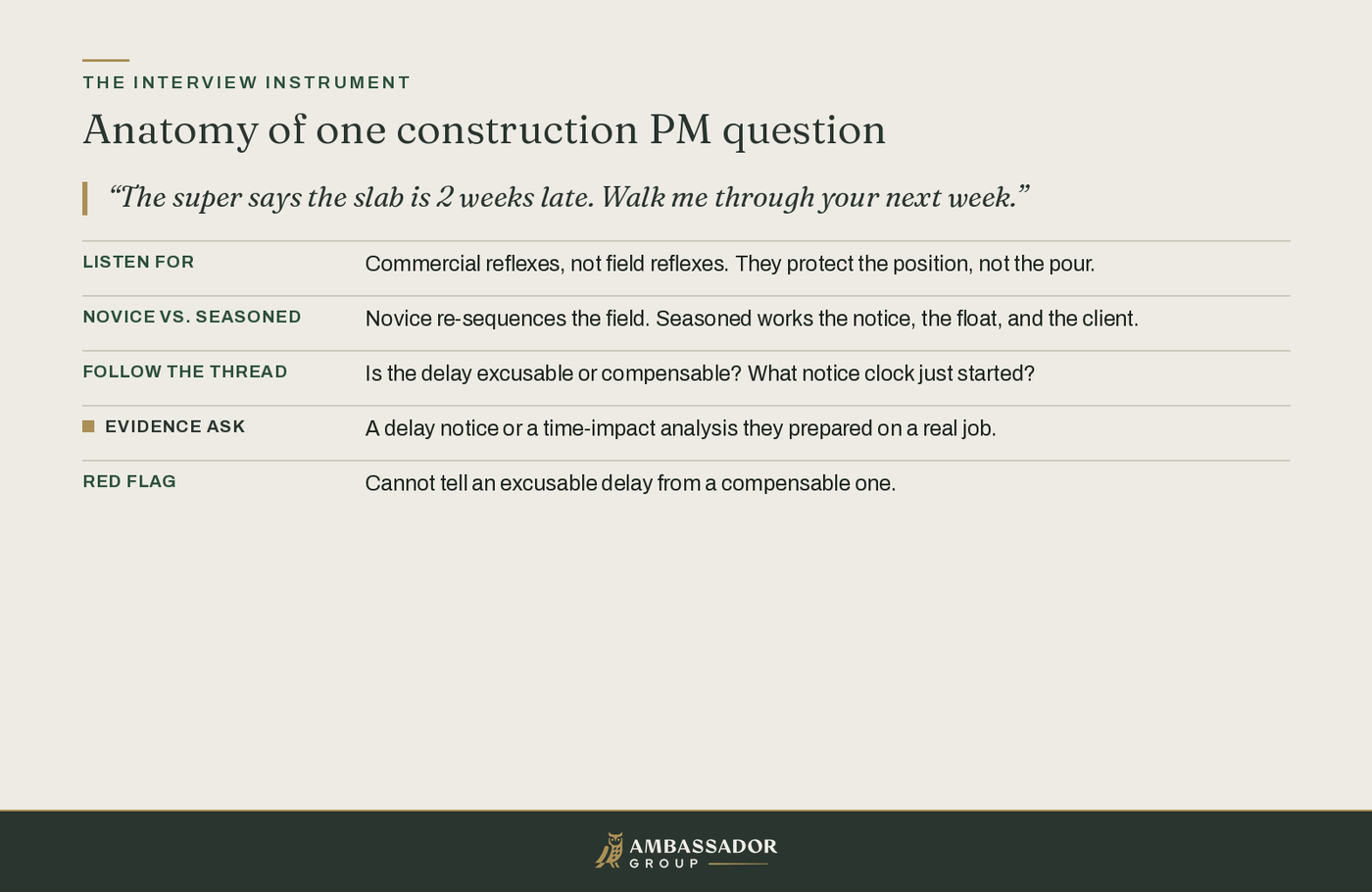
The superintendent tells you the slab is 2 weeks late. Walk me through the next week from your role.
- What you are listening for: commercial reflexes, not field reflexes. The strong PM does not start solving the slab. They start protecting the position: is this excusable, is it compensable, what notice clock just started, what does the float absorb, what does the client need to hear and when.
- Novice tell vs. seasoned tell: the novice grabs the schedule and re-sequences the field, doing the super's job. The seasoned PM lets the super own recovery and works the contract, the notice, and the client.
- Follow-the-thread: Ask what notice the contract requires and how fast. Ask how they decide whether to eat the delay or claim it, and how they keep the super owning recovery while they own consequence.
- Evidence ask: a delay notice or a time-impact analysis they prepared, or a baseline-versus-actual schedule they maintained.
- Red flag: they cannot tell you the difference between an excusable and a compensable delay. That gap costs real money on every job.
How do you build and maintain a schedule you did not personally sequence?
- What you are listening for: partnership discipline. The PM does not author the field sequence, but they own the master schedule as a commercial document, translating the super's plan into something contractually defensible and keeping it current.
- Novice tell vs. seasoned tell: the novice builds a schedule in isolation that the field ignores, or never builds one and flies on the super's gut. The seasoned PM co-owns it: the super drives the logic, the PM owns the contractual spine and the updates.
- Follow-the-thread: Ask how often they update and with whom. Ask how they handle a super who refuses to work off a written schedule.
- Evidence ask: an updated CPM schedule with revision history, showing how it moved over the life of a job.
- Red flag: the schedule is decoration. Built once and never touched means they file a schedule, not manage one.
Quality assurance and delivery standards
Quality is where margin and reputation meet. The PM owns the systems that catch defects before the owner does: submittals, RFIs, the punch, closeout.
Tell me about a quality failure that reached the owner before you caught it.
- What you are listening for: systems thinking and ownership. A strong PM names the breakdown in their own process, not the trade's hands, and tells you what gate should have caught it and what they changed.
- Novice tell vs. seasoned tell: the novice blames the sub's workmanship. The seasoned PM points at their own submittal review, inspection cadence, or failure to align the spec with the field before the work went in.
- Follow-the-thread: Ask what gate failed and what it cost to fix. Ask what they changed in their process afterward and whether it held.
- Evidence ask: a submittal log, a QA/QC inspection checklist, or a punch list they closed out.
- Red flag: every quality failure in their history is someone else's hands. A PM who owns no quality miss has never looked for one.
How do you run closeout so it is not a fire drill in the last month?
- What you are listening for: closeout as a discipline that starts at mobilization. Strong PMs collect O&M manuals, warranties, and as-builts continuously, because the last month is where margin quietly dies when closeout was deferred.
- Novice tell vs. seasoned tell: the novice describes closeout as a sprint at the end. The seasoned PM describes a running ledger they have kept since the first submittal.
- Follow-the-thread: Ask when closeout starts on their jobs and how retention release ties to it. Ask about the last project where closeout slipped and what it cost in held retention.
- Evidence ask: a closeout checklist or a retention-tracking log from a completed project.
- Red flag: closeout is an afterthought they tie only to the final invoice.
Client and stakeholder relationships
The margin-against-relationship seam in its purest form. The PM is the firm to the client, and how they hold both at once is the whole job.
Tell me about a time you had to deliver a change order the client did not want to hear.
- What you are listening for: early, documented, unsurprising. The strong PM flags the condition when it appears, prices it transparently, and walks the client through the why before the number lands.
- Novice tell vs. seasoned tell: the novice avoids the conversation until it is a crisis, or hides behind the contract with no relationship management. The seasoned PM makes the case so the client feels informed rather than ambushed, and still holds the margin.
- Follow-the-thread: Ask how early they flagged it and what they did when the client refused to sign. Ask about one they lost and what it taught them.
- Evidence ask: a change order proposal or a change order log showing how they tracked and communicated them.
- Red flag: they describe giving away margin to keep the client happy as if it were good judgment. That is your profit funding their popularity.
How do you keep a client confident on a project that is genuinely going badly?
- What you are listening for: candor as the trust-builder. The strong PM brings bad news early with a plan attached. Client confidence survives problems but not surprises.
- Novice tell vs. seasoned tell: the novice manages perception and hopes to recover before the client notices. The seasoned PM tells the client the truth on their own timeline, with a recovery path, before the client finds out another way.
- Follow-the-thread: Ask about a time hiding a problem made it worse. Ask how they rebuild trust after a real miss.
- Evidence ask: a project status report or an owner update they sent during a troubled job.
- Red flag: their instinct is to control information until they have a fix. That instinct ends client relationships.
Contracts, cost control, and project financials
The underwriting core of the role. The PM owns the budget from buyout to final accounting, reads the contract as a risk document, and protects margin in real time.
Walk me through how you run a monthly cost projection on a job.
- What you are listening for: real financial command. Cost-to-complete logic, committed versus projected, forecasting the final number rather than reporting the spent one. They manage to the projection, not the rear-view mirror.
- Novice tell vs. seasoned tell: the novice reports costs already incurred. The seasoned PM forecasts the final cost from current data and adjusts the job to protect the fade before it happens.
- Follow-the-thread: Ask how they handle a cost code trending over and when they tell leadership a job is fading. Ask about the gap between their projected final and the actual final on their last closed job.
- Evidence ask: a monthly WIP or job-cost report with cost-to-complete columns they maintained.
- Red flag: they cannot explain cost-to-complete, or they only look backward at spent dollars. A PM who cannot forecast a fade cannot protect margin.
Show me how you read a contract before you sign on to deliver it.
- What you are listening for: they read for risk transfer. Liquidated damages, payment terms, retention, the change-order clause, the notice provisions, the indemnity. They know which clauses can sink the margin and which they negotiate before signing.
- Novice tell vs. seasoned tell: the novice treats the contract as legal's problem and starts work off the scope. The seasoned PM has read the whole thing and can tell you where the teeth are.
- Follow-the-thread: Ask which clause they fight hardest to change. Ask about a time a term cost them because they missed it, and how they handle a notice provision they cannot realistically meet.
- Evidence ask: a contract risk review or a markup of terms they pushed back on during buyout.
- Red flag: they have never negotiated a term and do not know their own firm's liquidated-damages exposure. That PM signs risk blind.
Make sure the job fits the candidate
The interview runs both ways. A strong PM is evaluating whether your firm is a place they can succeed, and the questions they ask you are diagnostic. A candidate who asks nothing either does not care or does not know what to fear. Be the Lightning Rod: absorb their hardest questions rather than deflecting them.
Listen for what their questions reveal. A candidate who asks how budget responsibility splits between the PM and the estimator is checking whether they will own a number someone else built badly. One who asks how the PM and super relationship works at your firm is probing the exact seam where the job is won or lost, and the maturity of that question says they have been burned before. One who asks what your fade looks like on a typical job is running financial diligence on you, which is exactly what you want a PM to do.
The candidate who asks only about salary, title, and vacation is telling you what they optimize for. The one who asks about your worst recent project wants the truth before they sign. Match the role to the person as deliberately as you match the person to the role. A PM who succeeds where the conditions fit will fail where they do not, and that mismatch lands on you.
Do not leave the interview without capturing it
Write your feedback before the debrief, not after. The moment you hear another interviewer's read, yours bends toward it. Capture your own assessment in writing while the candidate's answers are still sharp.
Then tally the risk honestly. For every accountability, decide where this candidate lands: fill the gap (they grow into it with support you are willing to provide), engineer around it (you permanently structure the role to cover the weakness), or abandon (the gap is disqualifying for this role). A candidate who needs you to engineer around 3 of 6 accountabilities is not a PM hire. They are a project waiting to fail on your dime.
Name what you did not assess. Maybe you never got to how they handle a job that loses money from buyout, or talked schedule but never watched them defend a number under pressure. The honest interviewer knows the holes in their own read and either fills them in a second conversation or names them as accepted risk. The Hire in 4K standard is partly about resolution: you cannot underwrite what you did not look at.
And be willing to decide against the role itself. Sometimes the strongest finding is that the role as scoped matches no PM you can realistically hire, and the fix is to change the role rather than lower the bar.
The instrument is only as good as the hand
Every question above is a chisel, and the chisel does not make the cut. The hand does, and the hand is yours. You can run the best instrument in the trade and still learn nothing if you accept the first clean answer, nod at fluency, and let the candidate set the depth. The depth is your job. Listening past the rehearsed surface to the real seam underneath is the difference between a hire that holds for 3 years and one that fails in the first 90 days, on a job you are still paying for.
The Superintendent, Senior Project Manager, and Estimator instruments are built on the same spine. The seams differ. The standard does not.
You already own the outcome of this hire. The only question is whether you will interview like it.
The short version.
- What should construction project manager interview questions test?
- The three seams where the role breaks: margin against relationship, schedule consequence without schedule ownership, and the field-office partnership with the superintendent. Good PMs rarely fail at what the job description lists; they fail at these seams. Run the interview across six accountabilities, two deep probes each: team leadership, safety and risk, schedule management, quality assurance, client relationships, and contracts and financials. A question that does not pressure-test a seam is conversation, not assessment.
- How do I test a PM candidate's financial command?
- Have them walk through a monthly cost projection on a job. You are listening for cost-to-complete logic, committed versus projected, and forecasting the final number rather than reporting spent dollars. The seasoned PM manages to the projection and adjusts the job to protect against fade before it happens. A candidate who cannot explain cost-to-complete or only looks backward cannot protect margin.
- Who owns the schedule, the project manager or the superintendent?
- The superintendent owns the sequence, means, and methods in the field; the PM owns the commercial consequence of that schedule, meaning the notices, time extensions, float, and liquidated-damages exposure. The failure modes are a PM who abdicates the schedule entirely or one who grabs the clipboard and runs the field while the commercial protection goes unwritten. A PM who cannot explain the difference between an excusable and a compensable delay will cost real money on every job.
- What are red flags when interviewing a construction project manager?
- A candidate who was never part of the problem in a strained superintendent relationship, who manages subs on goodwill with no paper trail, who treats liability and insurance as someone else's job, whose quality failures are always someone else's hands, who describes giving away margin to keep a client happy as good judgment, or who controls information until they have a fix. Each one signals a seam that will break under a real project.
- What should the interviewer do after a PM interview?
- Write feedback before the debrief, because your read bends toward the first voice you hear. Then tally risk honestly: for each accountability, decide whether the candidate fills the gap, you engineer around it, or the gap is disqualifying. A candidate who needs the role engineered around 3 of 6 accountabilities is not a PM hire. Finally, name what you did not assess and either fill it in a second conversation or accept it as named risk.


