
The superintendent you hire is the project everyone else experiences. The owner sees your judgment in how the site runs. The trades feel it in whether the schedule is real. Your PM lives with it every day. So when the interview comes down to whether someone seems like a good field guy, you have outsourced the most consequential call on the job to a gut feeling. The list of construction superintendent interview questions below exists to take that call back. None of it works, though, until you accept the uncomfortable part: the quality of this hire is principally driven by you, not by the candidate who walks in. A strong superintendent can be read by a sharp interviewer and missed by a dull one. The questions are instruments. The discipline of listening is yours.
Most guides hand you a pile of questions and stop. This one assumes the questions are the easy part. What separates a real assessment from a pleasant conversation is knowing what a mature answer sounds like, where to push when you hear a thin one, and what document to ask for when you want proof instead of a story.
Interview to the three places this role breaks
A job description lists everything a superintendent touches. An interview cannot test everything, and trying to is how you end up testing nothing. Build the conversation around the two or three places the role genuinely breaks, then design questions that pull on those threads.
For a superintendent, three failure points carry most of the risk:
- The schedule stops being real. The look-ahead drifts from what is happening on the deck, the trades stop believing it, and recovery becomes a daily firefight.
- Safety becomes paperwork. The signs are posted and the binder is current, but production pressure quietly teaches the crew that the real rule is keep moving.
- The standard slips when no one is looking. Work gets put in place that is good enough to accept and expensive to fix, because the easy call in the moment is to let it go.
Every section that follows ladders back to one of these. If a question does not help you predict how this person behaves at one of those three breaking points, it is conversation, not assessment.
The six accountabilities of the role
The map of the job, and the structure of the interview:
- Field leadership and trade management
- Safety culture and risk control
- Schedule ownership and the look-ahead
- Quality and the work in place
- Coordination across subs, owner reps, inspectors, and the office
- Cost awareness in the field
What follows is not a question bank. It is a small set of probes per accountability, each with what to listen for, how to tell a seasoned answer from a rehearsed one, where to follow up, and the evidence to ask for. Depth beats volume. Four questions you know how to read are worth more than forty you do not.
Field leadership and trade management
The superintendent leads people who do not report to them on paper. Authority on a jobsite is earned through competence and consistency, not granted by a title. This is where you find out whether the trades will follow this person or merely tolerate them.
"Tell me about a crew or a sub that was not performing. What did you do?"
- What you are listening for: a sequence, not a verdict. Did they diagnose before they reacted? Did they separate a skill problem from a will problem from a coordination problem the office caused? Leadership maturity shows up as curiosity before judgment.
- Novice tell vs. seasoned tell: the novice goes straight to "I got them replaced" or "I lit them up." The seasoned super tells you how they figured out why, had a direct conversation, gave a clear expectation with a date, and only escalated when the pattern held. They name what they tried that did not work.
- Follow-the-thread: if they jump to removal, ask what they did before that. If they describe a conversation, ask what they said in the first sentence. If they blame the sub entirely, ask what the office or the schedule contributed.
- Evidence ask: "Walk me through how you documented it." A real performance conversation leaves a trail: a note to the sub's PM, a daily log entry, an email confirming the expectation. No trail often means no conversation.
"How do you run your morning huddle, and what changes when the job is behind?"
- What you are listening for: whether their leadership is a system or a mood. A repeatable daily cadence that tightens under pressure signals someone who creates order. Vague answers signal someone who rides the day the day gives them.
- Novice tell vs. seasoned tell: the novice describes a huddle as reading the schedule out loud. The seasoned super describes surfacing constraints, confirming who is blocked by whom, and leaving with commitments they will hold people to by lunch.
- Follow-the-thread: ask who talks in their huddle. If only the super talks, the trades are an audience, not a team. Ask for the last constraint a foreman raised that changed the plan.
- Evidence ask: a photo of a look-ahead board or a sample huddle agenda. Field leaders who run real huddles almost always have an artifact.
Safety culture and risk control
Safety is the cleanest test of whether a superintendent leads by stated values or by convenience. Anyone can recite the program. You are testing whether they hold it when holding it costs a day.
"Tell me about a time you stopped work. What did it cost, and what happened after?"
- What you are listening for: evidence they have done it, and that they understood the cost and called it anyway. The after matters as much as the stop: did they fix the condition that created the risk, or just clear the immediate hazard?
- Novice tell vs. seasoned tell: the novice speaks about safety in slogans ("safety is number one") with no specific stop to point to. The seasoned super has a story with a real cost attached, a crew that was unhappy in the moment, and a system change that followed.
- Follow-the-thread: if they cannot name a time they stopped work, ask about the last time they were tempted to and did not. The honest answer there tells you where their line is.
- Evidence ask: how do they run a stand-down, and can they describe their pre-task planning or JHA process. Ask what their last recordable was and what changed because of it.
- Red flag: a candidate who has never stopped work, or who frames safety entirely as protecting the company from liability rather than protecting people, is telling you what they value. Believe them.
"Where is the gap between your safety paperwork and what happens on the deck?"
- What you are listening for: self-awareness. Every real jobsite has a gap. A superintendent who claims there is none is either inexperienced or selling. The mature answer names the gap and the mechanism they use to keep closing it.
- Novice tell vs. seasoned tell: the novice insists their sites are fully compliant. The seasoned super tells you exactly where crews cut corners under pressure and how they catch it: walking the deck at the right times, watching the trades nobody is watching.
- Follow-the-thread: ask what time of day and what day of the week incidents cluster. Someone who has paid attention knows it is late in the shift and late in the week.
- Evidence ask: a sample of their daily safety documentation, or a description of how they audit their own subs rather than waiting for a safety manager to do it.
Schedule ownership and the look-ahead
The schedule is where a superintendent's judgment is most visible and most testable. A master scheduler in the office means nothing if the field does not believe the dates. This accountability maps directly to the first breaking point of the role.
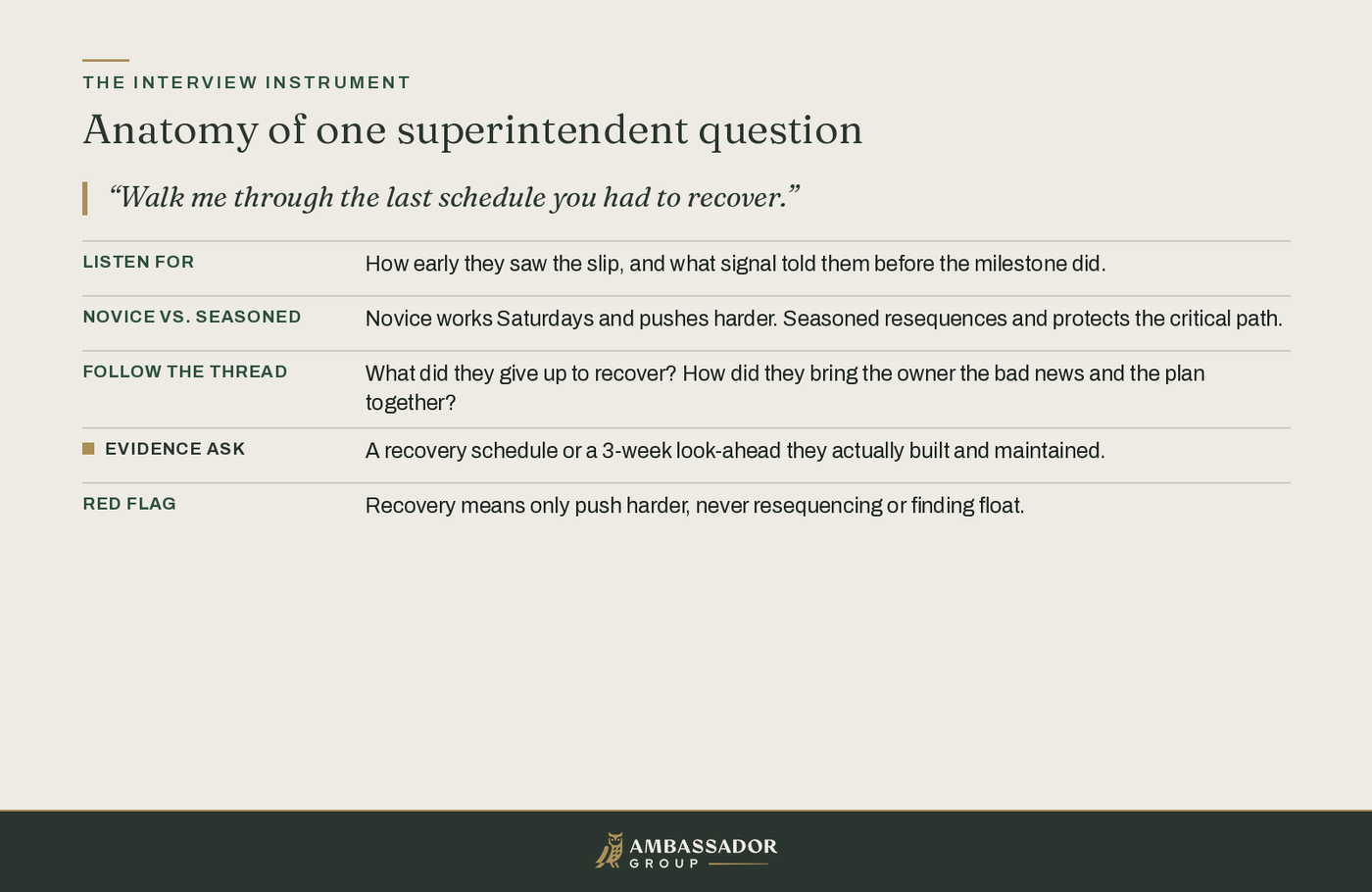
"Walk me through the last schedule you had to recover. Start from how you knew you were behind."
- What you are listening for: how early they saw it and what signal told them. Great superintendents read trouble in look-ahead drift and trade body language weeks before a milestone slips. Weak ones find out at the milestone.
- Novice tell vs. seasoned tell: the novice describes recovery as working Saturdays and pushing harder. The seasoned super describes resequencing, finding float, renegotiating the order of work with the trades, and protecting the critical path instead of accelerating everything at once.
- Follow-the-thread: ask what they gave up to recover, because real recovery has a tradeoff. Ask how they brought the owner the bad news and the plan in the same conversation.
- Evidence ask: "Can you show me a recovery schedule you built?" A two- or three-week look-ahead they maintained is one of the highest-signal artifacts a superintendent can produce. Ask how they build their three-week look-ahead and how often they update it.
"How do you make a schedule the trades believe?"
- What you are listening for: whether they treat the schedule as a command or a negotiation they own. Buy-in is built by pulling the plan with the foremen who have to execute it, not by publishing a Gantt chart and enforcing it.
- Novice tell vs. seasoned tell: the novice talks about holding people accountable to the dates. The seasoned super talks about pull planning, sequencing conversations, and making commitments visible so the trades hold each other accountable.
- Follow-the-thread: ask about the last time a foreman told them the date was wrong. What they did with that pushback reveals whether the schedule is shared or imposed.
- Evidence ask: a description of their pull-planning process, or a photo of a collaborative planning wall.
Quality and the work in place
Quality is the slow killer. It rarely shows up in the interview as a dramatic story, which is exactly why you have to dig for it. This maps to the third breaking point: the standard that slips when the easy call is to accept the work.
"Tell me about work you made a crew tear out. How did that conversation go?"
- What you are listening for: a spine. Holding the standard means being willing to be unpopular in the moment for an outcome no one will thank you for later. You want evidence they have spent that capital.
- Novice tell vs. seasoned tell: the novice cannot recall a teardown or describes it as a fight they won. The seasoned super describes catching it early, explaining the why, and protecting the relationship while holding the line.
- Follow-the-thread: ask how they prevent the same defect next time, because mature quality management is upstream. Ask what they check before a pour or a cover that they learned the hard way.
- Evidence ask: their pre-installation or first-work checklist, their punch process, or how they run mockups and benchmark units.
"What does good look like to you, and how do you make it visible to a new crew?"
- What you are listening for: whether their standard is in their head or out in the world where the crew can meet it. Written standards, mockups, and benchmarks separate superintendents who complain about quality from those who build it.
- Novice tell vs. seasoned tell: the novice says you know it when you see it. The seasoned super sets the standard physically and early so the crew calibrates before the work scales.
- Follow-the-thread: ask how they handle the trade that says "that is not in my scope." The answer shows whether quality lives in the contract or in their leadership.
- Evidence ask: photos of a mockup or benchmark unit they established, or a written quality expectation they handed a sub.
Coordination across subs, owner reps, inspectors, and the office
A superintendent sits at the center of a web: trades, owner, architect, inspectors, and their own PM. The job is to keep that web aligned without becoming the bottleneck it all routes through.
"Tell me about a conflict between what the field needed and what the office wanted. How did it resolve?"
- What you are listening for: whether they see the office as a partner or an obstacle. The strongest superintendents close the field-office gap instead of widening it. They bring problems with a proposed path attached.
- Novice tell vs. seasoned tell: the novice frames the office as people who do not understand the field. The seasoned super describes a working partnership with their PM, clear on who owns what, escalating cleanly when they have to.
- Follow-the-thread: ask how they keep their PM from being surprised. Surprise is the symptom of a coordination breakdown. Ask what they push up versus solve in the field.
- Evidence ask: how they run owner-architect-contractor meetings, or how they document and track RFIs and submittals so coordination gaps surface before they become field problems.
"How do you handle an inspector or an owner rep who is wrong but has authority?"
- What you are listening for: composure and judgment under someone else's power. You learn whether they escalate emotionally or manage the relationship while protecting the job.
- Novice tell vs. seasoned tell: the novice tells a story about being right and winning. The seasoned super tells you how they preserved the relationship, built the record, and got to the right outcome without making an enemy who signs off on their work for the next year.
- Follow-the-thread: ask what they do to build the relationship before they need it. Superintendents who only meet the inspector at the inspection are already behind.
Cost awareness in the field
A superintendent does not own the budget, but they spend it every day. Field productivity, rework, and how change events get captured are where the money is won or lost on the ground.
"Where does a job like ours quietly lose money in the field, and how do you catch it?"
- What you are listening for: an operator's instinct for waste. Labor productivity, double handling, trade stacking, rework, and unbilled changes. You want someone who feels the cost of a poorly sequenced day.
- Novice tell vs. seasoned tell: the novice talks about cost as the PM's job. The seasoned super names specific leaks they watch and the field habits that plug them.
- Follow-the-thread: ask about the last change event they identified before it became a dispute. Ask how they make sure field-directed work gets documented the day it happens, not at the end of the month.
- Evidence ask: how they track and communicate productivity, or an example of a change they captured in the field with the documentation that made it billable.
What the candidate asks you matters as much as how they answer
The interview runs both ways. A superintendent worth hiring is also interviewing you, because they have been burned by a company that sold them a functional jobsite and handed them a mess. The questions they ask are a window into what they have lived through and what they care about.
Listen for whether they ask about the things that determine whether they can succeed: the state of the buyout, the realism of the schedule they would inherit, how the company backs a superintendent who stops work, the relationship between field and office, what happened to the last person in the role. A candidate who asks only about pay and truck allowance is telling you they have not thought hard about the work. A candidate who interrogates the conditions of success is showing you exactly the judgment you are trying to hire.
When you answer them honestly, you are also doing the most underrated thing in hiring: making sure the job fits the candidate as much as the candidate fits the job. The match that lasts is the one where both sides saw clearly.
Do not leave the interview without capturing it
Memory is the enemy of a good hiring decision. By the third candidate, the first one is a blur and the most recent one feels strongest simply because they are recent. The fix is mechanical and it works.
- Write your assessment before you talk to anyone. Each interviewer writes their read against the six accountabilities before the debrief. Written-first feedback kills groupthink, because the loudest voice in the interview cannot anchor a number that is already on paper.
- Tally the risk, do not average a vibe. For each accountability, decide where the risk sits. You will fill some gaps with this person as they are, engineer around others with how you build the team around them, and a few you will choose not to accept. That is underwriting, and it is a cleaner decision than a thumbs up.
- Name what you did not assess. The most useful column is the one most interviewers skip. If you never got real evidence on schedule recovery, write "did not assess" rather than guessing. A column full of did-not-assess is not a verdict on the candidate. It is a verdict on your interview, and it tells you exactly what the next conversation or the reference call has to cover.
- Decide against the role, not against the other candidates. The question is whether this person clears the bar for the job, not whether they are the best of three people who may all be wrong.
This is the same discipline behind Hire in 4K, the working manual that turns a search into a scorecard, a structured interview, and a reference call instead of a gut call. The role guide is the field application of it.
Read the candidate, then read yourself
The hardest part of hiring a superintendent is not finding good questions. It is hearing the answers clearly enough to act on them, and that depends less on the candidate than on the person across the table. The interviewer who can tell a rehearsed answer from a lived one, who knows where to push and what to ask for, will out-hire a better-resourced competitor with a worse ear every time. That skill compounds. The Seven Levels of Interviewing Mastery lays out the climb, and Be the Lightning Rod makes the case that the outcome of this hire lands on you either way.
A bad superintendent hire does not announce itself for 90 days, and by then it is living on your jobsite and in your owner's confidence. The interview is the cheapest place you will ever get to catch it, and the most expensive one to waste. Every question above is a chance to see this person clearly while seeing clearly still costs you nothing.
You already have the questions. The only thing left to decide is how carefully you are going to listen.


