
Five of you walk out of a strong final interview for a project manager and gather to decide. The most senior person speaks first, leans back, and says the candidate "felt a little soft on the numbers." Four others walked in with their own read. Within ten minutes three are nodding along to soft-on-the-numbers and the fourth has gone quiet.
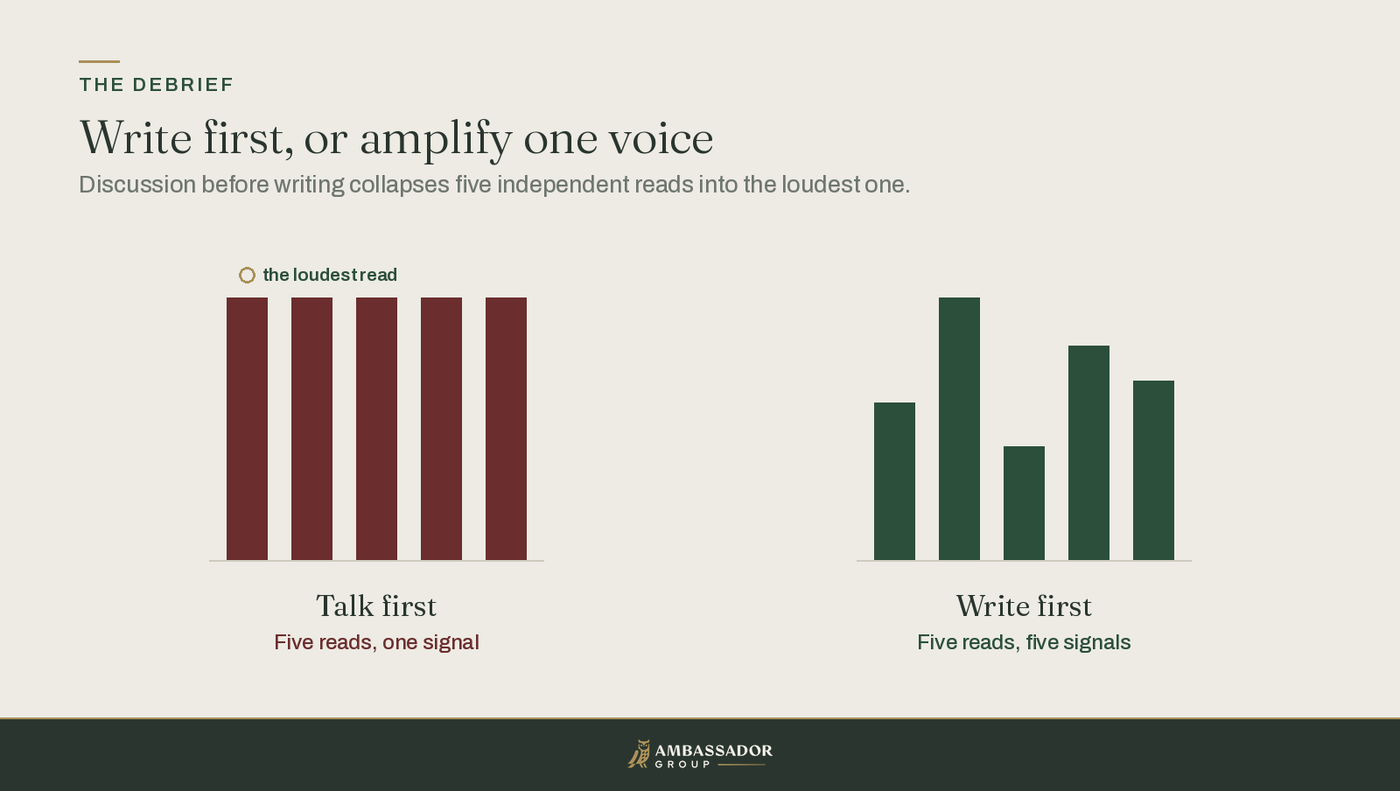
The group just turned five independent judgments into one, and nobody noticed it happen.
The interview was never the decision. The decision gets made in the hours after it, in the hallway and the debrief and the offer conversation, and every one of those steps either preserves the evidence you paid for or throws it away. This is where a leader's blind spot is most expensive, and it is entirely a design problem.
How five judgments become one
Anchoring is the mind's habit of latching onto the first number it hears and adjusting from there. In a debrief, the first strong opinion is that number. Seniority makes it heavier. Everyone else privately calibrates toward it, usually without registering the pull. You think you are hearing five data points. You are hearing one, repeated with variations.
This does not take a panel of five to bite. With two interviewers, the first confident read still bends the second.
The cost is specific: you lose signal. Five interviewers who each saw the candidate from a different angle are worth five angles only if the angles survive contact with each other. The moment the group hears the loudest read first, the quieter reads bend toward it, and the person who saw the problem keeps it to themselves. You cannot weigh a dissent you never hear.
The worst hiring decisions I have watched get made never looked like decisions. They looked like a team that clicked. Everyone nodded, the verdict felt obvious, and the meeting moved on. Months later the hire failed and not one person felt responsible, because nobody had thought it through on their own.
Groupthink usually starts the second the interview ends. Someone, often the most senior person or simply the loudest, offers a quick take in the hallway or on Slack: "I liked them." Or worse, "I don't know, something felt off." Once that anchor drops, every later opinion bends toward it. The junior interviewer who saw something genuinely important softens the observation or swallows it. The quiet, thoughtful voice defers to the confident one. The team loses the exact insight it most needed.
Belief intensity is not evidence
Inside every unstructured debrief sits a trap. The weight an issue receives is almost always tied to how strongly an interviewer is willing to feel about it, not to how important the issue is. Disagreeable personalities fight hard over minor things. Agreeable personalities quietly concede on critical ones. Seniority amplifies both distortions.
Belief intensity, absent logic and evidence, is noise. A whispered, well-reasoned observation from the most junior person on the panel may be the single most important data point in the entire process, and a groupthink debrief will never surface it.
A serious interview process has to make whispered wisdom audible and loud certainty accountable.
Groupthink does not announce itself, either. It compounds quietly and the bill arrives later, in a specific shape:
- Mis-hires everyone technically agreed on, so nobody owns the miss.
- The right candidate lost because one confident voice raised a soft concern.
- Whole dimensions of the role never discussed, because nobody said them out loud.
- Junior interviewers learning that their observations do not matter, and stopping.
- Blind spots reinforced, so you keep hiring people who feel like the team you already have.
What groupthink tells you about your standard
There is a deeper problem most hiring teams never confront. A team that allows groupthink is telling itself, and every future candidate, that consensus and gut feel are the real indicators of hire quality. Whoever feels most strongly wins. Whoever reads the group best sets the outcome.
That is not a hiring standard. That is a popularity contest in business casual.
The alternative rejects the premise outright. The job description is not marketing copy; it is a detailed responsibility punchlist, and the description itself is the rubric. Every question, every evaluation, every debrief exists to determine whether this candidate can do the work the description names. Not whether they seemed smart. Not whether they felt like a match. Whether they can do the job. That is why writing the description around outcomes is upstream of every decision that follows.

Two conditions have to be set before the first interview, and both belong to the design of the process rather than to this stage. Each interviewer is assigned a specific slice of the description to evaluate, with no overlap and no general-vibe assignments, because when everyone evaluates everything nobody evaluates anything. And every interview is recorded and transcribed, which strips out the halo of a candidate's charisma, the recency bias of their last answer, and the memory distortion that sets in within hours. Transcripts let interviewers evaluate what was said rather than what they remember feeling, and they make the evaluation auditable, which quietly raises the standard for everyone.

Write first, and require it
Now the load-bearing rule. Each interviewer commits an evidence-backed judgment to paper before the group meets, and before anyone compares notes in the hallway. No conferring. No pre-calibration. Each person writes what they saw, what it means, and how sure they are, alone.
Writing first does three things.
It captures each read while that read is still independent. It forces evidence, because a blank field under "what did you observe" is harder to fill with a feeling than a spoken "I liked her" is. And it puts the judgment on the record with a name attached.
That last part carries further than it looks. When an interviewer knows the reflection will be read, compared, and kept, writing it down changes how they behave. A reflection you have to sign is a reflection you think harder about. The form is an accountability instrument as much as a diagnostic one: being required to put an evidence-backed judgment on the record makes people underwrite their read instead of floating it.
It also levels the voices. The junior interviewer's carefully reasoned observation lands on the page with the same weight as the senior leader's instinct, and any reader can see which one is supported by evidence. Whispered wisdom becomes legible. Loud certainty becomes accountable.
And it produces a comprehensive overlay. Instead of a debrief orbiting the two or three dimensions the loudest voices happen to care about, you walk in with a full matrix: every interviewer's written evaluation across every dimension they owned. Nothing gets skipped because nobody raised it.
Two rules make the requirement stick. Keep the form short enough to finish in fifteen minutes, five fields and not a survey. And refuse to open the debrief until every form is in.
Rate against evidence, in four levels
A feedback form asks each interviewer to rate the candidate across the qualification areas they own: safety, leadership, risk mitigation, whatever the role requires. Four levels are enough, and how you apply them decides whether the form produces data or decoration.
Fully Qualified. Direct, recent, relevant experience. You would trust them to succeed independently with minimal ramp-up. Use it when the candidate explained their own ownership in comparable situations, showed fluency and decision-making appropriate to this scope, and you would be confident handing the work over with limited guidance. Evidence looks like this: "Described rebuilding morale and accountability after a team turnover, tied specific actions to outcomes, handled resistance directly."
Qualified but Requires Training. Partial experience, aptitude, or transferable skill, and not ready to fly solo. Use it when they have touched the work but not at full scale or complexity, when the gap looks coachable, and when they are self-aware and open to development. Evidence looks like this: "Participated in job hazard analyses but has not led one. General awareness, would need mentoring."
Unqualified. They lack the experience or insight, or their answers suggest real risk in this area. Use it when they misunderstood the question or answered off-topic, when the examples were outdated or theoretical, or when you would be uncomfortable assigning them responsibility in this domain. Evidence looks like this: "Could not describe a specific investigation. Offered vague comments about reporting issues to the superintendent."
Did Not Assess. You did not cover the area, or the signal was too weak to rate honestly. Use it when the area was not your assignment, when the topic never came up, or when you would be guessing. An honest Did Not Assess tells your team exactly what to follow up on, which is worth more than a half-informed guess.
Four disciplines keep the ratings honest. Anchor every rating in evidence, using a quote or an example. Do not inflate, because Qualified but Requires Training is a roadmap and not a negative mark. Do not let likability leak into role-relevant judgments. And when you are unsure, mark Did Not Assess and flag it for another round.
A training rating is a budget line
When you mark someone Qualified but Requires Training, you are not only noting a weakness. You are naming an investment: if we hire this person, we need X hours of coaching in Y area inside the first ninety days.
Plenty of companies hire strong people and then fail to deliver the support those people needed. A missing ramp-up plan is preventable failure, and the feedback form is the first building block of retention rather than the last artifact of selection.
Stretch hires are fine when the hiring manager understands what success will cost. So make the form answer two questions: what does this person need in order to succeed, and do we have the time, resources, and team maturity to provide it?
The target is not perfection. It is sufficient signal plus a named path to productivity. Good teams turn "almost ready" into high performers when they know what almost-ready requires.
Walk the forms, not the personalities
Writing first pays off twice. The second payoff is the debrief itself.
Most debriefs have no structure. They open the floor, and an open floor is an invitation for the most confident voice to set the agenda. You get a conversation that follows personality.
When every interviewer has already submitted a written reflection, the meeting has a spine. You walk the forms. Go accountability by accountability, or question by question, and read what each person independently concluded, ideally straight from the notes they took while interviewing. Now the structure of the meeting comes from the evidence on the page and not from who spoke first.
Three things surface immediately.
Agreement. Where four of five independently flagged the same strength, you have real signal rather than an echo of one person.
Disagreement. Where two people read the same answer in opposite directions, you have found the exact spot to dig. That split stayed invisible in a conversation driven by impressions, because the quieter read never made it into the air.
Gaps. Where three forms say "did not assess" on whether the candidate can hold a schedule once the job starts slipping, you have found a hole in your interview rather than in the candidate.
Disagreement stops being friction to smooth over and becomes the most useful thing on the table. The debrief's job is no longer to manufacture consensus. It is to stress-test conclusions that were formed independently, against the standard the description set.
Groupthink is the default state of any hiring team that does not deliberately engineer against it. Charisma, hierarchy, belief intensity, and social comfort will beat careful evaluation every single time, unless structure intervenes.
One honest limit. Writing first protects each read from the others. It does not protect all five from a blind spot they share, which is the charming candidate everyone independently likes. That is what deep reference calls and assessments are for. The forms are a first line, not the whole defense.

Reflect before you decide
Before the debrief and before the offer, each interviewer should work through a structured reflection rather than a general impression. Categories matter more than any individual question, because covering each category is what stops a strong first impression from deciding the whole thing.
Performance and first impressions. What was your overall read? Did they seem genuinely interested in this role and this company? How well did they articulate their experience? Did they give clear, specific examples to support their answers?
Skills and competency. Did they demonstrate the technical skills the role requires, or claim them? How did they handle problem-solving under questioning? Did their experience map to the actual scope here? Did they offer measurable outcomes for their achievements, or adjectives?
Communication and professionalism. Could they explain something complex clearly? Did they listen and respond, or wait and talk? Did they ask insightful questions about the company, the role, and the team?
Problem-solving and decision-making. How did they handle situational questions? Was there a structure to how they approached a problem? How comfortable were they deciding with incomplete information? Did they show resilience discussing a setback?
Work ethic and motivation. Was the motivation for this role clear and specific? How do they handle time and deadlines? Did they take accountability for past mistakes? Does what drives them line up with where the company is going?
Team and value alignment. Does their work style fit how this team operates? Do they share the company's approach to the work? Were there signs of a communication clash with the people they would sit next to? How do they handle different levels of leadership? Watch for openness to feedback, and treat alignment on values as the real test rather than whether the person feels familiar.
Then the gut check, which is a pause and not a verdict. Can you clearly picture this person excelling in the role? Would you be comfortable having them represent your company to an owner? How does this candidate compare against the others you interviewed? If you had to decide today, would you say yes, no, or maybe, and why?
And one question that cuts through more than the rest: if this candidate said no tomorrow, would you be disappointed or relieved? Relief is information.
Seven things to confirm before the offer goes out
Most bad hires happen because the person and the company failed to align at some level. The difficulty is how many levels there are. We work through seven of them after every interview, and we call it the Hiring Fit Confidence Checklist.

1. Ability. Can they handle the real challenges of this role? A resume tells you about the past; you need to know whether they have the technical foundation for the work in front of you now. Most interviews focus here, so this is rarely the sneaky problem. Rarely is not never: a project manager whose entire history is projects with abundant space for parking, materials, and excavation is not proven on a tall tower with zero lot lines in a crowded city.
2. Culture. Skills matter and shared values are what keep people together, which is why fit is relational rather than a trait a candidate carries in. Does the way they think and act fit your core beliefs, and are those beliefs defined? If your first principle is safety no matter what, a candidate who brags about skipping safety checks to finish early is a subtle liability. It is not that they reject safety. They trade it for efficiency. If your company decides fast, a candidate who needs to consult ten people before a small call is a mismatch, and your interview has to be capable of assessing pace and decision style at all.
3. Team dynamic. Look at the people who will sit next to this person. If your current team is quiet and likes to focus in silence, a candidate who wants to talk all day is a friction point. If your crew shares ideas in group meetings, a candidate who prefers a closed door and solo work is another. Neither preference is wrong. The combination might be untenable.
4. Shared motivation. A good hire is a win on both sides, and a mismatch on either side's goals is a mismatch for both. Can your company help this person reach what they are aiming at? A candidate who wants to stop traveling so they can see their kids at night does not belong in a role that requires three days a week out of state. A candidate who wants to be a vice president in two years does not belong in a company whose young vice presidents are not going anywhere.
5. Capacity for growth. The job you hire them for today will look different next year. Some companies are taking ground and need people who will flex into new challenges; some are holding ground, which asks for a different motivation. A candidate who refuses to learn the systems your next tier of projects requires is a ceiling you are choosing on purpose.
6. Leadership alignment. Management runs both ways, and a bilateral assessment is the cheapest way to see it before day one. Look honestly at your own strengths and weaknesses as a leader and ask whether you are the right kind of boss for this person. If you expect people to figure things out without asking, a candidate who needs direction every morning will struggle. If you check progress hourly, a candidate who does their best work left alone for a week will leave. We see this one constantly. Leadership self-awareness is difficult and uncommon.
7. Your own support systems. This is the level companies forget. Do you have the time and the tools to train this specific person? If you hire someone who needs real training and your best teacher starts a long vacation the same day they start, you have designed a failure. If you hire someone to run an expensive new machine and nobody has time to show them how, the same.
Hiring is a stress test on the whole business: finance, process, training, personalities. No hire should be taken lightly, because the people you hire are the company you build.
Cutting late is the process working
Walking away from a candidate in the final round feels like failure. It usually is not. It is the underwriting working the way it should. The discomfort is not a signal that you made a mistake earlier. It is a signal that you are finally seeing the person clearly, and what you see now matters more than the weeks you spent getting here.
Hiring is an investment, and investment breeds attachment. A team spends weeks evaluating someone, and somewhere in that stretch the evaluation quietly turns into ownership. By the final round the question has drifted from "is this the right person" to "how do we get to yes."
So when the disqualifying issue surfaces, two reactions fight each other. Sunk cost says we have put in so much, we should push through. Self-blame asks why you did not catch it sooner. Both feelings are real. Neither gets a vote.
Left alone they corrupt judgment in three predictable ways. You rationalize the flag, because the concern is inconvenient. You over-scrutinize the candidate, letting frustration distort a genuinely strong profile. Or you rush to fill the role, because starting over feels worse than being wrong.
Consider the math on self-knowledge. You spend every waking moment with yourself and still do not fully understand yourself. The expectation that you can fully read another person in a handful of interview hours is not rigor. It is fantasy. People reveal themselves over time, and the fit problems that matter most rarely appear in the first conversation. They surface in the deeper, later interactions. A process that disqualifies a candidate in the final round is not broken. It is thorough.
The only real mistake is ignoring a late-stage concern because of the time and emotion you have already spent.
The overcorrection trap
There is a failure mode here that masquerades as discipline. When a leader is frustrated with themselves for missing something, the frustration often turns outward into harsh, unfair analysis of the candidate.
The signs are easy to spot once you know them. Enthusiasm flips to intense criticism over minor issues. Strengths that genuinely impressed you a week ago get dismissed. You start to feel quietly resentful, as though the candidate tricked you. None of that is about the candidate. It is your own discomfort looking for somewhere to land.
Three moves separate the emotion from the evaluation.
Name the sunk cost out loud. Time invested is not evidence of fit. Saying it stops it operating on you silently.
Run the clean-slate test. If I had discovered this exact issue today, with no history attached, would it still be a dealbreaker? If yes, it is a dealbreaker. If no, you are overcorrecting.
Hold the candidate as a person and not as a verdict on you. Frustrating to learn does not mean bad to know. The candidate did not fail. They were not the match.
Walking away clean
Feeling good about a late disqualification is not about suppressing the doubt. It is about reading it correctly.
A serious misalignment caught late means your process caught what a rushed process would have shipped. Every honest no moves you one step closer to the right yes. A hire is a long-term decision, and a patient no protects the team in a way a hurried yes never can.
Then put the experience to work. Rather than regretting the miss, use it to sharpen what you screen for and where in the process you screen for it. The issue that showed up late this time is the issue you can design to surface early next time. That is underwriting that compounds.
And close it with the candidate well. Clear, honest feedback is a gift even when it disappoints. If someone was strong and not the right match for this role, say so plainly and leave the door open. Dignity on the way out is how you stay someone people want to work with later.
The conflicted feeling never fully goes away, and it should not. It is the cost of caring enough to get it right.
What the leader owns
None of this happens on its own. Someone has to decide that feedback goes in writing before the debrief, build the form that asks for evidence rather than adjectives, and hold the line when a senior person wants to just talk it through first. That is the leader's job, and it is the cheapest insurance in the whole hiring process.
The reflections stay useful after the decision. The evidence each interviewer captured before the hire becomes the raw material for onboarding. The named strengths become what you build on. The flagged risks become the first check-in agenda. The gaps become what you watch through the first ninety days. You build the form once to protect the hiring decision, and the same reflections carry into the work that follows.
Your next debrief will either surface five independent judgments or amplify one. The difference is whether the writing comes before the talking, and that is a choice you make before anyone sits down.
The short version.
- Why does written feedback have to come before the debrief?
- The first strong opinion becomes an anchor, and the quieter reads bend toward it. Writing first captures each read while it is still independent, forces evidence instead of adjectives, and puts a name on the judgment.
- What is anchoring in a hiring debrief?
- The mind's habit of latching onto the first read it hears and adjusting from there. Seniority makes it heavier. You think you are hearing five data points when you are hearing one, repeated with variations.
- How do you run a debrief once the forms are in?
- Walk the forms, not the personalities. Go accountability by accountability and read what each person independently concluded. Agreement, disagreement, and gaps all surface, and the loudest read becomes one column among several.
- What do the four interview rating levels mean?
- Fully Qualified means direct, recent, relevant experience you would trust to succeed independently. Qualified but Requires Training means partial or transferable experience with a coachable gap. Unqualified means the candidate lacks the experience or gave answers suggesting significant risk. Did Not Assess means you did not cover the area or did not get a clear signal.
- When should an interviewer mark "Did Not Assess"?
- When the area was not your assignment, the topic never came up, or the signal was too weak to rate honestly. An honest Did Not Assess tells your team exactly what to follow up on, which is more valuable than a half-informed guess.
- How do interview ratings affect onboarding?
- A Qualified but Requires Training rating is a budget signal rather than a weakness note. It defines how many hours of coaching the hire needs in a given area within the first ninety days. Many good hires fail from missing support, so the rating is the first building block of retention.
- What should I confirm before sending an offer letter?
- Seven things: the candidate's ability to handle the role's real challenges, alignment with how your company operates, the dynamic with the people they will work beside, shared motivation, capacity for growth, leadership alignment with you specifically, and your own support systems for onboarding.
- Is disqualifying a candidate in the final round a sign my process failed?
- Usually the opposite. People reveal themselves over time, and the fit problems that matter most rarely show up in the first conversation. A process that catches a serious misalignment in the final round is thorough. The only real mistake is ignoring a late concern because of the time already spent.
- Does the time already invested justify pushing a hire through?
- No. Time invested is not evidence of fit, and a bad hire costs many times more than restarting a search. If a concern is nagging at you now it will not get quieter once the offer is signed. Run the clean-slate test: if you found this exact issue today with no history attached, would it still be a dealbreaker?


