
Most hiring misses for this role get blamed on the candidate: the submittal that slipped, the RFI that sat for 3 weeks, the as-built nobody could trust at closeout. Look one step earlier and the cause sits on the interviewer's side of the table. The quality of a project engineer hire is set mostly by the person asking the questions. When I build a set of construction project engineer interview questions, I am not building a test for the candidate. I am building a lens, and whether it reads clearly depends on the leader holding it. A leader who cannot see clearly cannot hire clearly, and this role punishes a foggy lens faster than almost any other, because everything a project engineer touches travels downstream into the field, where a documentation error becomes rework.
The questions below are sharp tools. They will not rescue a leader who asks them and nods at the first confident answer. Read them as a way to slow yourself down and hear the difference between a candidate who has lived inside the work and one who has read about it. Hire in 4K covers the wider discipline of seeing a candidate in full resolution. This guide narrows that lens to one role.
Three places this role breaks down
The project engineer bridges the field and the office, and that bridge breaks in predictable places. Design your questions to those places rather than to a generic competency checklist.
The first place is technical rigor on submittals and RFIs. This role is the first set of hands on documents the superintendent, the subcontractors, and the owner all rely on. A mis-logged submittal revision, an RFI written so vaguely the architect answers a different question, an as-built that drifts from what got built: each one surfaces months later, when it is expensive to unwind.
The second place is communicating across field and office while junior. The project engineer has to earn credibility with a 40-year superintendent and a hard-nosed PM at the same time, usually without title or tenure to lean on. The ones who cannot hold that line either go silent or overcompensate, and both failures show up as information that stops moving.
The third place is trajectory and ownership. This is a feeder role. The hire who treats it as a clerical waystation stalls. The hire who treats it as the place to learn the whole job compounds into a PM. The interview has to surface which one is across the table.
The accountabilities to interview against
Six accountabilities define the role. Each gets its own section, each with two fully instrumented probes.
- Submittal and RFI management
- Document control and as-builts
- Quality and inspection support
- Field-office communication
- Technical and coordination support
- Learning posture and ownership
Submittal and RFI management
This is the technical core of the role. Probe for whether the candidate runs a submittal log and an RFI as schedule-protection instruments rather than filing.
Walk me through how you managed a submittal log on your last project, from receipt to approved-for-construction.
- Listen for: a real workflow with named steps. Receipt, logging, routing to the right design discipline for review, tracking ball-in-court, returning the stamped copy to the sub, and confirming the field holds the current revision.
- Novice vs seasoned: the novice describes a spreadsheet and stops at "I logged it." The seasoned candidate talks about lead times, long-lead items they flagged early, the difference between approved and approved-as-noted, and chasing a sub who built off a superseded set.
- Follow the thread: if they mention software, ask which fields they treated as mandatory on every entry. If they mention lead times, ask about a late submittal that threatened a procurement date and what they did. If they mention revisions, ask how they kept the field off a voided version.
- Evidence ask: have them describe a specific submittal register they owned, including peak active item count, how they tracked ball-in-court, and the format they used to report status to the PM.
- Red flag: if they cannot distinguish a submittal from a shop drawing, or treat approved-as-noted as approved, the technical floor is not there.
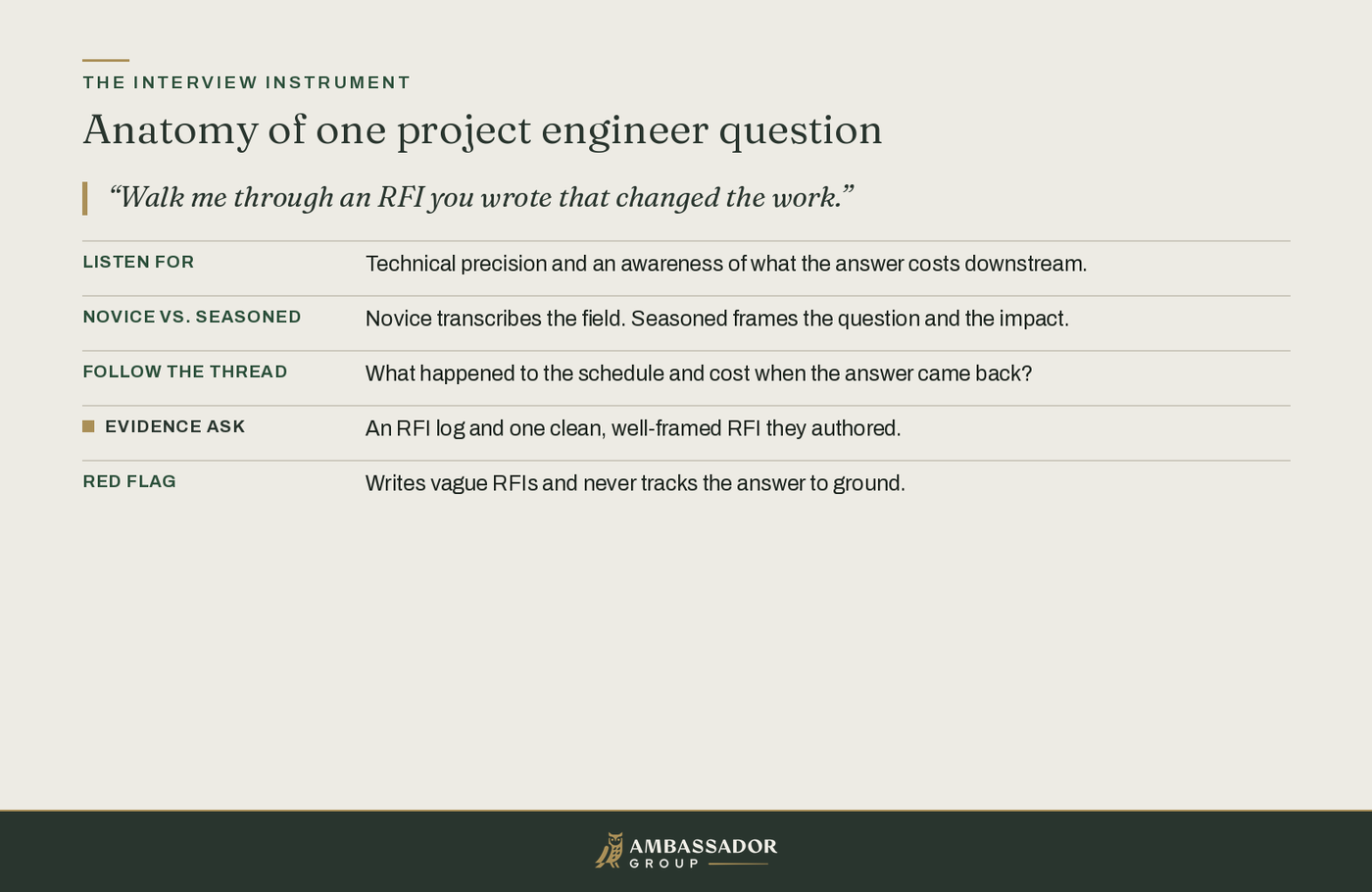
Show me how you write an RFI. Pick a real one you sent and reconstruct it.
- Listen for: a question built so the answer is unambiguous. A clear statement of the condition, the relevant drawing and detail references, the conflict or gap, and a proposed resolution where one is warranted.
- Novice vs seasoned: the novice asks an open question that hands the burden back to the architect ("please advise"). The seasoned candidate frames the issue, cites the contract documents, and proposes a path, which compresses response time and protects the schedule.
- Follow the thread: ask what happens when the answer comes back carrying a cost or time impact. Ask how they tracked the RFI so it did not vanish. Ask about an RFI that exposed a real design conflict and how they handled the downstream coordination.
- Evidence ask: ask for the structure of an RFI they authored that changed scope or cost, and how they linked it to a potential change order or PCO in the log.
- Red flag: an "ask the architect everything" reflex, with no attempt to resolve in the field first, signals someone who will flood the design team and erode the relationship.
Document control and as-builts
The unglamorous accountability that closeout lives or dies on. Probe for discipline that holds over months rather than a burst of effort at the end.
How did you keep the as-builts current, and who held the red pen?
- Listen for: a running cadence. Marking changes as they happened, reconciling RFIs, change orders, and field revisions into the record set, and a clear answer about whose marks were the source of truth.
- Novice vs seasoned: the novice admits the as-builts got "caught up at the end," which means reconstructed from memory. The seasoned candidate describes a weekly or monthly markup rhythm, a single controlled set, and a process for pulling the superintendent's field redlines into it.
- Follow the thread: ask what happened when the field made a change without telling anyone. Ask how they handled the gap between the super's redlines and the official set. Ask how they verified the record drawings matched what was built before turnover.
- Evidence ask: have them describe the record set from a project that closed out under their document control, how they reconciled it, and the form in which the owner received it at turnover.
- Red flag: treating as-builts as a closeout afterthought, with no running markup process, predicts an inaccurate handover the owner cannot trust.
Describe your system for version control on drawings and specs across the whole team.
- Listen for: a single controlled source, a clear method for distributing current sets, and a way to confirm the field is not building off a stale revision.
- Novice vs seasoned: the novice keeps files in a personal folder. The seasoned candidate describes a shared, permissioned set, a transmittal habit, and the moment they caught someone working from a voided sheet.
- Follow the thread: ask how they pushed a drawing revision to 12 subs in a way they could confirm landed. Ask what they did the time two versions were circulating at once.
- Evidence ask: ask about the transmittal log or document control structure they set up or inherited, and one change they made to it.
- Red flag: no method for confirming receipt of revised documents means revisions get lost, which is the most common silent source of field rework.
Quality and inspection support
The project engineer often runs the QC documentation backbone and coordinates inspections. Probe for whether they treat quality as a paper trail with teeth.
Walk me through how you prepared for and documented a major inspection.
- Listen for: pre-inspection coordination with the inspector and the subs, the inspection and test plan or checklist they worked from, and the records they produced for the file.
- Novice vs seasoned: the novice shows up the day of and takes notes. The seasoned candidate describes the pre-pour walk, confirming the work matched approved submittals, staging the right documents, and logging the result so it survives an audit.
- Follow the thread: ask about a failed or red-tagged inspection and what they did next. Ask how they tied inspection records back to the approved submittals and the spec section. Ask how they tracked open items to closure.
- Evidence ask: have them describe a QC log or inspection record set they maintained, plus one nonconformance report and how the deficiency moved from identified to closed.
- Red flag: treating inspections as the inspector's job rather than something the team prepares for signals someone who will let quality surprises hit the schedule.
Tell me about a time you caught work that did not match the approved documents.
- Listen for: that they were checking installed work against submittals and drawings, and that they raised it through the right channel rather than ignoring it or going around the chain.
- Novice vs seasoned: the novice has no such story, because they were processing paper instead of comparing it to the field. The seasoned candidate names the discrepancy, how they confirmed it, and how they got it corrected without blowing up a relationship.
- Follow the thread: ask how they were sure they were right before raising it. Ask who they took it to and why. Ask what the correction cost and who absorbed it.
- Evidence ask: ask for the specific condition, the spec section or detail it violated, and the NCR or field report that documented the resolution.
- Red flag: a candidate who would let a known nonconformance ride to avoid a hard conversation is wrong for a role whose value is catching things early.
Field-office communication
The bridge accountability. This is where junior credibility is won or lost, and it is the hardest thing to fake in an interview.
A superintendent tells you your RFI process is slowing him down. How do you handle it?
- Listen for: respect for the field's time, curiosity about what is breaking, and a way to hold the documentation discipline without caving or pulling rank they do not have.
- Novice vs seasoned: the novice either folds at once or hides behind process. The seasoned candidate goes to the field, finds where the friction is real, fixes what they can, and explains plainly why the parts that stay exist to protect the super downstream.
- Follow the thread: ask how they would rebuild trust with a superintendent who already wrote them off. Ask for a real instance of being caught between what the PM wanted and what the field needed.
- Evidence ask: have them reconstruct an actual exchange where they held a documentation requirement a senior field person resisted, and how it landed.
- Red flag: contempt for the field, or the assumption that the office outranks the trailer, predicts a project engineer the superintendent routes around inside a month.
How do you keep a project manager informed without either burying them or hiding a problem?
- Listen for: judgment about what rises and when, a regular reporting rhythm, and the instinct to surface a problem early with a proposed path rather than waiting until it is a crisis.
- Novice vs seasoned: the novice either reports everything or goes quiet when something goes wrong. The seasoned candidate describes a cadence, a sense of what the PM needs to decide versus merely know, and a story about flagging bad news early.
- Follow the thread: ask about a time they sat on something too long and what it cost. Ask how they decide what goes in a weekly report versus a same-hour phone call.
- Evidence ask: have them describe the format and rhythm of the status report or two-week look-ahead they owned to a PM.
- Red flag: a habit of withholding bad news to look competent. The office stops seeing the field clearly, which is the failure this role exists to prevent.
Technical and coordination support
Where the role touches layout, BIM, and trade coordination. Calibrate depth to your projects, but probe for spatial and technical literacy.
Describe your role in coordinating between trades, including any clash detection or model coordination you did.
- Listen for: that they can read a set well enough to see conflicts before the field does, and that they treat coordination as catching collisions in steel, MEP, and structure before money is spent.
- Novice vs seasoned: the novice has only seen models as pictures. The seasoned candidate names specific clashes they helped resolve, the coordination meetings they ran documents for, and how a model decision changed an install in the field.
- Follow the thread: if they have BIM exposure, ask about a clash they helped catch and what it saved. If layout is in scope, ask how they verified control points and handled a discrepancy between the model and field conditions.
- Evidence ask: ask for a specific coordination issue they tracked from identification to field resolution, plus the clash report or coordination sign-off that captured it.
- Red flag: model fluency that collapses under one specific follow-up suggests resume inflation on the most checkable technical claim in the role.
What part of layout or field engineering have you owned, and how did you verify your work?
- Listen for: a concrete grasp of control points, benchmarks, gridlines, and the habit of checking their own numbers against the documents before the trades build to them.
- Novice vs seasoned: the novice describes holding the dumb end of the tape. The seasoned candidate describes laying out a slab edge or anchor bolts, cross-checking against the structural set, and catching a bust before it got poured.
- Follow the thread: ask what they did when their layout disagreed with a field condition. Ask who they confirmed control with and how.
- Evidence ask: ask for a layout or field-engineering task they owned and the record that proved it was right, a survey check, a field measurement log, or a marked-up plan.
- Red flag: layout claimed but no verification step. Unchecked layout is poured concrete waiting to be demolished.
Learning posture and ownership
The trajectory accountability. It determines whether the hire becomes a project manager in 3 years or a clerk for 3 years.
What part of the job did you not understand a year ago that you understand now, and how did you close the gap?
- Listen for: a learner who pursues understanding, asks the field questions, reads the contract, and treats every RFI and change order as a lesson in how the project works.
- Novice vs seasoned: the novice describes learning a software feature. The seasoned candidate describes learning something structural about how a project makes or loses money, or how a relationship holds.
- Follow the thread: ask who they learned it from and how they sought that person out. Ask what they are deliberately trying to learn right now. Ask what they want to own in 2 years.
- Evidence ask: have them describe a process or document they improved on their own initiative, not because they were told to.
- Red flag: no growth story, or a candidate who frames the role as a holding pattern until a title arrives, plateaus and resents the work.
When you owned something on a project, what did ownership look like day to day?
- Listen for: a specific scope they carried to closure, the decisions they made without being told to, and the moment they took the weight rather than handing it up.
- Novice vs seasoned: the novice describes tasks assigned and completed. The seasoned candidate describes a piece of the project they ran, including a call they got wrong and what they changed after.
- Follow the thread: ask what they would have escalated and what they handled themselves. Ask how they knew the difference.
- Evidence ask: ask for one deliverable, a closeout package, a submittal register, a coordination log, that would not have existed in that form without them.
- Red flag: ownership described entirely as following instructions. This role needs someone who reaches for the next piece, not someone who waits for it.
What the candidate should be asking you
The interview runs both ways, and the point is making sure the role fits the candidate as much as the candidate fits the role. Pay attention to the questions they bring, because they reveal what kind of project engineer you are about to get.
A candidate worth hiring asks who they will learn from and how mentorship works here, which tells you they came to grow. They ask how the field and office relate at your company, which tells you they already understand where this role lives and dies. They ask what a project engineer who succeeded here went on to do, which tells you they are measuring trajectory. They ask how decisions get made when the field and the documents disagree, which tells you they have hit that wall before and want to know whether you have a real answer.
If the candidate has no questions, or only asks about hours and title, you have learned something. A feeder role with no curiosity in it does not feed anything. Be the Lightning Rod is about becoming the leader candidates reveal themselves to, and a leader who treats the bilateral half of the interview as wasted time is the same leader who later wonders why the hire never owned anything.
Do not leave the interview without capturing it
Write your feedback before the debrief. The moment you hear other voices, your own read blurs, and the project engineer interview is full of subtle signals that fade fast: the way a candidate distinguished approved-as-noted from approved, the half-second hesitation when you pushed on the model claim. Capture those while they are sharp.
Then tally the risk honestly across the role. For each accountability, decide one of three things. Fill: the candidate can do this now. Engineer around: there is a gap, but your team can cover it while the hire grows into it. Abandon: the gap is structural and you are pretending it will close on its own. A project engineer with two or three abandon marks on the technical accountabilities is a year of doing the work yourself with a title attached to it.
Name what you did not assess. Most interviews never touch document control discipline under deadline, or how the candidate behaves when a superintendent dismisses them, because those are uncomfortable to probe. If you skipped them, write that down and build the next conversation around the holes rather than re-running the parts the candidate already aced. The Seven Levels of Interviewing Mastery traces the climb from interrogator to instrument, and the holes are where most leaders stall on that climb.
Then decide against the role, not against your gut. A likeable candidate who cannot keep an as-built current is a likeable candidate who will hand the owner a fiction at closeout. The lens only works if you read it after you set down your enthusiasm.
The lens is yours
The candidate across the table is fixed. What they have done, what they understand, who they are becoming: none of it changes based on how well you interview. The only variable in the interview is you. A leader running these questions through a clear lens sees a project engineer in full. A leader running them through a foggy one hires the most confident voice and calls it instinct. The same discipline that sharpens a project engineer interview sharpens the roles beside it, the assistant project manager who will partner with this hire and the superintendent whose field this hire serves.
You already know which parts of your own read you tend to fill in with hope. The next interview is where you stop.
The short version.
- What should a construction project engineer interview focus on?
- The three spots where the role predictably breaks: technical rigor on submittals, RFIs, and as-builts; communicating across field and office while junior; and trajectory and ownership. The project engineer bridges the field and the office, so questions should pressure-test those break lines rather than run through a generic competency checklist across six accountabilities: submittal and RFI management, document control, quality and inspection support, field-office communication, technical coordination, and learning posture. Other roles follow the same method in our construction interview guides by role.
- How do I test a project engineer candidate's submittal and RFI skills?
- Have them walk through a submittal log they ran, from receipt to approved-for-construction, and reconstruct a real RFI they wrote. A seasoned candidate talks about lead times, long-lead items flagged early, the difference between approved and approved-as-noted, and keeping the field off superseded revisions; a strong RFI states the condition, cites drawings, and proposes a resolution. A candidate who cannot distinguish a submittal from a shop drawing, or whose reflex is to ask the architect everything, lacks the technical floor.
- What are red flags when interviewing a construction project engineer?
- As-builts that got caught up at the end, meaning reconstructed from memory; no method for confirming subs received revised drawings; treating inspections as the inspector's job; contempt for the field or the assumption the office outranks the trailer; a habit of withholding bad news to look competent; and no growth story. Each one predicts a specific downstream failure, from an untrustworthy closeout package to a superintendent who routes around the hire within a month.
- How can I tell if a junior project engineer will earn credibility with the field?
- Ask how they would respond to a superintendent who says their RFI process is slowing him down. The strong answer shows respect for the field's time, curiosity about what is breaking, and the ability to hold documentation discipline without caving or pulling rank they do not have: they go to the field, fix the real friction, and explain plainly why the parts that stay protect the super downstream.
- What questions should a strong project engineer candidate ask the interviewer?
- Who they will learn from and how mentorship works, how the field and office relate at your company, what a successful project engineer there went on to do, whether that was moving up to project manager, and how decisions get made when the field and the documents disagree. Those questions signal growth orientation and real understanding of the role. A candidate with no questions, or only questions about hours and title, has told you something too: a feeder role with no curiosity in it does not feed anything.


