
The company across the table came with questions for you. If you are like most operations leaders, you have spent 20 years learning to answer questions and almost no time deciding what to ask back. The questions to ask in a director of construction interview matter as much as the ones you will answer, because half of this decision is yours, and your half decides whether the mandate you were promised is the mandate you get. A company that wants an operating system built can be read by a sharp candidate, and a company that only wants the feeling of one can fool a hopeful one. The questions below are instruments. The discipline of listening is yours.
Most interview advice for candidates is about performing well: rehearse the stories, research the company, bring a few questions so you look engaged. This guide assumes you can already perform. It is about the other job you have in that conversation: deciding whether this company will let you build what it says it wants built. Plenty of companies want a Director of Construction the way a homeowner wants a gym membership: the purchase feels like the change. Deciding whether this one means it is an underwriting decision, and underwriting takes evidence, not vibes.
They are bringing an instrument. Bring your own.
A rigorous interviewer does not wing it. They will probe the 3 places a Director of Construction breaks: whether the standards you build outlive your personal attention, whether you can develop field and PM leaders across a whole company, and whether you can own operational results without holding the wheel on every job. They will ask to see artifacts: a standard still running without you, a staffing plan with names on it. You can read the exact instrument a disciplined interviewer runs on your role: director of construction interview questions. Read it.
And notice how they interview you, because it is evidence about them. A company that probes for a function-builder understands what it is buying. A company that hires the person who will design its entire operating system after 2 pleasant conversations about culture fit is showing you what it understands too. Free information that most candidates never collect.
You will not ask all of these at once. Earn the right first: answer their questions well, then ask yours, in the tone of a builder walking a job rather than an auditor working a file. The company and job questions belong in the first real conversation. The evidence asks and the team questions belong after mutual interest is on the table, where asking for the org chart reads as seriousness instead of presumption. Spread the rest across the process and let each conversation carry 2 or 3, asked well.
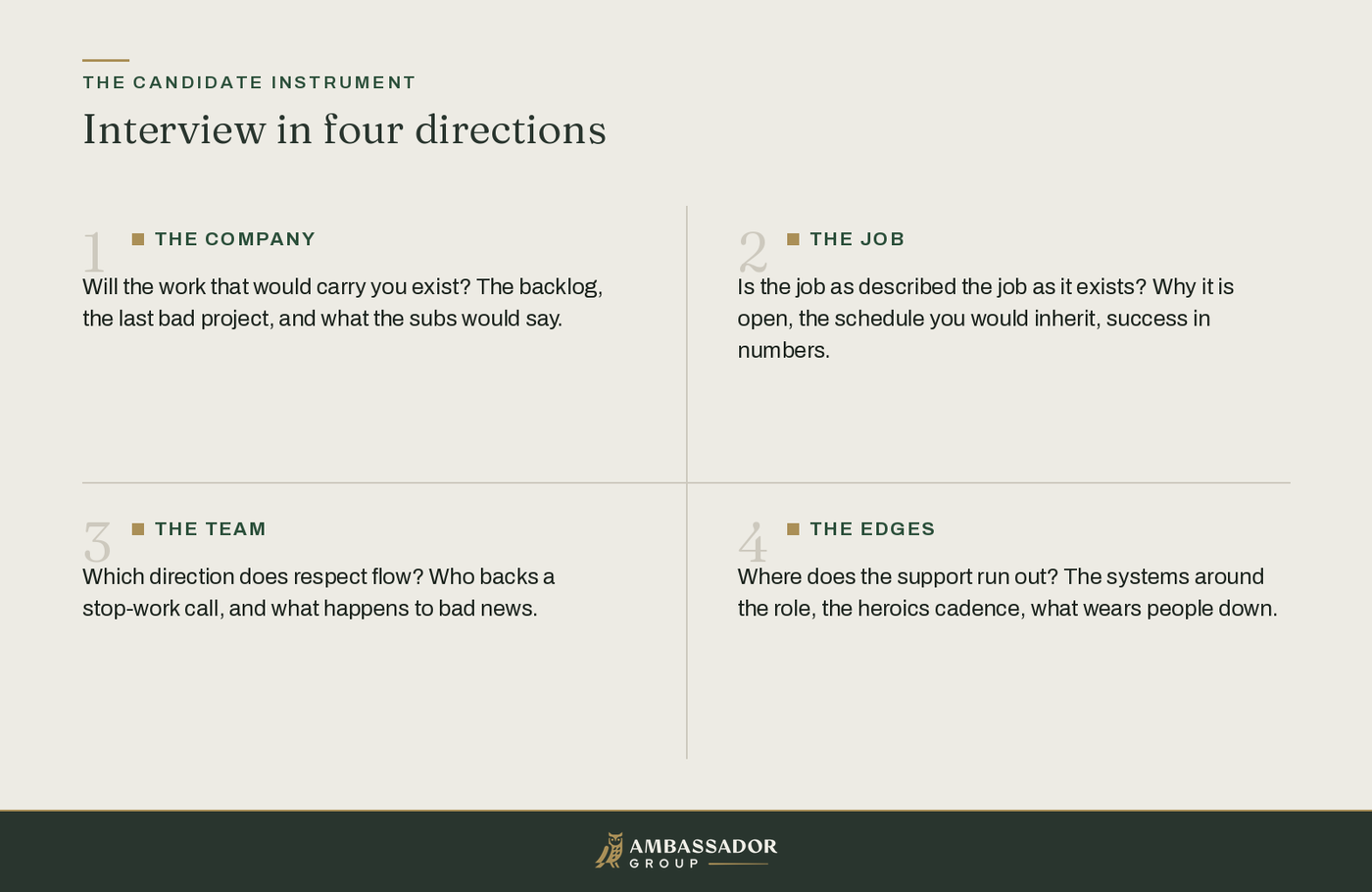
Your own questions run in four directions: the company, the job, the team, and the edges of the role. Each question comes with what to listen for, what an evasive answer sounds like next to a straight one, where to push, and what to ask to see. Give the edges the most care: a Director of Construction fails at the edges of the mandate more often than at the center.
Interview the company
The company is the material you would build with. A Director of Construction inherits its habits, its veterans, and its owner's relationship with control, and no operating system survives material that fights it. Directors get burned here: hired to build the machine by a company that wanted to be told it already had one.
"Why does this role exist now, and what happened in the year before you opened it?"
- What you are listening for: the honest origin. This role gets created for one of 3 reasons: growth outran the owner's span, operations slid into chaos, or somebody left. You need the true one: the origin story is the job underneath the job description.
- Evasive tell vs. straight tell: the evasive answer is unmarked growth language: scaling up, next level, nothing underneath it. The straight answer names the trigger: a job that went sideways, an owner spread across too many decisions, a predecessor and where they went.
- Follow-the-thread: ask what the company tried before deciding to hire for it. A company that tried something can describe what failed; a company that tried nothing is shopping for a savior, and saviors get consumed.
- Evidence ask: the role charter or scorecard, if one exists in writing. A company that scoped the role can show you the scoping; a company that cannot has bought a title and left the job to be discovered.
- Red flag: the role exists because the owner is tired. Fatigue is a fine reason to hire and a bad foundation for a mandate, because tired owners rest for a quarter and then reach for the wheel.
"What was the last operational change that stuck here, and who drove it?"
- What you are listening for: whether change survives in this company at all. You would be hired to make change stick, and the company's track record is your base rate.
- Evasive tell vs. straight tell: the evasive answer is continuous-improvement language with nothing named. The straight answer sounds like a story: the monthly project review the PMs fought and now defend.
- Follow-the-thread: ask where the person who drove that change sits today. Companies that promote their change agents will absorb yours. Companies that exhausted them will exhaust you.
- Evidence ask: the artifact the change produced, with project data removed: the startup checklist, the review format, the handoff protocol. A company proud of a change can show the thing itself.
- Red flag: every change that stuck was driven personally by the owner. Your standards will hold exactly as long as the owner's attention does.
"How much do you plan to grow, and what breaks first if you do?"
- What you are listening for: whether the growth plan has operational thinking behind it. A company that can name its constraint, the superintendent bench, precon capacity, one client's share of the book, has thought about what it is asking of you.
- Evasive tell vs. straight tell: the evasive answer treats growth as pure opportunity, with no constraint named. The straight answer has a number and a bottleneck, and the bottleneck is specific.
- Follow-the-thread: ask what the plan assumes about hiring, because a growth plan with no people plan is a promise the field will be made to keep.
- Evidence ask: the backlog by market or project type, and how much of it is signed versus hoped for. The shape of the book is a fair ask; the financials behind it are not.
- Red flag: the plan is to double, and the operations plan for doubling is you. That gap would be closed with your weekends.
Interview the job
The title is standard. The mandate is set one company at a time. One company hiring a Director of Construction means a function-builder with authority over standards, staffing, and delivery discipline. Another means a senior fixer with a better business card. Your work here is to measure the distance between the job as described and the job as funded.
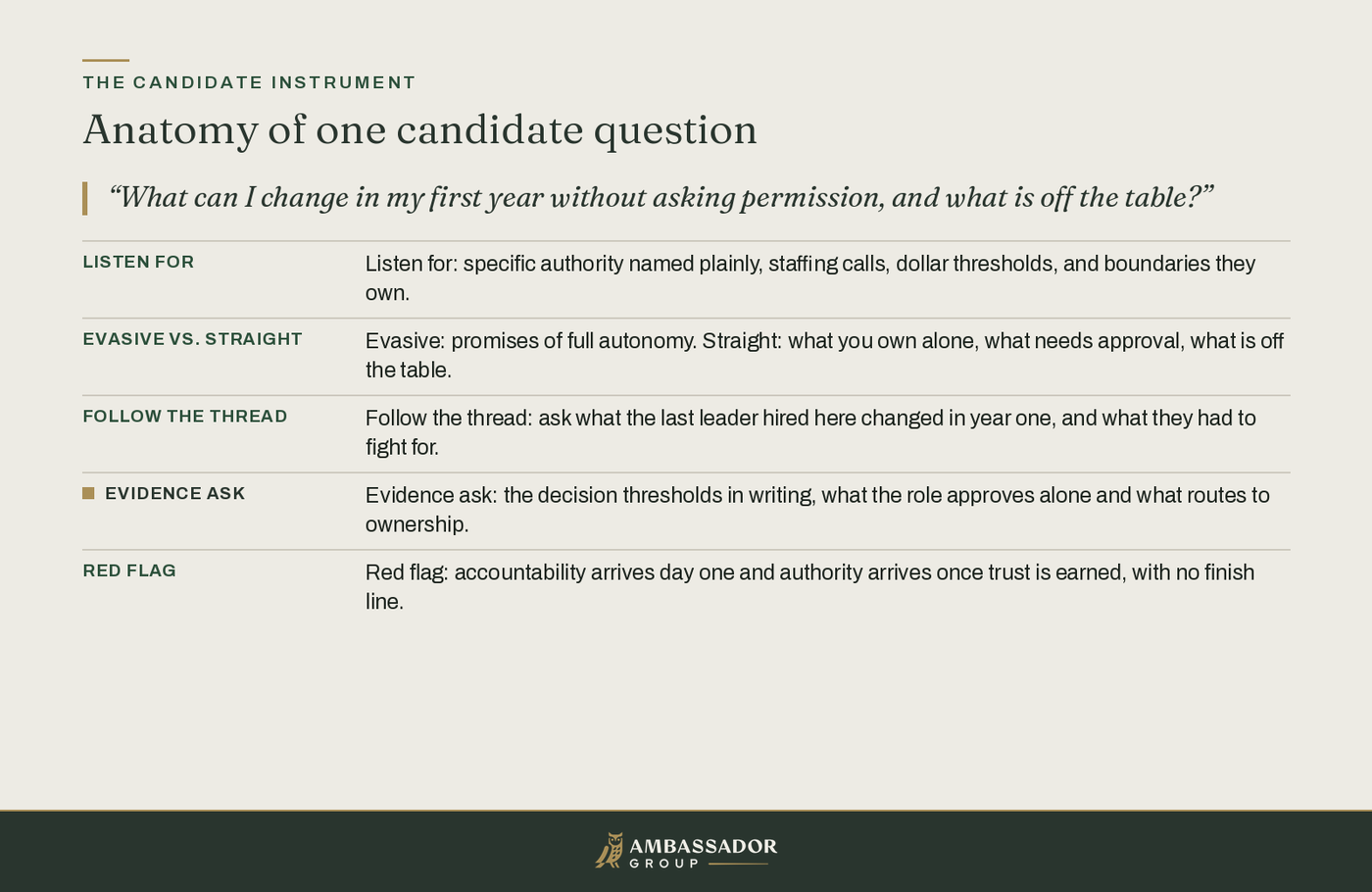
"What can I change in my first year without asking permission, and what is off the table?"
- What you are listening for: the real mandate. The most common failure in this role is accountability for operations without authority over the people or the systems, and this question measures that gap before you are standing in it.
- Evasive tell vs. straight tell: the evasive answer is a promise of full autonomy, which means the boundaries have never been thought about and you will find them by hitting them. The straight answer names specifics in both columns: staffing assignments are yours, the delivery platform is under contract until 2028, comp bands need ownership sign-off.
- Follow-the-thread: ask for the dollar thresholds: what this role approves alone, hires alone, buys alone. Then ask what the last leader hired at this level changed in year one, and what they had to fight for.
- Evidence ask: the decision thresholds in writing before you sign: what the role approves alone and what routes to ownership. Companies that intend to delegate can name numbers; companies that intend to supervise prefer the question stay vague.
- Red flag: accountability arrives on day one and authority arrives "once trust is earned." Trust with no defined finish line is a leash.
"Walk me through your operations meeting: who attends, what does it run on, and what happened in the last one?"
- What you are listening for: whether an operating rhythm exists, or whether you would build one from bare ground. The operations meeting is the smallest honest unit of an operating system: a cadence, the people in it, and the artifact it runs on.
- Evasive tell vs. straight tell: the evasive answer is constant communication, everyone talking all day. Communication without cadence is rumor. The straight answer has a day of the week, names, a report the meeting runs on, and a decision the last one produced.
- Follow-the-thread: ask what happens when a project shows red. If nothing ever shows red, the meeting is theater and the truth travels by phone at night.
- Evidence ask: the meeting format or the report it runs on, with project data removed. What the report tracks and how the last decision got logged shows you whether the rhythm is real, without exposing another project's numbers.
- Red flag: there is no operations meeting, and the owner describes that as agility. That company is run by hallway and cell phone.
"12 months in, how will ownership know this hire worked?"
- What you are listening for: whether success exists in a form you can hit: field turnover, margin fade trend, schedule reliability, a standard live on every job, the owner's calendar clear of daily operations.
- Evasive tell vs. straight tell: the evasive answer is relief language: things run smoother, fewer problems land on the owner's desk. The straight answer sounds like a scorecard, because somewhere behind it there is one.
- Follow-the-thread: ask what would make them call this hire a mistake. A company that can describe failure has thought harder than one that can only describe hope.
- Evidence ask: the success criteria on paper. If nothing exists in writing, the reaction to the question tells you whether they want an operating partner or a purchase.
- Red flag: success is defined as taking things off the owner's plate. A plate refills at the owner's discretion; you cannot hit a target that lives in somebody's mood.
Interview the team
Directors of Construction rarely fail on operational skill. They fail on alliances: the executive who loves the new standard until it costs a favorite client speed, the 20-year superintendent whose real reporting line runs straight to the owner, the leadership team whose boundaries blur where your accountability begins. The team decides whether your standards become policy or stay suggestion.
"Tell me about the last time a standard cost a favorite client speed. What did your executives do?"
- What you are listening for: whether backing survives its first invoice. The test arrives the first time a quality gate makes a favorite client wait, and whoever blinks in that moment is the real operations policy.
- Evasive tell vs. straight tell: the evasive answer is that clients here respect the process, with no story attached. The straight answer names a moment: the standard held, and somebody senior made the call to the client personally.
- Follow-the-thread: ask who owns the major client relationships, because if every one of them belongs personally to the owner, every standard you set has an appeals court.
- Red flag: the biggest client already runs on its own set of exceptions. You would inherit a two-track operation where the standard applies only to whoever lacks the power to object.
"Who has been running work here the longest, and what happens when they disagree with a new standard?"
- What you are listening for: the informal org chart. The veterans carry the company's real operating system in their habits. You are asking whether the company will make you their leader in fact or only on paper.
- Evasive tell vs. straight tell: the evasive answer is that everyone is excited for this hire. The straight answer has names and texture: who will be hardest to move, why they are worth moving, and what the owner has done to prepare them.
- Follow-the-thread: ask what happened the last time a veteran and a new leader collided, and who is still there.
- Evidence ask: conversations with the senior superintendent and the longest-tenured PM, without a chaperone. The speed of the yes tells you whether the company trusts its own people to speak.
- Red flag: the veterans found out about this role when you did. You would arrive pre-cast as the owner's plan being done to them.
"Walk me through the leadership team I would join: who owns what, and where do the lines blur?"
- What you are listening for: whether the boundaries around this role are real: where precon hands off to operations, who owns estimating's relationship with the field. Blurry lines around a Director become the Director's fault within a year.
- Evasive tell vs. straight tell: the evasive answer recites a clean org chart with friction nowhere, which means it is unexamined. The straight answer names the blur and describes how the last boundary dispute got resolved.
- Follow-the-thread: ask which function this role will collide with first, and watch whether the answer comes fast. Self-aware leadership teams know their fault lines.
- Evidence ask: the org chart with names on it, not boxes. A company hiring at this level shares its org chart with a finalist. Hesitation means the chart is embarrassing, fictional, or about to be redrawn.
- Red flag: half the boxes report to the owner directly. The company is still deciding whether to have a Director of Construction at all, and the org chart is where the hedge shows.
Find the edges of the role
Every role has edges: the places where the job is hardest and the support runs out. Edges are where pressure reveals the organization's leadership competency. For this role the edges cluster around one question: can this company be run by someone whose name is not on the door? Most Directors discover the answer in month 6; asking now means finding it while it costs you nothing.
"What does the company put around this role: who builds the reports, who runs the systems, who recruits for the field?"
- What you are listening for: whether the role comes with an organization or arrives alone. At some companies the Director inherits a project engineer pipeline, scheduling support, and working software. At others the title is a department of one, expected to design the machine while personally operating it.
- Evasive tell vs. straight tell: the evasive answer is a promise that you will have whatever you need, which is a budget decision nobody has made yet. The straight answer names who does what today and separates what exists from what is planned.
- Follow-the-thread: ask what the company invested in operations support in the last 2 years: people, software, process. Investment is where priorities stop being talk.
- Evidence ask: the current operations support on paper: names, roles, and which delivery systems are live today, with the gap between systems purchased and systems used.
- Red flag: the plan is that you will figure out what you need and ask for it later. That sequence converts every future request into a cost you created.
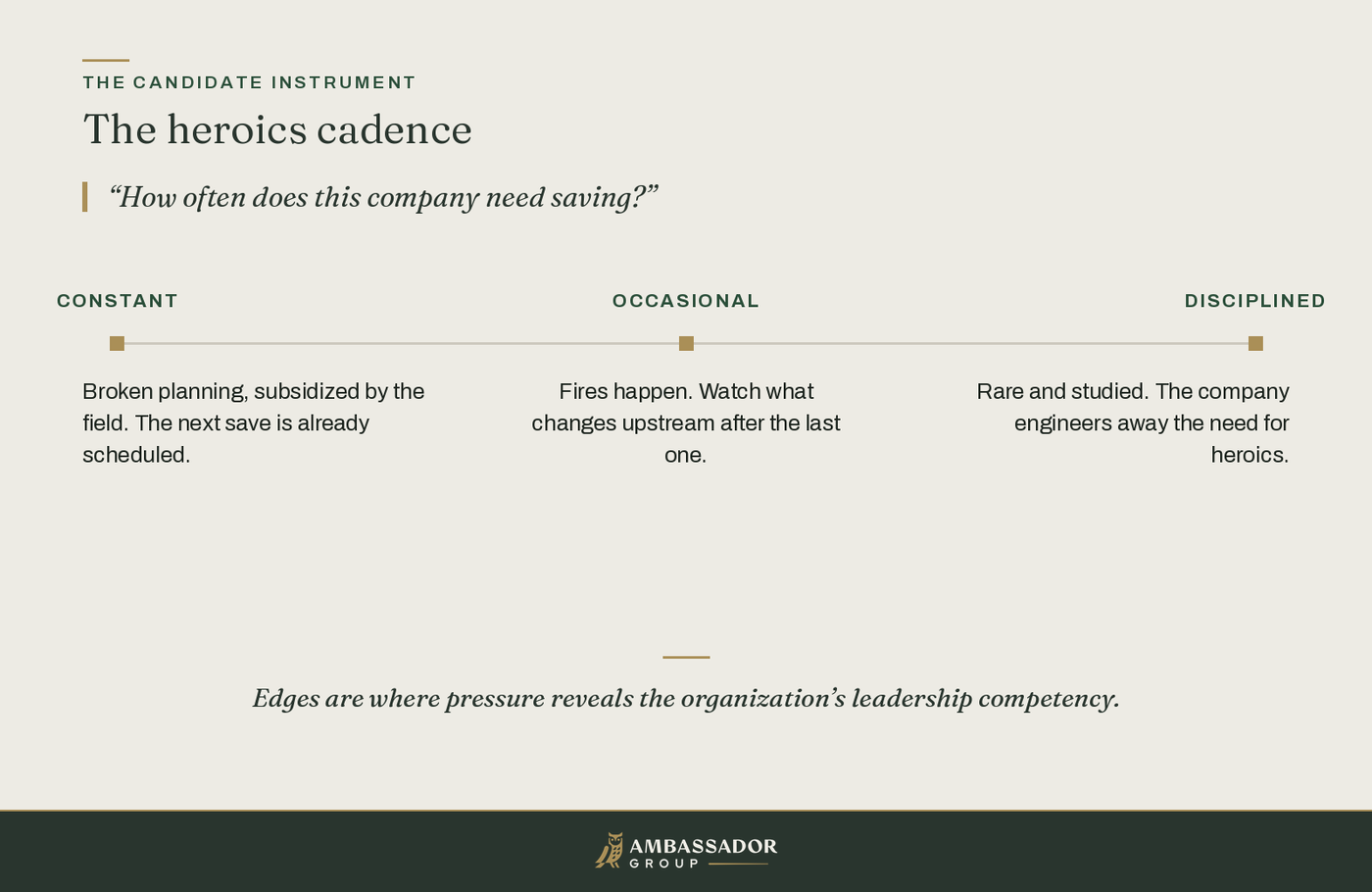
"Tell me about the last time this company needed heroics from operations. How often does that happen?"
- What you are listening for: the heroics cadence. Some companies require heroics constantly, some occasionally, and some are disciplined about avoiding the situations that require them. A firefighting culture is often sold to a Director of Construction as a building opportunity. The difference is whether the company wants the fires out or has learned to love the smoke.
- Evasive tell vs. straight tell: the evasive tell is pride: war stories told with a grin, all-nighters worn as culture. The straight answer names the last real fire, what it cost, and what changed upstream so it does not repeat.
- Follow-the-thread: ask what changed after the last one. If the answer is nothing, the next save is already scheduled, and you are interviewing to perform it.
- Red flag: the recruiting pitch for this role is a montage of saves. A company that courts you with its fires expects you to love them too, and it will measure you by how brightly you burn.
"You have run operations yourself for years. What will you hand off, and what will you keep?"
- What you are listening for: whether the owner can let go of operations, which decides this role's fate more than anything on your resume. An owner who built the company by making every call carries that habit as muscle memory, and muscle memory does not read org charts.
- Evasive tell vs. straight tell: the evasive answer is a wish to get back to strategy, because strategy is what owners say when they have not chosen what to release. The straight answer lists specific handoffs with a timeline and can point to something already handed to somebody and left there.
- Follow-the-thread: ask what the owner will do with the time this hire frees. An owner with no answer will spend that time back in operations, standing behind you.
- Evidence ask: the division of responsibilities in writing before the offer: what routes to this role on day one, what transitions by month 6, what the owner keeps.
- Red flag: the last 2 people hired to take work off the owner's hands are gone. The pattern is the answer, and the job may be a test the owner needs candidates to fail.
Write it down before the offer shapes it
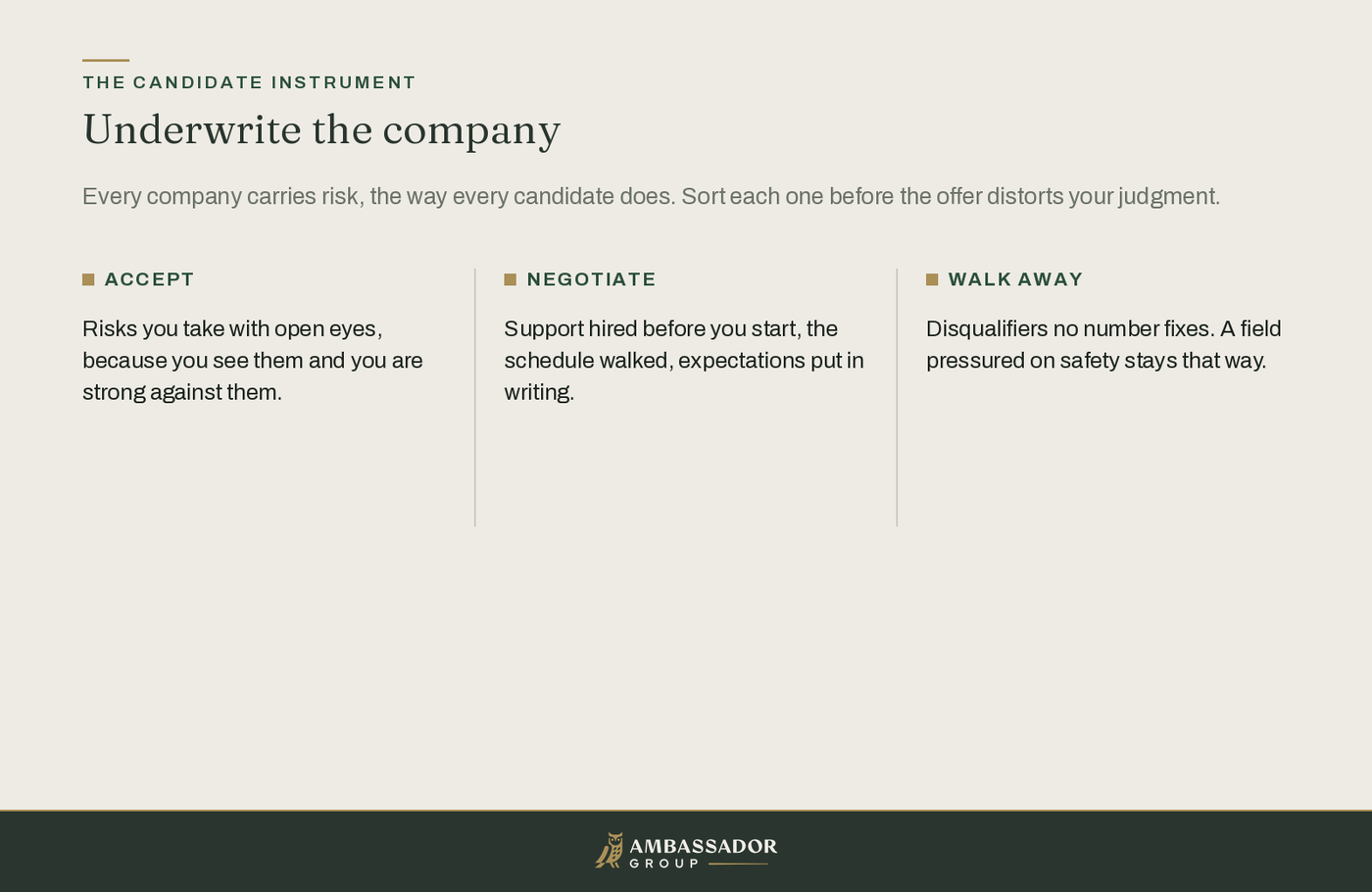
An offer distorts judgment, and at this level the offer arrives with courtship: dinners, growth talk, an owner calling you the missing piece. Once a number is on the table, everything you heard gets re-graded on a curve, and the edges you found start looking like quirks. The fix is the discipline a rigorous interviewer uses on candidates, pointed the other way. Underwrite the company before the offer arrives.
- Write your read the same day. After each conversation, write what you learned in the four directions: company, job, team, edges. By the third conversation your memory will be a blur of good feelings and one anecdote.
- Sort the risk: accept, negotiate, or walk. Some risks you accept: a thin support staff you know how to build around. Some you negotiate: the mandate in writing, decision thresholds named before you sign, the owner's handoff timeline on paper. And some are disqualifying no matter the number, because an owner who cannot let go does not change with the salary.
- Name what you did not assess. If you never met the veterans or saw the org chart, write that down as a hole, then go fill it. A company that refuses the extra conversation has answered a question too.
- Price the offer against the market, not against your current pay. A raise on an underpaid year is still underpaid. Know your market from data rather than folklore: the compensation benchmark exists for exactly this.
- Decide against your life, not against your current job. The question is whether this mandate clears the bar for the career you are building, not whether it beats the frustration you are escaping. The larger discipline of knowing that bar is a career's work, and Build to Last is a working manual for it.
The pre-offer checklist turns this into a worksheet you can run before you sign.
The other half of the decision
The company is running an interview to decide whether you can build their operating system. Somebody has to run the interview that decides whether they will let you; nobody else will. Ask plainly, follow the thread when an answer is thin, ask to see the artifact, and believe what the edges tell you. A company reveals itself under a good question the same way a candidate does.
The same four directions work one level up: the questions to ask in a VP of construction interview run them there. If your path ran through the field, the general superintendent guide points the same instrument at field command.
You already know how to build a system that tells the truth. Build this decision the same way: on evidence.
Ambassador Group represents construction leaders on both sides of the table and tells both sides the truth. If you want that kind of representation for your next move, send us your resume.
The short version.
- What questions should you ask in a director of construction interview?
- Ask in four directions: the company, the job, the team, and the edges of the role. Probe why the role exists now, the last operational change that stuck, what you can change in the first year without asking, and how the operations meeting runs. Ask what happened the last time a standard cost a favorite client speed, and whether the owner can hand off operations. The evasive answers teach you as much as the straight ones.
- How can a director of construction candidate test whether the role has real authority?
- Ask what you can change in the first year without asking permission and what is off the table. A straight answer names specifics: staffing calls you own, dollar thresholds you approve alone, and the boundaries that exist. A promise of full autonomy with no specifics means the boundaries have never been thought about, and you will find them by hitting them.
- What documents can a director of construction candidate ask to see before accepting?
- Ask for the org chart with names on it, the operations meeting format or the report it runs on, and the written success criteria for year 1. Ask for the shape of the backlog: how much is signed versus pursued. Internal financials and fee detail are off limits, but a company that scoped the role can show the scoping.
- What are the edges of a director of construction role, and why do they matter?
- Edges are where the job is hardest and the support runs out: whether the role comes with staff and systems or arrives alone, how often the company requires heroics from operations, and whether the owner can let go of the work. Edges are where pressure reveals the organization's leadership competency. Find them in the interview, while finding them costs you nothing.
- How should a director of construction evaluate a job offer?
- Write down what you learned the same day, before the offer distorts it. Sort each risk into accept, negotiate, or walk away, and get the mandate and the owner's handoff timeline in writing where you can. Price the offer against the market rather than your current pay, and decide against the career you are building instead of the job you are leaving.


