
The company across the table came with questions for you. You have probably prepared for every one and spent almost nothing deciding what to ask back. The questions to ask in a construction project engineer interview matter as much as the ones you will answer, because half of this decision is yours, and your half decides what the next 3 years teach you. This is the role where you learn how buildings get built; choosing a company is choosing your education. The questions below are instruments. The discipline of listening is yours.
Most interview advice at this stage of a career is about performing: rehearse your project stories, bring a few questions so you look engaged. This guide assumes you can perform. It is about the other job you have in that conversation: deciding whether this company will teach you the trade or spend your best learning years on data entry beside it. That is an underwriting decision, and underwriting runs on evidence.
They are bringing an instrument. Bring your own.
A rigorous interviewer does not wing it. They will probe the places a project engineer breaks: whether your submittal log protects the schedule or files paper, whether your documentation discipline holds when a superintendent with 30 years on you wants it gone. You can read the exact instrument a disciplined interviewer runs on your role: construction project engineer interview questions. Read it twice: once to prepare, once to learn what a serious company sounds like.
Notice, too: how they interview you is evidence about them. A company that tests your technical floor and asks how you keep a field crew off a superseded drawing is showing you how it makes decisions. A company that hands its entire document record to whoever seemed sharp in a 30-minute conversation is showing you the same. Both are free information, and the second should worry you more.
You will not ask all of these at once. Earn the right first: answer their questions well, then ask yours, in the tone of a builder walking a job rather than an auditor working a file. The company and job questions belong in the first real conversation. The evidence asks and the team questions belong after mutual interest is on the table, where asking to see the logs reads as seriousness instead of presumption. Spread the rest across the process; let each conversation carry 2 or 3, asked well. A sharp question, asked at the right moment, is also the fastest way to sound older than your resume.
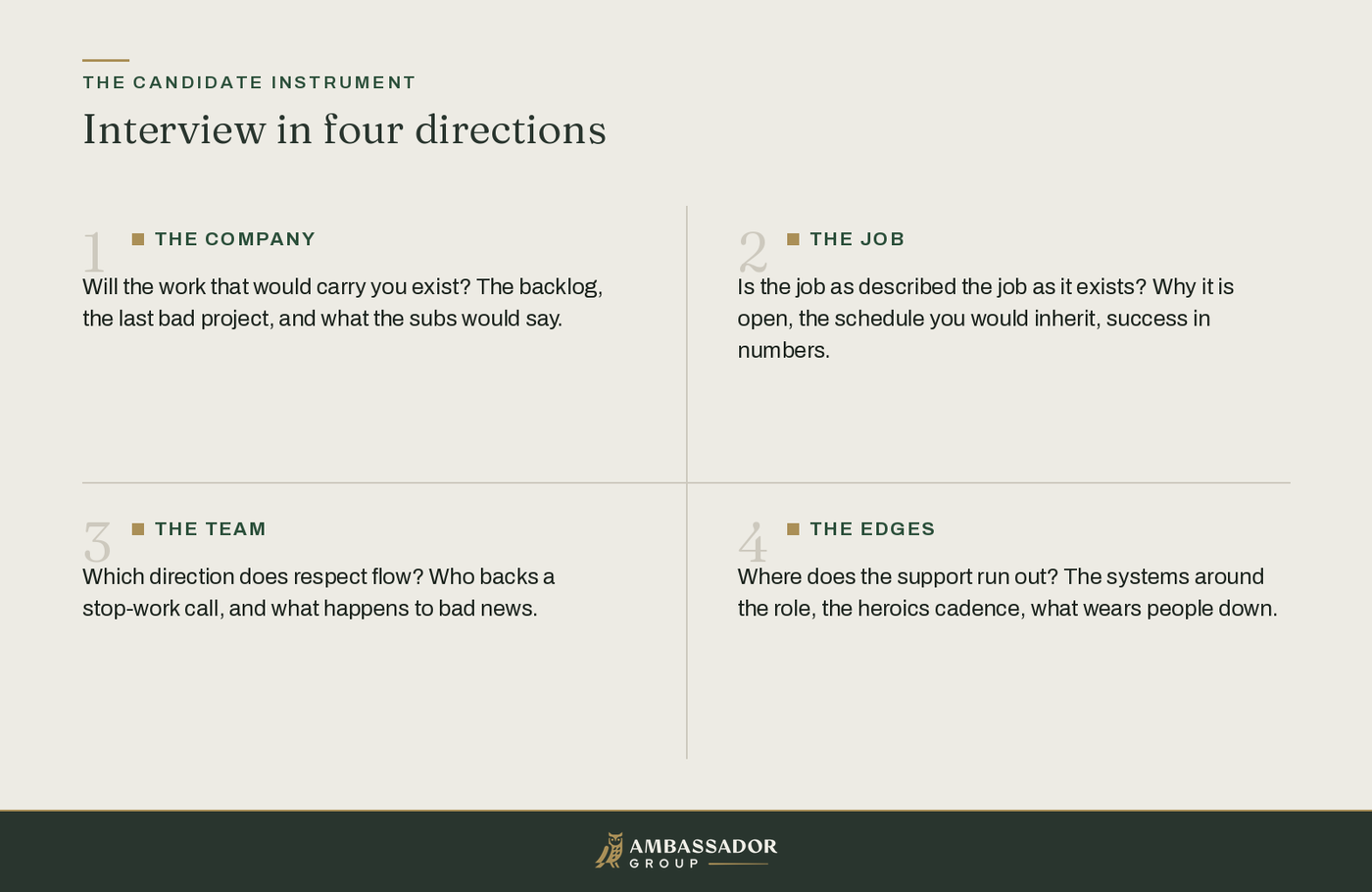
Your questions run in four directions: the company, the job, the team, and the edges of the role. Take them in that order. Each arrives with what to listen for, what an evasive answer sounds like next to a straight one, where to push, and what to ask to see. A handful of questions you know how to read are worth more than a page that fills the silence.
Interview the company
You are joining the company more than the project, and the company decides whether this role is an education or a clerkship: the same title at two different builders produces two different careers.
"What do the first 90 days look like for a project engineer here?"
- What you are listening for: a plan that has been run before: which systems you learn first, who teaches you, what you own by day 30 and by day 90.
- Evasive tell vs. straight tell: the evasive answer is "you will jump right in, the best training is doing." The straight answer has a sequence: shadow the PM through a full submittal cycle, take the RFI log in week 3, own the register by month 2.
- Follow-the-thread: ask who owned onboarding for the last engineer they hired, and how it went. A plan nobody owns is a hope.
- Evidence ask: the onboarding outline or training checklist they use for new engineers. A single page is enough; the existence of the page is the answer.
- Red flag: "sink or swim" said with pride. That is a company outsourcing its training program to your anxiety.
"What happens when a project engineer says, 'I do not know yet'?"
- What you are listening for: whether questions read as the job working or the hire failing. You will ask hundreds of questions in year 1, and the company's reflex determines whether you ask out loud or guess in private. A private guess is how a wrong revision reaches the field.
- Evasive tell vs. straight tell: the evasive answer is the slogan: "no such thing as a dumb question here." The straight answer is a story: an engineer who flagged what they did not know, who they took it to, and what the company did next.
- Follow-the-thread: ask the interviewer about the last question a junior engineer brought them. A leader who develops people can remember one; one who cannot is not being asked, and that silence has a cause.
- Evidence ask: a conversation with the most recently hired project engineer about their first 6 months. Ask what happened the first time they missed something.
- Red flag: any version of "we hire people who figure things out." In a documentation role that means learning by public error, on paper that reaches the owner with your name on it.
"What kind of work is in the backlog, and what would I get to build?"
- What you are listening for: whether the next 2 years of work exist, and what they would teach. Project mix is curriculum for an engineer: repeated building types teach depth, varied ones teach range, and hoped-for work teaches you what a layoff feels like.
- Evasive tell vs. straight tell: the evasive answer is pipeline optimism: "a lot of exciting opportunities in the pipeline." The straight answer names signed projects, their types, and which one a new engineer would likely land on.
- Follow-the-thread: ask which project they would put you on first, and why. Reasoning means someone has thought about your development; a shrug means you are capacity.
- Evidence ask: the shape of the backlog: how much is signed versus pursued, by project type. Contract values are off limits; the shape tells you whether the work that would carry your first 2 years exists on paper or in a business developer's optimism.
- Red flag: a backlog resting on one client or one pending award. When it slips, the newest engineer is the first line item reviewed.
Interview the job
The title says project engineer. The job is whatever this company, on this project, with this staffing plan, has made of it. One version teaches the whole trade in 3 years; another renames data entry. Your work is to find out which one is across the table.
"Which systems would I own outright: the submittal register, the RFI log, document control?"
- What you are listening for: the difference between owning and assisting. A role where you "help with" everything is a role where you own nothing, and nothing is hard to point to in your next interview.
- Evasive tell vs. straight tell: the evasive answer is breadth without weight: "you will be involved in all of it." The straight answer names the systems and the date: the RFI log is yours from day 1, the register transfers by month 2, and owning it means reporting status at the owner meeting.
- Follow-the-thread: ask who owns those systems today and what gets handed over. If the PM keeps the logs and you file what you are given, the title is larger than the job.
- Evidence ask: a walk through the submittal register and RFI log on a current project. You are asking for structure, ball-in-court, aging: none of that is confidential, and a company proud of its document discipline enjoys showing it.
- Red flag: nobody in the process can say which systems the role owns. Undefined ownership resolves to whatever nobody else wanted, and it resolves after you have signed.
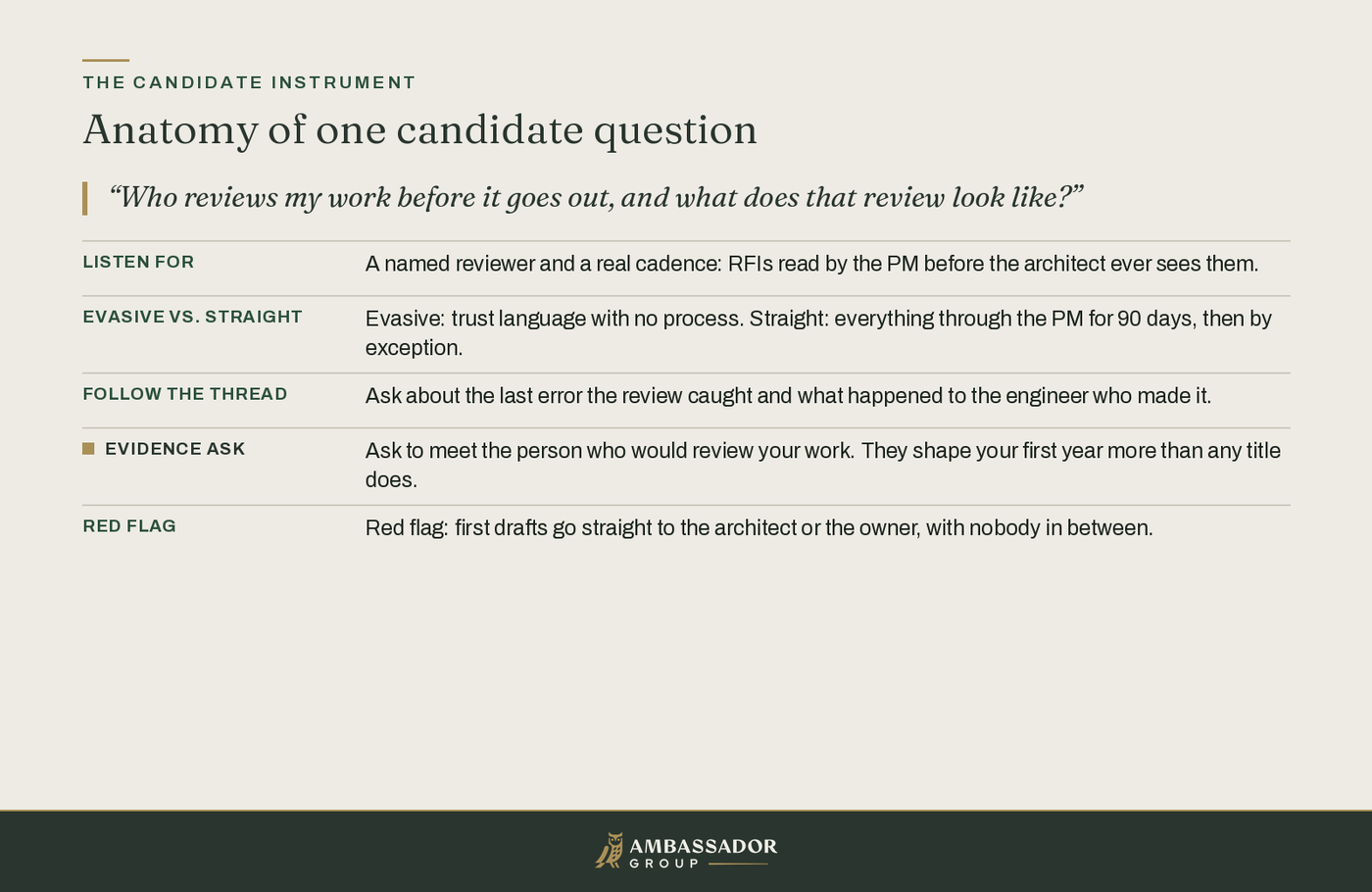
"Who reviews my work before it goes out, and what does that review look like?"
- What you are listening for: a real review net. RFIs read by the PM before the architect sees them, register entries spot-checked, someone over your shoulder in the early months. You want mistakes caught in front of one person who teaches, before they reach the owner's file.
- Evasive tell vs. straight tell: the evasive answer is trust language answering a process question: "we hire good people and trust them." The straight answer names the reviewer and the cadence, and how it loosens: everything through the PM for 90 days, then review by exception.
- Follow-the-thread: ask about the last error the review caught, and what happened to the engineer who made it. Correction with coaching and correction with a scar are 2 different companies wearing the same logo.
- Evidence ask: meet the person who would review your work, and ask them how they review. That person will shape your first year more than anyone with a bigger title.
- Red flag: your first drafts go straight to the architect or the owner. Freedom is the nicer word for that arrangement. The precise word is exposure.
"How much of the week would I spend in the field versus at a desk?"
- What you are listening for: whether field literacy is built into the role or left to chance. An engineer who never walks the job is logging fiction with confidence. Some companies rotate engineers through the field deliberately; at others the role lives in a trailer with a laptop.
- Evasive tell vs. straight tell: the evasive answer is "as much as you want," which hands a scheduling problem to the most junior person on the job. The straight answer describes a rhythm: the morning walk, inspection support, photographs for the daily log.
- Follow-the-thread: ask what the superintendent expects from a project engineer in the field; if the field expects nothing, it has learned to.
- Evidence ask: a site walk with the superintendent as part of the process. A company that will not put you in front of its field before hiring you has a reason, and the reason is rarely scheduling.
- Red flag: the current engineer has not been on the deck in a month and nobody finds that strange.
Interview the team
Project engineers rarely leave companies over document volume. They leave over being nobody's responsibility: a PM too buried to teach, a superintendent who treats the trailer as a nuisance. For a learning role, the team is the curriculum.
"Who would I learn from, and what does that look like in a normal week?"
- What you are listening for: a name and a cadence. Mentorship that exists shows up on a calendar: redlines reviewed together on Fridays, the walk after the owner meeting. Mentorship that is a value shows up in the brochure.
- Evasive tell vs. straight tell: the evasive answer is "everyone here helps everyone." The straight answer has a person and a habit: the PM reads every outgoing RFI with the engineer and explains the reasoning.
- Follow-the-thread: ask how the PM's workload leaves time for teaching. A PM stretched across 3 jobs may sincerely want to mentor you; wanting is different from having Tuesday afternoons.
- Evidence ask: a conversation with the PM you would report to, and one with a current or recent project engineer, without a chaperone. A company confident in its development hands you a phone number.
- Red flag: mentorship described entirely in the future tense: "that is something we are building." You would be the material it gets built from.
"Who was the last project engineer you promoted, and what did their path look like?"
- What you are listening for: whether the feeder role feeds, recently. This job exists to produce assistant project managers and project managers. A real path has a name, a timeline, and a gate you can hear.
- Evasive tell vs. straight tell: the evasive answer is opportunity in the abstract: "plenty of growth here for the right person." The straight answer sounds like a case: she ran closeout on the medical office job, took the APM title on the next project, and is running work 4 years in.
- Follow-the-thread: ask how many project engineers the company has hired in the last 5 years and where they are today. Promoted, retained, or churned: that distribution is the honest description of the role, whatever the posting says.
- Evidence ask: 15 minutes with the person they named. Someone who walked the path will tell you things the person describing it cannot.
- Red flag: every APM and PM in the company was hired from outside. The path exists on the org chart and nowhere else.
"How do your superintendents work with a new project engineer?"
- What you are listening for: whether the company builds the bridge between the trailer and the office or watches each new engineer swim the gap alone. You will hold documentation discipline with people who outrank you in every way except the org chart.
- Evasive tell vs. straight tell: the evasive answer is "our supers are great, you will love them." The straight answer describes structure: the superintendent is part of onboarding, and the PM explains the engineer's documentation duties to the field rather than letting friction explain them.
- Follow-the-thread: ask what happens when a superintendent decides an engineer's process is slowing him down. Who mediates, and does the documentation discipline hold or fold?
- Evidence ask: meet the superintendent you would serve, on site if possible. Watch whether they talk to you like a future colleague or like overhead that walks.
- Red flag: jokes about the field eating engineers alive. An interview joke is a workplace policy you have not met yet.
Find the edges of the role
Every role has edges: where the job is hardest, where the support runs out, where the organization's promises meet its habits. Edges are where pressure reveals the organization's leadership competency. For a project engineer the edges decide what kind of builder you become: that is where the learning either compounds or gets traded for survival. Most engineers discover them in month 3. Find them now, while the finding costs you nothing.
"Walk me through the team and systems around a project engineer on a typical job here."
- What you are listening for: whether the role arrives with structure or arrives alone. Some companies surround an engineer with real systems: a PM who owns their half, standard log formats, a shared document control standard. At others the engineer is the entire information system for the project.
- Evasive tell vs. straight tell: the evasive answer lists software licenses. The straight answer names who was on the last comparable project, what the engineer there owned, and which company standards let a new job start from a template, not a blank page.
- Follow-the-thread: ask what an engineer here spends time on that they should not have to. Self-aware companies answer fast.
- Evidence ask: the staffing plan for the project you would join, names and roles on paper. The distance between the org chart and the staffing plan is the distance you would personally cover.
- Red flag: one engineer stretched across several jobs "because they are sharp." Flattery is how understaffing recruits.
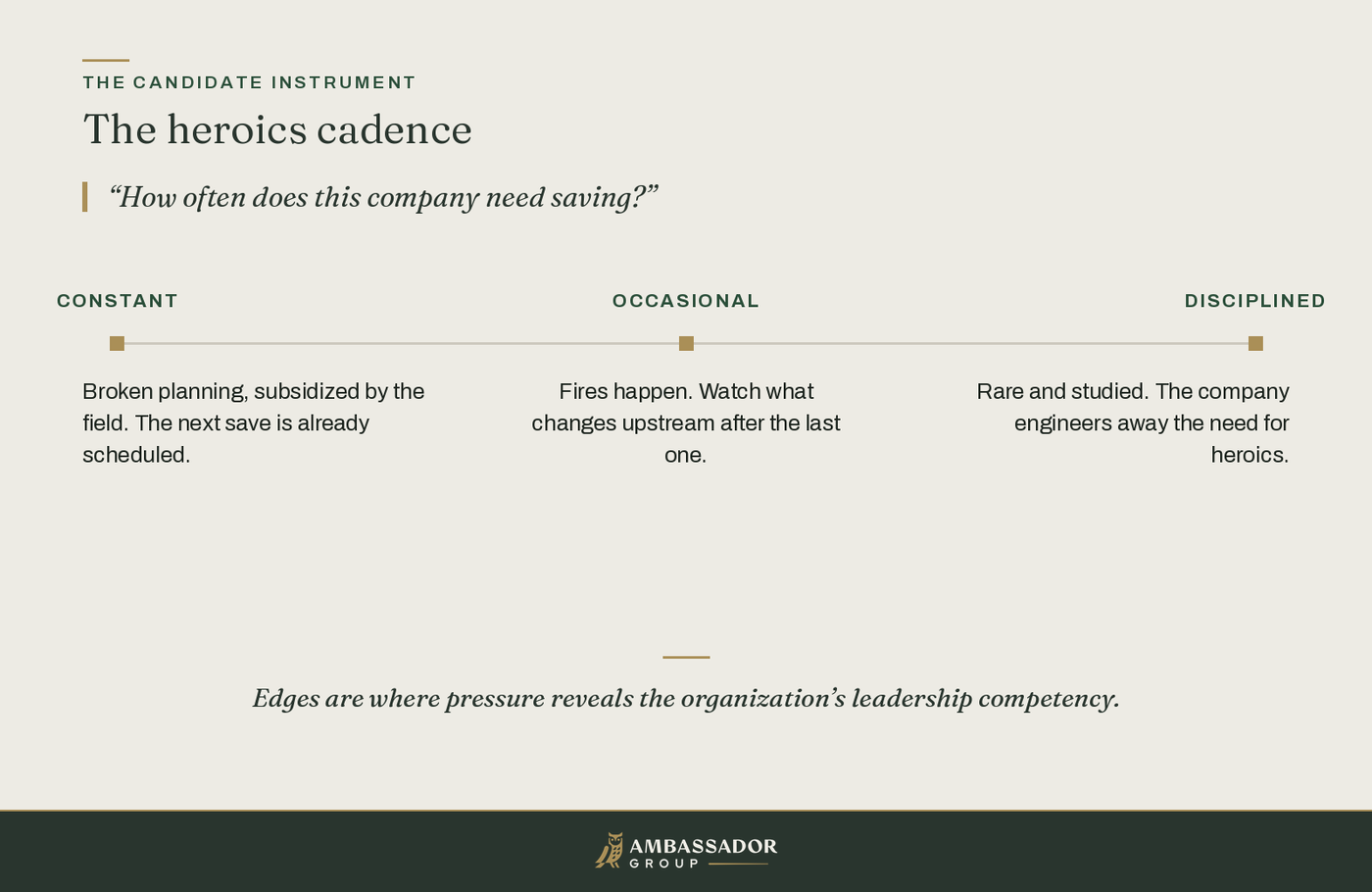
"Tell me about the last time the document side of a job needed heroics. How often does that happen?"
- What you are listening for: the heroics cadence. Some companies require heroics constantly, some occasionally, and some are disciplined about avoiding the situations that require them. For an engineer, heroics look like all-night submittal pushes, as-builts reconstructed from memory in the final month, closeout binders assembled over a weekend. You have a finite stock of those pushes in you.
- Evasive tell vs. straight tell: the evasive tell is pride: the all-nighter told as a founding myth. The straight answer names the last scramble, the upstream decision that caused it, and what changed so it does not repeat.
- Follow-the-thread: ask what changed after the last one. If the answer is nothing, the next scramble is already scheduled and you are interviewing for it.
- Evidence ask: the closeout on their most recently finished project: how long it took against what was planned. A company that measures it answers in weeks; one that cannot treats the end of every job as a surprise.
- Red flag: "we do whatever it takes" offered as a recruiting pitch. Whatever-it-takes has a schedule, and you just read it.
"How do you keep the document load from swallowing the learning?"
- What you are listening for: honesty about the volume, plus a deliberate counterweight. The paperwork is real: hundreds of active submittals, RFI churn, daily logs, meeting minutes. The question is whether the company treats the volume as the training or has built counterweights: protected field time, exposure to the owner meeting, review conversations that explain the reasoning.
- Evasive tell vs. straight tell: the evasive answer converts the grind into a perk: "you will touch everything." The straight answer names the heaviest document season on their kind of work and what they do so the engineer keeps learning through it.
- Follow-the-thread: ask what the last engineer wished they had spent less time on, and what the company has standardized in the last 2 years so engineers spend less time copying.
- Evidence ask: the workload, in numbers: active submittal count on a current job, open RFIs, and how many engineers carry it. Companies run these logs; the shape of the workload is a fair question, and a specific answer is the tell.
- Red flag: "you will wear a lot of hats" pointed at the most junior title on the job. In this role the hats are made of paper, and none of them comes with a teacher.
Write it down before the offer shapes it
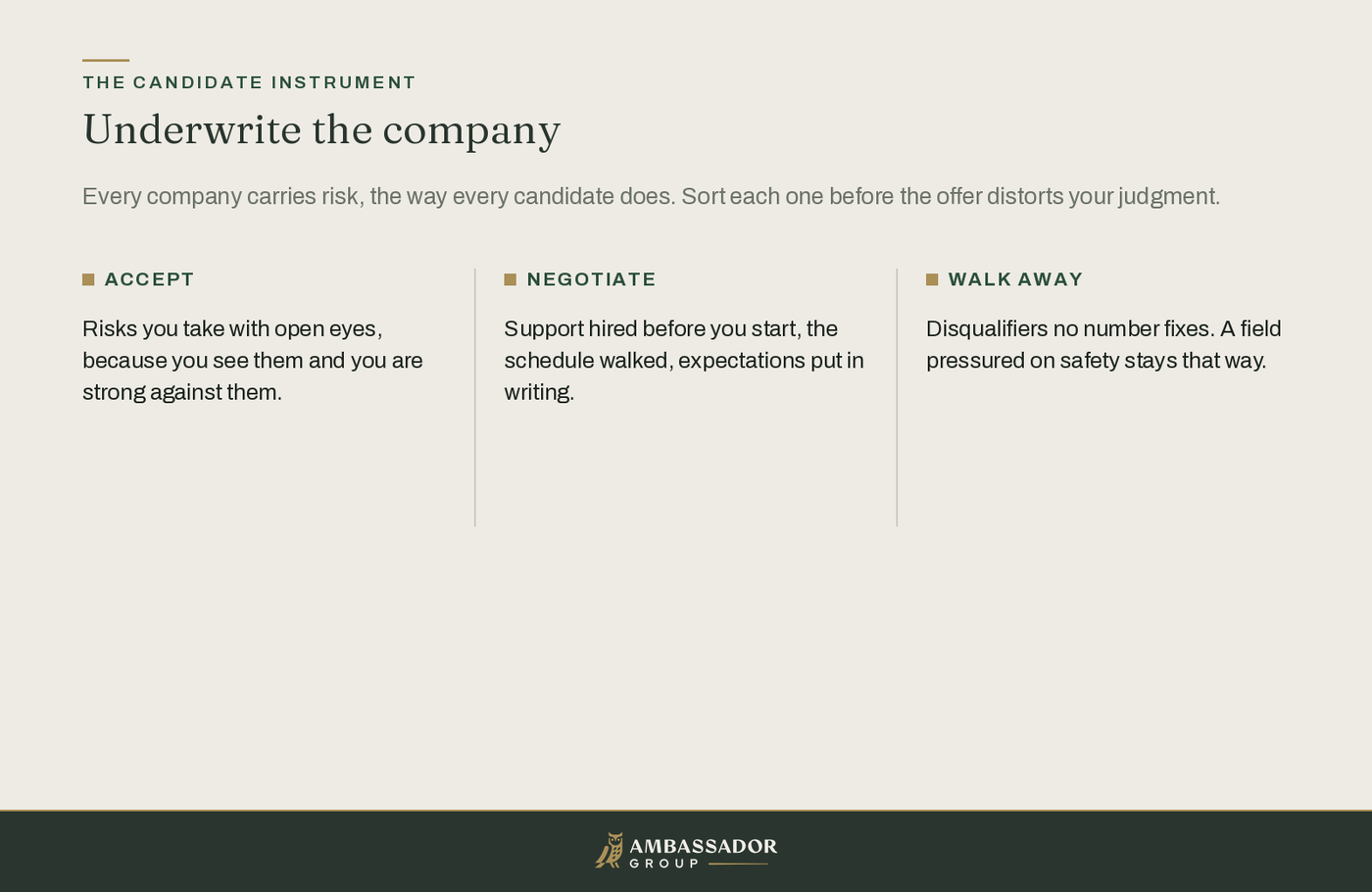
An offer distorts judgment, and a first or second offer distorts it most: relief negotiates badly. The moment a number is on the table, the missing mentor becomes a detail and the 3-job workload becomes a compliment. The fix is the one a disciplined interviewer uses on candidates, pointed the other way: underwrite the company before the offer arrives.
- Write your read the same day. Capture what you learned in the four directions: company, job, team, edges. Specifics, while they are fresh; by the third conversation your memory will be a warm blur and one anecdote.
- Sort the risk: accept, negotiate, or walk. Some you accept with open eyes: heavy document volume on a big healthcare job, if the mentorship around it is real. Some you negotiate: a named reviewer for your first 90 days, protected field time, the systems you will own put in writing. And some are disqualifying at any salary: a company where questions read as weakness is a company where you cannot learn, and the learning is the reason to take this job at this stage of your career.
- Name what you did not assess. If you never met the PM, saw the logs, or talked to a current engineer, write that down as a hole in your information, then go fill it. A company that refuses the extra conversation or the site walk has answered a question too.
- Price the offer against the market, not against your current pay. A raise on an underpaid year is still underpaid. Know the market from data: the compensation benchmark exists for exactly this.
- Decide against your life, not against your current job. The question is whether this role clears the bar for the career you are building, not whether it beats the job or the classroom you are leaving. Knowing that bar, your strengths, your direction, your worth, is a career's work, and Build to Last is a working manual for it.
The pre-offer checklist turns this into a worksheet you can run before you sign.
The other half of the decision
The company across the table is running an interview to decide whether you can carry their document record. Somebody has to run the interview that decides whether they deserve to shape your first years in the industry. Ask plainly, follow the thread when an answer is thin, ask to see the artifact, and believe what the edges tell you. The same four directions serve you at the next title: the assistant project manager guide and the construction project manager guide run the same discipline at higher altitude.
You are interviewing for the job where you learn how to build. Choose your teachers like it.
Ambassador Group represents construction leaders on both sides of the table and tells both sides the truth. If you want that kind of representation for your next move, send us your resume.
The short version.
- What questions should a project engineer ask in a job interview?
- Ask in four directions: the company, the job, the team, and the edges of the role. Probe how the company onboards engineers, which systems you would own outright, who reviews your work before it goes out, and who you would learn from in a normal week. Then find the edges: how often the job demands heroics and whether the document load swallows the learning.
- How can a project engineer candidate tell whether a company will teach them the job?
- Ask what the first 90 days look like and who owned onboarding for the last engineer hired. Ask for a named mentor and a weekly habit, ask who reviews an engineer's work before it goes out, and ask for the last project engineer promoted, with a name and a timeline. Companies that develop engineers answer with specifics, and companies that consume them answer with slogans.
- What can a project engineer candidate ask to see before accepting an offer?
- Ask to walk the submittal register and RFI log structure on a current project, and ask for the staffing plan with names and roles. Ask for a conversation with the project manager you would report to and with a current project engineer. The shape of the backlog, how much is signed versus pursued, is a fair question; contract values and sub pricing are off limits.
- What are the edges of a construction project engineer role?
- The edges are where the job is hardest and the support runs out: whether real systems and staffing surround the role, how often the company requires heroics like all-night submittal pushes or closeout scrambles, and whether the document volume crowds out the mentorship. Edges are where pressure reveals the organization's leadership competency. Find them in the interview, while finding them costs you nothing.
- How should a project engineer evaluate a job offer?
- Write down what you learned the same day, before the offer reshapes it. Sort each risk into accept, negotiate, or walk away, and put negotiable items like a named mentor and a review structure in writing. Price the offer against market data rather than your current pay, and decide against the career you are building, not the job you are leaving.


