
The company across the table came with questions for you. If you are like most estimators, you have spent almost nothing deciding what to ask them. The questions to ask in a construction estimator interview matter as much as the ones you will answer, because half of this decision is yours, and your half is the half that decides whether you are still glad you took the job in year 2. The quality of your next move is principally driven by you, not by the company recruiting you. A bad company can be read by a sharp candidate and missed by a hopeful one. You price uncertain work against incomplete documents for a living. Point that discipline at the company. The listening is yours.
Most interview advice for candidates is about performing well: rehearse your stories, research the company, have a few questions ready so you look engaged. This guide assumes you can perform. It is about the other job you have in that conversation, which is deciding whether this company deserves your judgment on its bids for the next 5 years. That is an underwriting decision, and underwriting takes evidence, not vibes.
They are bringing an instrument. Bring your own.
A rigorous interviewer does not wing it. They will probe the places an estimator breaks: whether your judgment holds when the documents are incomplete, whether your scope coverage is a method or a hope, whether your leveling survives bid-day pressure. They will push where your answers are thin and ask to see artifacts: a takeoff workbook, a qualifications page you wrote fresh instead of copying forward. You can read the exact instrument a disciplined interviewer runs on your role: construction estimator interview questions. Read it. Preparing for that level of judgment means arriving with specifics instead of adjectives.
And notice something while you are in the conversation: how they interview you is evidence about them. A company that runs a disciplined interview, with real probes and real listening, is showing you how it makes decisions. A company that hands its number, the thing the whole firm lives or dies on, to a stranger after 90 minutes of gut feel is also showing you how it makes decisions. Both are free information. Most candidates never collect it.
You will not ask all of these, and you will not ask them all at once. Earn the right first: answer their questions well, then ask yours, in the tone of a builder walking a job rather than an auditor working a file. The company and job questions belong in the first real conversation. The evidence asks and the team questions belong after mutual interest is on the table, where asking to see the bid calendar reads as seriousness instead of presumption. Spread the rest across the process and let each conversation carry 2 or 3, asked well.
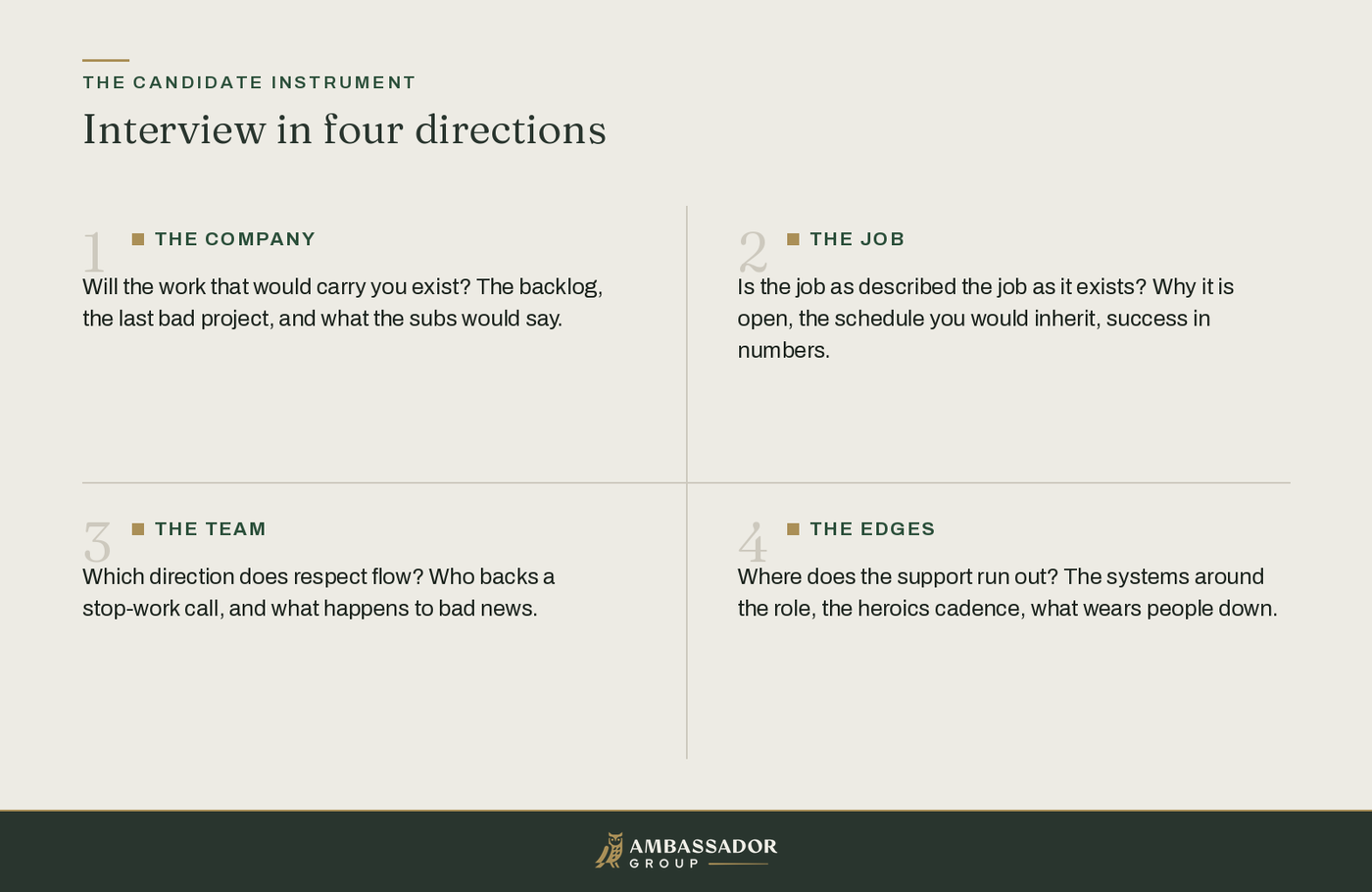
Your own questions run in four directions: the company, the job, the team, and the edges of the role. Take them in that order. Each question below comes with what to listen for, what an evasive answer sounds like next to a straight one, where to push, and what to ask to see. Four questions you know how to read are worth more than forty that fill the silence.
Interview the company
The company's bid strategy decides what lands on your desk: which work gets chased and at what margin. Estimators get ground down here more than anywhere: hired into a firm that bids everything, thinly, forever.
"What is your hit rate, and why do you win the work you win?"
- What you are listening for: honesty about the number and a theory behind it. A firm that knows why it wins can hand you biddable work at a survivable pace. One that wins on price alone needs your number lowest every time.
- Evasive tell vs. straight tell: the evasive answer is "we win our share" with no denominator. The straight answer is a number, cut by market or delivery method, and a plain reading of what it means.
- Follow-the-thread: ask which recent win they are proud of and which they wish they had lost. A regretted win, named, is the truth about thin work.
- Evidence ask: the contract-type mix over the last 2 years: hard bid, negotiated, design-build, CM at risk. Fee and margin detail is confidential and asking marks you as green; the mix is fair, and it tells you whether you would price relationships or lotteries.
- Red flag: a hit rate the company cannot explain, high or low. 1 win in 20 makes estimating a marketing expense, and you the expense.
"How does the company decide what to bid, and what did you last decline to price?"
- What you are listening for: a filter with authority behind it. Every pursuit that slips past a weak filter is priced with estimating's nights. A real go/no-go means fewer bids, better chosen.
- Evasive tell vs. straight tell: the evasive answer is appetite dressed as strategy: "we look at everything that fits our capabilities." The straight answer names the criteria and a project the firm declined, with the reason.
- Follow-the-thread: ask who can say no to a pursuit and when that last happened, then how far ahead estimating sees the pipeline. A bid that surfaces 4 days before it is due had no filter upstream.
- Evidence ask: how many pursuits the go/no-go killed last quarter. A count is the tell: a gate that never closes is a hallway.
- Red flag: the bid list is set by whoever wants the project most. Enthusiasm is a terrible filter, and the difference gets paid for at your desk.
"Would your subs say your bid invitations are worth answering?"
- What you are listening for: the company's reputation in the sub market, because your coverage depends on it. A firm subs trust gets 3 real numbers per trade. A firm subs avoid gets 1 late quote and a prayer.
- Evasive tell vs. straight tell: the evasive answer is "we have great sub relationships" with no names attached. The straight answer offers specifics: trade partners of a decade, numbers that arrive early, subs who call first when a market shifts.
- Follow-the-thread: ask which trades are hardest to get numbers from, whether losing subs get told the results, and whether pay applications move on time.
- Evidence ask: permission to talk to a trade partner who has bid their work for years. Sub pricing is confidential; a sub's read on the relationship is fair game, and confident companies hand you a name.
- Red flag: subs paid slow as a matter of policy. Coverage follows cash, and slow pay will one day hand you a bid due Thursday with 1 quote per trade.
Interview the job
The title says estimator. The job is whatever this specific company, with this specific bid strategy, has made of it. At one firm the estimator owns the number end to end; at another the same title covers takeoff and nothing else. Your work here is to close the distance between the job as described and the job as it exists.
"Which trades and scopes would I own, and who else touches the number?"
- What you are listening for: the shape of the desk, specific enough to compare against the work you want in 3 years: whole numbers on smaller work, divisions on larger, conceptual budgets, or support on the big pursuits.
- Evasive tell vs. straight tell: the evasive answer is "you will touch a bit of everything." The straight answer names the trades, the project types, the size band, and the split when 2 estimators share a bid.
- Follow-the-thread: ask what the last person in this role owned, and what happens to your scope when the senior estimator is buried. If everything urgent flows downhill, the job is overflow.
- Evidence ask: a walk through how the last real bid split across the team. The split on a real bid is the org chart that matters.
- Red flag: "we all do everything" in a department bigger than 2 people. Shared everything means owned nothing.
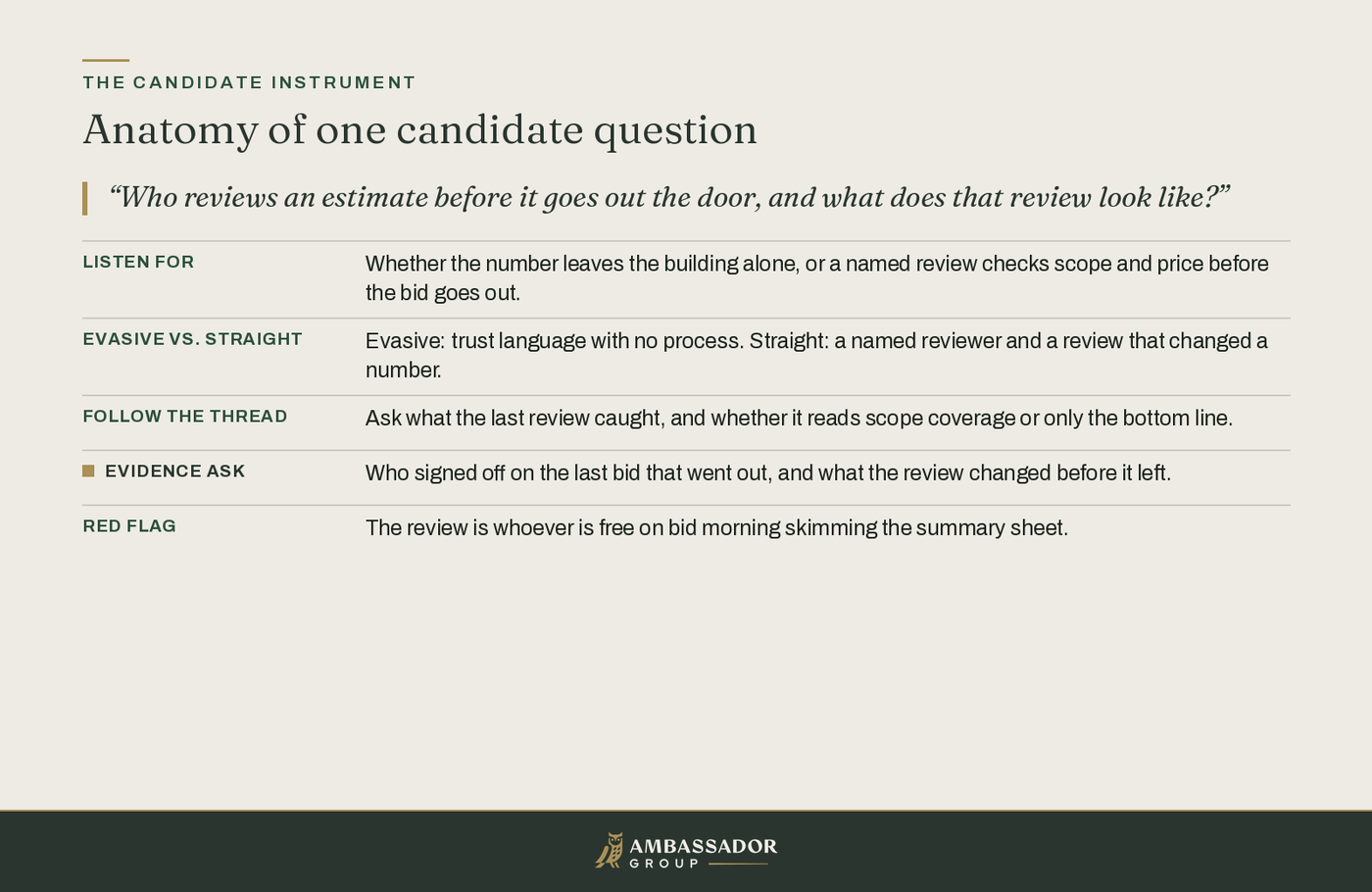
"Who reviews an estimate before it goes out the door, and what does that review look like?"
- What you are listening for: whether the number leaves the building alone. A disciplined firm puts a second set of eyes on scope coverage and a deliberate mind on markup before a bid goes out. A firm with no review is betting the company on your worst day.
- Evasive tell vs. straight tell: the evasive answer is flattery posing as process: "we trust our people." The straight answer names the reviewer, describes what the review checks, and can recall a bid the review changed.
- Follow-the-thread: ask what the last review caught, and whether the review reads scope coverage or only the bottom line. A review that only reads the total is a ritual, and rituals do not catch a missed scope.
- Evidence ask: who signed off on the most recent bid, and what changed between review and send. Firms with a real review have a recent story.
- Red flag: the review is whoever is free on bid morning skimming the summary sheet. The opposite pole flags too: a review so heavy your judgment is decoration.
"What would a good first year look like, in numbers an estimator can hit?"
- What you are listening for: whether expectations exist in a form you can measure: volume priced, coverage quality, buyout landing near the estimate, a hit rate read against the market rather than a wish.
- Evasive tell vs. straight tell: the evasive answer is chemistry language: "we will know it when we see it." The straight answer sounds like a scorecard, because somewhere behind it there is one.
- Follow-the-thread: ask how the last estimator's performance was measured and how often anyone talked to them about it. Then ask how the measure moves when the market turns and hit rates drop.
- Evidence ask: the measures the current estimating team is held to this year. A company that manages by numbers can state them.
- Red flag: success defined as wins alone. Hit rate is half strategy and half market; an estimator judged only on wins is judged on weather.
Interview the team
Estimators rarely leave companies over the spreadsheets. They leave over trust: the number cut in the final hour by someone who never read the assumptions, the loss pinned on the desk that priced it, the operations group that treats the estimate as fiction. The team is the job.
"Tell me about the last time estimating and leadership disagreed on a number. How did it end?"
- What you are listening for: whether your judgment would be trusted or decorative. Someone above you will own the final markup call, and that is right. The question is whether the estimate's risk flags survive the pursuit meeting.
- Evasive tell vs. straight tell: the evasive answer is harmony with no history: "estimating and leadership stay aligned here." The straight answer is a specific disagreement, who decided, and how the risk traveled with the bid.
- Follow-the-thread: ask what happens when leadership wants to strip contingency to win, and whether an estimator's no-bid recommendation has ever been honored. A recommendation that has never carried is a suggestion box.
- Evidence ask: the story of the last number that went out lower than estimating recommended, and how that job ended.
- Red flag: the cut happens and the record does not. If the number moves without a written trail, the next thin loss will be filed under your name.
"What does operations say about the estimates they inherit?"
- What you are listening for: the field's trust in the number, which is the truest performance review estimating gets. Where the handoff is real, project managers build from the estimate. Where it is theater, they re-estimate the job in week 1.
- Evasive tell vs. straight tell: the evasive answer is a partnership platitude. The straight answer describes the turnover: a meeting, a walkthrough of assumptions and exposures, a project manager who calls estimating during buyout instead of after the loss.
- Follow-the-thread: ask what happens when buyout beats the estimate, and when it misses. Bad-news-only meetings run feedback as prosecution.
- Evidence ask: a conversation with a project manager who built from a recent estimate. The PM's first unguarded sentence will tell you plenty.
"Who was the last estimator you grew into something bigger, and what did their path look like?"
- What you are listening for: whether the company develops estimators or consumes them. A real path, senior estimator to chief estimator, then into preconstruction leadership, walked recently, says estimating is a career here rather than a cost center.
- Evasive tell vs. straight tell: the evasive answer speaks of opportunity in the abstract. The straight answer has a name, a timeline, and what the company did to develop that person along the way.
- Follow-the-thread: ask what development looks like: site time on jobs you priced, exposure to precon strategy, a chief estimator who teaches. If the honest answer is "you will be busy bidding," you have learned the ceiling.
- Evidence ask: where the last 3 people in this role are now. Bigger jobs inside the company is one answer; gone within 2 years is another; not knowing is the worst.
- Red flag: every senior estimating and precon position filled from outside. The company either cannot grow leaders or does not keep them.
Find the edges of the role
Every role has edges: the places where the job is hardest, where the support runs out, where the organization's promises meet its habits. Edges are where pressure reveals the organization's leadership competency. An estimator's edges are specific: the tools and data behind the number, the cadence of bid-day fire drills, and what happens to the person who priced a job when the job loses or wins thin. Most candidates discover the edges in month 3. The whole point of asking is to find them now, while the finding costs you nothing.
"Walk me through the tools and data an estimator prices with here."
- What you are listening for: whether the desk comes with an instrument set or a blank page: takeoff software someone maintains, historical cost data worth trusting, help chasing sub coverage, administrative hands on bid day. Without them, you rebuild the firm's knowledge on every bid.
- Evasive tell vs. straight tell: the evasive answer is brand names as proof, software owned and unopened. The straight answer describes how the last bid used the tools and who keeps the cost data honest.
- Follow-the-thread: ask when the cost database last took in actual costs from a finished job, and what the company invested in estimating in the last 2 years. Investment is where priorities stop being talk.
- Evidence ask: a walkthrough of the estimating stack, and a straight answer to whether costs from finished jobs flow back into the data. Firms proud of their precon support love this question.
- Red flag: the historical cost data is one veteran's memory. When that person retires, the firm's pricing walks out the door; until then you price against folklore you cannot audit.
"Tell me about your last bid-day fire drill. How often does that happen?"
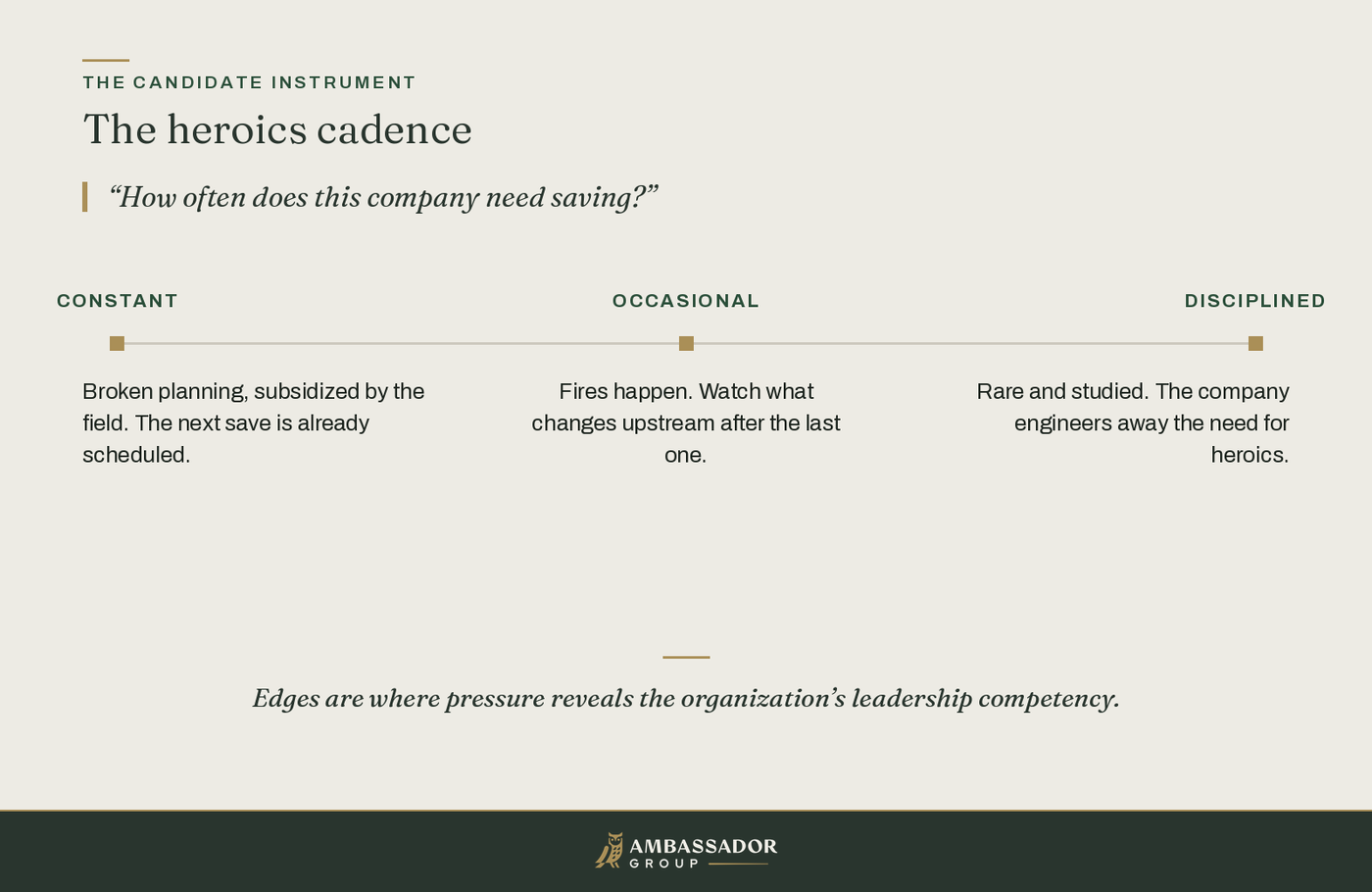
- What you are listening for: the heroics cadence. Some companies require heroics constantly, some occasionally, and some are disciplined about avoiding the situations that require them. Which is this one? Some fire is native to bid work; the tell is frequency.
- Evasive tell vs. straight tell: the evasive tell is pride: all-nighters told with a grin, pizza boxes as culture. The straight answer names the last real scramble, what caused it, and what changed upstream so it does not repeat.
- Follow-the-thread: ask how many bids an estimator carries in a normal month, and watch whether the answer is a number or a vibe. Then ask what happens when 2 deadlines land in the same week.
- Evidence ask: the bid calendar for a normal month, next to the department's headcount. Deadlines per estimator is arithmetic you can do across the table.
- Red flag: volume expectations answered with a shrug. A department that cannot state bids per estimator per month is staffed by hope, and hope works weekends. Yours.
"What happens to the estimator when a number loses? And when it wins thin?"
- What you are listening for: both halves of the feedback loop. On a loss: does anyone study why, or does the bid just disappear? On a thin win that goes over: does the estimator get the actual cost story, or only the blame? A firm where feedback arrives only as fault teaches its estimators to pad, and padding loses bids.
- Evasive tell vs. straight tell: the evasive answer is a slogan: "we win as a team and lose as a team." The straight answer describes a real loss review, a thin win discussed honestly, and a cost review that changed how something gets priced.
- Follow-the-thread: ask when actual cost data last changed a unit price in the estimating files, and who sits in the post-job review. A cost review that never reaches estimating is a filing exercise.
- Evidence ask: the post-job cost review cadence: whether one happens, how often, and the last time estimating sat in it.
- Red flag: the desk that priced a job hears about it again only when it lost money. That teaches estimators to hide risk in the number, and the lesson will be taught to you next.
Write it down before the offer shapes it
An offer distorts judgment. The moment a number is on the table, everything you heard gets re-graded on a curve, and the edges you found start looking like quirks. The fix is the discipline you already use on a sub's low number, pointed the other way: underwrite the company before the offer arrives.
- Write your read the same day. After each conversation, write what you learned in the four directions: company, job, team, edges. Specifics, while they are fresh. By the third interview your memory will be a blur of good feelings and one anecdote.
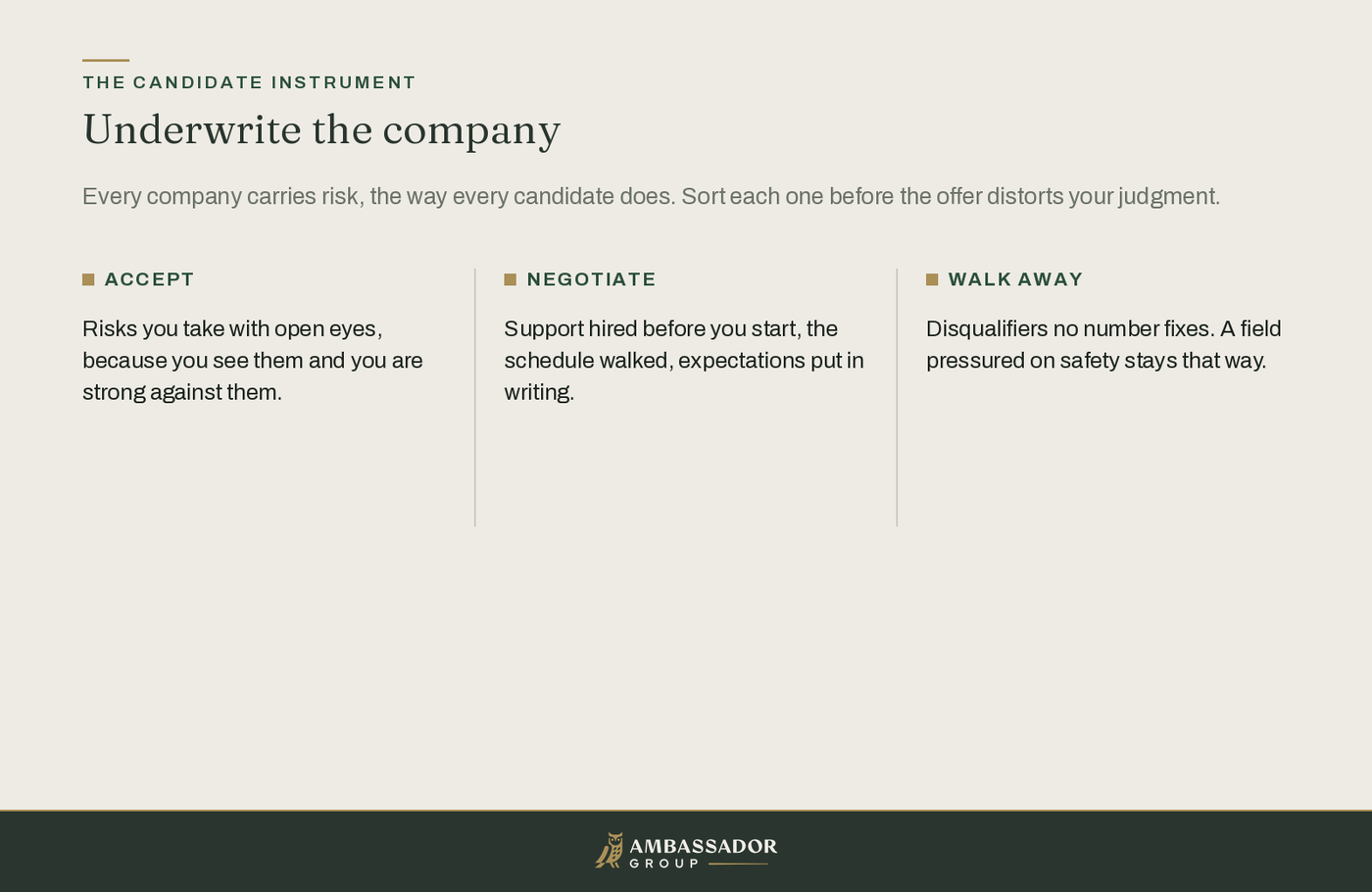
- Sort the risk: accept, negotiate, or walk. Every company carries risk, the way every bid set does. Some you accept with open eyes: a thin cost database you can build out, a volume cadence you can live with. Some you negotiate: a stated bid load, a named reviewer, expectations in writing. And some are disqualifying no matter the salary, because a company that cuts the number and hands the estimator the blame does not become different because it pays well.
- Name what you did not assess. If you never saw the bid calendar, never met the chief estimator, never heard how the last loss was handled, write it down as a hole in your information, then go fill it. Ask for the extra conversation. A company that refuses has answered a question too.
- Price the offer against the market, not against your current pay. A raise on an underpaid year is still underpaid. You would never price a scope from folklore; do not price yourself from it. The compensation benchmark exists for exactly this.
- Decide against your life, not against your current job. The question is whether this role clears the bar for the career you are building, not whether it beats the one you are escaping. Almost anything beats a job you already want to leave, which is why leaving is when estimators make their worst decisions. The larger discipline of knowing that bar, your strengths, your direction, your worth, is a career's work, and Build to Last is a working manual for it.
The pre-offer checklist turns this into a worksheet you can run before you sign.
The other half of the decision
The company across the table is running an interview to decide whether you fit the job. Somebody has to run the interview that decides whether the job fits you, and nobody else in the process is going to do it. Ask plainly, follow the thread when an answer is thin, ask to see the artifact instead of settling for the story, and believe what the edges tell you. A company reveals itself under a good question the same way a bid set does: in the gaps.
If your next move sits a level up, the same instrument adapts. The senior estimator guide points these questions at department leadership, and the preconstruction manager guide points them at the whole precon function. You already know how to price uncertainty. Price this.
Ambassador Group represents construction leaders on both sides of the table and tells both sides the truth. If you want that kind of representation for your next move, send us your resume.
The short version.
- What questions should an estimator ask in a construction job interview?
- Ask in four directions: the company, the job, the team, and the edges of the role. Probe the company's hit rate and why it wins work, which trades and scopes you would own, and who reviews an estimate before it goes out the door. Ask what happens when estimating and leadership disagree on a number. Then find the edges: bid volume per estimator, the tools and cost data behind the number, and what happens when a bid loses or wins thin.
- Why should an estimator interview the company as hard as the company interviews them?
- Because half the hiring decision belongs to the candidate, and it is the half that decides whether the job still fits in year 2. An estimator prices uncertain work against incomplete documents for a living, and choosing an employer is the same discipline pointed at a company. A bad company can be read by a sharp candidate and missed by a hopeful one.
- How many bids should one construction estimator handle per month?
- There is no universal number, but the company you interview with should have one. Ask how many bids an estimator carries in a normal month, and ask to see the bid calendar next to the department headcount. A firm that answers with a shrug instead of a number is staffed by hope, and hope works weekends.
- What are the edges of a construction estimator role, and why do they matter?
- Edges are where the job is hardest and the support runs out: the takeoff tools and historical cost data behind the number, the cadence of bid-day fire drills, and what happens to the estimator when a number loses or wins thin. Edges are where pressure reveals the organization's leadership competency. Find them in the interview, while finding them costs you nothing.
- How should a construction estimator evaluate a job offer?
- Write down what you learned the same day, before the offer distorts it. Sort each company risk into accept, negotiate, or walk away. Price the offer against market data rather than against your current pay, and decide against the life you are building, not the job you are escaping.


