
The company across the table came with questions for you. If you are like most superintendents, you have spent almost nothing deciding what to ask them. The questions to ask in a construction superintendent interview matter as much as the ones you will answer, because half of this decision is yours, and your half is the half that decides whether you are still glad you took the job in year two. The quality of your next move is principally driven by you, not by the company recruiting you. A bad company can be read by a sharp candidate and missed by a hopeful one. The questions below are instruments. The discipline of listening is yours.
Most interview advice for candidates is about performing well: rehearse your stories, research the company, have a few questions ready so you look engaged. This guide assumes you can already perform. It is about the other job you have in that conversation, which is deciding whether this company deserves you on its jobsite for the next five years. That is an underwriting decision, and underwriting takes evidence, not vibes.
They are bringing an instrument. Bring your own.
A rigorous interviewer does not wing it. They will probe the places a superintendent breaks: whether your schedule stays real under pressure, whether your safety line holds when holding it costs a day, whether your standard slips when accepting the work is the easy call. They will ask what a strong answer sounds like, push where yours is thin, and ask to see artifacts: a look-ahead you maintained, a recovery schedule you built. You can read the exact instrument a disciplined interviewer runs on your role: construction superintendent interview questions. Read it. Preparing for that level of judgment means arriving with specifics instead of adjectives.
And notice something while you are in the conversation: how they interview you is evidence about them. A company that runs a disciplined interview, with real probes and real listening, is showing you how it makes decisions. A company that hires the most consequential field role on the project after ninety minutes of gut feel is also showing you how it makes decisions. Both are free information. Most candidates never collect it.
You will not ask all of these, and you will not ask them all at once. Earn the right first: answer their questions well, then ask yours, in the tone of a builder walking a job rather than an auditor working a file. The company and job questions belong in the first real conversation. The evidence asks and the team questions belong after mutual interest is on the table, where asking to walk the schedule reads as seriousness instead of presumption. Spread the rest across the process and let each conversation carry two or three, asked well.
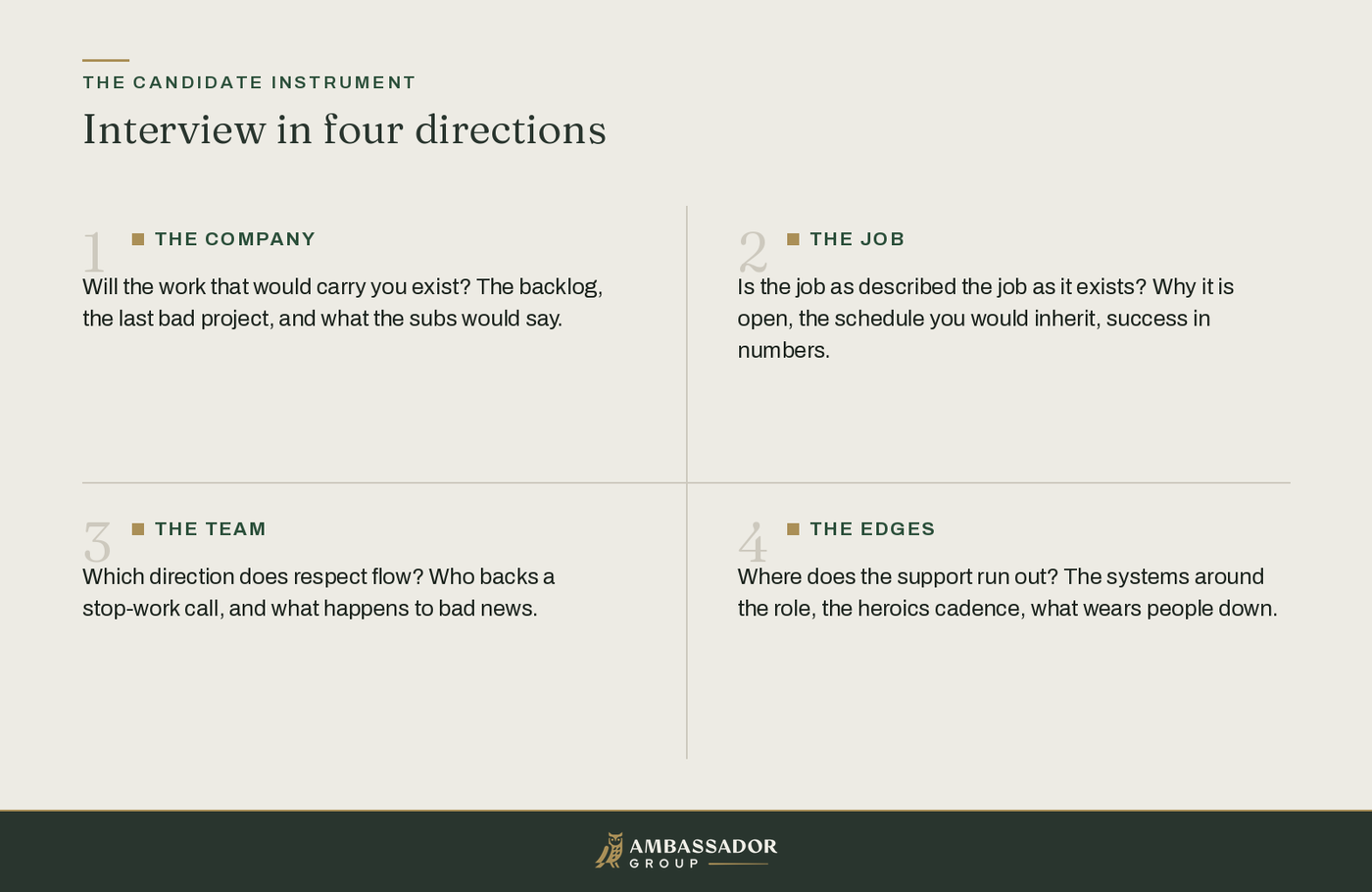
Your own questions run in four directions: the company, the job, the team, and the edges of the role. Take them in that order. Each question below comes with what to listen for, what an evasive answer sounds like next to a straight one, where to push, and what to ask to see. Four questions you know how to read are worth more than forty that fill the silence.
Interview the company
You are not joining a project. You are joining the company behind it, and the company decides whether the project you were promised is the project you get. Superintendents get burned here more than anywhere: sold a marquee job in the interview, handed a distressed one in month two.
"How does the company decide which work to chase, and what have you turned down lately?"
- What you are listening for: discipline about where the company plays. A firm that knows which work it wins, at what margin, with which clients, will hand you buildable jobs. A firm that bids everything will eventually hand you the job nobody should have taken.
- Evasive tell vs. straight tell: the evasive answer is growth language with no filter: "we are pursuing opportunities across several markets." The straight answer names the criteria and names a job they walked away from, with the reason.
- Follow-the-thread: ask who has the authority to say no to a project, and when that last happened. If nobody can name a no, the go/no-go process is a formality, and the field absorbs the consequences.
- Evidence ask: the current backlog, by project type, and how much of it is signed versus hoped for. You are not asking to audit the books. You are asking whether the work that would carry your next two years exists on paper or in a business developer's optimism.
- Red flag: a backlog concentrated in one client or one aggressive market bet. If that client sneezes, the layoff order starts in the field.
"Tell me about the last project that went badly here. What changed because of it?"
- What you are listening for: whether the company learns or blames. Every builder has a bad job. The question is what the organization did with it, because the same machinery will process the first bad month of yours.
- Evasive tell vs. straight tell: the evasive answer is that there has not been one, or a story where the owner, the architect, and the weather did all the damage. The straight answer names the loss, names the company's own contribution, and points to something specific that changed: a precon gate, a staffing rule, a scheduling practice.
- Follow-the-thread: ask where the superintendent on that job is now. The answer tells you what happens to field leaders when a project goes sideways, and whether the field wears the failures the office creates.
- Red flag: a story in which the field is the villain every time. You are looking at your own future performance review.
"Would your subs say you are good to work for?"
- What you are listening for: the company's reputation where it cannot be managed. Subs experience a general contractor's true character: whether pay applications move on time, whether change orders get honored, whether the schedule is a plan or a whip.
- Evasive tell vs. straight tell: the evasive answer is "we have great sub relationships" with no names attached. The straight answer offers specifics: long-tenured trade partners, a sub who follows them job to job, an invitation to go ask.
- Follow-the-thread: ask which trades refuse to bid their work, because every GC has at least one, and the honest answer is revealing. Ask how they handled the last sub that got in trouble mid-job.
- Evidence ask: permission to talk to a foreman or a sub PM who has worked with them for years. You would be amazed how fast this one question separates companies. The confident ones say yes before you finish the sentence. Companies reference-check you. Reference-check them.
- Red flag: subs paid slow as a matter of policy. A company that floats itself on its trade partners' cash will eventually float itself on your credibility, because you are the one making promises on the deck.
Interview the job
The title says superintendent. The job is whatever this specific company, on this specific project, with this specific history, has made of it. Your work here is to close the distance between the job as described and the job as it exists.
"Why is this role open, and where is the last superintendent now?"
- What you are listening for: the truth about what you are inheriting. Growth is a fine answer if the growth is real. A departure is a fine answer too, if the company can talk about it like adults.
- Evasive tell vs. straight tell: the evasive answer is a vague "it was not a fit," which is a phrase that does the same work in a company's mouth as it does in a candidate's: covering something. The straight answer tells you what the person struggled with or where they went, without bitterness.
- Follow-the-thread: ask how many superintendents have run work here in the last five years, and how many are still with the company. One departure is a story. A pattern is the job.
- Red flag: the last three people in this role are all "not a fit." The common variable is the company.
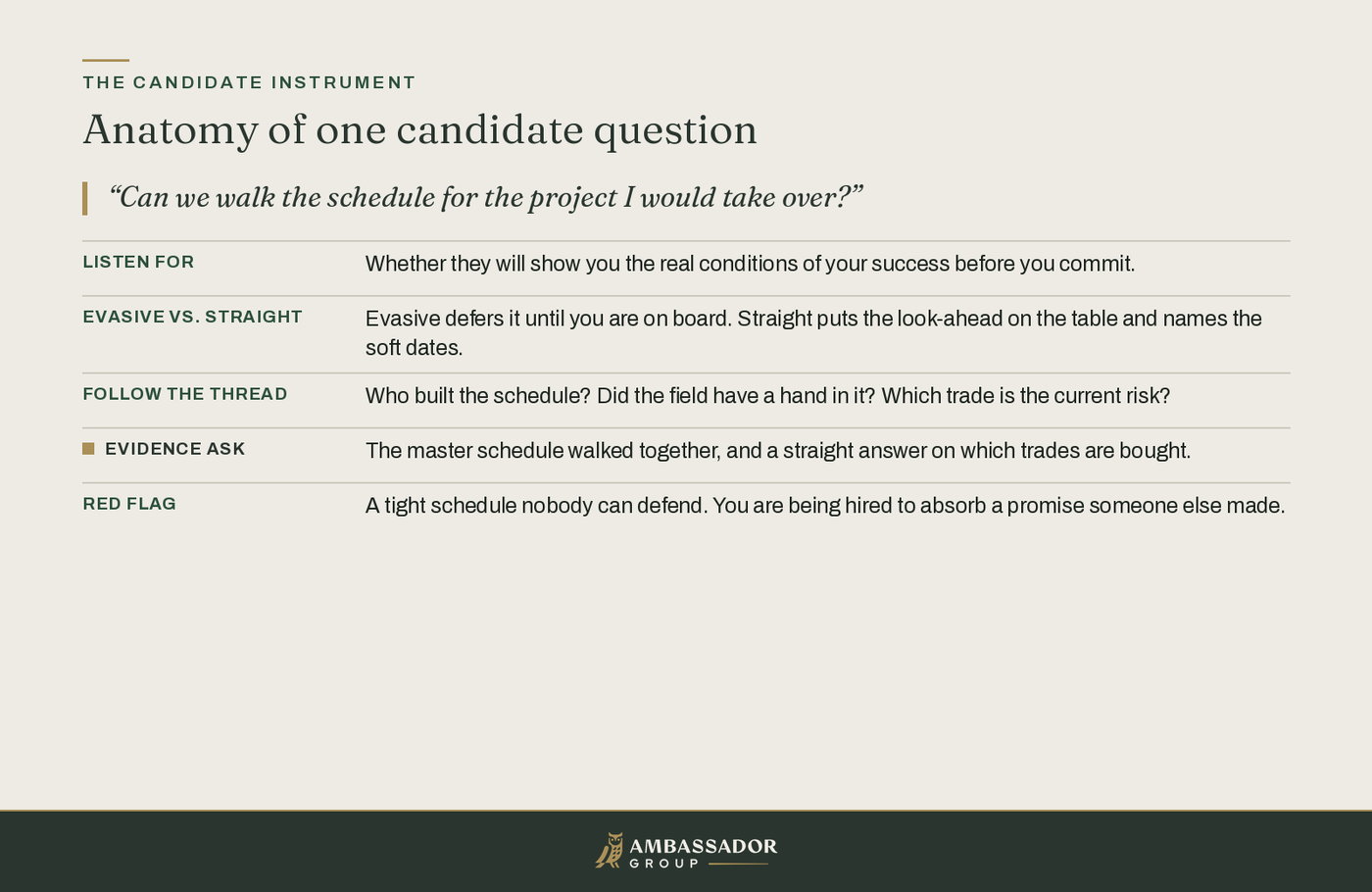
"Can we walk the schedule for the project I would take over?"
- What you are listening for: whether they will show you the actual conditions of your success. The schedule you inherit and the state of the buyout determine your first six months more than anything you will do. A company with a defensible plan is proud to walk you through it.
- Evasive tell vs. straight tell: the evasive answer defers: "we can get into that once you are on board." The straight answer puts the look-ahead on the table, tells you which dates are soft, and gives you a straight read on the buyout. Honesty about softness is the tell. Every schedule has soft spots. Only a real plan can admit where.
- Follow-the-thread: ask who built the schedule and whether the field had a hand in it. Ask which trade is the current risk. If the person interviewing you cannot answer, ask to meet the person who can, because that is who you will be living with.
- Evidence ask: the master schedule, walked together across the table, and a straight answer to which trades are bought and which are still exposed. Sub pricing is confidential and asking for it marks you as green; the shape of the buyout is a fair question, and a specific answer is the tell. Walking a schedule together is the closest an interview gets to working together.
- Red flag: an aggressive schedule the company describes as "tight but doable" without being able to say which activities carry the risk. You are being hired to absorb a promise someone else made.
"What would a good first year look like, in terms you could measure?"
- What you are listening for: whether expectations exist in a form you can hit. Milestones made, safety record, quality outcomes, trades that will work for you again. A company that can state the target is a company you can succeed at.
- Evasive tell vs. straight tell: the evasive answer is chemistry language: "we will know it when we see it, we just want a good fit." The straight answer sounds like a scorecard, because somewhere behind it there is one.
- Follow-the-thread: ask how the last superintendent's performance was measured, and how often anyone talked to them about it. An annual drive-by review means you will be managed by impression.
- Red flag: you cannot get a definition of success from anyone in the process. Undefined expectations do not stay undefined. They resolve, later, in someone else's favor.
Interview the team
Superintendents rarely leave companies over the work. They leave over the people above them and beside them: the PM who hides bad news until it lands on the field, the executive who backs the client over their own people, the office that treats the field like a subcontractor. The team is the job.
"When a superintendent stops work over safety here, what happens next?"
- What you are listening for: whether the company's backing survives contact with a schedule. Any interviewer will say safety comes first. You are asking for the machinery: who gets called, who absorbs the cost, what happened the last time.
- Evasive tell vs. straight tell: the evasive answer is a slogan with no story attached. The straight answer is a specific stop, what it cost, and what the company did for the person who called it. Companies that have honored a stop can name one.
- Follow-the-thread: ask what happened to the schedule commitment after the stop, and who explained it to the owner. If the superintendent was left to defend the delay alone, the backing is theoretical.
- Red flag: any hint, however joking, that the field gets pressure to keep moving. Jokes in interviews are policy in month six.
"Tell me about the last time the field changed the office's mind."
- What you are listening for: which direction respect flows. You will spend your tenure surfacing problems the office does not want to hear. This question tells you whether that information moves or dies.
- Evasive tell vs. straight tell: the evasive answer is a partnership platitude: "field and office work hand in hand here." The straight answer is a specific decision that got reversed because a field leader pushed back, told without resentment.
- Follow-the-thread: ask how a disagreement between a superintendent and a PM gets resolved, and who breaks the tie. Then ask about the last piece of bad news the field sent up, and what happened to the person who sent it.
- Evidence ask: a conversation with a current superintendent, without a chaperone. A company confident in how it treats the field will hand you a phone number. One that hesitates has a reason to hesitate.
"Who was the last field leader you promoted, and what did their path look like?"
- What you are listening for: whether the company grows its people or consumes them. A real path from the field upward, walked by someone recently, tells you the company sees field leadership as leadership.
- Evasive tell vs. straight tell: the evasive answer speaks of opportunity in the abstract. The straight answer has a name, a timeline, and what the company did to develop that person along the way.
- Follow-the-thread: ask what development looks like for someone in the role you are taking: training, mentorship, exposure to precon or the P&L. If the honest answer is "you will be busy running work," you have learned the ceiling.
- Red flag: every senior operations person was hired in from outside. The company either cannot grow leaders or does not keep them.
Find the edges of the role
Every role has edges: the places where the job is hardest, where the support runs out, where the organization's promises meet its habits. Edges are where pressure reveals the organization's leadership competency. Most candidates discover the edges in month three. The whole point of asking is to find them now, while the finding costs you nothing. A company that knows where its edges are and talks about them plainly is a company that manages them. A company that denies having any is asking you to find them alone.
"Walk me through who supports a superintendent on a typical project here."
- What you are listening for: whether the title comes with an organization or comes alone. Some companies put real systems around the role: a project engineer on site, scheduling support, a safety department that shows up, a PM who owns their half. At others, the superintendent is a one-person institution holding the job together by personal force.
- Evasive tell vs. straight tell: the evasive answer lists departments that exist on an org chart. The straight answer describes who was on the last comparable project, by role, and what the superintendent could hand off.
- Follow-the-thread: ask what a superintendent here spends time on that they should not have to. Self-aware companies answer fast. Ask what the company has invested in for field support in the last two years: software, people, process. Investment is where priorities stop being talk.
- Evidence ask: the staffing plan for the project you would run. Names and roles, on paper. The gap between the org chart and the staffing plan is the gap you will personally fill.
- Red flag: the interviewer is proud that their superintendents "wear a lot of hats." That is a budget decision wearing a compliment's clothes.
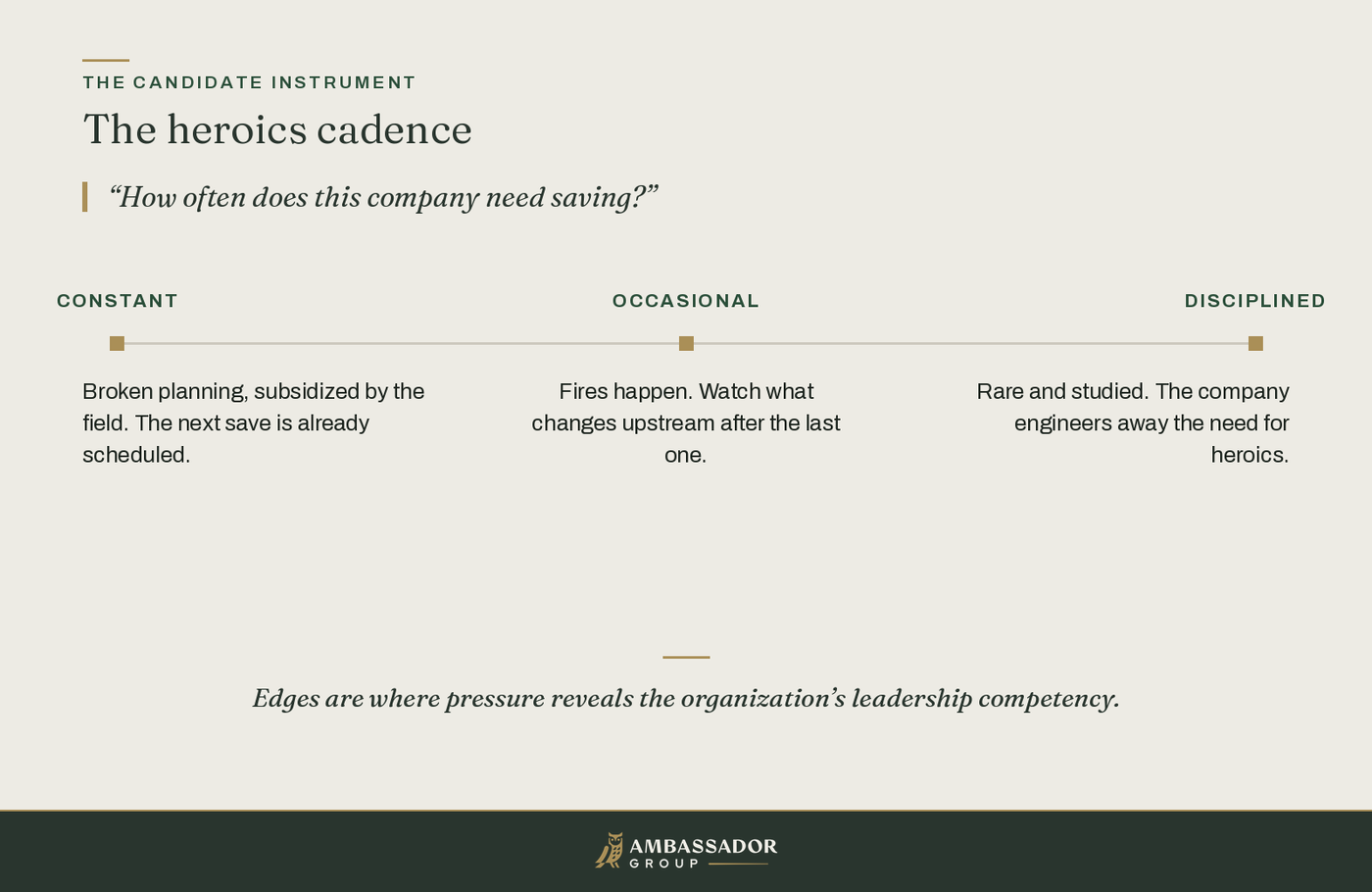
"Tell me about the last time this company needed heroics from the field. How often does that happen?"
- What you are listening for: the heroics cadence. Some companies require heroics constantly, some occasionally, and some are disciplined about avoiding the situations that require them. Which is this company? Constant heroics is a company subsidizing broken planning with the health of its field leaders. You have finite heroics in you. Spend them somewhere they are the exception.
- Evasive tell vs. straight tell: the evasive tell is pride: war stories told with a grin, weekend saves worn as culture. The straight answer names the last real fire drill, what it cost, and what changed upstream so it does not repeat. Rare and studied is the mark of a disciplined builder.
- Follow-the-thread: ask what the company changed after the last one. If the answer is nothing, the next heroic save is already scheduled, and you are interviewing for it. Ask how often superintendents work weekends in a normal month, and watch whether the answer is a number or a shrug.
- Red flag: "we are firefighters here, everybody pitches in" delivered as a recruiting pitch. Firefighting culture means the fires are structural. The people lighting them do not work weekends. You will.
"Where is this job hardest? What wears superintendents down here?"
- What you are listening for: the company's self-awareness, asked as directly as it can be asked. Every job has a grinding edge: a brutal market, a demanding flagship client, a thin bench, a commute-heavy footprint. You are not disqualifying the company for having one. You are testing whether they know theirs and tell the truth about it.
- Evasive tell vs. straight tell: the evasive answer converts the question into a strength: "honestly, the pace, we hold a high bar here." The straight answer costs the company something to say, names the edge specifically, and describes what they do to carry it: rotation off the tough client, comp that acknowledges the market, help that arrives before burnout instead of after.
- Follow-the-thread: ask the same question of everyone you meet in the process. A company that knows its edges gives consistent answers. A company in denial gives you a different strength-dressed-as-weakness from each person.
- Red flag: "no real downsides, this place sells itself." Somebody is finding the edges of that organization the hard way at this moment, and if you sign, the next somebody is you.
Write it down before the offer shapes it
An offer distorts judgment. The moment a number is on the table, everything you heard gets re-graded on a curve, and the edges you found start looking like quirks. The fix is the same one a disciplined interviewer uses on candidates, pointed the other way. Underwrite the company before the offer arrives.
- Write your read the same day. After each conversation, write what you learned in the four directions: company, job, team, edges. Specifics, while they are fresh. By the third interview your memory will be a blur of good feelings and one anecdote, which is exactly how bad decisions get made on both sides of hiring.
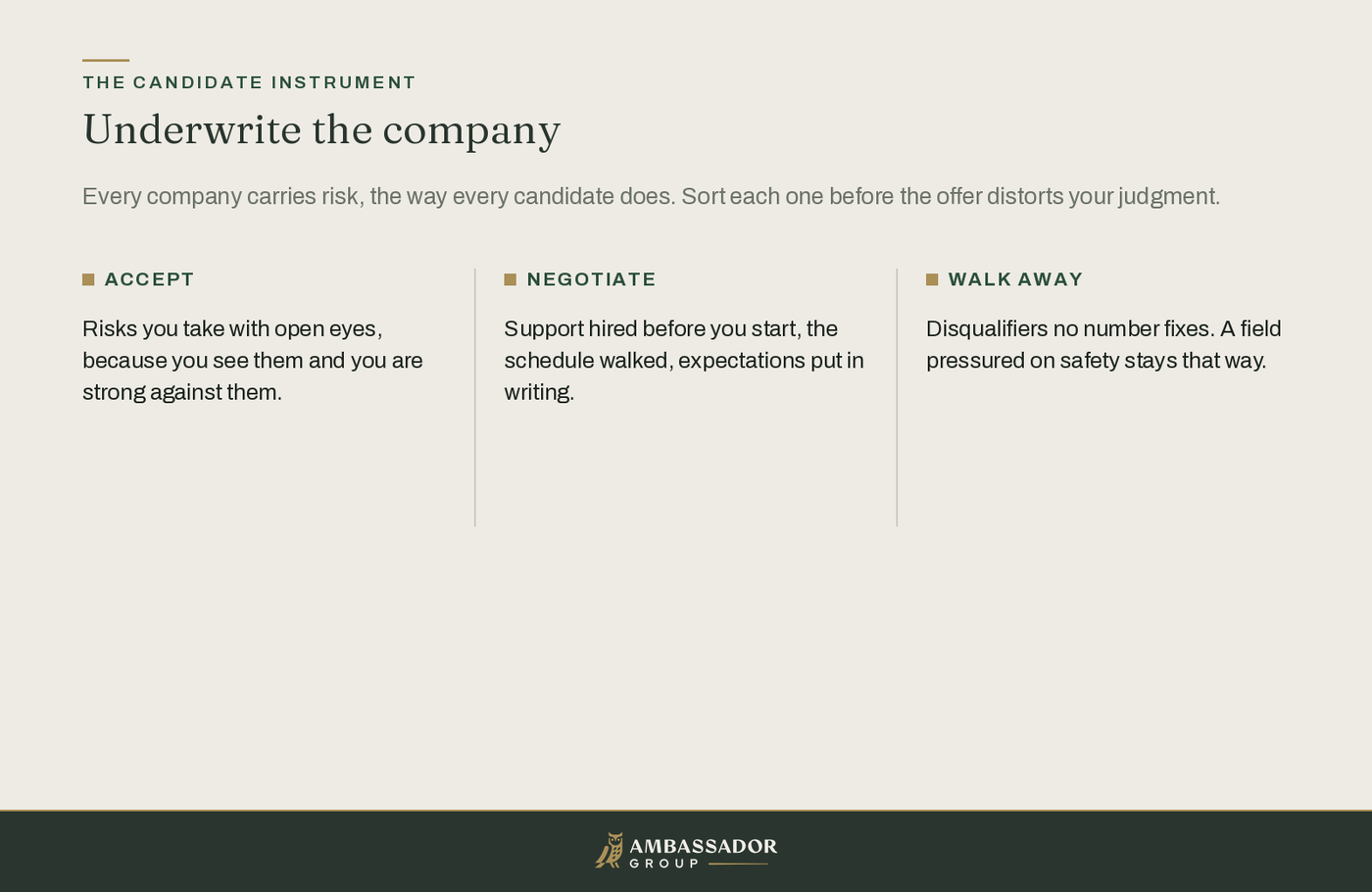
- Sort the risk: accept, negotiate, or walk. Every company you interview carries risk, the way every candidate does. Some risks you accept with open eyes: a thin bench you can live with, an edge you happen to be strong against. Some you negotiate: support that gets hired, a schedule reviewed before you commit, expectations put in writing. And some are disqualifying no matter the number, because a company that pressures the field on safety does not become a different company because it pays well.
- Name what you did not assess. If you never saw the schedule, never met your PM, never talked to a current superintendent, write that down as a hole in your information, then go fill it. Ask for the extra conversation or the site walk. A company that refuses has answered a question too.
- Price the offer against the market, not against your current pay. A raise on an underpaid year is still underpaid. Know your market before the negotiation, from data rather than folklore: the compensation benchmark exists for exactly this.
- Decide against your life, not against your current job. The question is whether this role clears the bar for the career you are building, not whether it beats the one you are escaping. Almost anything beats a job you already want to leave, which is why leaving is when superintendents make their worst decisions. The larger discipline of knowing that bar, your strengths, your direction, your worth, is a career's work, and Build to Last is a working manual for it.
The pre-offer checklist turns this into a worksheet you can run before you sign.
The other half of the decision
The company across the table is running an interview to decide whether you fit the job. Somebody has to run the interview that decides whether the job fits you, and nobody else in the process is going to do it. Ask plainly, follow the thread when an answer is thin, ask to see the artifact instead of settling for the story, and believe what the edges tell you. A company reveals itself under a good question the same way a candidate does. If the move you are weighing is a step up rather than sideways, the general superintendent guide runs the same instrument at the multiplier level, and the project manager guide covers the office half of the partnership you are about to join.
You already know how to run a jobsite. Run this the same way: on evidence.
Ambassador Group represents construction leaders on both sides of the table and tells both sides the truth. If you want that kind of representation for your next move, send us your resume.
The short version.
- What questions should a superintendent ask in a job interview?
- Ask in four directions: the company, the job, the team, and the edges of the role. Probe the company’s backlog, its last bad project, and how it treats subs; probe why the job is open, the schedule you would inherit, and what success looks like in numbers. Ask who backs a stop-work call and how the field and office resolve conflict. Then find the edges: where the job is hardest and how often it demands heroics.
- Why should a candidate interview the company as hard as the company interviews them?
- Because half the hiring decision belongs to the candidate, and it is the half that decides whether the job still fits in year two. The company is pricing risk on you; price risk on them. A bad company can be read by a sharp candidate and missed by a hopeful one.
- What documents can a superintendent candidate ask to see before accepting a job?
- Ask to walk the master schedule for the project you would run and for a straight answer on which trades are bought. Ask for the staffing plan with names on it, the backlog and how much of it is signed, and a conversation with a current superintendent. A company with a defensible plan is proud to walk you through it.
- What are the edges of a construction role, and why do they matter?
- Edges are where the job is hardest and the support runs out: whether the role comes with real systems and a support team, and how often the company requires heroics from the field. Edges are where pressure reveals the organization’s leadership competency. Find them in the interview, while finding them costs you nothing.
- How should a superintendent evaluate a job offer?
- Write down what you learned the same day, before the offer distorts it. Sort each company risk into accept, negotiate, or walk away. Price the offer against the market, not against your current pay, and decide against the life you are building, not the job you are escaping.


