
The ownership group across the table came with questions for you. If you are like most construction executives, you have spent a career reading operators and almost no time deciding what to ask about this company. The questions to ask in a VP of Construction interview matter as much as the ones you will answer, because half of this decision is yours, and your half decides whether the authority you are being offered exists anywhere outside the offer letter. A company that wants a real operating partner and a company that wants an expensive buffer between ownership and the field sound identical over dinner. The questions below are instruments. The discipline of listening is yours.
Most interview advice at this level is about presence: know the company's work, carry your record lightly, ask a few sharp questions so the conversation feels mutual. This guide assumes you can already do that. It is about the other job in the process: deciding whether this company deserves the next decade of your working life. That is an underwriting decision, and underwriting takes evidence, not chemistry.
They are bringing an instrument. Bring your own.
A rigorous interviewer does not wing an executive hire. They will probe the places a VP of Construction breaks: whether you shaped a portfolio or followed one, whether you built a leadership team or managed a roster, whether you reach for the number or the explanation when a year goes wrong. You can read the exact instrument a disciplined interviewer runs on your role: VP of Construction interview questions. Read it, and arrive with artifacts, because at this altitude adjectives read as evasion.
And notice how they interview you, because it is evidence about them. A company that runs a disciplined process for the executive who will own its operation is showing you how it makes decisions. A company that offers that same role after two dinners and a jobsite tour is also showing you how it makes decisions.
You will not ask all of these, and not all at once. An executive process is short and personal: a first conversation, a dinner with ownership, a day with the executive team. Earn the right first: answer their questions well, then ask yours, in the tone of a builder walking a job rather than an auditor working a file. The company and job questions belong in the first real conversation. The evidence asks and the team questions belong after mutual interest is on the table, where asking how decisions get recorded reads as seriousness instead of presumption. Let each conversation carry two or three, asked well.
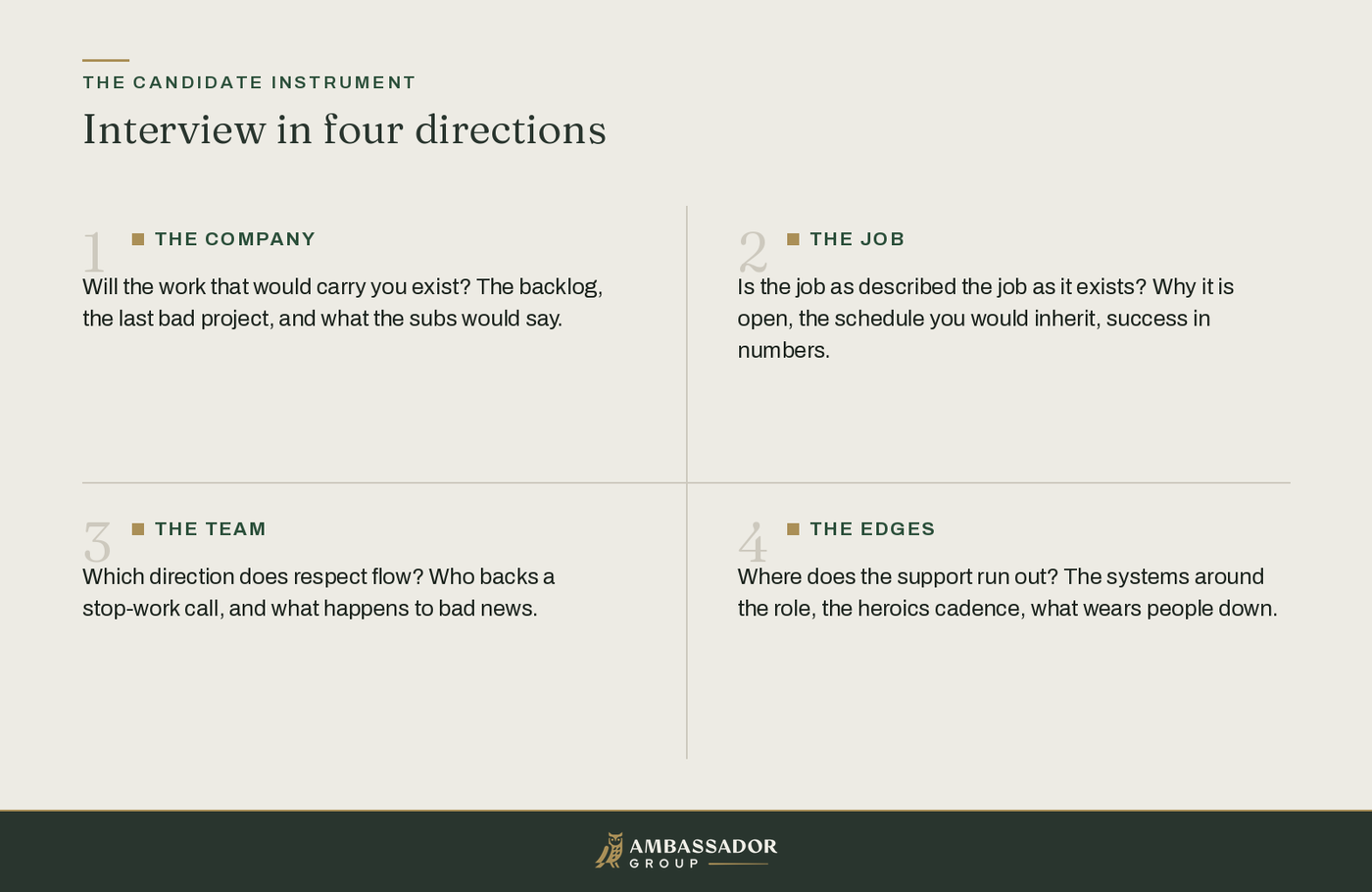
Your own questions run in four directions: the company, the job, the team, and the edges of the role. Each question below comes with what to listen for, what an evasive answer sounds like next to a straight one, where to push, and what to ask to see. Four questions you know how to read are worth more than forty that fill the silence.
Interview the company
At this level the company's trajectory becomes your record. The backlog it assembled before you arrived, the risk it carries, the clients it depends on: all of it lands in your accountability the day you start. Executives get burned here more than anywhere: recruited to lead a transformation, hired to decorate one.
“Where is this company trying to be in five years, and what has to change for it to get there?”
- What you are listening for: a real arc: markets, size, ownership's intent, and an honest account of the gap between here and there. A company that describes five more years of the current year is hiring a caretaker.
- Evasive tell vs. straight tell: the evasive answer is growth arithmetic: "we want to double." The straight answer names the markets, the constraint (bench, bonding capacity, precon, ownership bandwidth), and what has already been tried.
- Follow-the-thread: ask what has to be true about this role for that arc to happen. If the answer is effort language instead of authority language, the arc is a wish.
- Evidence ask: whether the arc exists on paper: a strategic plan, an annual operating plan, minutes from wherever direction gets set. You are asking whether direction is recorded or lives in ownership's head.
- Red flag: a different five-year answer from each executive. The company is not going anywhere in particular, and you would be accountable for the arrival.
“What work has this company walked away from in the last few years, and what did walking away cost?”
- What you are listening for: market posture. What a company declines defines it more honestly than what it pursues. A real answer names the market or the client, and the revenue it gave up to stay disciplined.
- Evasive tell vs. straight tell: the evasive answer is "we look at everything opportunistically," which means nothing has ever been declined on purpose. The straight answer names the job or the sector, the reason, and who argued for taking it anyway.
- Follow-the-thread: ask who holds the authority to say no to work today, and whether this role would. You are about to be accountable for the portfolio.
- Evidence ask: the go/no-go criteria, walked through against a real pursuit. The criteria are fair to ask for; the pricing behind any single job is not. Criteria with a dead deal attached are a discipline; drafted last quarter, a brochure.
- Red flag: nothing has ever been turned down. A company that chases everything hands its VP a backlog assembled by appetite.
“How concentrated is the work? If the largest client paused tomorrow, what would this company do?”
- What you are listening for: risk posture. Client concentration, market bets, and how much of the future is signed versus hoped for. You inherit this risk on day one.
- Evasive tell vs. straight tell: the evasive answer is relationship language where the question was arithmetic: "our client relationships are very strong." The straight answer gives shape: roughly what share the top client carries, how much backlog is signed versus pursued, and what the bonding posture allows.
- Follow-the-thread: ask what the surety relationship looks like: headroom growing, flat, or tight. Shape, not statements. A company that bristles at a bonding question will bristle at the executive whose projects the surety underwrites.
- Evidence ask: the backlog in summary form, by market and client: how much is signed, how much is awarded but uncontracted, how much is pipeline optimism. The internal financials are private; the shape of the book is a fair question for the person hired to carry it.
- Red flag: concentration described as loyalty. "That client will never leave" is the sentence companies say the year before the client leaves.
Interview the job
The title says VP of Construction. The job is whatever authority ownership will genuinely release, and no title carries a wider gap between the version described in the interview and the version that exists in practice. Measure that gap before you sign.
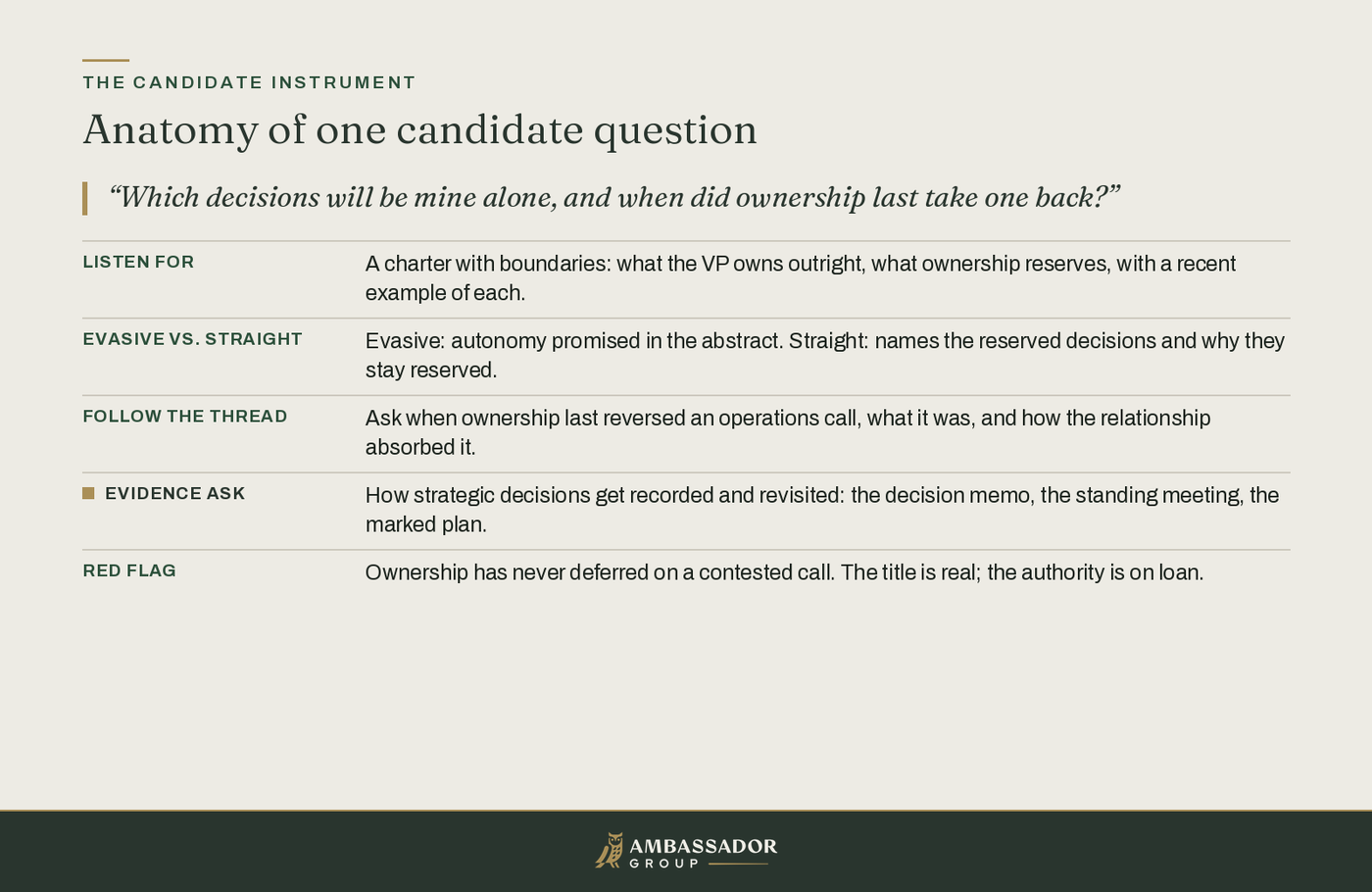
“Which decisions will be mine alone, and when did ownership last take one back?”
- What you are listening for: real P&L authority versus reporting theater. Some companies hire a VP to run the operation. Others hire one to explain the operation to ownership while ownership keeps running it. Both write the same job description.
- Evasive tell vs. straight tell: the evasive answer promises autonomy in the abstract: "you will have full authority here, we do not micromanage." The straight answer names the boundary: what the VP owns outright, what ownership reserves, with a recent example of each.
- Follow-the-thread: ask when ownership last reversed an operations decision, what it was, and how the relationship absorbed it.
- Evidence ask: how strategic decisions get recorded and revisited here: a decision memo, a standing executive meeting with minutes, an annual plan that gets marked against reality. Where nothing is written down, authority is whatever ownership recalls it being.
- Red flag: "you will earn autonomy over time" with no definition of earned. Undefined authority resolves in the owner's favor, every time.
“What do you want this role to change, and what has stopped that change so far?”
- What you are listening for: whether the company wants change or wants to feel like it is changing. The second half of the question is the test, because genuinely blocked change has a story with names and costs in it.
- Evasive tell vs. straight tell: the evasive answer is a capability gap: "we just have not had the right leader yet." The straight answer names the real obstacle: an owner who cannot release pursuit decisions, a loyal legacy manager nobody will move, a culture that treats process as an insult.
- Follow-the-thread: ask what the last person who pushed this change did, and where that person is now. The answer tells you whether you would lead a transformation or absorb the blame for its absence.
- Evidence ask: the last operational change that stuck: what it was, who drove it, how long it took to become habit. A long pause is a company that has never tried.
- Red flag: every stalled change is the fault of someone who no longer works there. The machinery that stalled it is still in the building, waiting for you.
“What would a good first two years look like, in numbers ownership would sign?”
- What you are listening for: whether success exists in a form you can hit and defend: the margin the operation produces, the leadership bench built, turnover in key roles, the shape of the backlog. A company that cannot state the target will grade you on feel, and feel is a currency ownership controls.
- Evasive tell vs. straight tell: the evasive answer is trajectory language: "we will know we made the right hire when things feel calmer." The straight answer sounds like an operating plan: the number, the team, the systems, with a timeline attached.
- Follow-the-thread: ask how the previous executive was measured and how often ownership discussed it. Ask what happens in a year the number is missed for defensible reasons: management tool or trapdoor.
- Evidence ask: the shape of the operating plan this role would inherit: whether an annual plan exists, who builds it, and how the VP's targets connect to it.
- Red flag: success defined as "take things off my plate." That is a chief of staff's job wearing a VP title, and the plate stays owned by somebody else.
Interview the team
A VP of Construction fails through people more often than through markets: a peer executive protecting territory, a CFO who treats operations as a cost center, an ownership group that handles exits so badly the survivors stop telling the truth. The executive table you would join is the job.
“Who else sits at the executive table, and what does each of them own?”
- What you are listening for: whether an executive team exists or a hub and spoke around the owner does. A wheel of direct reports means every decision routes through one person's bandwidth and moods.
- Evasive tell vs. straight tell: the evasive answer is a list of titles. The straight answer describes the working machinery: who runs the meeting, what gets decided there versus in the owner's office afterward, which two executives disagree most often and how it resolves.
- Follow-the-thread: ask for the most recent decision the executive team made that the owner disagreed with and let stand. It is the fastest read on whether the table decides or attends.
- Evidence ask: time with each peer executive before you sign, one on one, without ownership present. A company that hesitates is managing your access to something.
- Red flag: peers described only in terms of loyalty and tenure. Loyalty is a fine trait and a terrible charter.
“How do operations and finance work together here? Walk me through how the monthly number comes together.”
- What you are listening for: the CFO relationship, because no peer determines a VP's success more. You need finance that produces true job cost fast and tells you what the number means.
- Evasive tell vs. straight tell: the evasive answer is harmony: "finance and operations get along great here." The straight answer describes mechanics: when job cost closes, who runs the WIP review, how a projection dispute gets settled, how fast a bad month surfaces.
- Follow-the-thread: ask the CFO, separately, what operations gets wrong about the financials, and ask your interviewer what finance gets wrong about the field. Symmetrical honesty is the health tell; one-directional contempt is the org chart telling you who wins.
- Evidence ask: a conversation with the CFO before you sign. The internal statements are confidential; the working relationship is exactly your business.
- Red flag: the monthly number described as a recurring surprise, told with a laugh. Executives laugh about the problems they have decided to keep.
“Tell me about the last executive who left this company. What happened, and how was it handled?”
- What you are listening for: how the company treats its senior people when the relationship ends, because it previews your own eventual exit. The handling is the culture.
- Evasive tell vs. straight tell: the evasive answer is a euphemism sealed shut: "we agreed to part ways, it was mutual." The straight answer tells the story like an adult: what the mismatch was, what the company contributed, and how the person was treated on the way out.
- Follow-the-thread: ask how the departure was communicated inside the company, and whether the departed executive would take a call from you. A clean exit survives that question. A buried one does not.
- Evidence ask: the departed executive's phone number, offered with the company's blessing. The company is checking your references at this level; check theirs.
- Red flag: a pattern of executives who "were not a fit," arriving and leaving on a two-year cycle. The common variable is ownership, and the next data point in the pattern is you.
Find the edges of the role
Every role has edges: the places where the job runs out of support and the organization's promises meet its habits. Edges are where pressure reveals the organization's leadership competency. At the VP level the edges are quieter than in the field, and they cost more: an authority boundary that moves, a support structure that is one overworked controller, an ownership dynamic nobody named. Find them now, while the finding costs you nothing.
“What sits underneath this role? Who builds the reporting, who runs preconstruction, who owns the systems?”
- What you are listening for: whether the VP title comes with an operating infrastructure or with a desk. Some companies surround the role with real capability: finance that closes job cost on time, a precon function, HR that can recruit. At others the VP is expected to personally be the infrastructure.
- Evasive tell vs. straight tell: the evasive answer lists departments that exist on paper. The straight answer tells you who produced the last WIP review and what the previous VP had to do personally that a VP should not.
- Follow-the-thread: ask what the company has invested in operational infrastructure over the last three years: people, systems, process. Then ask what this role would have to build from scratch, and whether the budget exists.
- Evidence ask: the org chart as it stands today, with open positions marked honestly. The distance between the chart as drawn and as staffed is the job you are being handed without being told.
- Red flag: pride that the last VP "did it all." A company that consumed its last executive and calls it work ethic is planning to consume the next one.
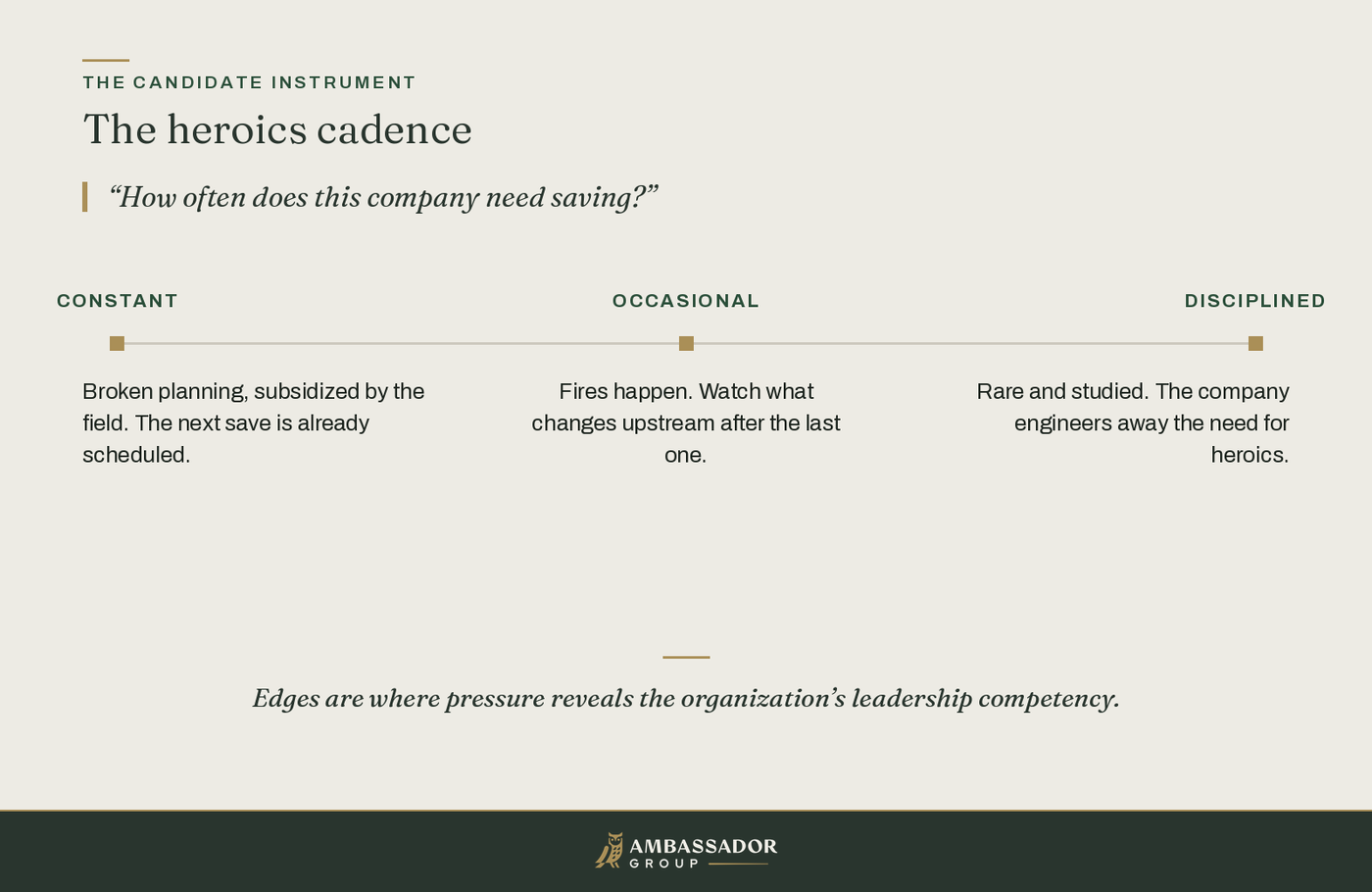
“When did this company last need an executive to personally rescue a project? How often does that happen?”
- What you are listening for: the heroics cadence. Some companies require heroics constantly, some occasionally, and some are disciplined about avoiding the situations that require them. Which is this company? Constant rescue duty means the operating system underneath you does not exist, and building it lands on you.
- Evasive tell vs. straight tell: the evasive tell is pride: the story of the owner and the last VP living on a troubled job for a quarter, told as culture. The straight answer names the last real rescue, what it cost, and what changed upstream so it does not repeat.
- Follow-the-thread: ask what changed after the last one. If the answer is nothing, the next rescue is already scheduled, and you are interviewing for it.
- Red flag: "we all roll up our sleeves here" offered as the answer to a question about frequency. A cadence question answered with a values statement means the cadence is constant.
“How does ownership see its own next ten years? Who is this company being built for?”
- What you are listening for: succession honesty. Family ownership, a founder nearing the end of a career, a possible sale: none of these disqualifies a company; every one reshapes the VP role when it surfaces. An ownership group that cannot talk plainly about its own future is asking you to invest a decade against a variable it refuses to name.
- Evasive tell vs. straight tell: the evasive answer is deflection with a smile: "we are not going anywhere." The straight answer engages: the son or daughter in the business and what they are honestly being groomed for, the timeline the founder is privately working against.
- Follow-the-thread: where family works in the business, ask what happens when the VP and a family member disagree, and whether it has happened yet. Then ask the owner and the peer executives the same future question separately: aligned answers mean it has been discussed. Scattered ones mean you are the succession plan, or the bridge to one, and nobody has decided which.
- Red flag: the question lands as an offense. An ownership group that treats its own future as an insult to raise will treat your hardest questions as insubordination once you are inside.
Write it down before the offer shapes it
An offer distorts judgment, and an executive offer distorts it more. Once a number is on the table, everything you heard gets re-graded on a curve, and the edges start reading as quirks. Underwrite the company before the offer arrives.
- Write your read the same day. After each conversation, write what you learned in the four directions: company, job, team, edges. By the third dinner your memory will be a warm blur and one anecdote.
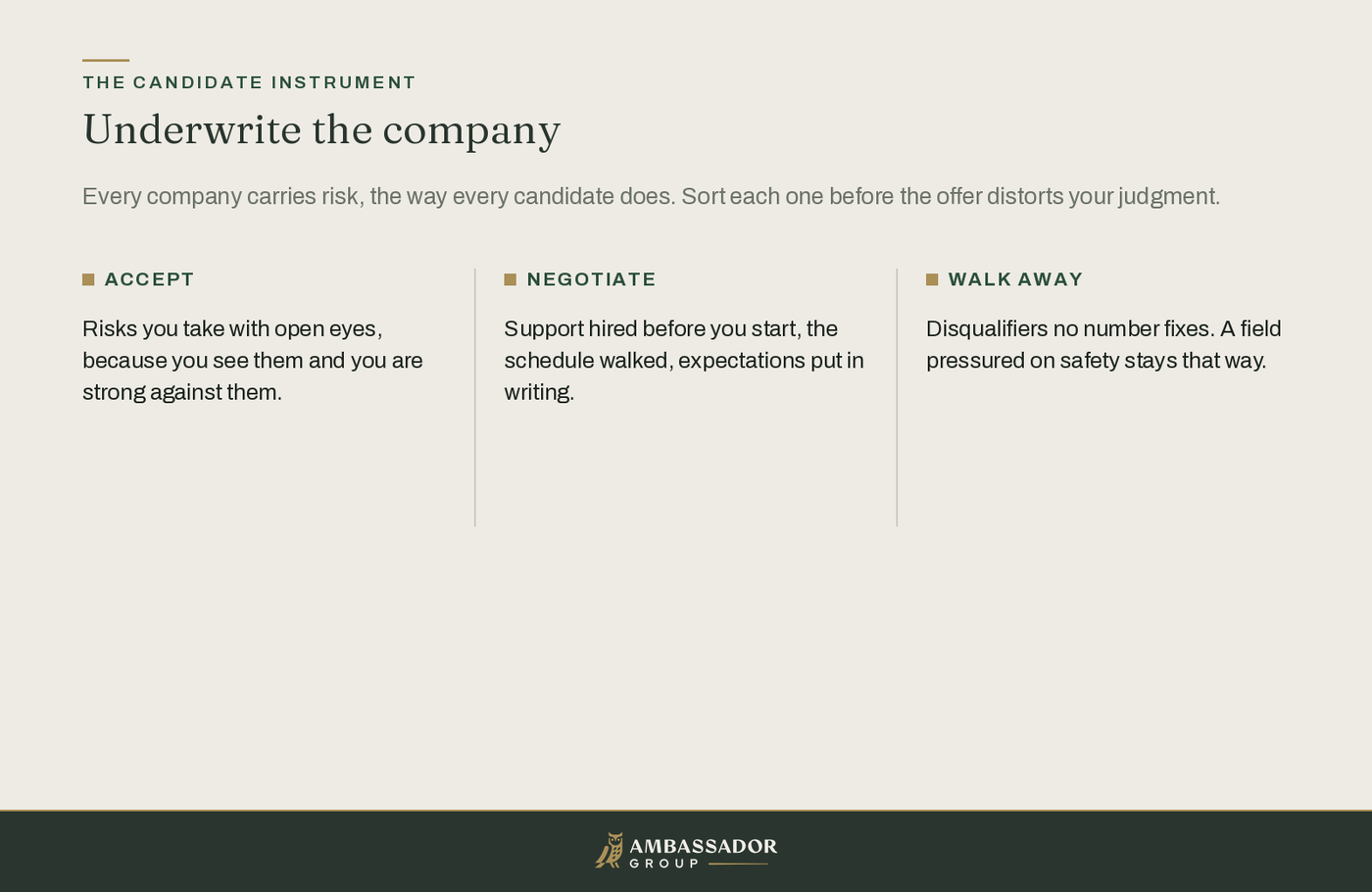
- Sort the risk: accept, negotiate, or walk. Some risks you accept with open eyes: a thin bench you were hired to build, a market bet you happen to believe in. Some you negotiate: the charter in writing with the reserved decisions named, infrastructure hires committed before you start, the succession conversation before the signature. And some are disqualifying at any package.
- Name what you did not assess. If you never met the CFO, never heard the five-year arc from more than one person, never learned how the last exit was handled, write it down as a hole, then go fill it. A company that refuses the extra conversation has answered a question too.
- Price the offer against the market, not against your current package. A raise on an underpaid year is still underpaid. Know your market from data: the compensation benchmark exists for exactly this.
- Decide against your life, not against your current job. The question is whether this role clears the bar for the career you are building, not whether it beats the one you are escaping. Knowing that bar, your strengths, your direction, your worth, is a career's work, and Build to Last is a working manual for it.
The pre-offer checklist turns this into a worksheet you can run before you sign.
The other half of the decision
The company across the table is deciding whether to hand you its operation. Somebody has to decide whether the operation deserves your next decade, and nobody else will do it. Ask plainly, follow the thread when an answer is thin, ask how decisions get recorded instead of settling for how they get described, and believe what the edges tell you. A company reveals itself under a good question the same way an operator does.
One level down, the same discipline is tuned for the Director of Construction interview; for the portfolio role, the Project Executive guide points the instrument there.
You already know how to underwrite a company's work. Underwrite the company the same way: on evidence.
Ambassador Group represents construction leaders on both sides of the table and tells both sides the truth. If you want that kind of representation for your next move, send us your resume.
The short version.
- What questions should a VP of Construction candidate ask in an interview?
- Ask in four directions: the company, the job, the team, and the edges of the role. Probe the five-year arc, what the company has walked away from, and how concentrated the work is; probe which decisions the role owns outright and what success looks like in numbers. Ask about the peer executives, the CFO relationship, and how the last executive exit was handled. Then find the edges: the support under the role, the heroics cadence, and ownership's honesty about its own future.
- How can a candidate tell whether a VP of Construction role has real P&L authority?
- Ask which decisions would be the role's alone and when ownership last took one back. Ask how strategic decisions get recorded and revisited, because authority that lives only in conversation is authority on loan. A straight answer names what ownership reserves and gives a recent example of each. Vague promises of autonomy signal reporting theater: a role that explains the operation while ownership keeps running it.
- What should a VP of Construction candidate ask about ownership and succession?
- Ask how ownership sees its own next ten years and who the company is being built for. Family involvement, a founder nearing the end of a career, or a possible sale all reshape the role when they surface, and an ownership group that discusses its future plainly is offering a real partnership. Ask the same question of the owner and the peer executives separately and compare the answers.
- What are the edges of a VP of Construction role, and why do they matter?
- Edges are where the job is hardest and the support runs out: whether the role comes with real operating infrastructure, how often the company needs executives to personally rescue projects, and how honestly ownership talks about its own future. Edges are where pressure reveals the organization's leadership competency. Find them in the interview, while finding them costs you nothing.
- How should a VP of Construction evaluate a job offer?
- Write down what you learned the same day, before the offer distorts it. Sort each company risk into accept, negotiate, or walk away, and put the negotiated authority boundaries in writing. Price the package against the market rather than your current pay, and decide against the life you are building, not the job you are leaving.


