
The company across the table came with questions for you: how you grow superintendents, how you split scarce manpower across competing jobs, how you stabilize troubled work without burning the super running it. If you are like most field leaders, you have prepared answers and almost nothing to ask back. The questions to ask in a general superintendent interview matter as much as the ones you will answer, because half of this decision is yours, and your half decides whether you are still glad you took the job 2 years in. The quality of your next move is principally driven by you, not by the company recruiting you. A bad company can be read by a sharp candidate and missed by a hopeful one. The questions below are instruments. The discipline of listening is yours.
A superintendent who takes the wrong job loses a project. A general superintendent who takes the wrong job multiplies the company's dysfunction across every site at once, with your name on the results. Deciding whether a company deserves the multiplier years of your career is an underwriting decision, and underwriting takes evidence, not vibes.
They are bringing an instrument. Bring your own.
A rigorous interviewer does not wing it. They will probe the 3 places a general superintendent breaks: whether you can starve a healthy job to save a sick one and own both outcomes, whether your standard holds on sites you cannot walk every day, and whether you can stabilize a troubled job without taking it over and without burning the superintendent still running it. They will push where your answer is thin and ask to see artifacts: a manpower plan you maintained, a development plan you wrote for a struggling super. You can read the exact instrument a disciplined interviewer runs on your role: general superintendent interview questions. Read it. Arriving with specifics instead of adjectives is the floor.
And notice something while you are in the conversation: how they interview you is evidence about them. A company that probes your development record with real follow-ups is showing you how it makes decisions about people. A company that hands its entire field organization to whoever survives 2 friendly conversations is also showing you how it makes decisions. Both are free information. Most candidates never collect it.
You will not ask all of these, and you will not ask them all at once. Earn the right first: answer their questions well, then ask yours, in the tone of a builder walking a job rather than an auditor working a file. The company and job questions belong in the first real conversation. The evidence asks and the team questions belong after mutual interest is on the table, where asking for the field org chart reads as seriousness instead of presumption. Spread the rest across the process and let each conversation carry 2 or 3, asked well.
Your own questions run in 4 directions: the company, the job, the team, and the edges of the role. Take them in that order. Each question below comes with what to listen for, what an evasive answer sounds like next to a straight one, where to push, and what to ask to see. A handful of questions you know how to read are worth more than 40 that fill the silence.
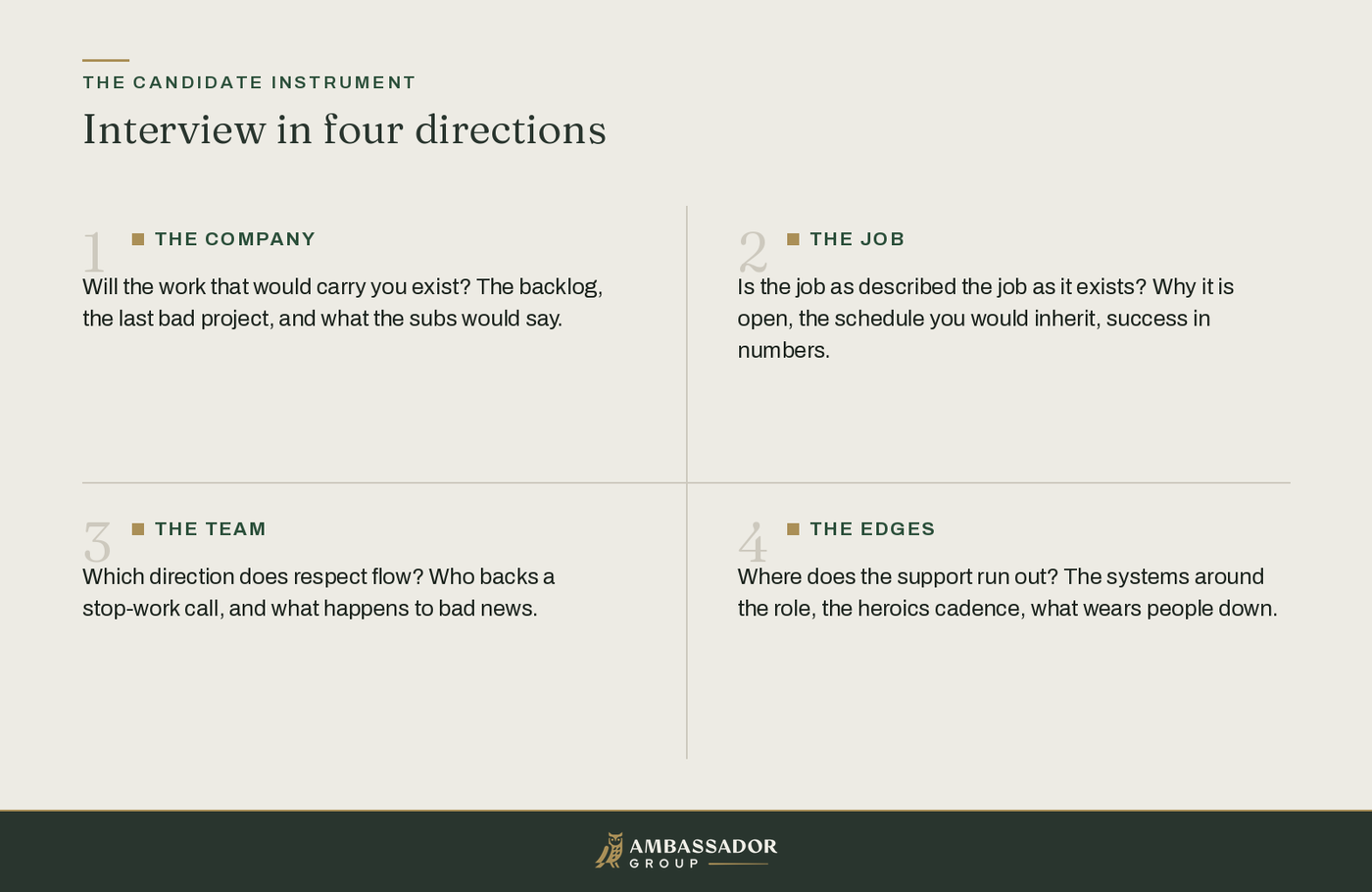
Interview the company
A superintendent joins a project. A general superintendent joins the whole field operation, and the role multiplies whatever the company already is. A disciplined builder gets more disciplined. A chaotic one burns its new general superintendent as fuel.
“How is field leadership developed here, and who is the last superintendent you grew from inside?”
- What you are listening for: whether the company has ever done the work you are being hired to multiply. A company that has grown even 1 superintendent from assistant to running work has the raw material. A company that has only ever bought supers from competitors is asking you to build a development culture from bare dirt.
- Evasive tell vs. straight tell: the evasive answer is belief language with no names: “we believe strongly in promoting from within.” The straight answer is a name, the path that person walked, how long it took, and who carried them along the way.
- Follow-the-thread: ask what the company spends on field development: training, an assistant superintendent pipeline, time budgeted for ride-alongs. Investment is where priorities stop being talk.
- Evidence ask: a conversation with a superintendent the company grew. If nobody qualifies, you have the answer anyway.
- Red flag: every field leader was poached from somewhere else. Your first development project would be the company itself.
“How does the company decide how much work the field can carry, and who gets to say the field is full?”
- What you are listening for: whether field capacity is a real input to what the company chases or a problem the field absorbs after the ink dries. You would personally own the gap between what was sold and what can be staffed.
- Evasive tell vs. straight tell: the evasive answer is confidence with no mechanism: “we have always found a way.” The straight answer names the mechanism: backlog reviewed against a manpower plan on a cadence, plus a job the company passed on because the field could not staff it.
- Follow-the-thread: ask when the field last pushed a start date, and what happened. Ask who is in the go/no-go conversation and whether field leadership is one of them.
- Evidence ask: the manpower planning artifact: whether one exists across jobs, who maintains it, and how often it gets updated. The shape and cadence tell you whether you would inherit a planning discipline or be hired to invent one.
- Red flag: pride that the field has always kept up. That sentence is the sound of a company selling ahead of its bench and calling the field's exhaustion a culture.
“How many superintendents have left in the last 3 years, and where did they go?”
- What you are listening for: the retention record of the exact people you would lead. Field turnover is the most expensive number in a general superintendent's world, and you inherit its causes on day 1.
- Evasive tell vs. straight tell: the evasive answer normalizes without numbers: “some turnover is healthy.” The straight answer is a count, honest reasons, and no bitterness toward the people who left.
- Follow-the-thread: ask whether any super has ever come back, because a boomerang is the strongest evidence a field culture is livable.
- Evidence ask: the average tenure of the current superintendents, as a number. Tenure is a fair thing to ask for and a hard thing to spin.
- Red flag: several supers left for the same competitor. The market has already priced this company's field culture. Believe the market.
Interview the job
The title is the same everywhere. The job is defined by what this company lets it own, and general superintendent postings hide 2 different jobs behind identical language: a role with real authority over the field, and an advisory title that carries the field's problems without the power to fix them.
“Is this a new role, or am I following someone? Either way, walk me through what happened.”
- What you are listening for: the true origin of the opening. A new role means the company outgrew somebody's span of control, and the authority you need is currently in that person's hands. Following someone means inheriting their wake: the trust they built or burned with the supers, the systems they left behind or never made.
- Evasive tell vs. straight tell: the evasive answer is a relief valve with no shape: “the field just needs more leadership.” The straight answer explains what changed to create the role, or gives an adult account of the last person: what they struggled with, where they are now.
- Follow-the-thread: if the role is new, ask who makes field staffing calls today and how that person feels about handing them over. If you are following someone, ask what the supers would say that person did for them.
- Evidence ask: the written accountabilities for the role. A company that cannot produce them is asking you to sign up for a shape it has not drawn.
- Red flag: the role has existed twice before and both people are gone. The job as designed may be the thing that fails, and you would be the third test.
“What does the general superintendent own here, and what does operations keep?”
- What you are listening for: real authority over field staffing versus an advisory title. Can you hire a superintendent, exit one, promote a foreman? Or do you recommend and wait? This role breaks fastest at exactly this boundary: accountability for the field without authority over who is in it.
- Evasive tell vs. straight tell: the evasive answer is autonomy language: “you will have a lot of rope here.” The straight answer sounds like a decision map: named calls with named owners, and who breaks a tie when the general superintendent and operations disagree.
- Follow-the-thread: walk the last superintendent hire end to end: who sourced, who interviewed, who decided, who made the offer. Then the last exit, the same way. History outranks intention.
- Evidence ask: the last 3 field staffing decisions, told with the name of who made each call. A company that can tell those stories cleanly has a working boundary. One that hedges is telling you the boundary moves with the weather.
- Red flag: you would carry field performance while operations keeps the hiring, the exits, and the promotions. That is a title, and titles do not staff jobs.
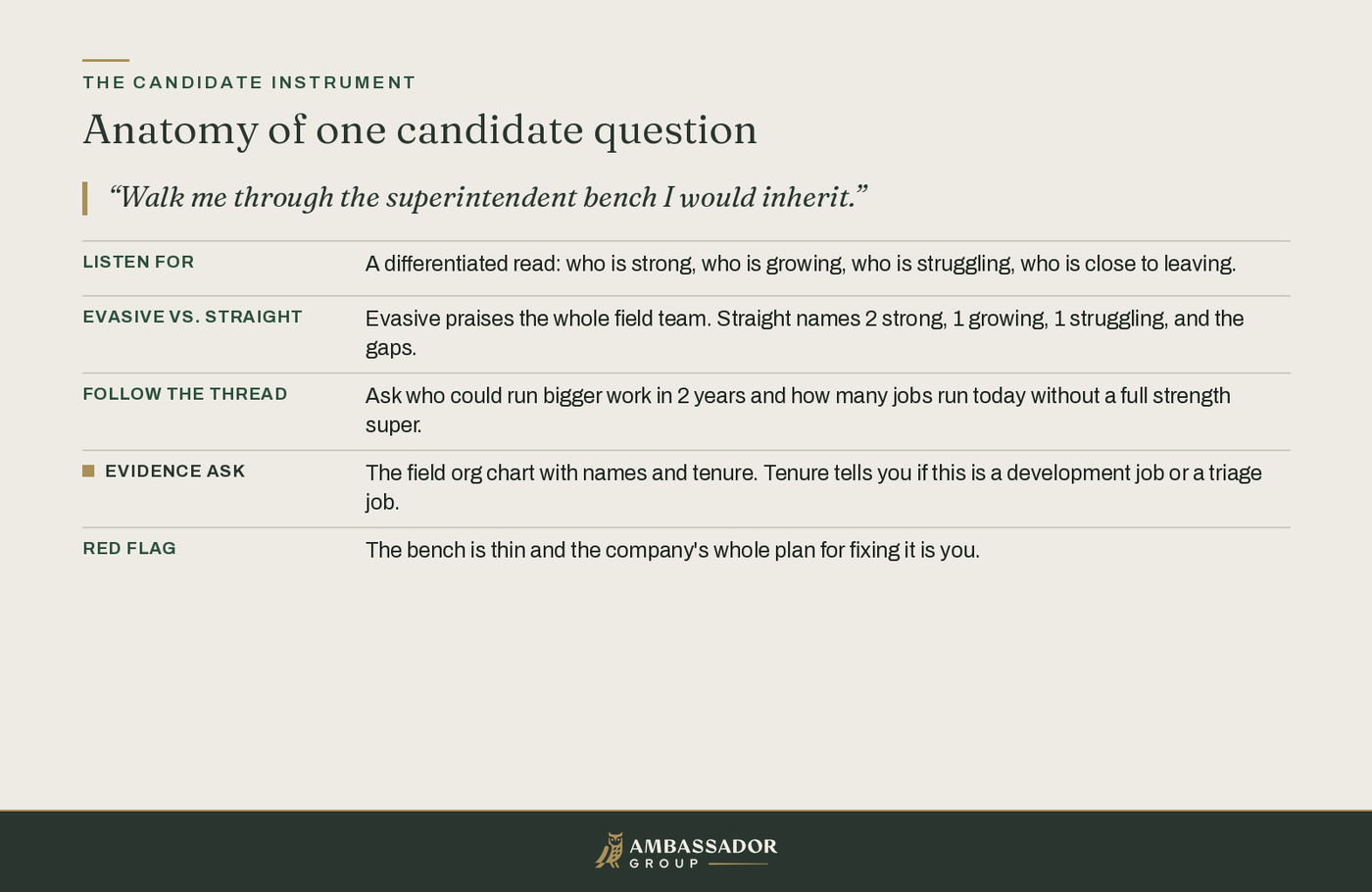
“Walk me through the superintendent bench I would inherit.”
- What you are listening for: whether this is a development job or a triage job. Who is strong, who is growing, who is struggling, who is close to leaving, who retires in 2 years. The bench decides your first year more than the backlog does.
- Evasive tell vs. straight tell: the evasive answer is uniform praise: “our supers are the best in the market.” The straight answer is a differentiated read: 2 strong, 1 growing into bigger work, 1 struggling, and honesty about the hole in the middle.
- Follow-the-thread: ask who could run larger work in 2 years and what is being done about it now. Ask how many jobs are running today without a full-strength super, because that number is your triage list.
- Evidence ask: the field org chart with names and tenure on it. Reading it takes 2 minutes and tells you what the interview cannot: spans, gaps, and how long people stay.
- Red flag: the bench is thin and the company's whole plan for fixing it is you. Enthusiasm about your arrival is flattering. A plan would have more names in it than yours.
Interview the team
General superintendents rarely fail alone. They get failed by the structure around them: an operations manager who never releases the authority, project managers who treat the field standard as friction, executives who promise dates the field never saw.
“When holding the field standard costs a project manager speed, who backs whom?”
- What you are listening for: whether the standard survives contact with a schedule. You would enforce a single standard across jobs that project managers are driving to dates, and that collision is structural, so the question is who wins it and whether winning costs the field its standing.
- Evasive tell vs. straight tell: the evasive answer is harmony: “field and office are on the same team here.” The straight answer is a specific collision: what holding the standard cost, who made the final call, and what leadership said afterward.
- Follow-the-thread: ask who breaks a tie between the general superintendent and a project manager, and how fast. Ask what happened to the last superintendent caught between the field standard and a project manager's date.
- Evidence ask: a conversation with the project manager you would collide with most often. The company's willingness to set it up is evidence. So is the conversation.
- Red flag: “it never really comes up.” Standard and schedule collide at every builder on earth. A company that cannot name a collision is not resolving them. It is losing them quietly.
“Can I talk with the superintendents I would be leading?”
- What you are listening for: 2 things at once: the company's confidence, and the supers' honest read on whether this role arrives as help or as overhead. If the role is new, listen for whether they even know it is coming, because a bench that discovers its new boss by announcement starts you at a deficit.
- Evasive tell vs. straight tell: the evasive answer defers or chaperones: “we can arrange something once we are further along.” The straight answer hands you 2 phone numbers before you finish the sentence.
- Follow-the-thread: ask the supers what they need that they do not get. Ask what they would want the person in this role to do first, and what they hope that person never does.
- Evidence ask: the conversations themselves, without a chaperone. 30 minutes with 2 supers will teach you more about this job than every interview combined.
“Tell me about the last time the field's read changed a company decision.”
- What you are listening for: whether field leadership is leadership here or expensive supervision. This role is the field's voice at the level where work gets chosen, dates get promised, and headcount gets budgeted. If that voice moves nothing, you would spend your tenure carrying bad news uphill into a headwind.
- Evasive tell vs. straight tell: the evasive answer is a partnership platitude: “field input is hugely valued here.” The straight answer is a specific decision that moved: a pursuit dropped, a duration extended before it was promised, a super hired ahead of need.
- Follow-the-thread: ask whether the general superintendent reviews schedules before the company commits them to owners.
- Evidence ask: the last schedule commitment the field pushed back on before the company signed.
- Red flag: schedules are promised to owners before the field ever sees them. You would inherit promises made without you and be measured against them anyway.
Find the edges of the role
Every role has edges: the places where the job is hardest, where the support runs out, where the organization's promises meet its habits. Edges are where pressure reveals the organization's leadership competency. For a general superintendent the edges hide in the gap between the title and the org chart: the support that exists only on paper, the heroics the company quietly runs on, and the miles between the sites. Find them now, while the finding costs you nothing.
“Who supports the general superintendent here: field recruiting, safety, scheduling, training?”
- What you are listening for: whether the multiplier role comes with machinery or arrives alone. Some companies put real structure around the role: field recruiting, a safety lead, scheduling help, a training budget. At others the general superintendent is all of those departments in a single pair of boots.
- Evasive tell vs. straight tell: the evasive answer lists functions that exist as boxes on an org chart. The straight answer tells you who ran the last field hire and who administered the safety program this week, by name.
- Follow-the-thread: ask who recruited the last superintendent the company hired and how long that search took.
- Evidence ask: names attached to functions: who owns field recruiting, safety administration, and training today. A name is an answer. A pause is also an answer.
- Red flag: the interviewer describes all of it as part of the role, with pride. That is 3 jobs invoiced as 1 title.
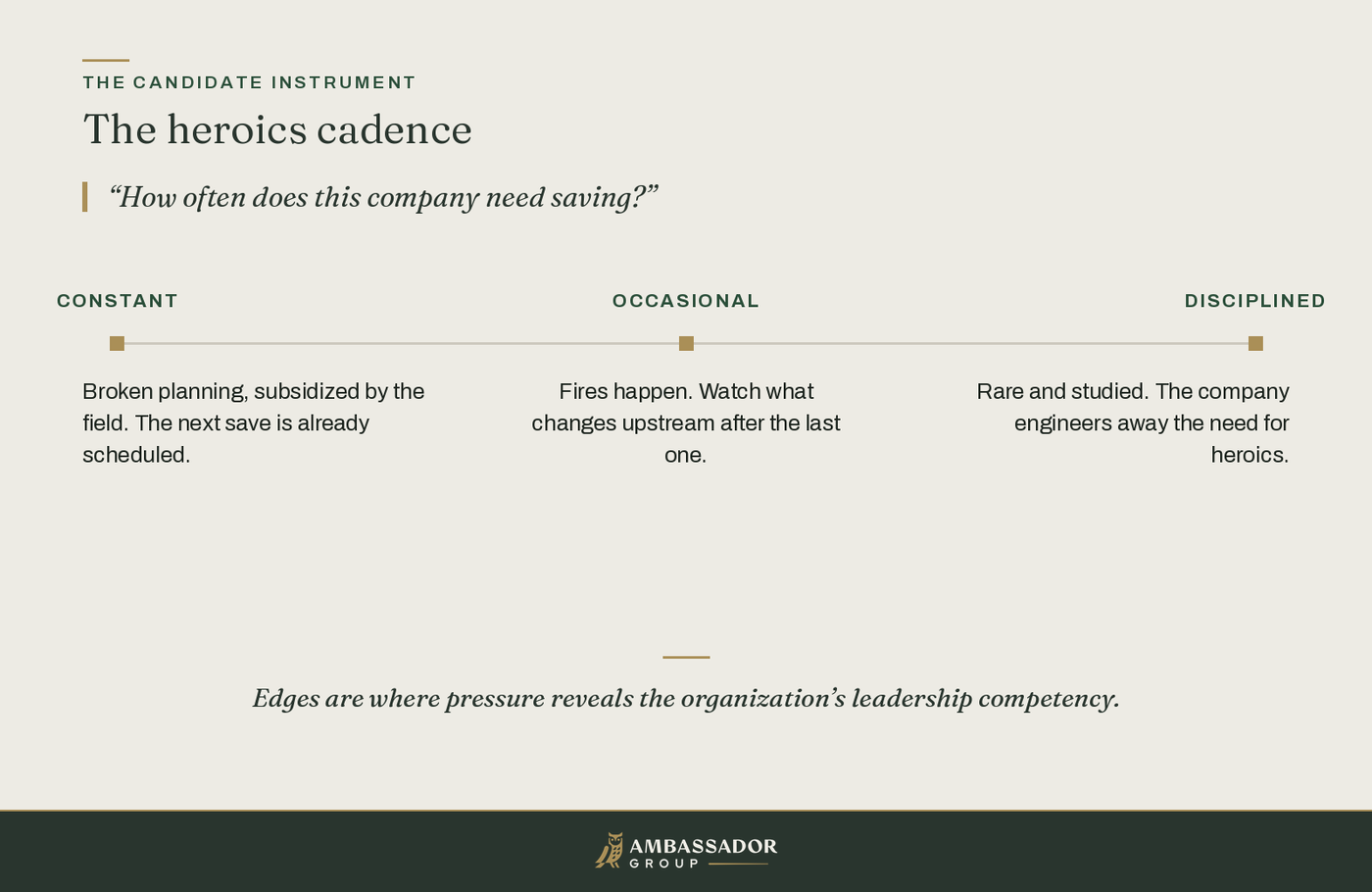
“Tell me about the last time this company needed heroics from the field. How often does that happen?”
- What you are listening for: the heroics cadence. Some companies require heroics constantly, some occasionally, and some are disciplined about avoiding the situations that require them. Which is this company? At this level the question is personal, because the general superintendent is who gets deployed. A constant cadence turns the role into a traveling rescue super, and the development half of the job, the half that multiplies, never happens.
- Evasive tell vs. straight tell: the evasive tell is pride: war stories told with a grin, weekend saves worn as culture. The straight answer names the last real fire, what it cost, and what changed upstream so it does not repeat.
- Follow-the-thread: ask how many jobs went into rescue mode in the last 2 years, and listen for whether the answer is a number or a shrug. Ask what changed after the most recent one.
- Evidence ask: the rescue count with the cause attached to each. A disciplined builder can name both. A firefighting culture remembers the saves and forgets the causes.
- Red flag: the role is being sold to you as the fix for the fires. A company hiring a hero has already decided to keep starting fires.
“How many active sites would I cover, how far apart, and where is next year's work?”
- What you are listening for: the physics of the job. 5 sites inside a single metro and 8 sites across 3 hours of highway are different jobs wearing the same title. Site count, radius, and the geography of the signed backlog decide how much of your week is windshield and how much is the real work.
- Evasive tell vs. straight tell: the evasive answer is flexibility language: “you will manage your own schedule.” The straight answer is numbers: sites now, expected cadence per site, the radius, and an honest read on where the next 18 months of work sit on the map.
- Follow-the-thread: ask what presence is expected at pours, inspections, and owner walks, and how many nights away a normal month holds.
- Evidence ask: the active project list with locations, plus signed work not yet started. Companies share project lists proudly, and the map you assemble tells the truth about your windshield time.
- Red flag: the company is entering a new region and the plan for covering it is your name. A territory whose whole plan is 1 person is an edge you would meet at 5 a.m. on a Tuesday.
Write it down before the offer shapes it
An offer distorts judgment. The moment a number is on the table, everything you heard gets re-graded on a curve, and the edges you found start looking like quirks. The fix is the same discipline a rigorous interviewer uses on candidates, pointed the other way. Underwrite the company before the offer arrives.
- Write your read the same day. After each conversation, write what you learned in the 4 directions: company, job, team, edges. Specifics, while they are fresh. By the third interview your memory will be a blur of good feelings and 1 anecdote, which is exactly how bad decisions get made on both sides of hiring.
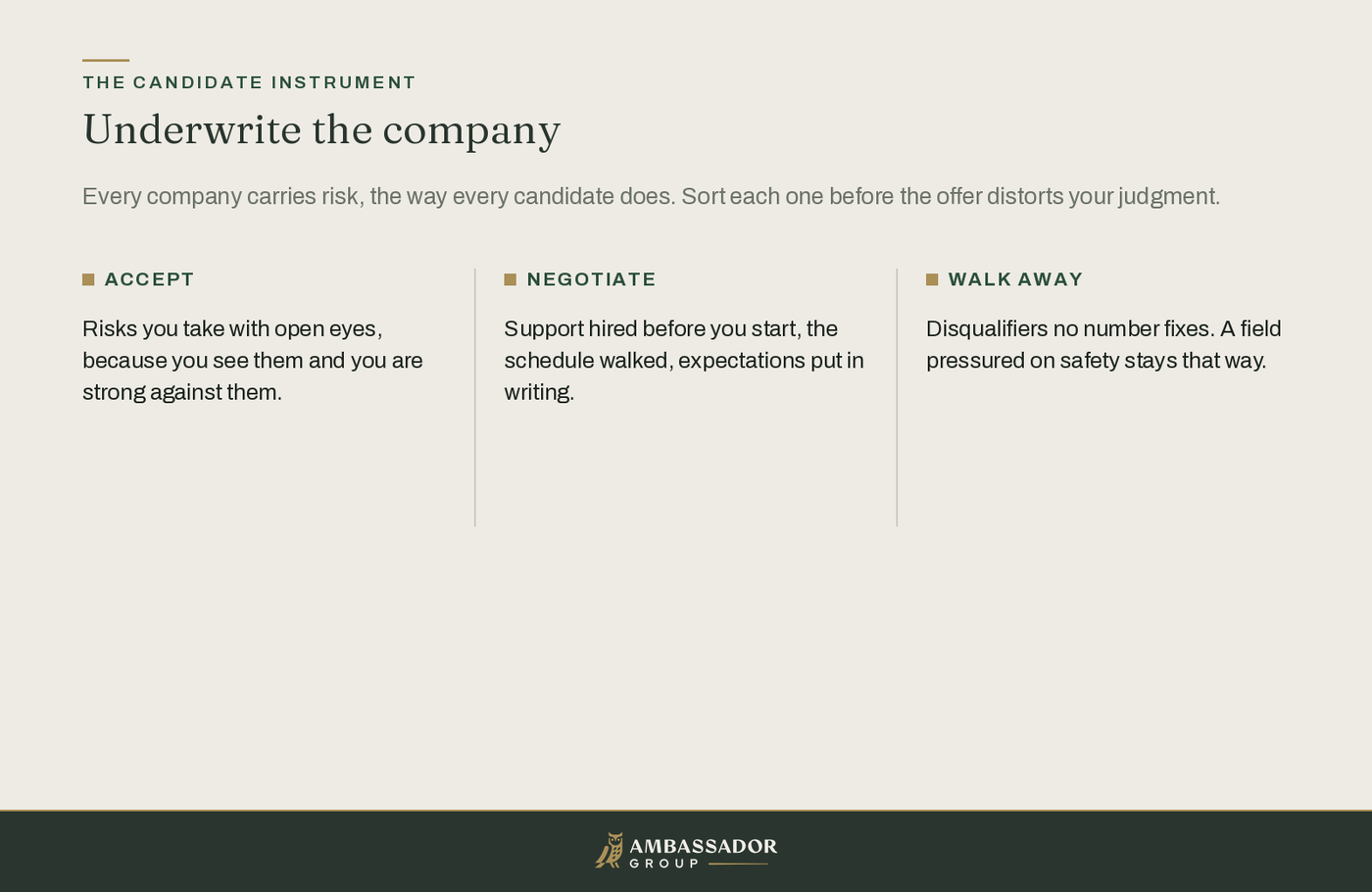
- Sort the risk: accept, negotiate, or walk. Every company carries risk, the way every candidate does. Some risks you accept with open eyes: a thin bench, if development is the strength you are selling. Some you negotiate: staffing authority in writing, a support hire, schedule review before the next commitment. And some are disqualifying no matter the number, because accountability for the field without authority over the field does not become a different job because it pays well.
- Name what you did not assess. If you never saw the org chart, never met the supers, never got a straight answer on manpower planning, write that down as a hole in your information, then go fill it. Ask for the extra conversation. A company that refuses has answered a question too.
- Price the offer against the market, not against your current pay. A raise on an underpaid year is still underpaid. Know your market before the negotiation, from data rather than folklore: the compensation benchmark exists for exactly this.
- Decide against your life, not against your current job. The question is whether this role clears the bar for the career you are building, not whether it beats the one you are escaping. Almost anything beats a job you already want to leave, which is why leaving is when field leaders make their worst decisions. The larger discipline of knowing that bar, your strengths, your direction, your worth, is a career's work, and Build to Last is a working manual for it.
The pre-offer checklist turns this into a worksheet you can run before you sign.
The other half of the decision
The company across the table is running an interview to decide whether you fit the job. Somebody has to run the interview that decides whether the job fits you, and nobody else in the process is going to do it. Ask plainly, follow the thread when an answer is thin, ask to see the artifact instead of settling for the story, and believe what the edges tell you. The same discipline reads the roles on either side of this one: the superintendent guide covers the job your supers hold, and the director of construction guide covers the one this role grows into.
You are being hired to read field leaders for a living. Start with the company asking you to do it.
Ambassador Group represents construction leaders on both sides of the table and tells both sides the truth. If you want that kind of representation for your next move, send us your resume.
The short version.
- What questions should you ask in a general superintendent interview?
- Ask in 4 directions: the company, the job, the team, and the edges of the role. Probe how the company develops field leadership, how much work it lets the field carry, and what the general superintendent owns versus what operations keeps. Ask to walk the superintendent bench you would inherit, then find the edges: support systems, heroics cadence, and windshield time.
- How much authority should a general superintendent have over field staffing?
- Enough to hire, exit, and promote field staff, or at minimum a decision map that names who owns each call. The role breaks fastest when it carries accountability for field performance without authority over who is in the field. Ask for the story of the last 3 field staffing decisions and who made each one.
- What can a general superintendent candidate ask to see before accepting a job?
- Ask for the field org chart with names and tenure, which shows spans, gaps, and how long people stay. Ask whether a manpower plan exists across jobs and how often it is updated. Ask for the active project list with locations, and for unchaperoned conversations with the superintendents you would lead.
- What are the edges of a general superintendent role?
- The edges are where the job is hardest and the support runs out: whether real support exists for field recruiting, safety, and training, how often the company requires heroics from the field, and how much of the week disappears into windshield time between sites. Edges are where pressure reveals the organization's leadership competency. Find them in the interview, while finding them costs you nothing.
- How should a general superintendent evaluate a job offer?
- Write down what you learned the same day, before the offer distorts it. Sort each risk into accept, negotiate, or walk away, and treat accountability without staffing authority as disqualifying. Price the offer against the market rather than your current pay, and decide against the life you are building, not the job you are leaving.


