
The company across the table came with questions for you. If you are like most assistant superintendents, you have spent almost nothing deciding what to ask them. That imbalance costs you more in this role than it ever will again, because the questions to ask in an assistant superintendent interview decide whether you spend the next 3 years learning to run work or learning to wait for instructions. Half of this decision is yours, and your half is the half that decides whether the job builds you. A development role at a company that does not develop people is a detour dressed as a beginning. The questions below are instruments. The judgment is yours.
Most interview advice for early field careers is about eagerness: show up sharp, know the company, ask something so you look engaged. This guide assumes you can do that. It is about your other job in that conversation: deciding whether this company can turn your field time into a superintendent's career. That is an underwriting decision, and underwriting takes evidence, not enthusiasm.
They are bringing an instrument. Bring your own.
A rigorous interviewer does not wing it on this role. They will probe the places an assistant superintendent breaks: whether you own an assigned slice without being told twice, whether you can hold a line with a foreman who was hanging doors before you could drive, whether correction changes your behavior or only your expression. They will push where your answers run thin and ask to see artifacts: a daily log you authored, a punch list with your tracking on it. You can read the exact instrument a disciplined interviewer runs on your role: assistant superintendent interview questions. Read it. Preparing for that level of judgment means arriving with specifics instead of adjectives.
And notice how they interview you: it is evidence about them. A company that probes carefully for coachability is a company that intends to coach. A company that hires a development role on 90 minutes of gut feel will develop you the same way: by accident. Both are free information, and most candidates never collect it.
You will not ask all of these at once. Earn the right first: answer their questions well, then ask yours, in the tone of a builder walking a job rather than an auditor working a file. Coming from the junior person in the conversation, good questions read as seriousness. The company and job questions belong in the first real conversation. The evidence asks and the team questions belong after mutual interest is on the table, where asking to meet your superintendent reads as commitment instead of presumption. Spread the rest across the process and let each conversation carry 2 or 3, asked well.
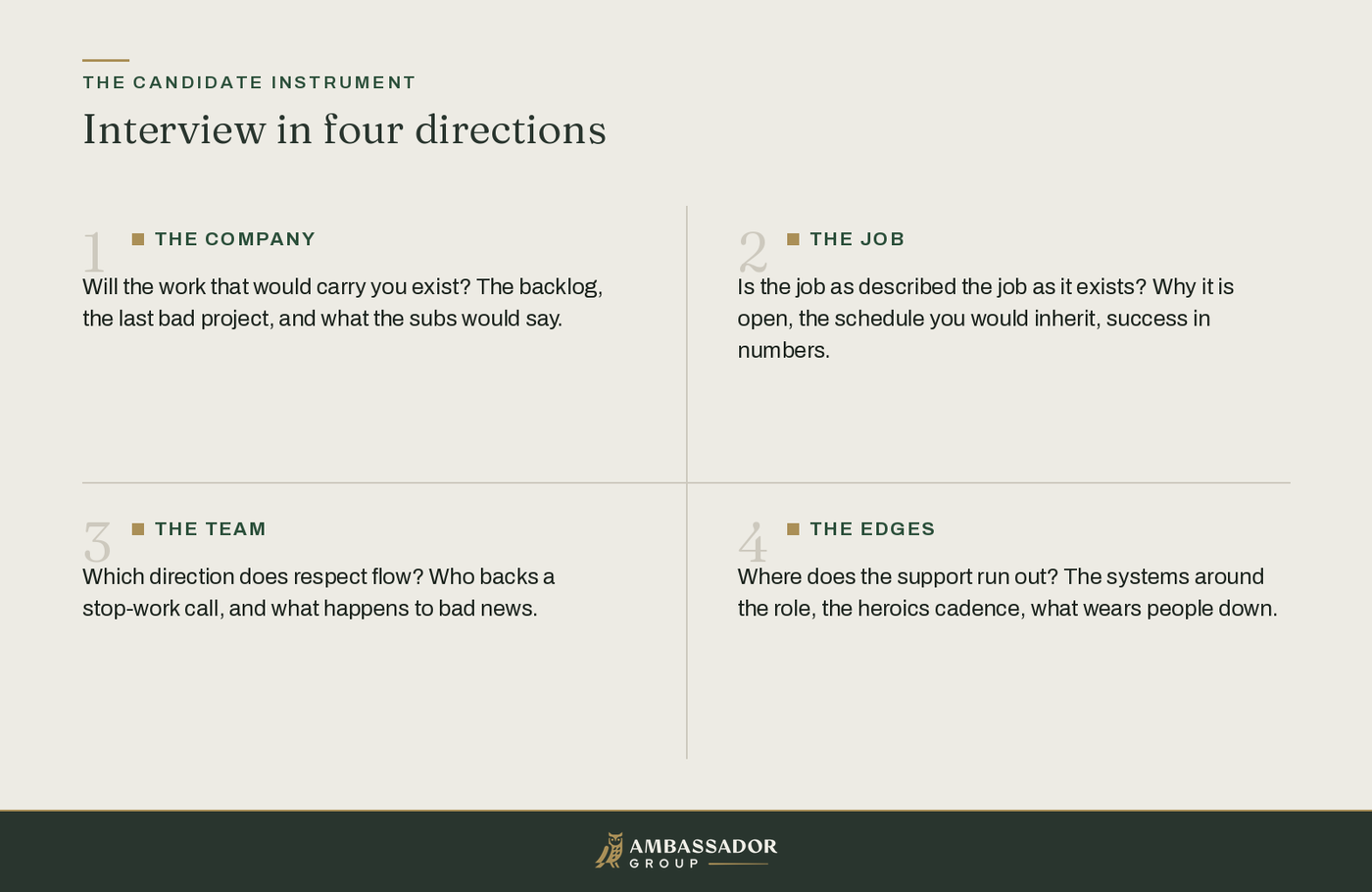
Your questions run in four directions: the company, the job, the team, and the edges of the role. Each question below comes with what to listen for, what an evasive answer sounds like next to a straight one, where to push, and what to ask to see. Four questions you know how to read are worth more than forty that fill the silence.
Interview the company
You are choosing a school as much as an employer. The projects will change and your superintendent may change; the company's habits about growing people follow you through every one of them. Interview those habits first.
“How does this company grow its field leaders?”
- What you are listening for: a system with parts you can name. Deliberate pairing with a superintendent who teaches, scope that grows on purpose, training that costs the company something, and a habit of promoting from inside. Development that lives in one person's goodwill disappears the day that person gets busy.
- Evasive tell vs. straight tell: the evasive answer is opportunity language: "you will learn so much here, we throw people right in." Getting thrown in is exposure, and exposure without teaching is just risk. The straight answer names the mechanics: who mentors, what gets taught deliberately, how often somebody reviews your progress.
- Follow-the-thread: ask what the company teaches an assistant on purpose, and what you would be expected to absorb on your own. Then ask how they decide which superintendent gets to develop someone.
- Evidence ask: the names and rough timelines of field leaders who came up through this role here.
- Red flag: every superintendent on staff was hired in from outside. The assistant role feeds nothing at this company; it is labor with a hopeful title.
“How many assistant superintendents do you have right now, and how many superintendents?”
- What you are listening for: what the ratio says about the role. Assistants paired with superintendents on real projects describe a pipeline. A few assistants scattered across jobs as floating help describe a cost decision.
- Evasive tell vs. straight tell: the evasive answer waves at project needs: "it varies, we staff to the work." The straight answer has numbers and locations: how many assistants, where each sits, and who each works under.
- Follow-the-thread: ask how long the longest-tenured assistant has held the title. Ask how many assistants left in the last 2 years and where they went.
- Evidence ask: the field org chart, names optional. The shape of the field organization tells you whether this title is a rung or a parking spot.
- Red flag: assistants who have been assistants for 5 years, with no story attached. The title is where field careers stall at this company.
“What work is coming that someone in this role would grow into?”
- What you are listening for: runway. Your promotion needs a project to land on. Without new work that needs new superintendents, belief in development stays theoretical.
- Evasive tell vs. straight tell: the evasive answer is growth talk with no shape: "we are expanding fast, big things coming." The straight answer names project types, rough sizes, and how much of the backlog is signed versus pursued.
- Follow-the-thread: ask what happens to assistants when the work gets thin, and who got cut in the last slow stretch. Assistants learn a company's real priorities first.
- Evidence ask: the backlog by project type and how much of it is signed. You are asking whether the job you would grow into exists on paper or in a business developer's optimism.
- Red flag: the growth story leans on one client or one market bet. When it wobbles, development budgets and assistant roles go first.
Interview the job
The title is the least reliable word in the posting. At one company, assistant superintendent means an apprenticeship in running work: real trades, real schedule, real correction. At another it means a radio, a task list, and whatever the superintendent did not feel like doing that day. Your work here is to find out which job this one is.
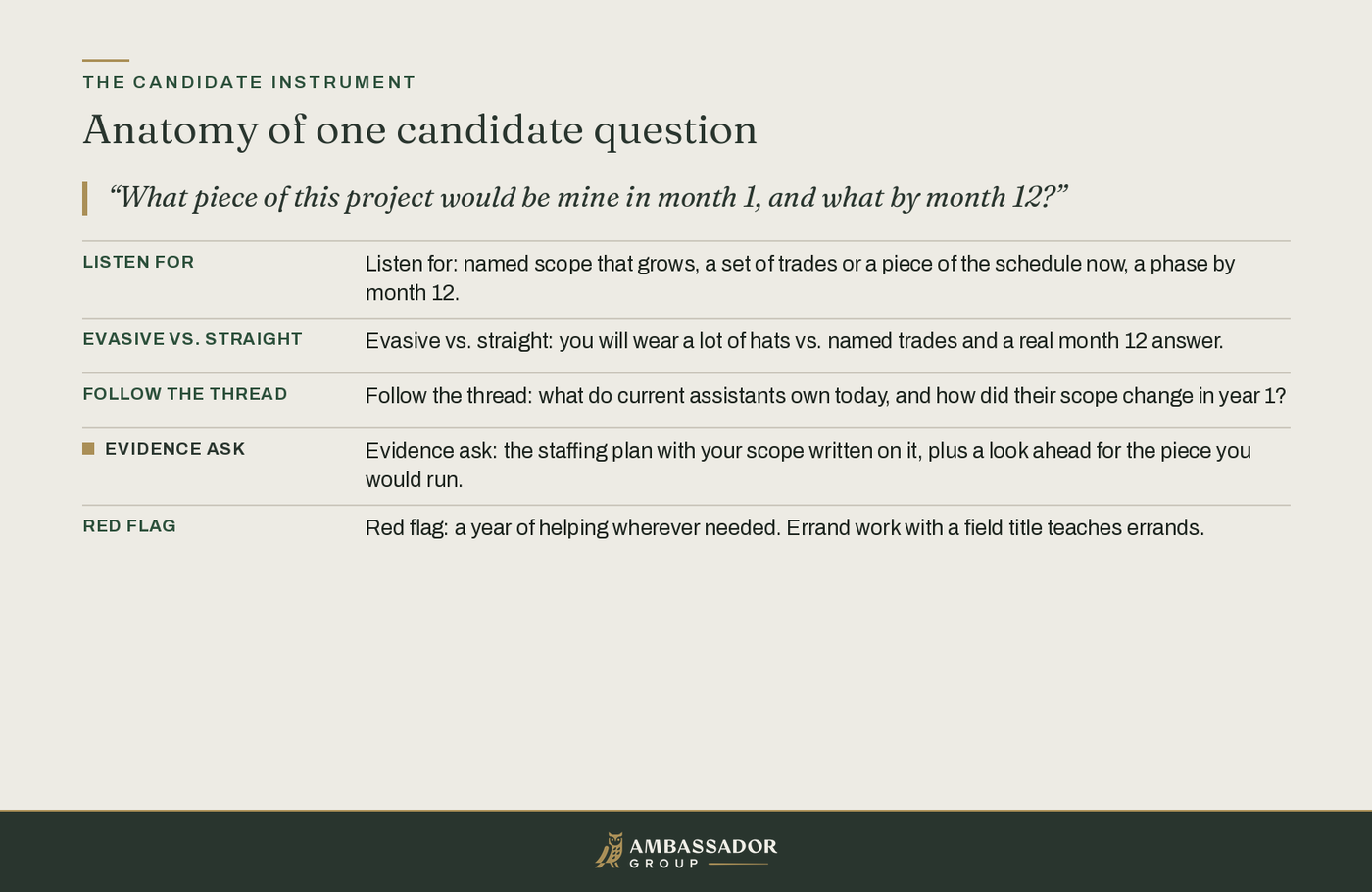
“What piece of this project would be mine in month 1, and what by month 12?”
- What you are listening for: named scope that grows. A set of trades to run, the punch on a building, a piece of the look-ahead that is yours to maintain. The month 12 answer matters more, because it tells you whether anyone has thought past your first week.
- Evasive tell vs. straight tell: the evasive answer is "you will wear a lot of hats" or "we will see what you can handle." The straight answer names the trades, names the piece of the schedule, and describes what a strong performer owns by the end of the first year.
- Follow-the-thread: ask what the current assistants own today and how their scope changed across their first year. A company that can answer has a development plan; a company that cannot has a vacancy.
- Evidence ask: the staffing plan for the project with the assistant's scope written on it, and the current look-ahead for the piece you would run.
- Red flag: no named scope, "helping wherever needed." A year of errands teaches errands.
“Walk me through what your current assistant superintendents did yesterday.”
- What you are listening for: the texture of the real job. A daily log written, a punch walked, 2 trades sequenced around each other, a delivery chased down. The specifics tell you whether assistants here run a slice or run errands, and yesterday is much harder to decorate than a job description.
- Evasive tell vs. straight tell: the evasive answer recites the posting: "field reports, quality, safety support." The straight answer sounds like a day on a named project, with the small collisions real days contain.
- Follow-the-thread: ask who writes the daily log on their jobs, because the person who owns the record owns the slice. Ask what assistants here do that a laborer could do.
- Evidence ask: a conversation with a current assistant superintendent, without a chaperone. 10 minutes with the person living the job beats an hour of anyone describing it.
- Red flag: the interviewer cannot describe an assistant's day at their own company. Nobody is managing what the role contains; you would inherit whatever the superintendent least wants to do.
“Why is this role open, and where is the last person who held it?”
- What you are listening for: what the role does to the people in it. The best answer in the industry: the last assistant now runs work here, and you are backfilling a promotion.
- Evasive tell vs. straight tell: the evasive answer is a vague "it was not a fit." The straight answer says where the person went and talks about it like an adult: promoted, left for a superintendent title elsewhere, or struggled, and at what.
- Follow-the-thread: ask how many people have held this role in the last 5 years and where each one is now. Promotions describe a pipeline. Departures for bigger titles elsewhere describe a school that loses its graduates. Quiet exits with no story describe the job itself.
- Red flag: the last 2 assistants left to become superintendents somewhere else. The company grows people it will not promote, and you are looking at your own exit interview.
Interview the team
For most roles the team shapes the job. For this role, one person on the team decides nearly everything: the superintendent you are assigned to. The same company can hold a superintendent who builds careers and one who burns through assistants, and the company's reputation will not tell you which one you are getting. Ask.
“Which superintendent would I work under, and how was that pairing decided?”
- What you are listening for: whether development entered the decision at all. The strong answer is a name, a reason that includes teaching, and some evidence the superintendent wants an assistant rather than tolerates one. You are listening for a match somebody thought about rather than a hole somebody filled.
- Evasive tell vs. straight tell: the evasive answer is logistics: "depends where we land you, probably whoever needs the help." The straight answer names the person, says why them, and is honest about what they are like to work for, including the hard parts.
- Follow-the-thread: ask about the last person that superintendent developed and where they are now. Ask whether the superintendent asked for an assistant or was assigned one, because a mentor drafted unwillingly teaches resentment.
- Evidence ask: an hour with that superintendent, ideally on their jobsite. Taking this job without meeting the person who will shape your next 3 years is signing a contract without reading it. A company that will not produce them has told you the pairing is a fiction.
- Red flag: the superintendent in question has gone through 3 assistants in 2 years. You are not the variable that will change that arithmetic.
“Who is the last assistant superintendent here who moved up to running work, and what did that path look like?”
- What you are listening for: a recent example with a name and a timeline. Scope that grew, then a small project or a phase with backup close by, then their own job.
- Evasive tell vs. straight tell: the evasive answer is opportunity in the abstract: "for the right person, the sky is the limit." The straight answer has a name, roughly when it happened, and what the company did to get that person ready.
- Follow-the-thread: ask what triggered the promotion: readiness, or a vacancy that needed a body. Ask how many assistants have made that jump in 5 years.
- Evidence ask: 10 minutes with that person. Recent graduates are the best reference a development role has.
- Red flag: nobody can name an example. The path exists in the job posting and nowhere else.
“What happens when an assistant superintendent makes a mistake here?”
- What you are listening for: a learning role produces mistakes by design, so the question is what the organization does with them. You want a story: a real mistake, what it cost, how the superintendent handled it, and where that assistant is now.
- Evasive tell vs. straight tell: the evasive answer is a culture slogan: "we treat everything as a learning experience." The straight answer is specific: the wrong sequence called, the pour that had to wait, the conversation that followed, the person still employed and better for it.
- Follow-the-thread: ask about the last mistake that cost real money and what happened to the person who made it. Ask whether the superintendent takes the heat upward or passes it down, because you will be standing under whichever way it flows.
- Red flag: zero-mistake bravado, or a story where the assistant quietly disappeared afterward. A company that punishes learning teaches hiding, and hiding problems is the one habit that ends field careers.
Find the edges of the role
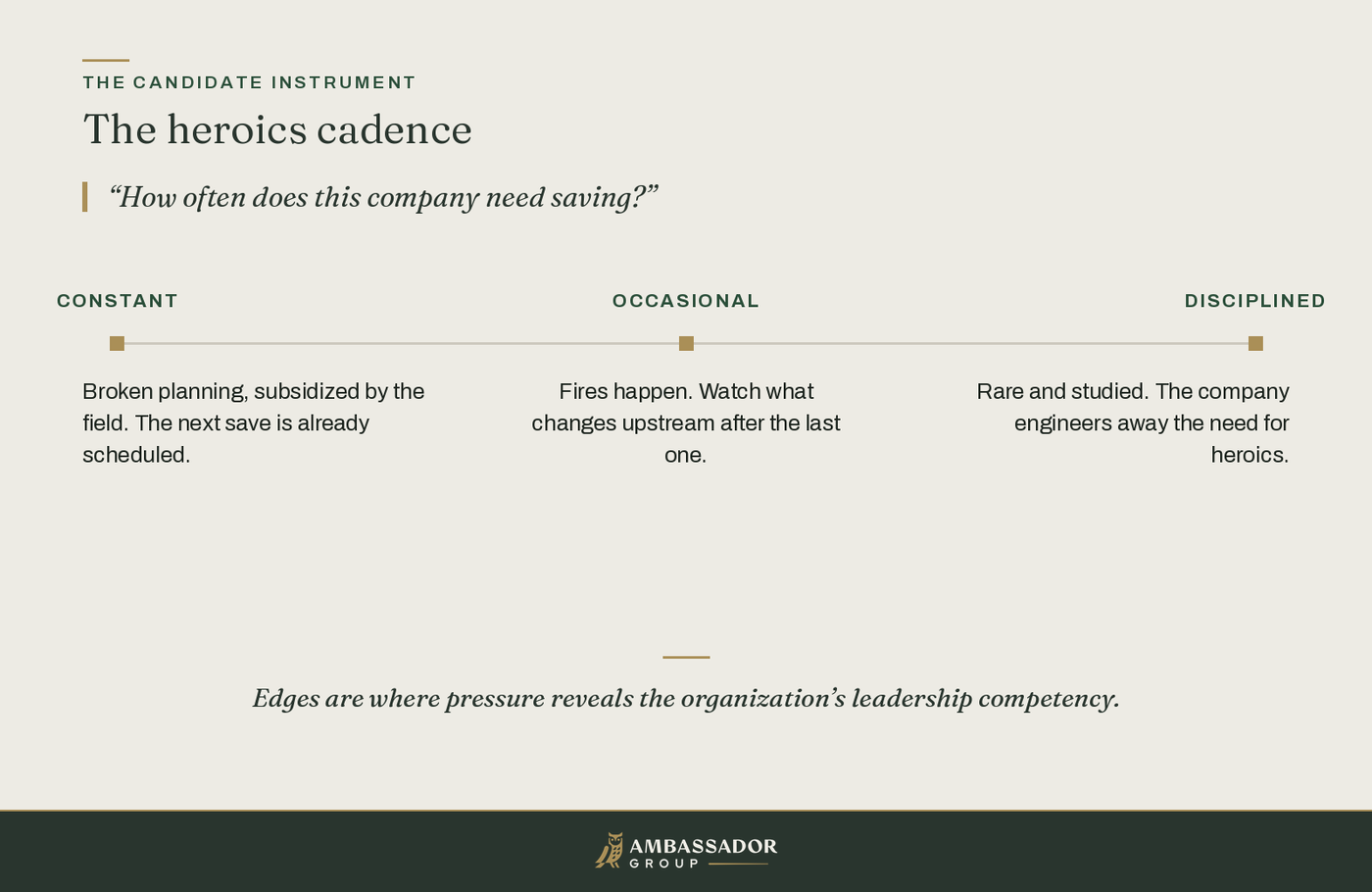
Every role has edges: the places where the job is hardest, where the support runs out, where the organization's promises meet its habits. Edges are where pressure reveals the organization's leadership competency. For an assistant superintendent the edges sit closer than they do for anyone else on site, because you hold the least authority, the shortest track record, and the smallest claim on anyone's protection. Find the edges now, while finding them costs you nothing.
“If my superintendent gets pulled to another project, what happens to this one, and to me?”
- What you are listening for: whether structure exists around you when the organization stretches thin. Superintendents get pulled: to fires, to new work, to a health event nobody planned for. The question is whether the company has a plan for that day or whether you are the plan.
- Evasive tell vs. straight tell: the evasive answer flatters you: "honestly, that would be your moment to step up." The straight answer describes coverage: a general superintendent who shows up, a project manager who owns their half, clarity about what you can sign and what waits.
- Follow-the-thread: ask about the last time an assistant was left running work alone, for how long, and how it went for them.
- Evidence ask: the staffing plan, showing whether your superintendent is committed to this project full time. A superintendent split across 2 jobs is an absence with a truck.
- Red flag: being left alone with a job gets framed as a perk. Unsupported opportunity is risk transferred downhill, and when it goes wrong, the daily reports carry your name.
“Tell me about the last time this company needed heroics from the field. How often does that happen?”
- What you are listening for: the heroics cadence. Some companies require heroics constantly, some occasionally, and some are disciplined about avoiding the situations that require them. Which is this one? Heroics roll downhill, and assistants are the cheapest hours on the org chart. A year of firefighting teaches you firefighting. A year of planned work teaches you how work gets planned.
- Evasive tell vs. straight tell: the evasive tell is pride: weekend saves told with a grin, chaos worn as culture. The straight answer names the last real fire, what it cost, and what changed upstream so it does not repeat.
- Follow-the-thread: ask how many weekends the assistants worked in the last month, and watch whether the answer is a number or a shrug. Ask what changed after the last fire drill, because if the answer is nothing, the next one is already scheduled, and you are interviewing for it.
- Red flag: "everybody pitches in around here" delivered as a recruiting pitch. The person holding the hose is the one with the least standing to refuse, and that is you.
“If I see something unsafe and the foreman tells me to keep moving, what am I authorized to do?”
- What you are listening for: whether the least-titled leader on site holds real authority on a safety call. The strong answer is direct: you stop it, then you call, and the company sorts out the schedule and the egos afterward, in that order.
- Evasive tell vs. straight tell: the evasive answer routes you around your own judgment: "flag it to your super and they will handle it," which means a hazard waits on a phone call. The straight answer gives you the authority and the machinery behind it: who you call, who backs you.
- Follow-the-thread: ask what happened to the last assistant who stopped work here. Ask who explained the lost day to the owner.
- Red flag: a laugh, or any version of "use good judgment, we have a schedule." If the company's backing depends on the stop being convenient, you have no authority. You have exposure with a title on it.
Write it down before the offer shapes it
An offer distorts judgment, and an early-career offer distorts it most. The moment a number is on the table, everything you heard gets re-graded on a curve, and the edges you found start looking like quirks. The fix is the discipline a good interviewer uses on candidates, pointed the other way. Underwrite the company before the offer arrives.
- Write your read the same day. After each conversation, capture what you learned in the four directions: company, job, team, edges. Specifics, while they are fresh: the superintendent's name, the scope described, the promotion example given or dodged. By the third conversation your memory will be a blur of good feelings.
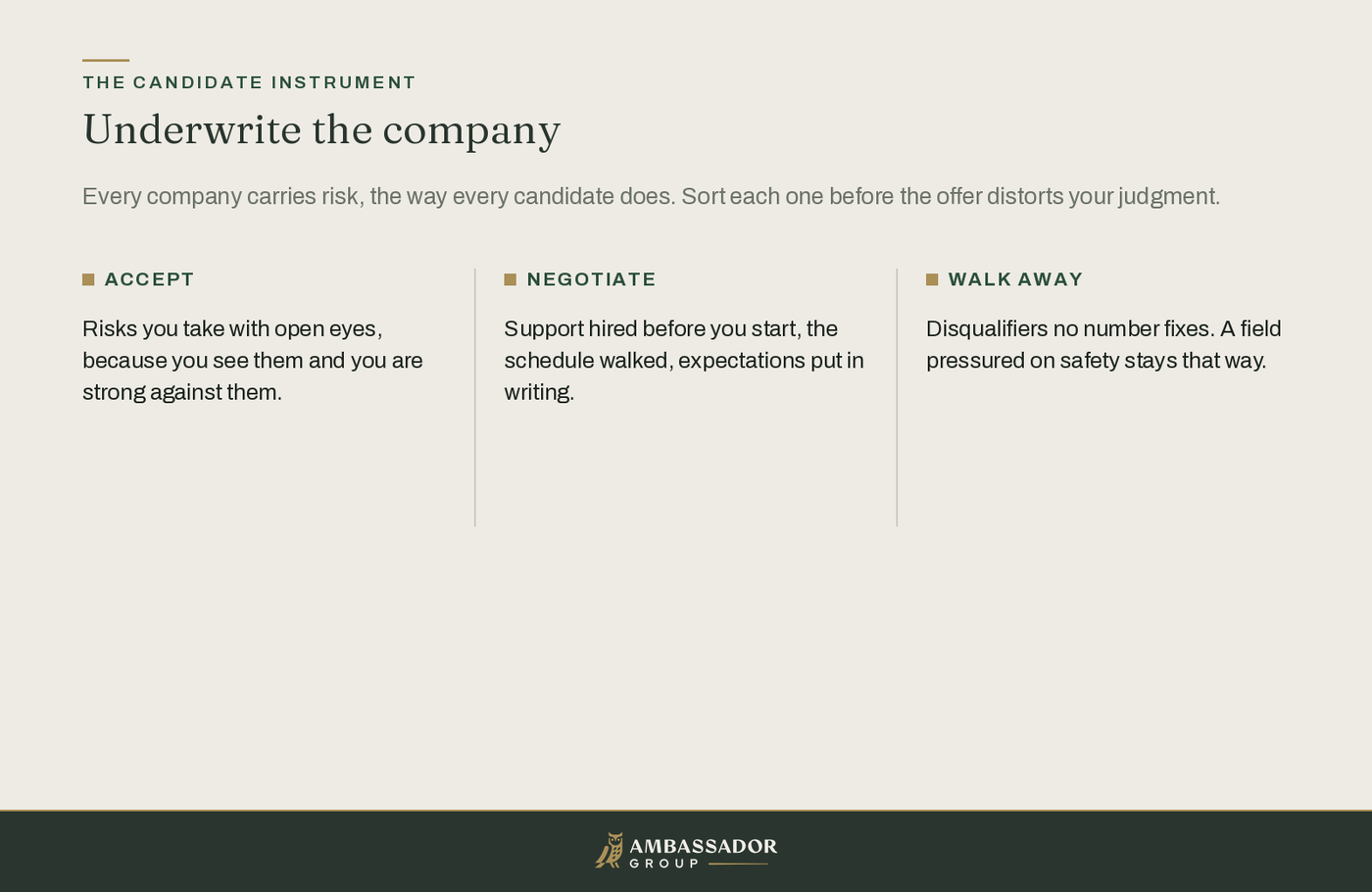
- Sort the risk: accept, negotiate, or walk. Every company carries risk, the way every candidate does. Some you accept with open eyes: a thin backlog in one market, a superintendent with a gruff reputation and a strong record of graduates. Some you negotiate: scope put in writing, a review cadence with a name attached. And some are disqualifying at any salary, because a company that punishes safety calls from the field does not become a different company because it made you an offer.
- Name what you did not assess. If you never met your superintendent, never heard a promotion example, never got a month 12 answer, write those down as holes in your information, then go fill them. Ask for the extra conversation or the site walk. A company that refuses has answered a question too.
- Price the offer against the market, not against your current pay. A raise on an underpaid year is still underpaid, and early-career candidates are the easiest to flatter with one. Know your market from data rather than folklore: the compensation benchmark exists for exactly this.
- Decide against your life, not against your current job. The question is whether this role builds the career you are aiming at, not whether it beats the job you are leaving. Almost anything beats a job you already want out of, which is why leaving is when people take the wrong development role. The larger discipline of knowing your direction, your strengths, and your worth is a career's work, and Build to Last is a working manual for it.
The pre-offer checklist turns this into a worksheet you can run before you sign.
The other half of the decision
The company is running an interview to decide whether you can grow into this role. Somebody has to run the interview that decides whether this company can grow you, and nobody else in the process is going to do it. Ask plainly, follow the thread when an answer runs thin, ask to meet the people instead of settling for descriptions of them, and believe what the edges tell you. The habit will outlast the job: the same four directions work at the next title up, in a construction superintendent interview, and further along in a general superintendent interview.
You are asking a company to make you a superintendent. Interview it like one.
Ambassador Group represents construction leaders on both sides of the table and tells both sides the truth. If you want that kind of representation for your next move, send us your resume.
The short version.
- What questions should an assistant superintendent ask in a job interview?
- Ask in four directions: the company, the job, the team, and the edges of the role. Probe how the company grows field leaders, what piece of the project you would own in month 1 and month 12, which superintendent you would work under and how that pairing was decided, and how often the company demands heroics from the field.
- How can a candidate tell whether an assistant superintendent job is a real development role?
- Ask for named scope: a set of trades or a piece of the schedule in month 1, growing by month 12. Ask who the last assistant superintendent promoted to running work was and what that path looked like. A company with a real pipeline answers with names and timelines. A company with errand work answers with "you will wear a lot of hats."
- What should an assistant superintendent candidate ask about the superintendent they would work under?
- Ask for the name, how the pairing was decided, and what that superintendent is like as a teacher. Ask about the last person the superintendent developed and where they are now. Then ask to meet them, ideally on their jobsite. A company that will not produce your future boss has told you the pairing is a fiction.
- What are the edges of an assistant superintendent role, and why do they matter?
- Edges are where the job is hardest and the support runs out: what happens when your superintendent gets pulled to another project, how often the company requires heroics from the field, and what authority you hold on a safety call. Edges are where pressure reveals the organization's leadership competency. Find them in the interview, while finding them costs you nothing.
- How should an assistant superintendent evaluate a job offer?
- Write down what you learned the same day, before the offer distorts it. Sort each risk into accept, negotiate, or walk away. Price the offer against the market rather than your current pay, and decide whether the role builds the career you want, not whether it beats the job you are leaving.


