
A general contractor loses more margin in the estimating room than on any jobsite, and the person who runs that room is the hardest role in the company to read across a table. When a leadership team writes senior estimator interview questions, the instinct is to quiz for takeoff speed and software fluency. Those are table stakes. The quality of this hire is principally driven by the interviewer, not the candidate. A strong Senior or Chief Estimator reads well to a sharp questioner and disappears in front of a dull one, because the qualities that decide the role (judgment under pricing pressure, discipline with cost data, the spine to walk a bad bid) do not announce themselves. They surface only when someone in the interview knows how to listen for them. The questions below are instruments. The reading belongs to the leader holding them, and that is where the hire is won or lost.
Hiring a Senior or Chief Estimator is an act of underwriting. You are pricing a person against a risk, and you price well only by interviewing to the places where the role fails. For the broader discipline of reading a candidate to depth, Hire in 4K is the companion to this guide.
Interview to the 3 places this role breaks
Most interviews for this role wander across a whole career and land nowhere. A Senior or Chief Estimator fails in three predictable places, and every probe here comes from one.
The first is bid and pricing strategy under pressure. Margins are thin, ownership wants the backlog full, and the estimator who cannot say no to the wrong job quietly fills the pipeline with work the company loses money building. The second is historical cost data and the estimating system. An estimator who carries numbers in their head instead of a repeatable system is a single point of failure, and the day they leave, the company forgets what things cost. The third is leadership of the function: owning win rate as a measurable number, developing estimators, and governing the handoff to operations are different muscles than building a clean estimate alone.
Read for those three. Everything else is supporting detail.
The accountabilities this role owns
A Senior or Chief Estimator is accountable for six things, and the probes that follow sit under each.
- Estimating strategy and bid/no-bid leadership.
- Pricing, margin, and risk strategy.
- Estimating-team development.
- Historical cost data and systems.
- Owner, executive, and client interface.
- Governance of the precon-to-operations handoff.
This guide goes deep on a few probes per accountability rather than wide across a hundred questions. A handful you can read beats a long list you cannot.
Estimating strategy and bid/no-bid leadership
This is what separates a Chief Estimator from a strong estimator. Anyone can price a job that lands on their desk. The leader decides which jobs are worth pricing at all, and that decision is where the margin lives.
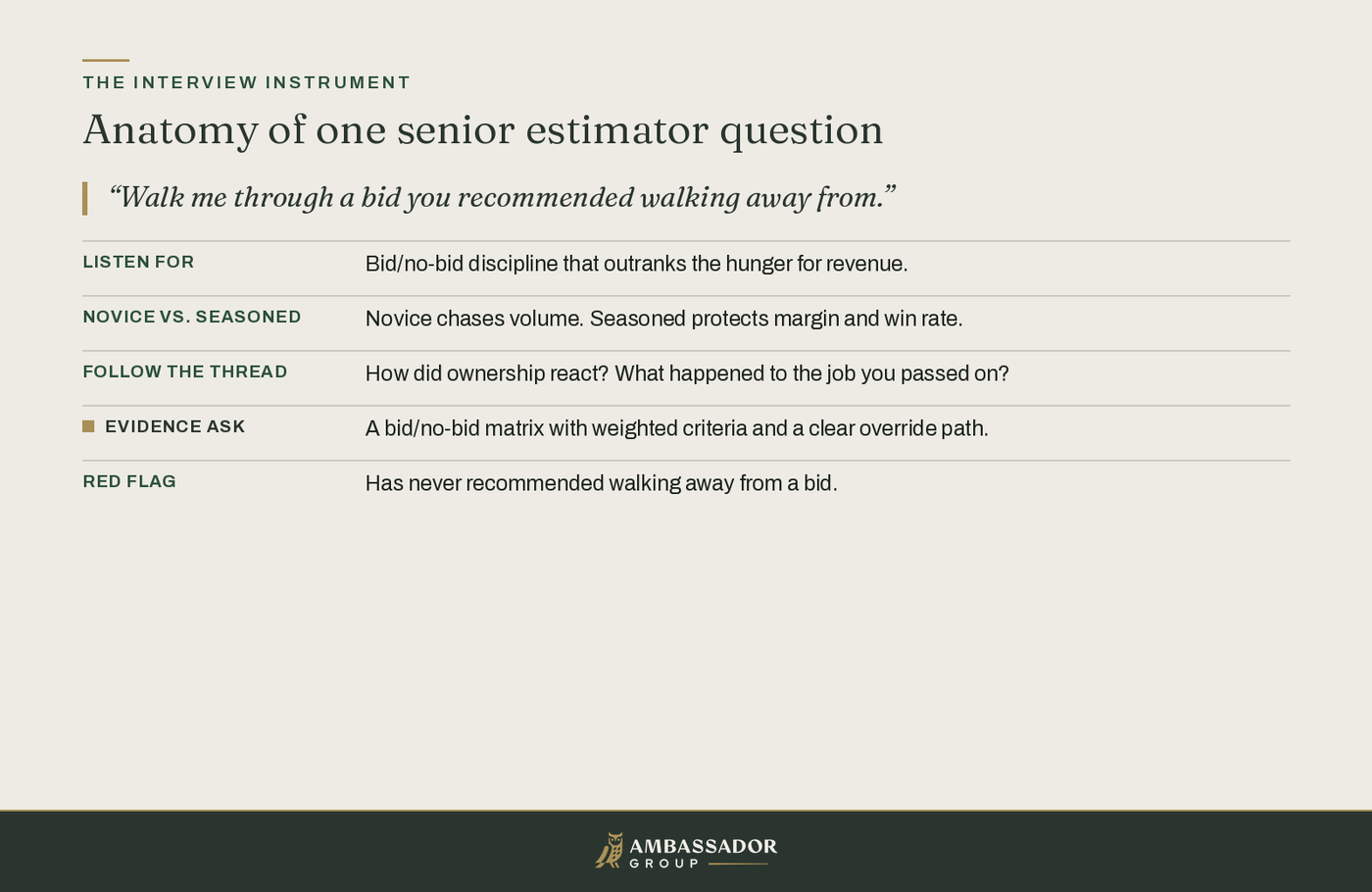
Walk me through the last bid you killed, and who you had to convince to kill it
- What you are listening for: a bid/no-bid decision driven by a framework, not a feeling, and the standing to say no when ownership wanted the work. The strongest candidates name criteria (self-perform capacity, schedule risk, owner and architect reputation, the GC field, fee compression) and a moment where they held the line.
- Novice tell vs. seasoned tell: the novice talks about bids they won and treats no-bid as a passive non-event ("we just didn't have time"). The seasoned estimator talks about bids they walked, names the revenue they turned away, and can tell you what the job would have cost had they chased it.
- Follow-the-thread: if they cite a framework, ask the threshold on the variable that nearly flipped the decision. If they convinced ownership, ask the owner's counterargument and their answer to it. If a competitor took the job they walked, ask what happened to that competitor on it.
- Evidence ask: their bid/no-bid matrix or go/no-go scorecard, even a redacted screenshot. A real one carries weighted criteria, a scoring threshold, and a documented override where judgment beat the score. Ask to see one completed pursuit run through it.
- Red flag: a candidate who has never killed a bid they could have chased, or who treats every invitation to bid as a job to pursue, is an order-taker, not an estimating leader.
How do you decide your bid hit rate is too high, not too low
- What you are listening for: a disciplined target hit rate, not a maximal one, and a feel for what it costs the company to win too easily.
- Novice tell vs. seasoned tell: the novice treats every win as good news and quotes a high close rate with pride. The seasoned estimator can name the band they aim for and the quarter they had to correct when the rate ran hot.
- Follow-the-thread: ask the target band and the reasoning behind it. Ask for a quarter where the rate ran hot and what they changed. Ask how hit rate breaks out by project type, delivery method, or client tier.
- Evidence ask: a win/loss log by pursuit, carrying the spread between their number and the winning number on the jobs they lost. The discipline shows in whether they capture the losing covers at all, and whether they know the median gap.
Pricing, margin, and risk strategy
This is the underwriting core of the role. The estimator sets the number the company lives or dies on, and the question is whether it reflects real risk or wishful thinking.
Tell me about an estimate where you priced the risk wrong, and what it cost
- What you are listening for: ownership of a real miss, the mechanism behind it (a scope gap between trades, an escalation assumption that broke, a sub who walked at buyout), and the structural change they made afterward.
- Novice tell vs. seasoned tell: the novice blames the field, the subs, or the market and frames the miss as bad luck. The seasoned estimator names the exact line where their judgment failed and the guardrail they built so it could not happen the same way twice.
- Follow-the-thread: ask how and how late the miss surfaced (buyout, change orders, closeout). Ask their contingency and escalation assumptions going in. Ask whether the fix is now standing practice.
- Evidence ask: an estimate-to-actual variance report, or a buyout log on a job that ran over, showing where the gap opened by cost code. The candidate who tracks estimate against actual has a feedback loop; the one who does not is guessing every time.
- Red flag: an estimator who cannot name a single estimate that went wrong has not run enough work, or is not honest enough to run your number.
How do you set contingency and margin differently across project types
- What you are listening for: a differentiated view of risk, where contingency and fee flex with design completeness, delivery method, client relationship, and self-perform exposure. A flat markup on everything is the tell of someone who has never owned the consequences.
- Novice tell vs. seasoned tell: the novice quotes one number ("we carry X percent"). The seasoned estimator describes a range and the conditions that move them across it, and can walk you through a job where they carried more than usual and why.
- Follow-the-thread: ask what pushes contingency up on a design-build or GMP versus a hard-bid lump sum. Ask how a new client moves their fee against a repeat one. Ask the last time they recommended walking on fee rather than cutting it.
- Evidence ask: a markup or contingency policy they authored or shaped, or a fee summary across several recent pursuits that shows the spread. The variance across jobs is the proof of judgment; a single number across every job is the proof of its absence.
Estimating-team development
A Chief Estimator who is only a strong individual contributor is a bottleneck with a title. The function has to outlast any one person: ask what would break the day after they get hit by a bus, and listen for how little, not how much. The answer turns on whether they developed the people under them.
How do you develop an estimator who is fast but sloppy, versus one who is accurate but slow
- What you are listening for: a coaching model that diagnoses the underlying habit, not a generic answer about "more training." The two failure modes call for opposite interventions, and a leader who has grown estimators knows which lever to pull.
- Novice tell vs. seasoned tell: the novice checks everyone's work personally, which is supervision, not development. The seasoned leader builds the estimator's own self-check discipline so the leader stops being the safety net.
- Follow-the-thread: ask for an estimator they grew and what that person could do at the end that they could not at the start. Ask how they catch a sloppy takeoff without redoing it. Ask who on their last team got promoted and how they made it happen.
- Evidence ask: a takeoff QC checklist or peer-review standard they built, or a ramp plan for a junior estimator naming which trades they hand off first. The artifact shows whether development is a system or a hope.
- Red flag: a candidate who reviews every number personally and cannot describe handing real estimating authority to anyone else becomes the ceiling, not the multiplier. Compare against the patterns in the Estimator interview guide to calibrate the difference between the role you are filling and the role below it.
Historical cost data and systems
This is the role's institutional memory. Historical cost data is the company's most underpriced asset, and the estimator owns whether it is trustworthy or fiction. A leader names the system that makes it defensible: standardized takeoff methods, an assemblies library, a tightened buyout-to-actual loop. A contributor names a software platform and stops.
How do you know your historical cost data is true
- What you are listening for: a closed loop between estimate and actual. The estimator who trusts their unit costs because the field feeds real numbers back, and who knows where their data is stale or thin. Skepticism of their own database is the mark of someone who has been burned trusting it blind.
- Novice tell vs. seasoned tell: the novice trusts the database because it exists and quotes unit costs with false confidence. The seasoned estimator tells you which cost codes they trust, which they distrust and why, and how recently each was checked against a real job.
- Follow-the-thread: ask how actual costs get back into the database and who owns that loop. Ask which trades their data is weakest on now. Ask what they do when a sub's number comes in 30 percent off their historical.
- Evidence ask: a unit-cost database, assemblies library, or cost-history file they built or maintain, with the date each line was last validated against job-cost actuals. A database with no provenance is a liability they have not noticed.
- Red flag: an estimator who cannot describe how actuals get reconciled back into their estimating data is pricing on faith, and that faith costs a job's worth of margin eventually.
Owner, executive, and client interface
The estimator who can build a flawless number but cannot defend it to ownership or a client is half the role. This tests whether the candidate carries the company's risk posture into the room where the deal gets made, including the hard version: a client pushing value engineering to a number that breaks the project. Listen for whether they name what gets sacrificed at each level of cut and refuse the one that turns into a change-order war or a safety problem, rather than cutting to the number and letting the field absorb it.
Tell me about a time you had to tell ownership a number they did not want to hear
- What you are listening for: the spine to deliver an honest price into pressure, and the skill to do it without burning the relationship. The estimator is the company's check against wishful pricing, and that check works only if they will hold a number against the boss.
- Novice tell vs. seasoned tell: the novice softens the number to keep the peace or caves when pushed. The seasoned estimator holds the line, shows the work behind the number, and gives ownership a real decision rather than a comfortable one.
- Follow-the-thread: ask how ownership reacted and what happened to the job. Ask whether the job later showed them right or wrong. Ask how they present a number they know the room will dislike.
- Evidence ask: a bid-review or pricing presentation they walked an owner or client through, the kind that shows the number against scope, assumptions, qualifications, and contingency. The structure shows whether they argue from data or from authority.
Governance of the precon-to-operations handoff
The best estimate fails if operations inherits it cold. This tests whether the candidate treats the handoff as part of their job or someone else's problem.
What does operations need from you that most estimators never give them
- What you are listening for: regard for the field and a structured handoff. The estimator who knows the project team builds to the estimate's assumptions, and hands over buyout logic, clarifications, and risk notes rather than a bare number. This is the seam where precon and operations either trust each other or blame each other.
- Novice tell vs. seasoned tell: the novice throws the estimate over the wall and considers the job done at award. The seasoned leader sits in the turnover, walks the assumptions, and stays reachable when the field hits something the estimate did not anticipate.
- Follow-the-thread: ask what is in their handoff package today. Ask the last time a project manager came back angry about an estimate and how that went. Ask how they capture field feedback so the next estimate is better.
- Evidence ask: a turnover package, buyout log, or basis-of-estimate memo they hand project teams at award, carrying inclusions, exclusions, allowances, and the assumptions behind the number. A real handoff artifact is the difference between a leader who owns the whole arc and one who owns only the bid.
- Red flag: an estimator who frames the field's overruns as the field's failure, with no reflection on what the estimate missed, will poison the relationship between precon and operations. For how this role sits inside the larger preconstruction function, the Preconstruction Manager interview guide maps the adjacent ground.
What the candidate should be asking you
The interview runs both directions, and a Senior or Chief Estimator who does not interrogate the role is a candidate who has not led one. The job has to fit the person as much as the person fits the job, because a strong estimator matched into a role that cannot support them fails and calls it their own.
Listen for whether they ask what a real leader of this function needs to know. The bid volume and pursuit calendar tell them whether the role is staffed to win or set up to drown. Whether ownership overrides the bid/no-bid call, and whether fee gets cut after they hand over the number, tells them whether the role carries authority or only responsibility. The state of the cost data and the maturity of the team tell them what they are walking into. The candidate who asks what happened to the last person in the role is underwriting you back.
The estimator who asks none of this and only asks about compensation and title wants a job, not a function to own. The one who presses you on authority, data quality, and how operations and precon get along is showing you how they will lead.
Do not leave the interview without capturing it
The debrief is where good interviews come apart, because memory rewrites itself fast. Write your feedback before anyone in the interview talks. The moment another interviewer speaks, your own assessment bends toward theirs, and the specific things you heard get overwritten by the loudest voice in the interview. Get your read on paper first, with the actual quotes that moved you.
Then tally the risk honestly. For every concern you surfaced, decide one of three things: you can fill it (the candidate grows into it with support you will provide), you can engineer around it (the org absorbs the gap through how you structure the role), or you cannot, and the risk is disqualifying. Do not let a strong answer in one accountability paper over a fatal gap in another. An estimator brilliant at pricing and unable to develop a team is still a bottleneck.
Name what you did not assess. No single interview reads every seam. If you never got to historical cost data, or never pressed on whether they will hold a number against ownership, write it down as an open question rather than letting it quietly resolve to "probably fine."
And decide against the role, not the other candidates. The question is never whether this person beats the other two in the pipeline. It is whether they clear the bar the role demands. A relative best can still be an absolute miss. The full discipline of capturing a read to depth lives in Hire in 4K.
The instrument is only as good as the hand that holds it
Every question here can be asked by a strong interviewer and a weak one, and only one hears the answer that matters. A Chief Estimator who has walked a hundred bad bids reads, on a transcript, almost identical to one who has never walked a single one. The difference lives in the follow-up, in the silence you hold, in whether you press on the artifact or accept the story. The reading is the work, and it sharpens with practice the way any craft does, the argument running through the Seven Levels of Interviewing Mastery. The leader who becomes the steady point every hard conversation runs through reads these roles correctly, the subject of Be the Lightning Rod.
The candidate did not get easier to read. You got better at reading them. The only question left is whether you do the reading or leave it to chance.
The short version.
- What should senior estimator interview questions focus on?
- The three predictable spots where the role breaks: bid and pricing strategy under pressure, ownership of historical cost data and the estimating system, and leadership of the function, meaning win rate, developing estimators, and governing the handoff to operations. Takeoff speed and software fluency are table stakes, the ground the core estimator interview questions already cover. Interview to where the role fails; everything else is supporting detail.
- How do I tell a Chief Estimator from a merely strong estimator?
- The leader decides which jobs are worth pricing at all, not just how to price whatever lands on the desk. Seasoned estimators talk about bids they walked, name the revenue they turned away, aim for a disciplined hit-rate band rather than a maximal one, and build people and systems that outlast them. A candidate who has never killed a bid they could have chased is an order-taker, not an estimating leader.
- What evidence should I ask a senior estimator candidate to show?
- Real artifacts: a bid/no-bid matrix with weighted criteria and a documented override, a win/loss log carrying the spread against winning numbers, an estimate-to-actual variance report or buyout log, a markup or contingency policy they authored, a takeoff QC checklist or junior-estimator ramp plan, and a turnover package with inclusions, exclusions, allowances, and assumptions. Artifacts separate systems from stories.
- What are the red flags when interviewing a senior estimator?
- A candidate who has never killed a chaseable bid, cannot name a single estimate that went wrong, personally reviews every number and has never handed real estimating authority to anyone, cannot describe how actual costs reconcile back into the estimating database, or frames the field's overruns as purely the field's failure. Each signals an order-taker, a bottleneck, or someone pricing on faith.
- What questions should a strong estimator candidate ask me?
- A real leader of the function underwrites you back: bid volume and the pursuit calendar, whether ownership overrides the bid/no-bid call, whether fee gets cut after they hand over the number, the state of the cost data, the maturity of the team, and what happened to the last person in the role. A candidate who asks only about compensation and title wants a job, not a function to own.


