
The company across the table came with questions for you. If you are early in your career, you have spent your preparation rehearsing answers and almost none of it deciding what to ask back. The questions to ask in an assistant project manager interview matter as much as the ones you will answer, because the APM job is where you learn the craft, and half of this decision is yours. The quality of your next move is principally driven by you, not by the company recruiting you. Two companies can post the identical APM job. One will teach you to run work. The other will use you as a document clerk and call it experience. The posting will not tell you which one is across the table. The questions below will.
Most interview advice for candidates at your stage is about performing well: rehearse your stories, have a few questions ready so you look engaged. This guide assumes you can perform. It is about the other job you have in that conversation: deciding whether this company deserves the years in which you form your habits as a builder. That is an underwriting decision, and underwriting takes evidence, not vibes.
They are bringing an instrument. Bring your own.
A rigorous interviewer does not wing this hire. They will probe the places an APM breaks: whether your follow-through holds when the submittal log gets deep, whether you know which two of the hundred weekly issues belong in front of the PM, whether you take correction and convert it into changed behavior. You can read the exact instrument a disciplined interviewer runs on your role: assistant project manager interview questions. Read it. Arriving with specifics instead of adjectives is most of the performing half of your job.
And notice something while you are in the conversation: how they interview you is evidence about them. A company that interviews its feeder role with real probes and real listening develops young builders on purpose. A company that fills the role after a friendly chat about your GPA is showing you how deliberately it will develop you: by accident. Both are free information. Most candidates never collect it.
You will not ask all of these, and you will not ask them all at once. Earn the right first: answer their questions well, then ask yours, in the tone of a builder walking a job rather than an auditor working a file. The company and job questions belong in the first real conversation. The evidence asks and the team questions belong after mutual interest is on the table, where asking to meet the PM reads as seriousness instead of presumption. Spread the rest across the process and let each conversation carry two or three, asked well.
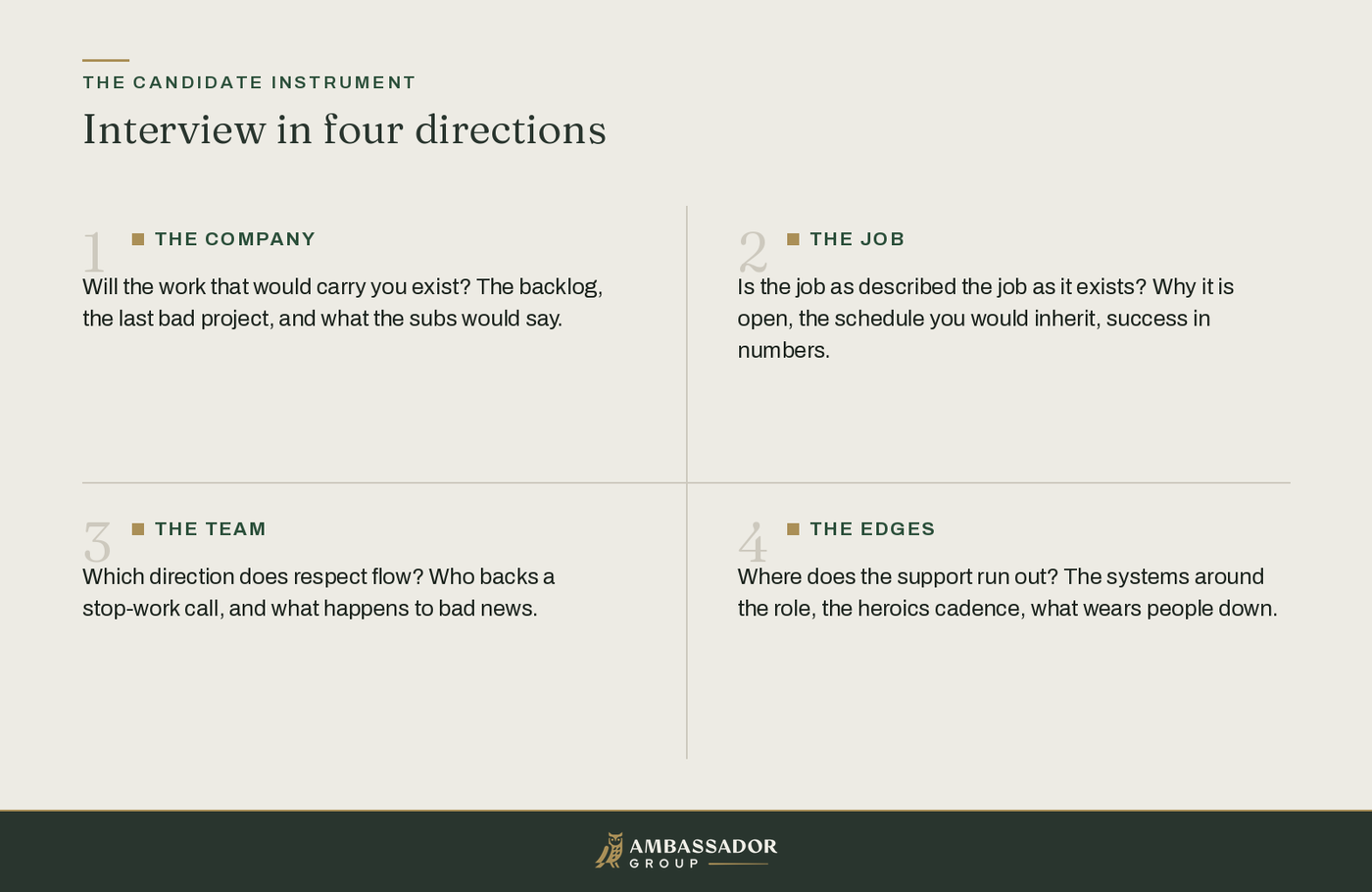
Your own questions run in four directions: the company, the job, the team, and the edges of the role. Take them in that order. Each question below comes with what to listen for, what an evasive answer sounds like next to a straight one, where to push, and what to ask to see. Four questions you know how to read are worth more than forty that fill the silence.
Interview the company
You are choosing a school as much as an employer. The company, more than the project or the title, decides whether your next two years compound into a career or evaporate into paperwork.
“Where are the APMs you hired two and three years ago now?”
- What you are listening for: whether the company grows its young people or burns through them. APMs promoted and still there mean the machine produces what it is promising you. A trail of 18-month departures means it consumes what it hires.
- Evasive tell vs. straight tell: the evasive answer is opportunity language with no names: "there is a lot of growth here for someone hungry." The straight answer has names and destinations: one is a PM now, one runs their own project, one left, and the company can say why without flinching.
- Follow-the-thread: ask how many APMs the company has hired in the last five years and how many are still there. One departure is a story. A pattern is the job.
- Evidence ask: a conversation with an APM who has been there more than a year. Companies reference-check you. Reference-check them.
- Red flag: nobody can name an APM who became a PM here. The path you are being sold has no footprints on it.
“What does the company invest in teaching people at my level?”
- What you are listening for: investment you can point at: a structured first 90 days, scheduled one-on-ones, PM time for mentoring counted as work rather than charity. Culture words are free. Calendars and budgets are commitments.
- Evasive tell vs. straight tell: the evasive answer is drowning dressed as pedagogy: "we throw people in, you will learn fast here." The straight answer names the habit or the program: who runs onboarding, what the last new APM's first month looked like, which PM teaches.
- Follow-the-thread: ask what changed about developing APMs after the last one struggled, and whether mentoring shows up in a PM's own review.
- Evidence ask: the onboarding or training plan for your first 90 days, on paper. A company that has one is glad you asked. One improvising in front of you just answered the question.
- Red flag: "sink or swim" said with pride. That is a company outsourcing its teaching to your panic.
“What kind of projects would I work on in my first two years?”
- What you are listening for: the variety and the reality of the work. Different project types, delivery methods, and clients teach faster than one building built five times, and the work has to exist.
- Evasive tell vs. straight tell: the evasive answer is pipeline excitement: "a lot of great stuff coming." The straight answer names projects, their type and stage, which are signed versus still pursuits, and which you would touch first.
- Follow-the-thread: ask which project they would put you on, and why that one for you. A specific answer means someone has thought about you rather than a headcount.
- Evidence ask: the current backlog by project type and how much of it is signed versus hoped for. The dollar detail is the company's to keep. The shape of the next two years of your education is a fair question.
- Red flag: every project in the story is the same building for the same client. You will learn one job five times and call it two years of experience.
Interview the job
The title is identical everywhere. The job is whatever this company, on this project, under this PM, has made of it. For an APM the question lives in the distance between what you will own and what you will merely process. Owning the submittal register teaches you construction. Typing into it teaches you typing.
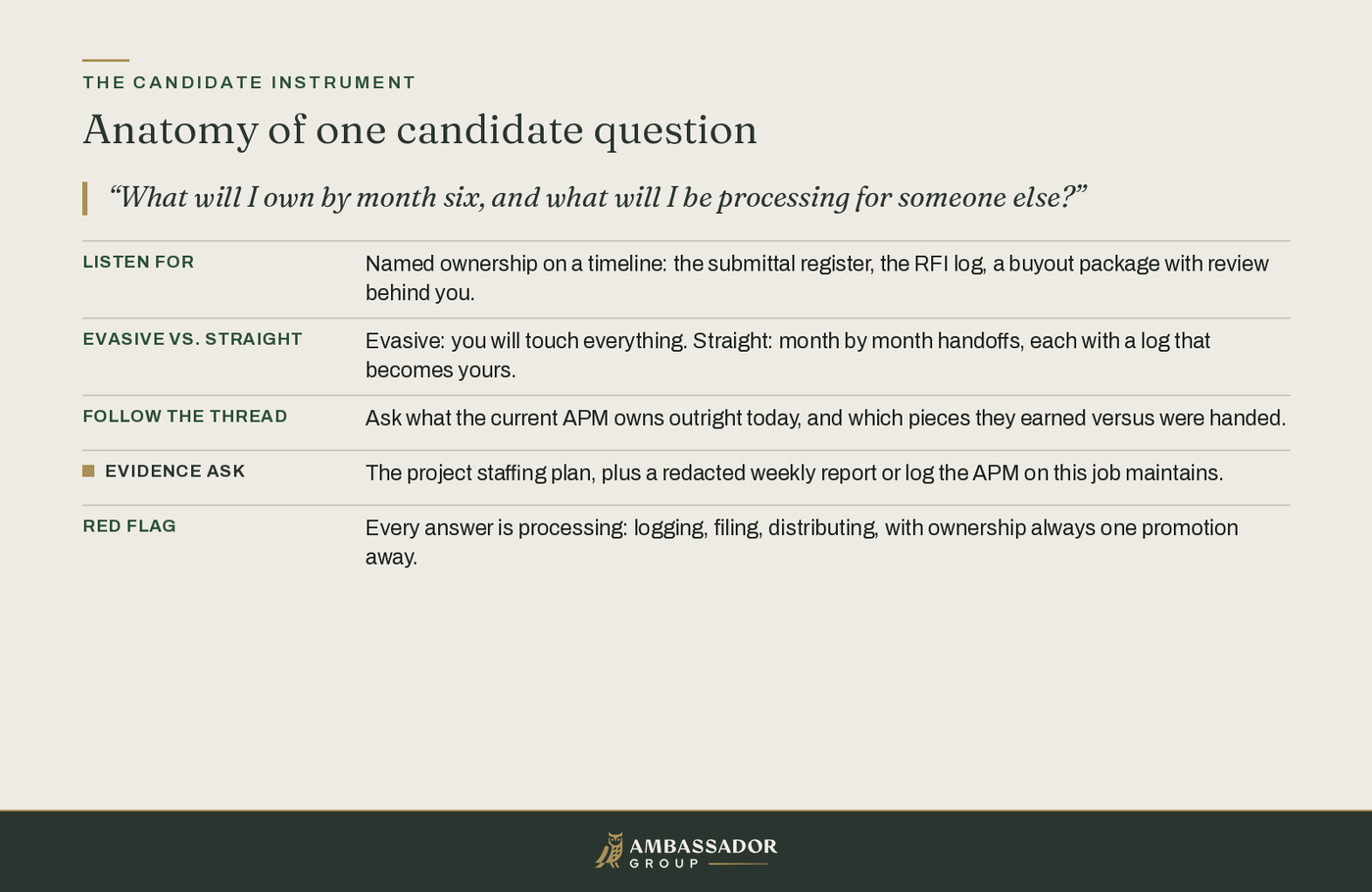
“What will I own by month six, and what will I be processing for someone else?”
- What you are listening for: named ownership on a timeline. Every APM job includes processing; the ratio and the trajectory are what you are buying. Own means the submittal register is yours to run and be wrong about, the RFI log yours to chase, a small buyout package yours to level with review behind you.
- Evasive tell vs. straight tell: the evasive answer is "you will touch everything," which is ownership everywhere and therefore nowhere. The straight answer sounds like a schedule of handoffs: the register at 30 days, RFIs by 90, meeting minutes and the action log from week one, each with a named reviewer.
- Follow-the-thread: ask what the current APM owns outright today, and which of those pieces they earned versus were handed.
- Evidence ask: a walk through the submittal log the current APM runs, on screen. Ten minutes in the live system shows you what an APM here owns better than any answer across a table.
- Red flag: every answer describes processing: logging, filing, updating, distributing, with ownership always one promotion away. That is the document clerk job wearing the APM title.
“How much time does an APM here spend in the field?”
- What you are listening for: whether the company treats the building as part of your education. A submittal means more once you have watched the thing it describes get installed. The strong answer has structure: days on site, job walks with the superintendent, your paperwork becoming work.
- Evasive tell vs. straight tell: the evasive answer is "as much as you want," which means field time is unplanned, and unplanned time on a busy project rounds to zero. The straight answer names a cadence and where the APM sits: the trailer, the main office, or the split.
- Follow-the-thread: ask when the last APM did their first job walk with a superintendent. Ask what the field thinks of the APMs here; the interviewer's face will answer before their words do.
- Evidence ask: the answer itself, specifically: where would my desk be, and what does a normal week look like. Vagueness here is data.
- Red flag: "the field is the superintendent's world" offered as a boundary. A company that fences its APMs off from the building is training administrators.
“What would a good first year look like for me, in terms someone could measure?”
- What you are listening for: whether expectations exist in a learnable form. A company that can state the target can teach to it: running the submittal process without a safety net, a set of RFIs closed clean in one round, first buyout support.
- Evasive tell vs. straight tell: the evasive answer is chemistry language: "we just want someone who fits in and works hard." The straight answer sounds like a checklist, because somewhere behind it there is one.
- Follow-the-thread: ask how the last APM's first year was reviewed, and how often anyone talked to them about progress along the way. An annual drive-by means you will be managed by impression.
- Evidence ask: the role's accountabilities in writing. Disciplined companies hire this role against a short list. Ask to see the list you would be measured on.
Interview the team
For an early-career hire, the team is the curriculum. You will learn roughly what the people within ten feet of you know, minus what they have no time to explain. APMs rarely leave companies over the paperwork. They leave because nobody was teaching, nobody was reviewing, and the growth they were promised turned out to be scheduled for never.
“Who would I report to, and how much time does that person have to teach?”
- What you are listening for: a named PM with capacity. Teaching is hours: review passes, redlines explained, questions answered in the moment. A PM stretched across three jobs with no support will teach you nothing but urgency.
- Evasive tell vs. straight tell: the evasive answer is "the whole team supports each other," which assigns your development to everyone and therefore to no one. The straight answer names the PM, describes their current load, and can say how the last person under them learned.
- Follow-the-thread: ask how many people that PM has developed and where those people are now.
- Evidence ask: an hour with the PM you would report to, before you accept. A company confident in its teacher makes the introduction without hesitating.
- Red flag: the PM you would learn from never appears in your interview process. If they have no time to meet the person they are supposed to develop, the development has already been descoped.
“When my work has a mistake in it, how will I find out?”
- What you are listening for: the feedback machinery. Someone should review an APM's work before it leaves the building, and mistakes should come back as teaching: promptly, privately, with the reason attached.
- Evasive tell vs. straight tell: the evasive answer is "we are pretty relaxed, nobody micromanages here," which means nobody reviews, which means your mistakes ship with your name on them. The straight answer describes the loop: the PM reviews packages for the first months, redlines come back with reasons, one-on-ones happen on a cadence.
- Follow-the-thread: ask about the last mistake an APM made here and what happened next, to the document and to the person. Companies with a healthy loop tell that story easily, and the person still works there.
- Evidence ask: when you get your conversation with a current APM, ask how they found out about their last one. Their answer is the policy, whatever the interviewer told you.
- Red flag: young staff mistakes told as punchlines. You are hearing exactly how yours will be told.
“Who was the last APM you promoted, and what did their path look like?”
- What you are listening for: a recent example with a name, a timeline, and the bar they cleared. Every company sells this job on trajectory. The most recent promotion is what the trajectory pays in practice.
- Evasive tell vs. straight tell: the evasive answer is "we promote from within" delivered as policy, with nobody attached to it. The straight answer is a name, the years it took, the milestones they crossed, and what the company did to build them.
- Follow-the-thread: ask how long ago that promotion happened and how many APMs have been hired since. One promotion three years back across ten hires is a lottery ticket posing as a career path.
- Evidence ask: a conversation with the promoted person. Someone who walked the path can tell you whether it is a path or a story.
- Red flag: the freshest example the interviewer can reach for is someone who left and became a PM somewhere else. The company grows PMs. Other companies harvest them. Ask why.
Find the edges of the role
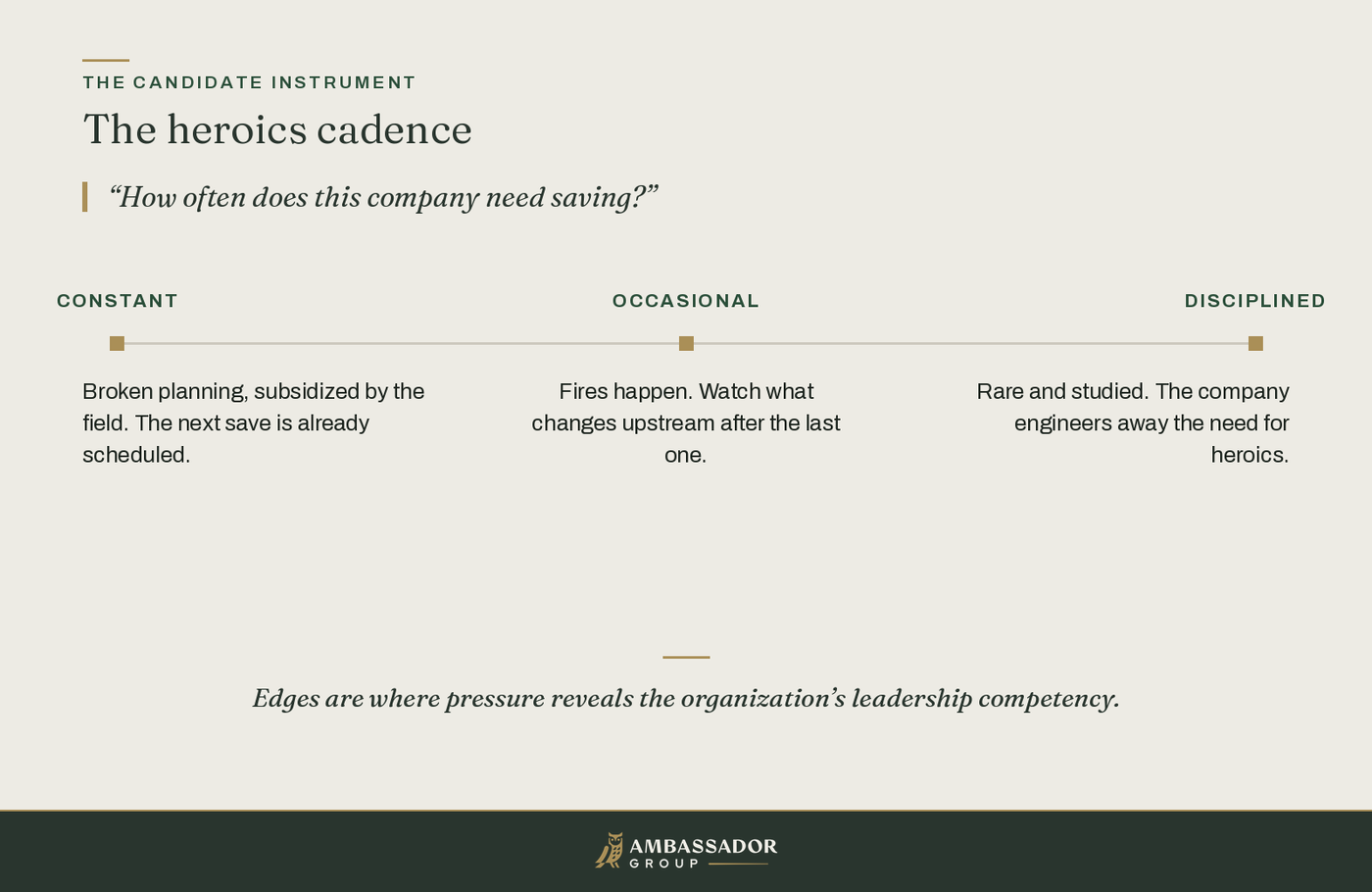
Every role has edges: the places where the job is hardest, where the support runs out, where the organization's promises meet its habits. Edges are where pressure reveals the organization's leadership competency. For an APM the edges matter double: teaching, review, and field time are the first things a company under pressure cuts. Most APMs discover the edges in month three. Find them now, while the finding costs you nothing.
“Walk me through what sits around an APM on a typical project here.”
- What you are listening for: whether the role lives inside a working system or is expected to be one. Real support looks like committed software, templates and logs that already exist, a PM who reviews, and clerical bulk that does not all land on the youngest desk.
- Evasive tell vs. straight tell: the evasive answer lists departments that exist on an org chart. The straight answer describes the last comparable project by role: who did what, what the APM could hand off, and what was stood up before the job started versus improvised during it.
- Follow-the-thread: ask what an APM here spends time on that they should not have to. Ask what the company has invested in project systems in the last two years, because investment is where priorities stop being talk.
- Evidence ask: the staffing plan for the project you would join, names and roles on paper. The gap between the org chart and the staffing plan is the gap you will personally fill.
- Red flag: you would be the first APM the company has ever had, and nobody can describe your first month. Being the experiment suits a veteran. It is a poor bet for the years that form your habits.
“Tell me about the last time this company needed heroics from a project team. How often does that happen?”
- What you are listening for: the heroics cadence. Some companies require heroics constantly, some occasionally, and some are disciplined about avoiding the situations that require them. Which is this company? At your level, heroics means the all-nighter before the OAC meeting and the weekend rebuilding a submittal log, because paperwork emergencies roll downhill to the youngest desk. Constant heroics is broken planning subsidized with your evenings, and a heroic evening is an evening nobody taught you anything.
- Evasive tell vs. straight tell: the evasive tell is pride: war stories told with a grin, "we do whatever it takes" as a recruiting pitch. The straight answer names the last real fire drill, what it cost, and what changed upstream so it does not repeat. Rare and studied is the mark of a disciplined builder.
- Follow-the-thread: ask what changed after the last one. If the answer is nothing, the next crunch is already scheduled, and you are interviewing for it.
- Evidence ask: how often the current project team worked weekends last quarter. Watch whether the answer comes back as a number or a shrug. In a disciplined company it is a number, and a small one.
- Red flag: "everybody pitches in here" delivered warmly. The people whose decisions create the crunches rarely stay for them. You will.
“How many projects, open submittals, and RFIs does one APM carry at a time here?”
- What you are listening for: a number, and what kind of load it describes. There is a volume at which an APM reads every submittal and learns from it, and a volume at which they can only push paper through. The second teaches speed and nothing else. The number varies by project type; the tell is whether they know theirs.
- Evasive tell vs. straight tell: the evasive answer is "it depends, we keep things balanced." The straight answer gives the current team's numbers, says how they move across a project's life, and can name the last time the load got unhealthy.
- Follow-the-thread: ask what happens when a project spikes: does help arrive, or does the day stretch?
- Evidence ask: the numbers themselves, per project and per APM, for the team as it stands today. That answer costs a company nothing to share and everything to lack.
- Red flag: the interviewer laughs and says "a lot" with affection. Volume worn as culture means the clerk risk is structural, and teaching is the first thing volume eats.
Write it down before the offer shapes it
An offer distorts judgment, and early in a career it distorts hardest, because the first real offer feels like a verdict on your worth. The moment a number is on the table, everything you heard gets re-graded on a curve, and the edges you found start looking like quirks. The fix is the discipline a rigorous interviewer would use on you, pointed the other way. Underwrite the company before the offer arrives.
- Write your read the same day. After each conversation, write what you learned in the four directions: company, job, team, edges. Specifics, while they are fresh. By the third interview your memory will be a blur of good feelings and one anecdote, which is exactly how bad decisions get made on both sides of hiring.
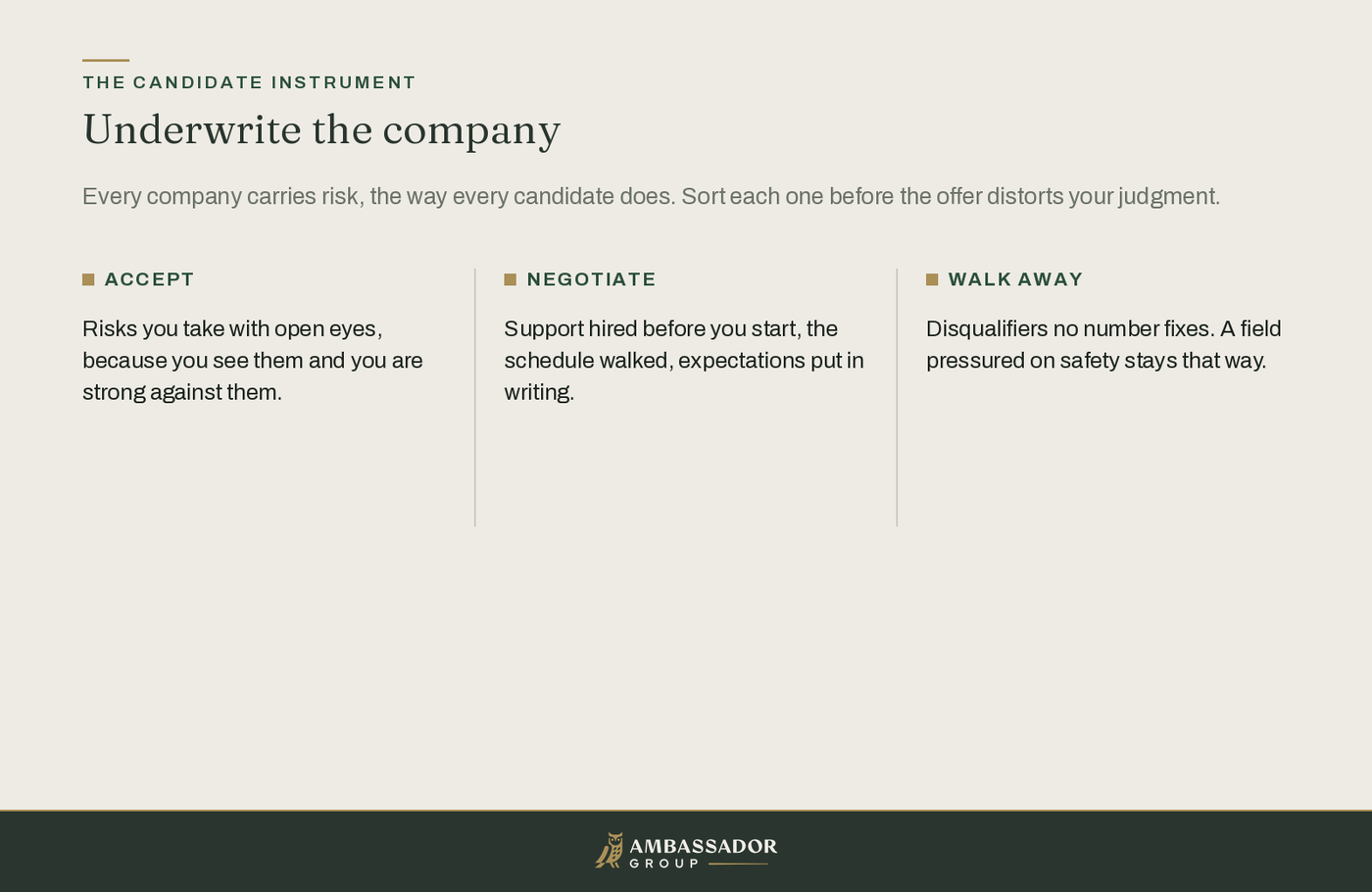
- Sort the risk: accept, negotiate, or walk. Every company carries risk. Some you accept with open eyes: a thin training program balanced by a PM who visibly teaches. Some you negotiate: field time on the calendar, a review cadence named before you sign. And some are disqualifying no matter the salary: a company whose APMs vanish every 18 months does not become a different company because it made you an offer.
- Name what you did not assess. If you never met the PM, never talked to a current APM, never heard a real number on workload, write that down as a hole in your information, then go fill it. A company that refuses the extra conversation has answered a question too.
- Price the offer against the market, not against your last paycheck. A low first anchor follows you for years. Know the market from data rather than folklore: the compensation benchmark exists for exactly this.
- Decide against your life, not against your current job. The question is whether this company clears the bar for the builder you intend to become, not whether it beats the internship or the job you are leaving. The larger discipline of knowing that bar, your strengths, your direction, your worth, is a career's work, and Build to Last is a working manual for it.
The pre-offer checklist turns this into a worksheet you can run before you sign.
The other half of the decision
The company across the table is running an interview to decide whether you fit the job. Somebody has to run the interview that decides whether the job fits you, and nobody else in the process is going to do it. Ask plainly, follow the thread when an answer is thin, ask to see the artifact instead of settling for the story, and believe what the edges tell you. The stakes tilt your way: the company is filling a position, and you are choosing the habits you will carry for a career. To see where this role leads, the project manager guide runs the same interview one level up, and the project engineer guide covers the parallel technical track.
You are early. That is the advantage. Choose the company that teaches, and everything else compounds.
Ambassador Group represents construction leaders on both sides of the table and tells both sides the truth. If you want that kind of representation for your next move, send us your resume.
The short version.
- What questions should you ask in an assistant project manager interview?
- Ask in four directions: the company, the job, the team, and the edges of the role. Probe where the company's last APMs are now, what you will own versus process, who reviews your work, and how often the job demands heroics. The goal is deciding whether this company will teach you the craft or use you as a document clerk.
- How can an APM candidate tell if a company will train them or use them as a document clerk?
- Ask what you will own by month six and what you will be processing for someone else. A teaching company answers with named handoffs on a timeline: the submittal register, the RFI log, a small buyout package with review behind it. A clerk mill says you will touch everything and can never name what becomes yours.
- What are the edges of an assistant project manager role, and why do they matter?
- Edges are where the job is hardest and the support runs out: the workload one APM carries, whether APMs get field time, and whether anyone has time to teach. Edges are where pressure reveals the organization's leadership competency. Find them in the interview, while finding them costs you nothing.
- What can an APM candidate ask to see before accepting an offer?
- Ask for the project staffing plan with names and roles, the onboarding plan for your first 90 days, and a conversation with a current APM. Ask to meet the PM you would report to. A company proud of how it develops people says yes quickly.
- How should an early-career candidate evaluate an assistant project manager offer?
- Write down what you learned the same day, before the offer distorts it. Sort each risk into accept, negotiate, or walk away. Price the offer against market data rather than your last paycheck, and decide against the career you are building, not the job you are leaving.


