
The company across the table came with questions for you. If you are like most construction project managers, you have rehearsed your answers and spent almost nothing deciding what to ask. The questions to ask in a construction project manager interview matter as much as the ones you will answer, because half of this decision is yours, and your half is the half that decides whether you are still glad you took the job in year 2. The quality of your next move is principally driven by you, not by the company recruiting you. Taking the job is a contract you sign with your next five years. The questions below are instruments. The discipline of listening is yours.
Most interview advice for candidates is about performing well: polish the story about the fade you caught, research the company, keep a few questions ready so you look engaged. This guide assumes you can perform. It is about the other job you have in that conversation: deciding whether this company deserves to hand you its contracts, its clients, and its money. You underwrite subcontractors before award. Underwrite the company the same way, on evidence.
They are bringing an instrument. Bring your own.
A rigorous interviewer does not wing it. They will probe the seams where a project manager breaks: whether you can protect the margin and the client in the same conversation, whether you own the commercial consequence of a schedule you did not sequence, whether you can hold the partnership with a superintendent you cannot command. They will push where your answer is thin and ask to see artifacts: a cost projection you ran, a delay notice you wrote. You can read the exact instrument a disciplined interviewer runs on your role: construction project manager interview questions. Read it.
And notice something while you are in the conversation: how they interview you is evidence about them. A company that probes your cost-to-complete logic is showing you how it makes decisions. A company that hands several million dollars of commercial exposure to whoever interviews smoothly is also showing you how it makes decisions.
You will not ask all of these, and you will not ask them all at once. Earn the right first: answer their questions well, then ask yours, in the tone of a builder walking a job rather than an auditor working a file. The company and job questions belong in the first real conversation. The evidence asks and the team questions belong after mutual interest is on the table, where asking to see the turnover checklist reads as seriousness instead of presumption. Spread the rest across the process and let each conversation carry 2 or 3, asked well.
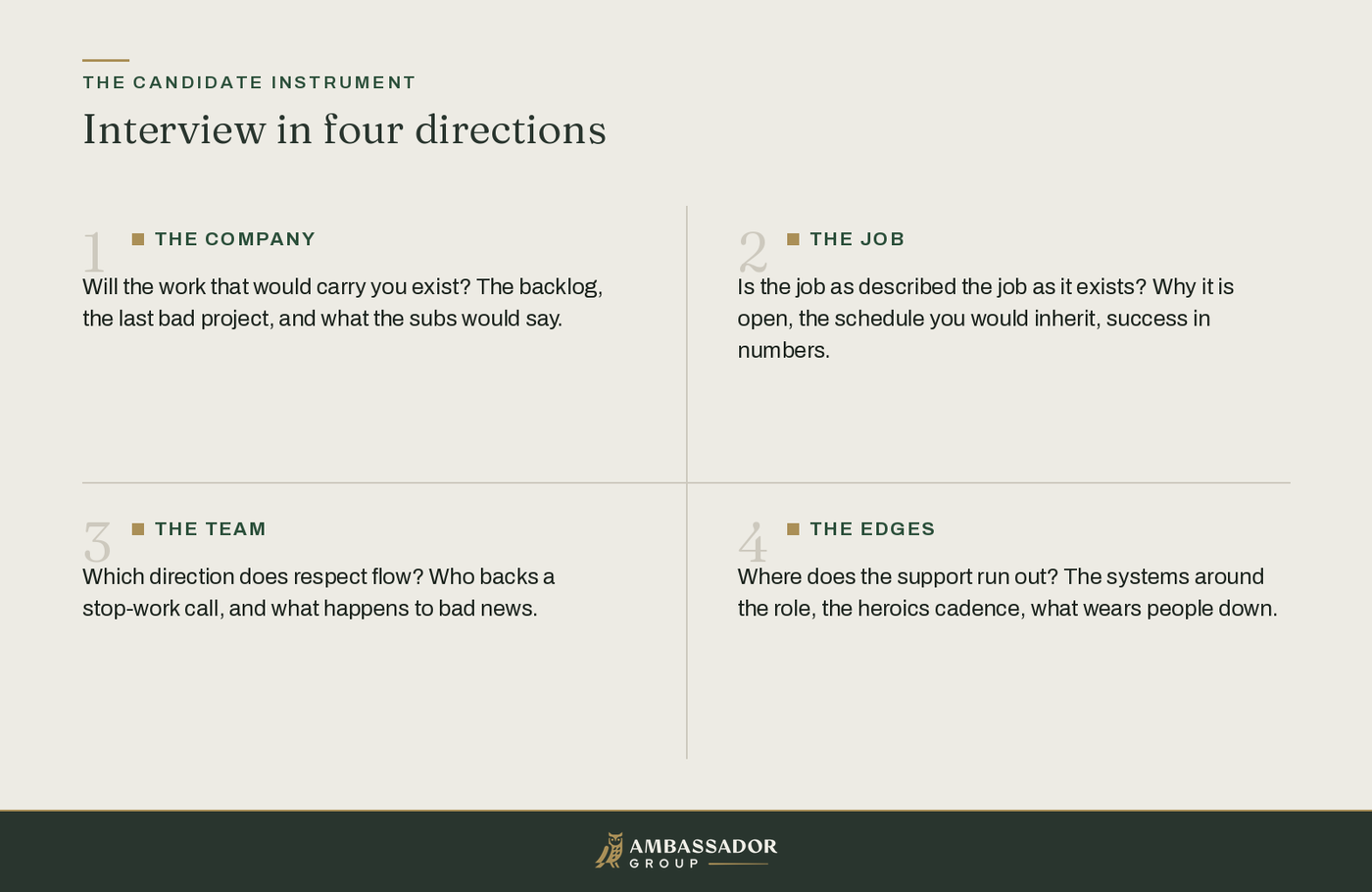
Your own questions run in four directions: the company, the job, the team, and the edges of the role. Each question below comes with what to listen for, what an evasive answer sounds like next to a straight one, where to push, and what to ask to see. Four questions you know how to read are worth more than forty that fill the silence.
Interview the company
A project manager's margin is mostly decided before the PM arrives: in the contract the company signed, the estimate it bought the job on, the client it chose to chase. Interview the company that makes those choices, because you will be accountable for their consequences.
“What does your contract mix look like: lump sum, GMP, negotiated? And which way is it moving?”
- What you are listening for: the risk profile you would inherit. Contract type is the physics of the PM job: hard-bid lump sum means thin fees, adversarial paper, and a premium on your notice discipline, while negotiated and GMP work lets the client relationship carry more of the margin.
- Evasive tell vs. straight tell: the evasive answer is a brand statement: "we are a relationship contractor." The straight answer gives the mix in rough proportions and says which way it is drifting.
- Follow-the-thread: ask which contract type produced their last painful job and what changed about how they pursue work.
- Evidence ask: the backlog by contract type, and how much of it is signed versus pursued. Sub pricing and fee detail are confidential; the shape of the backlog is fair, because the next 2 years of your work is your risk to price.
- Red flag: a mix moving hard toward lump sum while the company still talks like a negotiated builder. That fee pressure lands on the PM first.
“Tell me about the last job that lost money. What changed because of it, and where is that PM now?”
- What you are listening for: whether the company learns or blames. What the organization did with its last loss is the machinery that will process your first bad quarter.
- Evasive tell vs. straight tell: the evasive answer is that there has not been one, or a story where the owner and the market did all the damage. The straight answer names the company's own contribution (a bad buy, a thin estimate, a client they should have declined) and points to a specific change.
- Follow-the-thread: ask where the PM who ran that job is today. The answer tells you whether losses here get investigated or prosecuted, and who wears them.
- Evidence ask: the specific process that changed, and when it was put in place. A real lesson has a date on it.
- Red flag: the PM is the villain of every losing-job story. Money dies in estimating, in buyout, in precon, and in the field. If it only ever dies in the PM's hands, you are reading your own file.
“How does leadership review job financials between award and closeout? Walk me through it.”
- What you are listening for: the WIP cadence. A disciplined builder reviews projected final cost on every job at a set rhythm and expects PMs to move the projection when the news is bad.
- Evasive tell vs. straight tell: the evasive answer is trust language: "we hire good people and stay out of their way." The straight answer names the cadence, who attends the review, and what happens when a projection drops.
- Follow-the-thread: ask what happened the last time a PM moved a projection down early.
- Evidence ask: a blank copy of the cost projection template PMs run, or the standing agenda of the monthly review. The tool is shareable where the numbers are not.
- Red flag: no regular review at all, sold as autonomy. The freedom to run your own job without oversight is also the freedom to drown without anyone noticing until the invoices do.
Interview the job
Every company will tell you its PMs "own their jobs." The phrase is cheap. Ownership is a set of specific authorities: what you can buy, what you can sign, whose client it is. Find out whether the accountability comes with the authority, because accountability without authority is how PMs get spent.
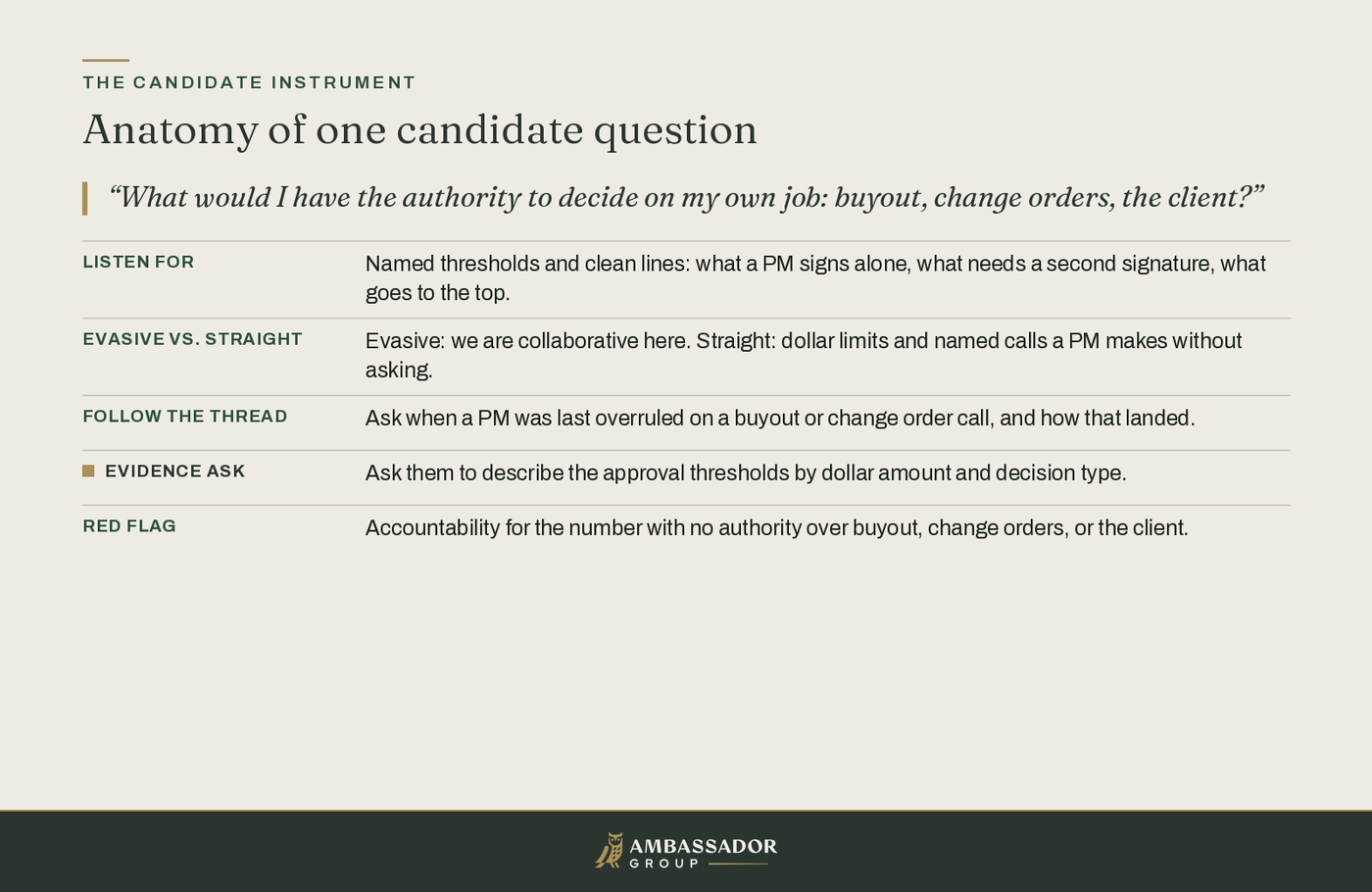
“What would I have the authority to decide on my own job: buyout, change orders, the client?”
- What you are listening for: whether the company's answer has edges. Real authority comes with numbers and names: a PM buys out trades to a threshold, signs change orders to a limit, runs the client day to day with a project executive behind them. Vague authority is no authority.
- Evasive tell vs. straight tell: the evasive answer is culture language: "we are collaborative, nobody stands on ceremony here." The straight answer sounds like a delegation matrix because somewhere behind it there is one.
- Follow-the-thread: ask about the last time leadership overruled a PM on a buyout or a change order, and whether it happened through the PM or around them.
- Evidence ask: the approval thresholds, described plainly: dollar limits by decision type. A hiring manager who cannot state them is telling you the limits are personal rather than structural.
- Red flag: full accountability for the final number with no authority over the decisions that produce it. That is the job posting for a scapegoat.
“Walk me through how a job moves from estimating to the PM here. What does the handover look like?”
- What you are listening for: the precon quality of what you would inherit. A PM's year is set at turnover: whether the estimate has scope holes, whether the schedule assumptions survived the buy, whether anyone told operations what sales promised.
- Evasive tell vs. straight tell: the evasive answer is seamlessness: "estimating and operations work hand in hand." The straight answer describes the mechanics: when the PM first sees the job, what the turnover package contains, and what happens when the PM finds a gap between the estimate and reality.
- Follow-the-thread: ask what a PM here does when they inherit a number they believe is wrong; the answer is the company's real position on truth.
- Evidence ask: the turnover checklist or agenda used when estimating hands a job to operations. A template carries no confidential numbers, and a company that has one will show it with some pride.
- Red flag: PMs meet their jobs after award, as finished decisions. You would be inheriting other people's optimism, priced by someone who will never have to deliver it.
“On the jobs I would run, who owns the client: me, a project executive, or whoever sold the work?”
- What you are listening for: clean ownership of the relationship you will be accountable to. The PM who owns margin needs standing with the client, because change orders and hard conversations travel through that relationship.
- Evasive tell vs. straight tell: the evasive answer is that everyone owns the client together, which means nobody does. The straight answer draws the line: the PM runs the client day to day, and the project executive holds the executive relationship.
- Follow-the-thread: ask what happens when the client calls the owner of the company directly to ask for something. Then ask whether the answer traveled back through the PM or around them. The route that request takes is the real org chart.
- Evidence ask: a conversation with the project executive or principal you would share your largest client with. Meeting that relationship before you sign is due diligence, and a confident company will make the introduction.
- Red flag: stories, told with a laugh, about the founder promising clients work that operations then has to absorb. Every laugh in an interview is somebody's month of nights.
Interview the team
PMs rarely leave companies over the work. They leave over the superintendent who fights them instead of building with them, the executive who folds when the client pushes, the culture where the messenger takes the bullet. The team is the job.
“Who would run the field on my first job, and what happens when a PM and a superintendent disagree here?”
- What you are listening for: whether the field-office partnership has machinery or only hope. The PM and super are a 2-person leadership team with no org chart between them; somebody has to break ties, and you want that somebody to be a name and a principle, not whoever shouts last.
- Evasive tell vs. straight tell: the evasive answer is a platitude about one team. The straight answer names the superintendent and describes a real disagreement and how it resolved: who mediated, and whether both people are still there.
- Follow-the-thread: ask how the company splits schedule authority between PM and super: who owns the sequence, who owns the commercial consequence.
- Evidence ask: a meeting with the superintendent you would be paired with, before you sign. You are about to bet 2 or 3 years on that relationship, and companies make the introduction when they are proud of the pairing.
- Red flag: superintendent turnover explained as bad luck, or a super described as "a character" with an apology in the voice. That is a problem the company has decided to make its PMs' problem.
“Tell me about your last serious dispute with an owner. What happened to the PM who ran that job?”
- What you are listening for: whether the company backs the paper it asks for. When a dispute comes, does the organization stand behind the notice trail and treat the PM as its representative, or settle quietly and reprice the PM as difficult?
- Evasive tell vs. straight tell: the evasive answer is that disputes do not happen here because relationships come first; every builder of any size has had one. The straight answer describes the dispute in outline, what the record did for the company, and what the company did for the PM.
- Follow-the-thread: ask how the company weighs a contractually required notice against a client relationship it wants to keep, and whether a notice has ever been softened to save one. Watch the pause before the answer.
- Evidence ask: whether the company has ever put real resources behind a PM's position: a claims consultant, a scheduling expert, counsel. Dollar outcomes are confidential and asking for them marks you as green; whether the company invests in defending its PMs' paper is a fair question with a factual answer.
- Red flag: a story in which the notices were right, the position was strong, and the PM was quietly moved along anyway for being adversarial. That company wants the record kept and the keeper deniable.
“When a job starts to fade, what happens to the PM who says so first?”
- What you are listening for: which direction truth travels, and at what cost. You are asking whether this company rewards the PM who moves the number down in month 4 or the one who holds the fiction until month 14.
- Evasive tell vs. straight tell: the evasive answer is an open-door assurance: "there are no surprises here, my door is always open." The straight answer is a story: a PM who flagged a fade early, what help arrived, and how that PM's standing looks today.
- Follow-the-thread: ask what happened on the last job where the projection was wrong for months and nobody said so.
- Evidence ask: a conversation with a current PM, without a chaperone. Ask them this same question. A company confident in how it treats its PMs will hand you a phone number; one that hesitates has a reason to hesitate.
- Red flag: "our PMs hit their numbers" delivered as culture. Pressure to hit a number is also pressure to report hitting it.
Find the edges of the role
Every role has edges: the places where the job is hardest, where the support runs out, where the organization's promises meet its habits. Edges are where pressure reveals the organization's leadership competency. Most PMs discover the edges in month 3. The point of asking is to find them now, while the finding costs you nothing. A company that knows its edges and talks about them plainly manages them. A company that denies having any is asking you to find them alone.
“Walk me through who supports a PM on a typical job here.”
- What you are listening for: whether the title comes with an organization or comes alone. Some companies put real systems around the role: a project engineer on the job, a contracts person who reads what the PM signs, accounting that produces cost data on time.
- Evasive tell vs. straight tell: the evasive answer lists departments that exist on an org chart. The straight answer describes the last comparable job, by role and name, and what the PM there could hand off.
- Follow-the-thread: ask what PMs here spend time on that they should not have to; self-aware companies answer fast.
- Evidence ask: the staffing plan for the first job you would run. Names and roles, on paper.
- Red flag: the interviewer is proud that their PMs "do it all." That is a budget decision wearing a compliment's clothes.
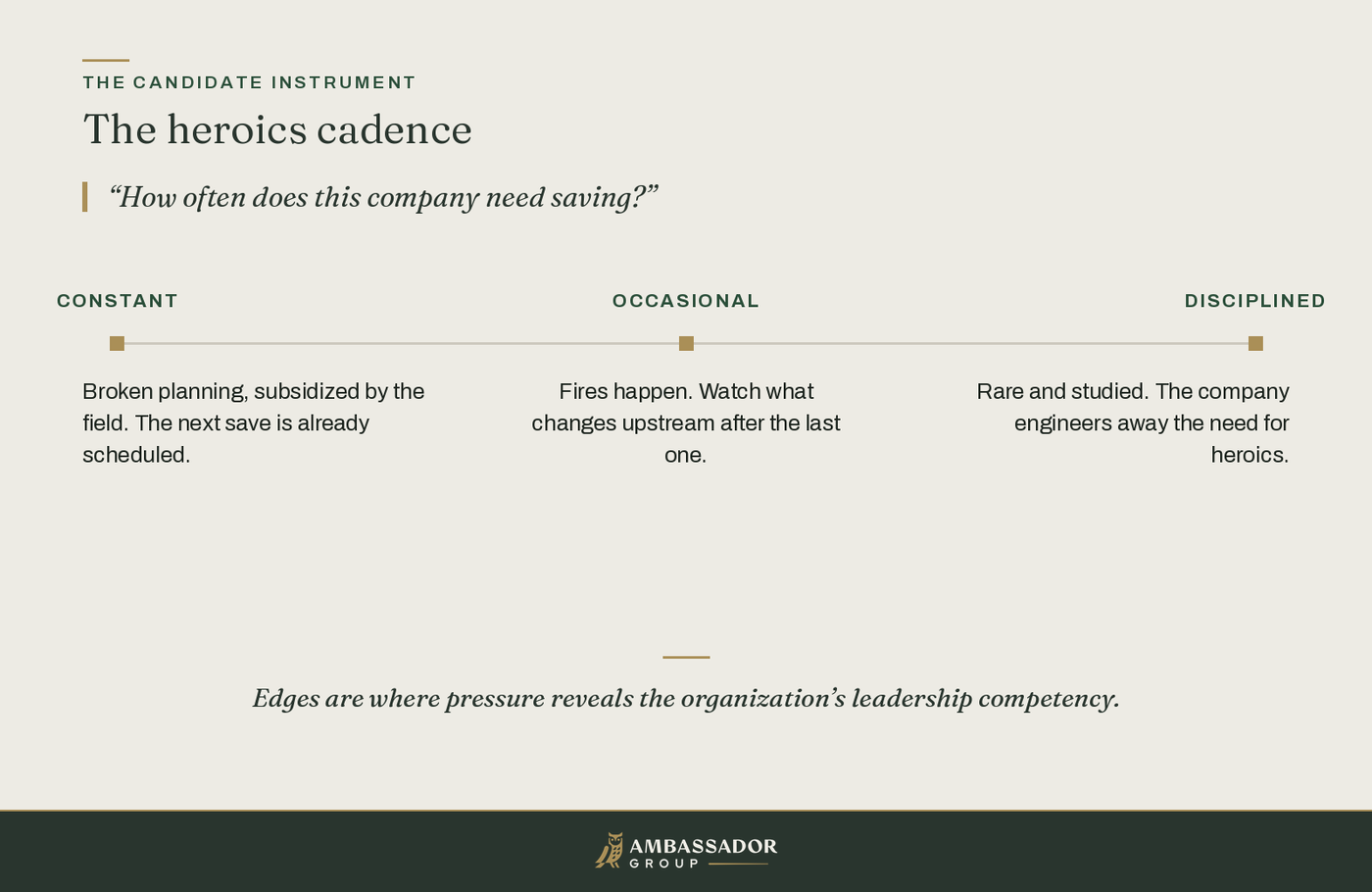
“Tell me about the last time this company needed heroics from a PM. How often does that happen?”
- What you are listening for: the heroics cadence. Some companies require heroics constantly, some occasionally, and some are disciplined about avoiding the situations that require them. Which is this company? For a PM, constant heroics means disputes fought without support, closeouts rescued from precon's sins, and weekends rebuilding a record someone should have kept in March.
- Evasive tell vs. straight tell: the evasive tell is pride: the all-nighter before the mediation told with a grin, the billing rescue worn as culture. The straight answer names the last real fire, what it cost, and what changed upstream so it does not repeat.
- Follow-the-thread: ask what changed after the last one. If the answer is nothing, the next save is already scheduled, and you are interviewing for it.
- Evidence ask: a date. When was the last all-hands rescue here, and what changed afterward? Companies that manage their edges answer with a month and a mechanism.
- Red flag: "we run lean and our PMs figure it out" as a recruiting pitch. Lean is a cost structure. Figure-it-out is the name of the person absorbing it.
“When a job comes in with a thin fee, what does the company tell the PM, and what does it expect?”
- What you are listening for: whether fee pressure arrives with honesty or arrives silently. Companies buy work thin sometimes: to hold a crew together, to enter a market, to keep a client. A disciplined company says so at turnover, re-baselines expectations, and evaluates the PM against the job as bought.
- Evasive tell vs. straight tell: the evasive answer is that every job stands on its own and good PMs protect the fee. The straight answer admits thin jobs exist, names why the company takes them, and explains how it manages the PM's side of that bargain.
- Follow-the-thread: ask how the PM on the last thin job was reviewed: against the estimate as sold, or against an honest budget set at turnover.
- Evidence ask: one factual answer: has this company ever re-baselined a job at turnover because the buy was optimistic? A yes with a story means the pressure gets named. A confused look means the pressure gets passed.
- Red flag: "a good PM finds the margin" offered as philosophy. On a job bought wrong, the margin gets found in your evenings or your notice file.
Write it down before the offer shapes it
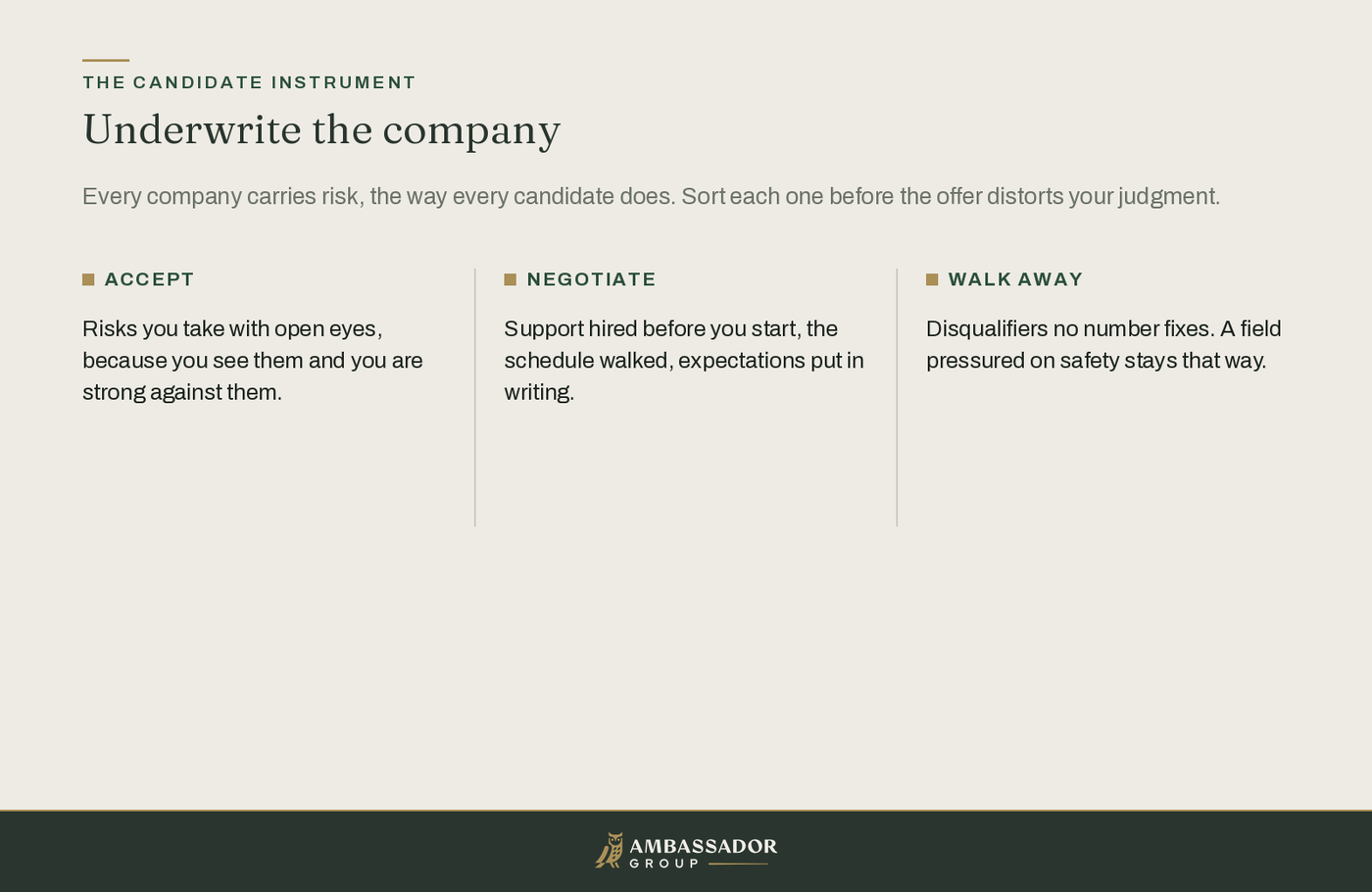
An offer distorts judgment. The moment a number is on the table, everything you heard gets re-graded on a curve, and the edges you found start looking like quirks. You already know the fix, because you run it on every job: write the record while it is fresh and project the outcome before you commit. Underwrite the company before the offer arrives.
- Write your read the same day. After each conversation, write what you learned in the four directions: company, job, team, edges. Specifics, while they are fresh. By the third interview your memory will be a blur of good feelings and one anecdote.
- Sort the risk: accept, negotiate, or walk. Some risks you accept with open eyes: a thin support bench, a contract mix you know how to run. Some you negotiate: authority thresholds stated before you sign, a meeting with your superintendent, expectations for the thin job put in writing. And some are disqualifying no matter the number, because a company that blames its PMs for losses it manufactured in precon does not become a different company because it pays well.
- Name what you did not assess. If you never learned the contract mix, never met the super, never heard how the last losing job was handled, write that down as a hole in your information, then go fill it. A company that refuses the extra conversation has answered a question too.
- Price the offer against the market, not against your current pay. A raise on an underpaid year is still underpaid. Know your market from data rather than folklore: the compensation benchmark exists for exactly this.
- Decide against your life, not against your current job. The question is whether this role clears the bar for the career you are building, not whether it beats the one you are escaping. The larger discipline of knowing that bar, your strengths, your direction, your worth, is a career's work, and Build to Last is a working manual for it.
The pre-offer checklist turns this into a worksheet you can run before you sign.
The other half of the decision
The company across the table is running an interview to decide whether you can carry a job commercially. Somebody has to run the interview that decides whether they deserve a PM who can, and nobody else in the process is going to do it. Ask plainly, follow the thread when an answer is thin, ask for the artifact instead of settling for the story, and believe what the edges tell you. If your path runs toward the field side of the partnership or up a rung, the superintendent guide and the senior project manager guide run the same four directions on those roles.
You already know how to protect a number. Protect this one the same way: on evidence.
Ambassador Group represents construction leaders on both sides of the table and tells both sides the truth. If you want that kind of representation for your next move, send us your resume.
The short version.
- What questions should a construction project manager ask in a job interview?
- Ask in four directions: the company, the job, the team, and the edges of the role. Probe the contract mix, the last job that lost money, and how leadership reviews job financials. Ask what you would have authority to decide, how jobs move from estimating to operations, and who owns the client. Then find the edges: the support around the role, the heroics cadence, and what happens when the fee is thin.
- What authority should a construction project manager ask about before taking a job?
- Ask what you could decide on your own job: buyout to what threshold, change orders to what limit, and whether you run the client relationship day to day. A straight answer sounds like a delegation matrix, with dollar limits and named decisions. Accountability for the final number without authority over buyout, change orders, or the client is a setup, and the interview is the time to find it.
- What documents or answers can a PM candidate ask for before accepting a construction job?
- Ask for the backlog by contract type and how much of it is signed, the turnover checklist estimating uses to hand a job to operations, and the staffing plan for your first job. Ask to meet the superintendent you would be paired with and to talk to a current PM without a chaperone. Sub pricing, fee detail, and internal financials are confidential; the shape of them is a fair question.
- What are the edges of a construction project manager role, and why do they matter?
- Edges are where the job is hardest and the support runs out: thin fees passed down silently, disputes where the company may or may not back the PM's notice trail, and how often the job demands heroics. Edges are where pressure reveals the organization's leadership competency. Find them in the interview, while finding them costs you nothing.
- How should a construction project manager evaluate a job offer?
- Write down what you learned the same day, before the offer distorts it. Sort each company risk into accept, negotiate, or walk away. Price the offer against the market rather than against your current pay, and decide against the life you are building, not the job you are escaping.


