
The company across the table came with questions for you. If you are like most senior project managers, you have given almost no thought to what you will ask them. The questions to ask in a senior project manager interview matter as much as the ones you will answer, because half of this decision is yours, and your half decides whether you are still glad you took the job in year 2. The quality of your next move is principally driven by you, not by the company recruiting you. A bad company can be read by a sharp candidate and missed by a hopeful one. The title on offer is either a portfolio you lead through people, or three jobs and a longer week. The questions below are instruments. The discipline of listening is yours.
Most interview advice is about performing well: rehearse the claim story, research the backlog, have a few questions ready so you look engaged. This guide assumes you can already perform. It is about the other job you have in that conversation: deciding whether this company deserves your judgment for the next 5 years. A senior project manager runs several jobs through other people. Whether that describes the job on offer, or only the title, is the most consequential thing you will establish. That is an underwriting decision, and underwriting takes evidence, not vibes.
They are bringing an instrument. Bring your own.
A rigorous interviewer will probe the places a senior project manager breaks: whether you can carry a claim to a paid outcome without burning the client, whether the PMs under you develop or depend, whether you manage the portfolio or merely report it. They will push where your answers are thin and ask to see artifacts: a cost-to-complete you corrected, a change-order package that survived scrutiny. You can read the exact instrument a disciplined interviewer runs on your role: senior construction project manager interview questions. Read it. Preparing for that level of judgment means arriving with specifics instead of adjectives.
How they interview you is also evidence about them. A company that probes your portfolio judgment is showing you how it makes decisions. A company that hands out a senior title after an hour of rapport is also showing you how it makes decisions. Both are free information. Most candidates never collect it.
You will not ask all of these, and you will not ask them all at once. Earn the right first: answer their questions well, then ask yours, in the tone of a builder walking a job rather than an auditor working a file. The company and job questions belong in the first real conversation. The evidence asks and the team questions belong after mutual interest is on the table, where asking to meet the PMs you would lead reads as seriousness instead of presumption. Spread the rest across the process and let each conversation carry 2 or 3, asked well.
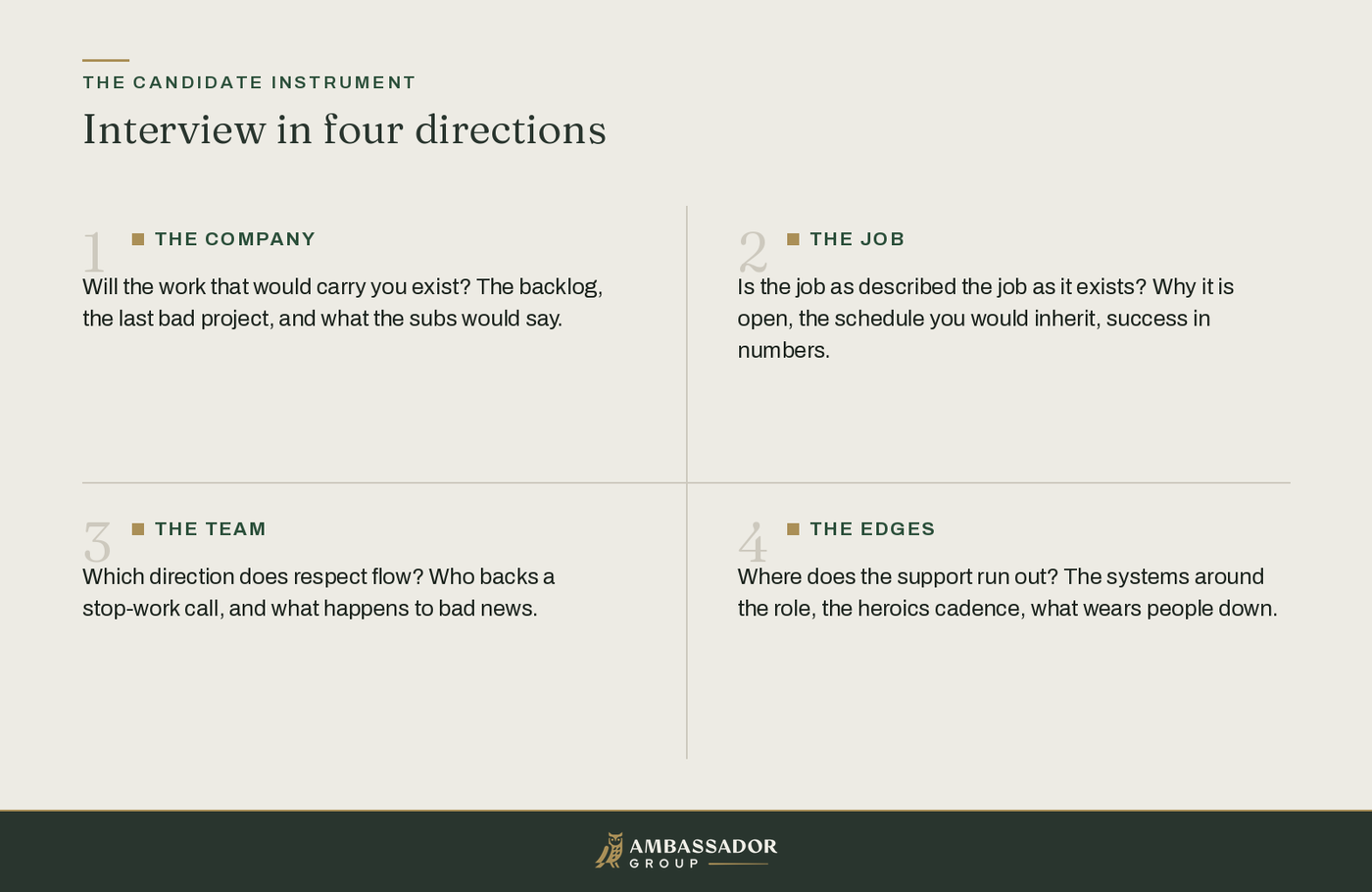
Your questions run in 4 directions: the company, the job, the team, and the edges of the role. Each question below comes with what to listen for, what an evasive answer sounds like next to a straight one, where to push, and what to ask to see.
Interview the company
A senior project manager's working life is set above the portfolio: what work gets chased, how it gets distributed, and whether growth comes with people. Senior PMs get burned here: hired to lead a group that exists on the org chart and nowhere else.
"How does work get assigned across PMs here, and who decides?"
- What you are listening for: a system with an owner. In a disciplined company, assignment weighs capacity, fit, and development. In the other kind, work goes wherever the panic is loudest.
- Evasive tell vs. straight tell: the evasive answer is teamwork language: "we all pitch in where the work needs us." The straight answer names who makes the assignment call, on what cadence, and how the last contested assignment got settled.
- Follow-the-thread: ask how many jobs each PM carries right now, and whether that number is a policy or an accident. Then ask what happens when a new job lands and everyone is full.
- Evidence ask: the current load across the PM group, in numbers: jobs per PM, at what size. A company that manages its load can recite it.
- Red flag: work goes to "whoever can take it." A company with no assignment discipline will discover your capacity the same way, one job at a time.
"You are planning to grow. Walk me through the staffing behind the plan."
- What you are listening for: whether growth hires ahead of the work or behind it. A backed plan pairs revenue targets with roles and timing. An unbacked plan pairs them with adjectives, and the gap gets closed by the people already employed, senior first.
- Evasive tell vs. straight tell: the evasive answer is lean-team pride: "we staff up when the work lands." The straight answer names which roles are budgeted over the next 12 months, in what order, and which parts of the backlog they land on.
- Follow-the-thread: ask what happened the last time the company won more work than its staff could carry. That story is the plan's track record.
- Evidence ask: the backlog by project type, split into signed and pursued, with the hiring plan beside it. Internal financials are theirs to keep; whether the next 2 years of work exists on paper, and who will build it, is fair to ask.
- Red flag: growth described entirely in revenue. Revenue without staffing is workload, and a senior title puts you first in line for it.
"Tell me about the last project that lost money here. What changed because of it?"
- What you are listening for: whether the company learns or blames, and who caught the slide. The machinery that processed the last loss will process the first bad quarter of your portfolio.
- Evasive tell vs. straight tell: the evasive answer is that there has not been one, or a story where the owner, the architect, and the market did all the damage. The straight answer names the loss, names the company's own contribution, and points to something that changed: a go/no-go gate, a portfolio review, a buyout rule.
- Follow-the-thread: ask where the PM who ran that job is now, and whether the senior PM above them kept their portfolio.
- Evidence ask: the review practice that came out of it: who attends, what a flag triggers. Cost detail is confidential; the existence of the machinery is fair.
- Red flag: a story where the PM is the villain and the estimate, the contract, and the client all picked themselves. You are reading the postmortem format for your own future losses.
Interview the job
The title says senior. Companies make 2 very different jobs out of it. In one, you run a portfolio through PMs you develop. In the other, you personally run 3 jobs at once and the word senior is the compensation.
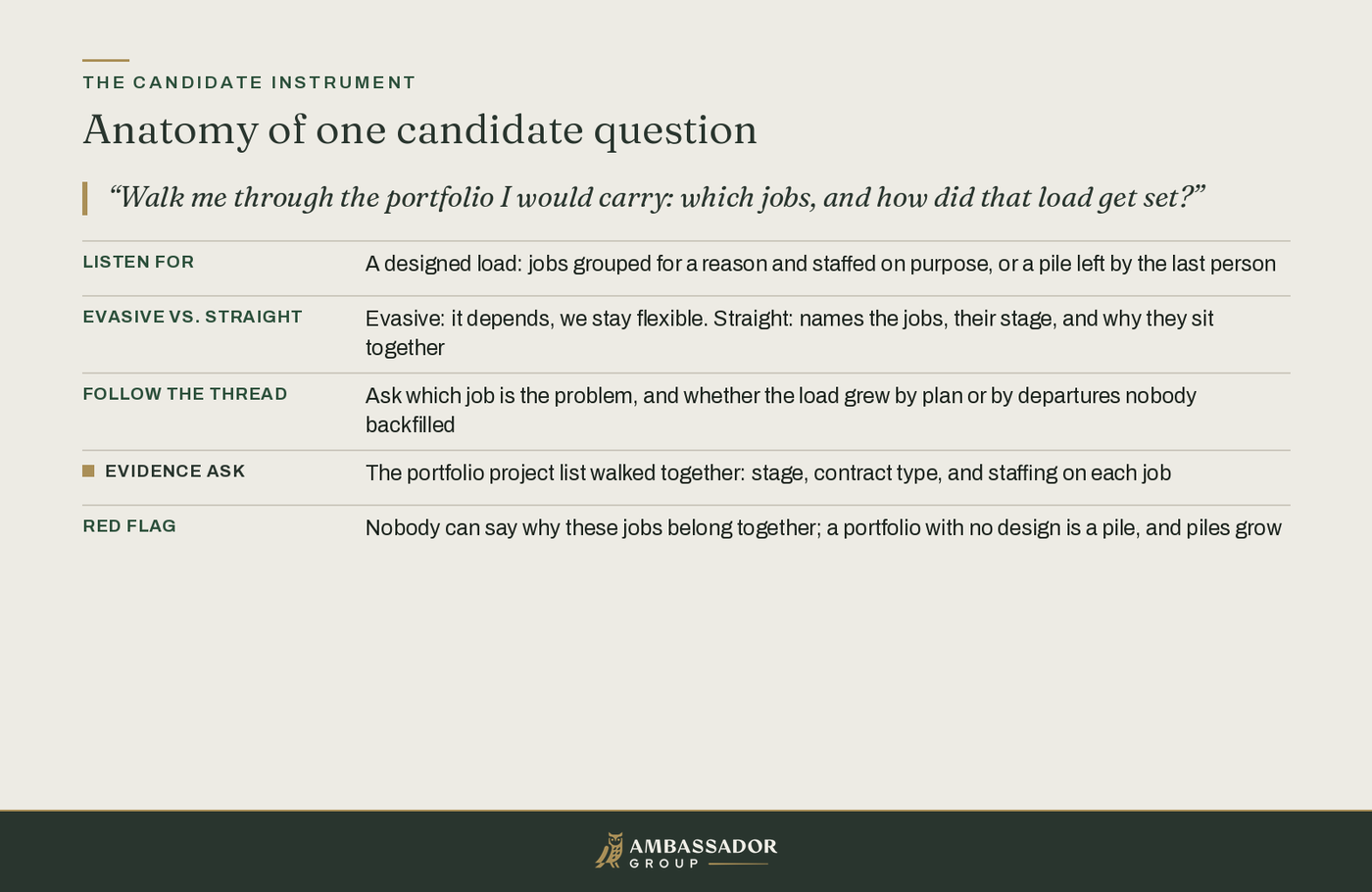
"Walk me through the portfolio I would carry: which jobs, and how did that load get set?"
- What you are listening for: a designed load or an accreted one. A designed portfolio was built on purpose: jobs grouped for a reason, staffed for it, sized to leave you capacity to lead. An accreted load is whatever was on fire when the last person left, plus everything that has landed since.
- Evasive tell vs. straight tell: the evasive answer stays loose: "it depends, we stay flexible, call it 3 to 5 jobs." The straight answer names the jobs, their stage, what each one carries, and why they sit together under one senior PM.
- Follow-the-thread: ask which job in the portfolio is the problem, because there is one. Then ask how the load has changed over the last year: grown by plan, or grown by departures nobody backfilled.
- Evidence ask: the project list for the portfolio, walked together: stage, contract type, and staffing on each. Margin by job is confidential and asking marks you as green; the shape of the load is fair, and a company that designed the portfolio is proud to walk it.
- Red flag: nobody can say why these jobs belong together. A portfolio with no design is a pile, and piles grow.
"What can a senior PM here decide about people without asking permission: hiring, exiting, promoting?"
- What you are listening for: development authority to match the responsibility. A role that runs jobs through other people needs real say over which people. The strong answer draws an honest line between recommend and decide.
- Evasive tell vs. straight tell: the evasive answer is collaborative fog: "you will have a lot of input, we make people decisions together." The straight answer names decision rights: who builds the interview panel, whether a senior PM can move a struggling PM off a job, and what an exit requires.
- Follow-the-thread: ask about the last time a senior PM moved someone off a project, and what it took.
- Evidence ask: the decision rights in writing, if they exist: signing thresholds, hiring approvals, change-order authority by level. A firm that never wrote them down settles every one by argument.
- Red flag: responsibility for people named in the job description and authority over people absent from it. Accountability without authority is accountability in name and exposure in fact.
"If margin slides on one of my jobs, what levers do I hold?"
- What you are listening for: whether margin responsibility comes with the controls that move margin: staffing moves, a hand in the remaining buyout, authority to set a recovery plan. Otherwise you own the number while someone else owns everything that produces it.
- Evasive tell vs. straight tell: the evasive answer restates the responsibility: "you own the number, and we hold our people accountable." The straight answer lists the levers, names their limits, and tells you where you would need help.
- Follow-the-thread: ask about the last time a senior PM flagged a margin slide early, and what leadership put behind the recovery: people and money, or a lecture.
- Evidence ask: how the portfolio review runs: cadence, who sits in it, what a flagged job triggers. The numbers inside are internal; the machinery decides whether your accountability comes with help or with blame.
- Red flag: "we expect our senior people to figure it out." Margin accountability without levers is a whip with a title on it.
Interview the team
A senior project manager's output is other people's work. The PMs you inherit will decide your first year more than any schedule. Without a bench, senior means alone.
"Tell me about the PMs I would lead: tenure, strengths, and who is struggling."
- What you are listening for: whether a bench exists and whether management knows it as people. A real answer has texture: tenures, who is ready for more, who is still green on buyout, who is struggling and why.
- Evasive tell vs. straight tell: the evasive answer is a group compliment: "solid group, hard workers, you will like them." The straight answer differentiates: this one is ready for more, this one needs backup on commercial work, this one is being coached through a rough stretch.
- Follow-the-thread: ask how many PMs the company has lost in the last 2 years. Then ask why this role was not filled from inside.
- Evidence ask: conversations with the PMs you would lead, at least one without a chaperone. A company confident in its bench hands you phone numbers. One that hesitates is telling you what the bench would say.
- Red flag: the answer describes workload instead of people. If nobody can tell you who the PMs are, only what they carry, nobody has been leading this group.
"Who was the last PM developed and promoted under a senior PM here, and what did their path look like?"
- What you are listening for: proof the structure has ever produced what it promises. A name and a timeline mean the development is real. Abstractions mean it is aspiration.
- Evasive tell vs. straight tell: the evasive answer speaks of runway in the abstract: "we love promoting from within." The straight answer has a name, a path, the senior PM who developed them, and what the company invested along the way.
- Follow-the-thread: ask what the senior PM handed off, and what they let the newer PM struggle through without taking it back. Then ask where the promoted PM is now.
- Evidence ask: permission to talk to that person. A company proud of the story makes the introduction before you finish asking.
- Red flag: every PM-level promotion is either ancient history or hired in from outside. The development machinery you are being hired to run has never produced a finished part.
"When a senior PM tells leadership a job will miss its number, what happens next?"
- What you are listening for: what bad news costs here, because you will carry the worst of it. You are asking for the machinery: who gets told, and what arrives next, support or blame.
- Evasive tell vs. straight tell: the evasive answer is a culture slogan: "no surprises here, we value transparency." The straight answer is a specific miss, who flagged it, what leadership put behind the recovery, and where that person is today.
- Follow-the-thread: ask whether the early flag changed the outcome, and whether forecasts here are graded for accuracy or negotiated for optics.
- Evidence ask: the story, held to specifics. It rarely lives in a document; the people are the artifact. Ask to meet the senior PM who carried the last miss.
- Red flag: "our senior people do not miss their numbers," delivered straight. Somewhere in that company a forecast is being tuned instead of reported, and the tuner is your predecessor.
Find the edges of the role
Every role has edges: the places where the job is hardest, where the support runs out, where the organization's promises meet its habits. Edges are where pressure reveals the organization's leadership competency. For a senior project manager the edges concentrate around one question: what happens when the load exceeds the people. Most candidates discover the edges in month 3. Find them now, while the finding costs you nothing. A company that knows its edges and talks about them plainly is a company that manages them. A company that denies having any is asking you to find them alone.
"Walk me through who supports a senior PM here, across the whole portfolio."
- What you are listening for: whether the role comes with an organization or comes alone. Real support looks like project engineers on the jobs, scheduling help, cost reports on time, preconstruction that answers the phone.
- Evasive tell vs. straight tell: the evasive answer lists departments that exist on an org chart. The straight answer describes who supported the last comparable portfolio, by role, and what its senior PM could hand off.
- Follow-the-thread: ask what senior PMs here spend time on that they should not have to. Self-aware companies answer fast. Then ask what the company invested in PM support in the last 2 years.
- Evidence ask: the staffing plan for the portfolio you would carry, names and roles on paper. The gap between the org chart and the staffing plan is the gap you will personally fill.
- Red flag: pride that senior people here are "self-sufficient." That is a support budget that never got approved, wearing a compliment's clothes.
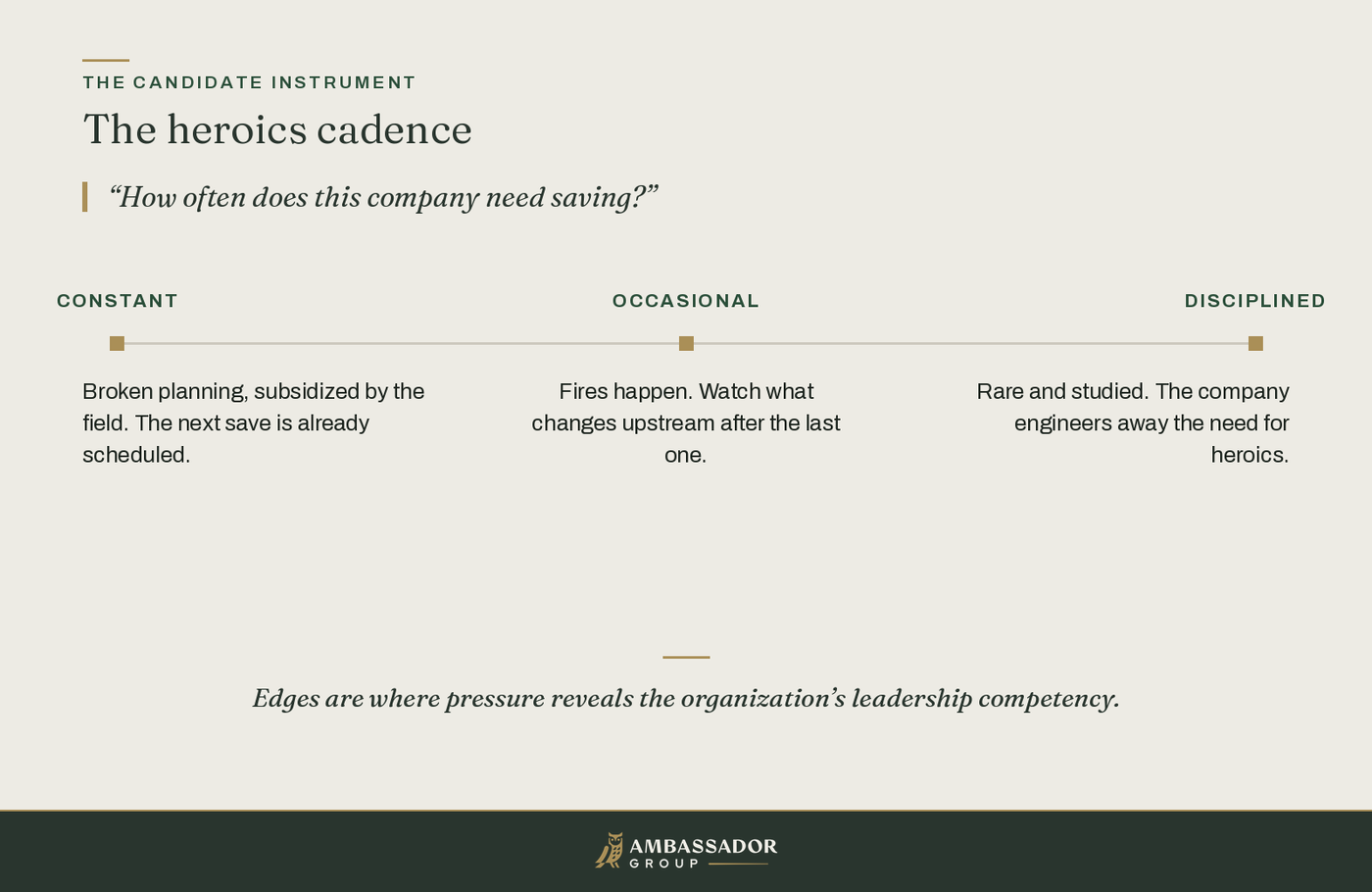
"Tell me about the last time this company needed heroics from its PMs. How often does that happen?"
- What you are listening for: the heroics cadence. Some companies require heroics constantly, some occasionally, and some are disciplined about avoiding the situations that require them. Which is this company? For a senior PM it lands harder: you are the designated hero. You have finite heroics in you. Spend them somewhere they are the exception.
- Evasive tell vs. straight tell: the evasive tell is pride: war stories told with a grin, the quarter somebody ran 4 jobs worn as culture. The straight answer names the last real fire drill, what it cost, and what changed upstream so it does not repeat.
- Follow-the-thread: ask what changed after the last one. If the answer is nothing, the next save is already scheduled, and you are interviewing for it. Then ask how many jobs the most loaded senior PM carried at last year's peak, and whether anyone decided that number or merely counted it.
- Red flag: "our senior PMs thrive under pressure" delivered as a recruiting pitch. A company that plans on heroics has priced your reserves into its overhead, and it will spend them.
"When a PM leaves mid-project here, who is running that job the next morning?"
- What you are listening for: bench depth, asked where it hurts. Either the senior PM leads the response, or the senior PM absorbs the job. If every departure lands on your desk and stays, the portfolio is an accretion plan and the title is a queue.
- Evasive tell vs. straight tell: the evasive answer is rally language: "we pull together, everyone steps up." The straight answer names the last time it happened: who took the job, for how long, what got backfilled, and when.
- Follow-the-thread: ask how long the longest "temporary" absorption lasted. Then ask how many jobs this role runs personally on day one, and where that number ended for the last person.
- Evidence ask: the story of the last mid-project departure, held to specifics: dates, the backfill, the load before and after. A company that handled it can narrate it. A company still handling it will change the subject.
- Red flag: the last senior PM left while personally running 3 jobs, and the interviewer describes that as commitment. You are interviewing to inherit a workload that already consumed its owner.
Write it down before the offer shapes it
An offer distorts judgment, and senior offers distort it more, because the number is bigger and the title is the one you have been working toward. The moment it is on the table, everything you heard gets re-graded on a curve, and an accreted portfolio starts sounding like a challenge you are equal to. The fix is the same one a disciplined interviewer uses on candidates, pointed the other way. Underwrite the company before the offer arrives.
- Write your read the same day. After each conversation, write what you learned in the 4 directions: company, job, team, edges. Specifics, while they are fresh. By the third conversation your memory will be a blur of good feelings and one anecdote.
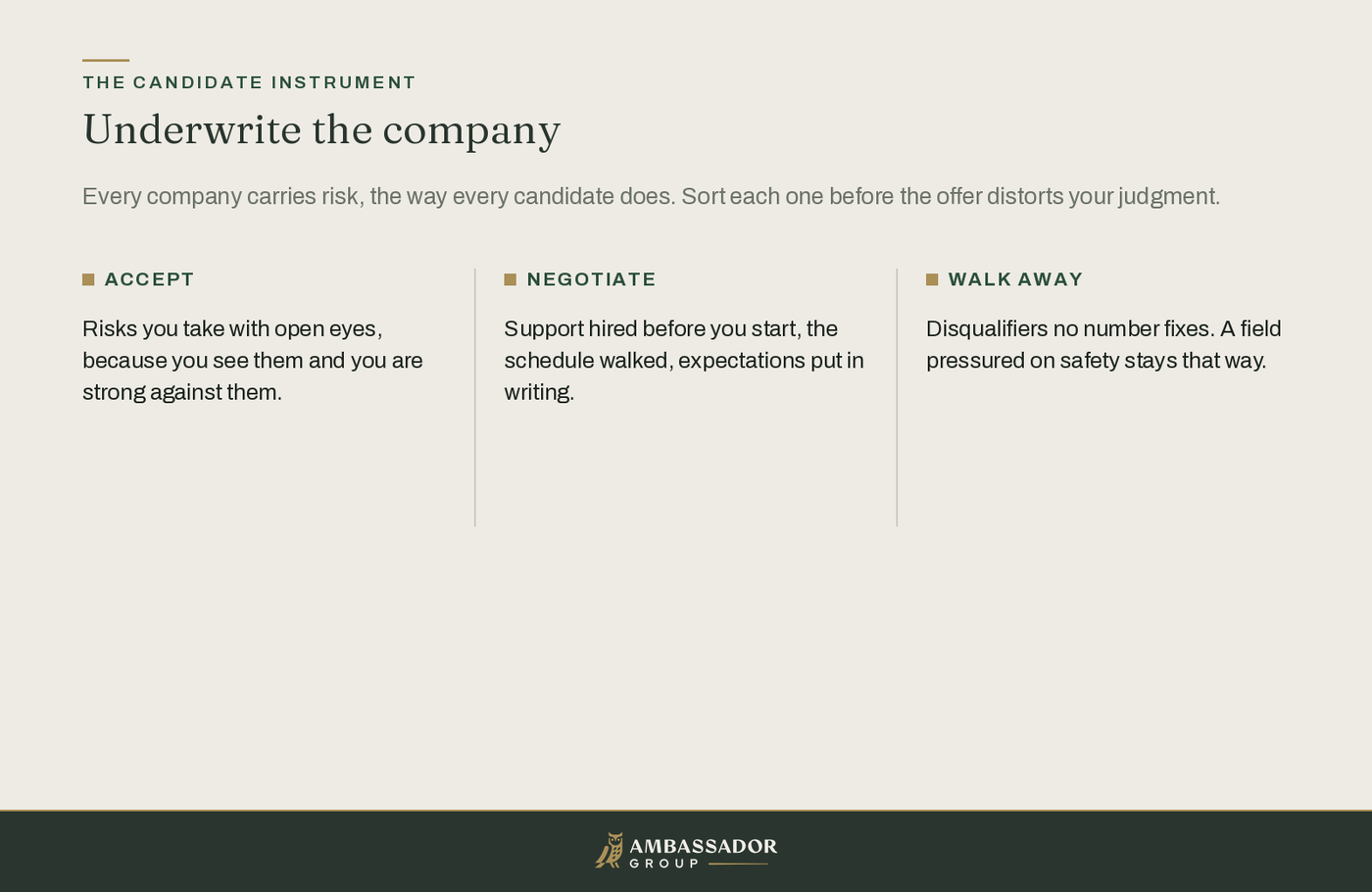
- Sort the risk: accept, negotiate, or walk. Some risks you accept with open eyes: a thin bench you were hired to build, a problem job you saw clearly before you signed. Some you negotiate: authority put in writing, a PM hired before you commit, a cap on how many jobs you personally run. And some are disqualifying at any number: margin accountability without authority does not become acceptable because it pays well.
- Name what you did not assess. If you never met the PMs, never saw the portfolio list, never got a straight answer on what you can decide about people, write that down as a hole in your information, then go fill it. A company that refuses the extra conversation has answered a question too.
- Price the offer against the market, not against your current pay. A raise on an underpaid year is still underpaid. Know your market from data, not folklore: the compensation benchmark exists for exactly this.
- Decide against your life, not against your current job. The question is whether this role clears the bar for the career you are building, not whether it beats the one you are escaping. Almost anything beats a job you already want to leave. The larger discipline of knowing that bar, your strengths, your direction, your worth, is a career's work, and Build to Last is a working manual for it.
The pre-offer checklist turns this into a worksheet you can run before you sign.
The other half of the decision
The company across the table is running an interview to decide whether you can carry the portfolio. Somebody has to run the interview that decides whether the portfolio is worth carrying, and nobody else in the process is going to do it. Ask plainly, follow the thread when an answer is thin, ask to see the artifact instead of settling for the story, and believe what the edges tell you. If the job on offer reads like a heavier version of the one you hold, the construction project manager guide asks the questions at that altitude. If it reads like a step toward running an operation, the project executive guide shows what the next conversation demands.
You already know how to read a job through the people running it. Read this one the same way: on evidence.
Ambassador Group represents construction leaders on both sides of the table and tells both sides the truth. If you want that kind of representation for your next move, send us your resume.
The short version.
- What questions should a senior project manager ask in a job interview?
- Ask in 4 directions: the company, the job, the team, and the edges of the role. Probe how work gets assigned across PMs, whether the growth plan has staffing behind it, how the portfolio load was set, and what authority you would hold over people and margin. Then ask who you would inherit and how often the company needs heroics from its PMs.
- How can a candidate tell whether a senior project manager role means leading PMs or carrying more jobs alone?
- Ask how the portfolio load was set and whether it grew by plan or by departures nobody backfilled. Ask who you would lead and what happens when a PM leaves mid-project. If every departure lands on the senior PM's desk and stays there, senior means alone.
- What can a senior project manager candidate ask to see before accepting an offer?
- Ask to walk the project list for the portfolio you would carry, with stage, contract type, and staffing on each job. Ask for the staffing plan with names, the decision rights in writing, and conversations with the PMs you would lead. A company that designed the portfolio is proud to walk you through it.
- What are the edges of a construction role, and why do they matter?
- Edges are where the job is hardest and the support runs out: whether the role comes with real systems and a team, and how often the company requires heroics. Edges are where pressure reveals the organization's leadership competency. Find them in the interview, while finding them costs you nothing.
- How should a senior project manager evaluate a job offer?
- Write down what you learned the same day, before the offer distorts it. Sort each risk into accept, negotiate, or walk away. Price the offer against the market rather than your current pay, and decide against the life you are building, not the job you are escaping.


