
The firm across the table came with questions for you. If you are like most operations leaders, you have spent almost nothing deciding what to ask them back. The questions to ask in a project executive interview matter as much as the ones you will answer, because half of this decision is yours, and your half decides whether the book you take on is a portfolio or a rescue assignment. The quality of your next move is principally driven by you, not by the firm recruiting you. A bad firm can be read by a sharp candidate and missed by a hopeful one. The questions below are instruments. The discipline of listening is yours.
Most interview advice at this level is about polish: tell the portfolio story cleanly, know the firm's projects, arrive with a few smart questions so you look engaged. This guide assumes you can already perform. It is about the other job you have in that conversation, which is deciding whether this firm deserves the next five years of your judgment. A project executive inherits a portfolio someone else assembled, clients someone else won, and people someone else hired. Taking that inheritance on is an underwriting decision, and underwriting takes evidence, not vibes.
They are bringing an instrument. Bring your own.
A rigorous interviewer does not wing it. They will probe the places a project executive breaks: whether you catch margin fade across five jobs before the cost report confirms it, whether a client relationship survives your hardest conversation, whether you can hold a project manager accountable without taking the job back. They will push where your answer is thin and ask to see artifacts: a portfolio review cadence you ran, a recovery you sequenced. You can read the exact instrument a disciplined interviewer runs on your role: project executive interview questions. Read it. Preparing for that level of judgment means arriving with specifics instead of adjectives.
And notice something while you are in the conversation: how they interview you is evidence about them. A firm that runs a disciplined interview for the role that will hold its portfolio is showing you how it makes decisions. A firm that offers the keys to a quarter of its revenue after two pleasant dinners is also showing you how it makes decisions. Both are free information. Most candidates never collect it.
You will not ask all of these, and you will not ask them all at once. Earn the right first: answer their questions well, then ask yours, in the tone of a builder walking a job rather than an auditor working a file. The company and job questions belong in the first real conversation. The evidence asks and the team questions belong after mutual interest is on the table, where asking to walk the portfolio reads as seriousness instead of presumption. Spread the rest across the process and let each conversation carry two or three, asked well.
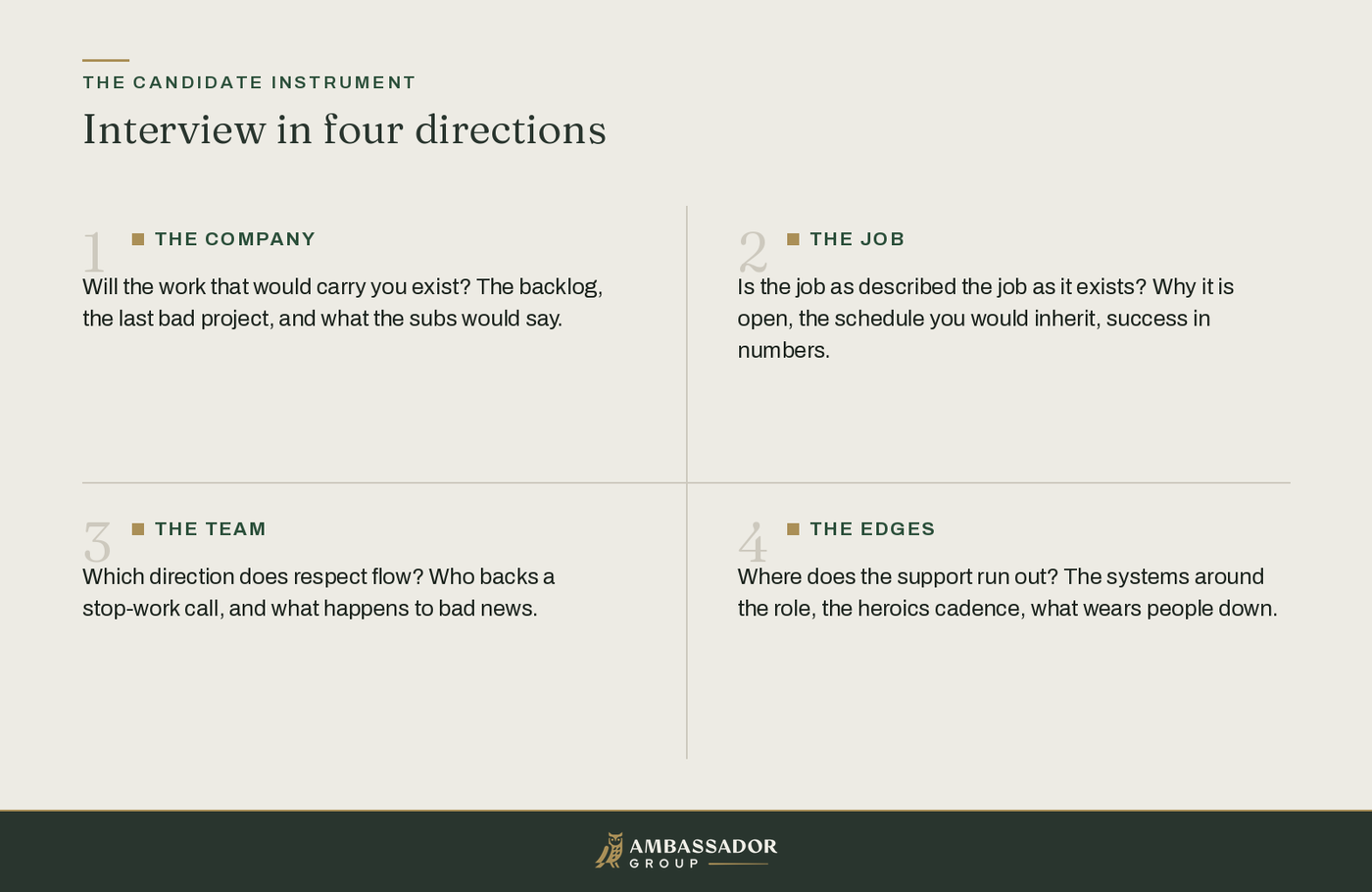
Your own questions run in four directions: the company, the job, the team, and the edges of the role. Take them in that order. Each question below comes with what to listen for, what an evasive answer sounds like next to a straight one, where to push, and what to ask to see. Four questions you know how to read are worth more than forty that fill the silence.
Interview the company
The portfolio you would carry is the output of the firm's appetite. Every job in it was won upstream of you, by a pursuit discipline you will inherit and only slowly influence. If the firm bids desperate, you will own desperate work; no operational skill downstream saves a margin spent before mobilization.
"How does this firm win work, and what did it last walk away from?"
- What you are listening for: the mix, and whether anyone can describe it. Negotiated and repeat work signals clients who came back; a hard-bid book signals margin won by being cheapest. A firm that bids everything hands you whatever the market coughed up.
- Evasive tell vs. straight tell: the evasive answer is reputation language with no mechanism: relationships, word of mouth, a name that opens doors. The straight answer gives the split between negotiated and bid work and names a pursuit the firm declined, with the reason.
- Follow-the-thread: ask who holds the authority to kill a pursuit, and when that last happened. A no that nobody can remember is a formality, and formalities land on operations.
- Evidence ask: the shape of the backlog: how much is negotiated or repeat, how much is signed versus hoped for. Fee and margin detail is the firm's to keep; the shape of where the work comes from is yours to know.
- Red flag: pride in never having walked away from work. The portfolio you would inherit is the record of that habit.
"How much of the work rides on your top two or three clients?"
- What you are listening for: concentration risk, honestly held. Repeat clients are the best evidence a builder has; dependence on one of them is exposure.
- Evasive tell vs. straight tell: the evasive answer waves at diversity without proportions: "a healthy mix across markets." The straight answer gives the rough split without flinching, then tells you what the plan is if the anchor client goes quiet for a year.
- Follow-the-thread: ask which client the firm lost last and what the post-mortem concluded. Ask how much of next year's plan assumes an award that has not landed yet.
- Evidence ask: proportions, told plainly: the rough share of revenue carried by the top relationships. Client names and contract values can stay theirs. The shape of the dependence is a fair question, because a concentrated book decides your staffing and your risk.
- Red flag: one client is the plan. If that relationship wobbles, the portfolio you were hired to grow becomes the portfolio you were hired to shrink.
"Tell me about the last job this firm should never have taken. Who saw it coming?"
- What you are listening for: whether the firm can trace a bad job to its own decision instead of to weather and bad luck. Every builder has one. The machinery that took it will fill your portfolio; the question is whether it has changed.
- Evasive tell vs. straight tell: the evasive answer has only villains in it: the client, the market, the estimator who left. The straight answer names the pursuit decision, what the warning looked like at the time, and what the go/no-go asks now that it did not ask then.
- Follow-the-thread: ask whether anyone argued against taking the job, and what happened to that argument. The answer previews what will happen the first time you make the same argument.
- Red flag: a story with no decision in it. A firm that cannot find itself in its worst job will not find itself in yours.
Interview the job
The title is consistent across the industry; the job is whatever this specific firm has made of it. At some firms a project executive owns clients, staffing, and pursuit judgment; at others the title decorates a senior project manager who attends business development dinners. Your work here is to find out which version is on the table, and what condition it is in.
"Why is this role open, and where is the last project executive now?"
- What you are listening for: the truth about what you inherit. Growth is a fine answer if the growth is real. A departure is fine too, if the firm talks about it like adults. At this level a departure moves more than a desk: some of what left with the person may be on your list to win back.
- Evasive tell vs. straight tell: the evasive answer is a vague "not a fit," a phrase that covers the same territory in a firm's mouth as in a candidate's. The straight answer says what the person struggled with or where they went, without bitterness, and which clients wobbled when they left.
- Follow-the-thread: ask how many people have held this role or its equivalent in the last ten years, and where they sit now. One departure is a story. A pattern is the job.
- Red flag: the last few people in the role are all "not a fit." The common variable is the firm.
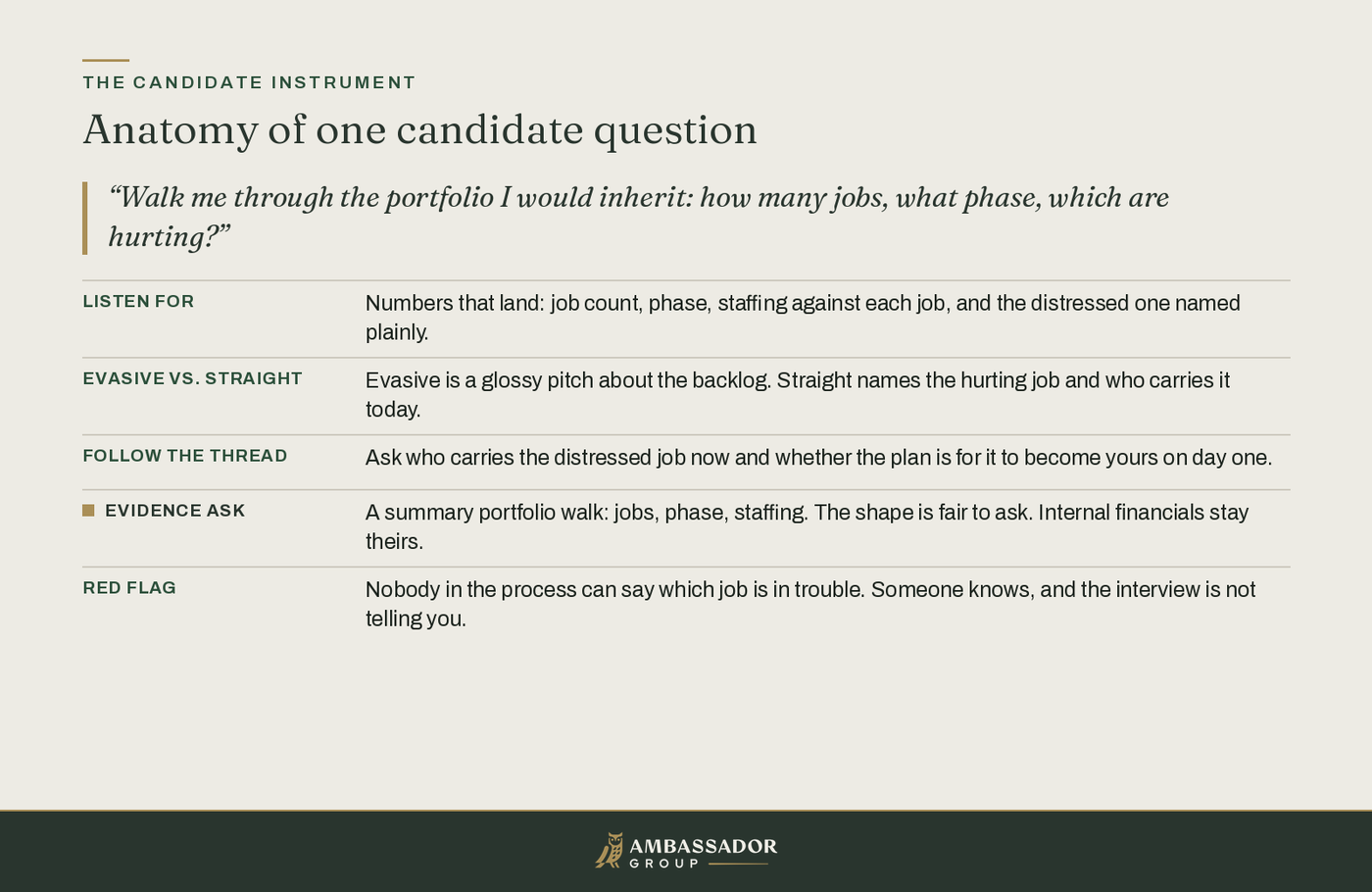
"Walk me through the portfolio I would inherit: how many jobs, what phase, and which ones are hurting?"
- What you are listening for: whether the numbers land. Job count, phase, staffing against each, and the distressed job named plainly. Every portfolio has one. A firm that is honest about a hurting job before you sign will be honest about yours after.
- Evasive tell vs. straight tell: the evasive answer is a glossy pitch: strong backlog, great clients, nothing to worry about. The straight answer puts a summary on the table: the jobs, where each sits, which one is in trouble, who carries it today, and what the plan is.
- Follow-the-thread: ask who carries the distressed job right now, and whether the plan is for it to become yours on day one. Ask which jobs are staffed with names and which are staffed with hope.
- Evidence ask: a summary-level portfolio walk: job count, phase, and the staffing plan against each. You are not asking for cost reports or fee positions; the internal financials are the firm's. The shape of the load is yours to see before you agree to carry it.
- Red flag: nobody in the process can say which job is in trouble. Someone knows. If the interview will not tell you, month one will.
"Which decisions does this role own outright: staffing, go/no-go, stepping away from a client?"
- What you are listening for: real authority versus accountability theater. Every firm holds this role accountable for portfolio outcomes; fewer hand it the levers: who staffs the jobs, which pursuits die, when a client relationship has become a losing trade. Owning results produced by someone else's decisions is a trap with a title on it.
- Evasive tell vs. straight tell: the evasive answer is collaboration language in which every decision is made together and owned by nobody. The straight answer draws the line: what a project executive decides alone, what requires the operations leader or an owner, and the most recent decision on each side of that line.
- Follow-the-thread: ask about the last time a project executive here moved a project manager off a job, or killed a pursuit, and whether the decision held.
- Evidence ask: the story of a staffing call a project executive made that an owner disliked, and what happened next. A firm where no such story exists has answered the question.
- Red flag: accountability for margin with no authority over staffing or pursuit. You would be underwriting outcomes with someone else's pen.
Interview the team
A project executive fails through interfaces: ownership above, preconstruction beside, project teams below. You will spend your tenure moving bad news across those connections. Interview the organization around the role as hard as the role itself.
"What happened the last time a project executive flagged a pursuit as a bad one?"
- What you are listening for: whether dissent survives upstream. The answer tells you whether the firm wants a portfolio owner or a portfolio absorber.
- Evasive tell vs. straight tell: the evasive answer is harmony language: leadership aligns, everyone gets heard. The straight answer is a story with a pursuit in it, an objection, and a decision, whichever way it went, told without embarrassment.
- Follow-the-thread: ask whether the pursuit went ahead anyway, and how the job performed.
- Evidence ask: the pursuit criteria in writing, and the last pursuit that failed them. A firm that has institutionalized the no can show you where it lives.
- Red flag: no such story exists. Either nobody has ever flagged a pursuit, which means the flag is unwelcome, or every pursuit has been good, which means somebody is grading their own homework.
"How does the handoff from preconstruction to operations work, and where did it last break?"
- What you are listening for: a project executive inherits estimates other people committed to. The questions underneath: does operations touch the number before it hardens, and does precon stay accountable after turnover, or does the estimate become your problem alone at contract signing.
- Evasive tell vs. straight tell: the evasive answer recites the process diagram. The straight answer names the last handoff that went badly, the gap it exposed, and what the turnover meeting includes now that it did not include then.
- Follow-the-thread: ask whether operations has ever moved a number before a bid went out. Ask who attends the turnover meeting, and whether the superintendent is one of them.
- Evidence ask: the turnover package for a recent job, described: what a project team receives on day one, from estimate assumptions to buyout status. The contents can stay internal; the completeness is the tell.
"Tell me about the project managers and superintendents I would lead. Who is ready for more, and who is stretched thin?"
- What you are listening for: whether the firm knows its bench. A leadership team that can describe these people individually, with development plans attached, has been leading them. One that describes them as headcount has been scheduling them.
- Evasive tell vs. straight tell: the evasive answer is a roster with adjectives: solid group, good people, deep bench. The straight answer offers specifics with the names held back: a project manager ready for a bigger job, a superintendent carrying two jobs and feeling it, and what is being done about both.
- Follow-the-thread: ask what happened to the last project manager who outgrew the role here, and the last one who did not work out. The pair of answers maps the ceiling and the floor of the team.
- Evidence ask: conversations with one or two of the people you would lead, without a chaperone, once mutual interest is established. A firm confident in how it leads hands you the introductions.
- Red flag: every question about individuals gets answered with the org chart. You would be inheriting a structure, and nobody can tell you about the people inside it.
Find the edges of the role
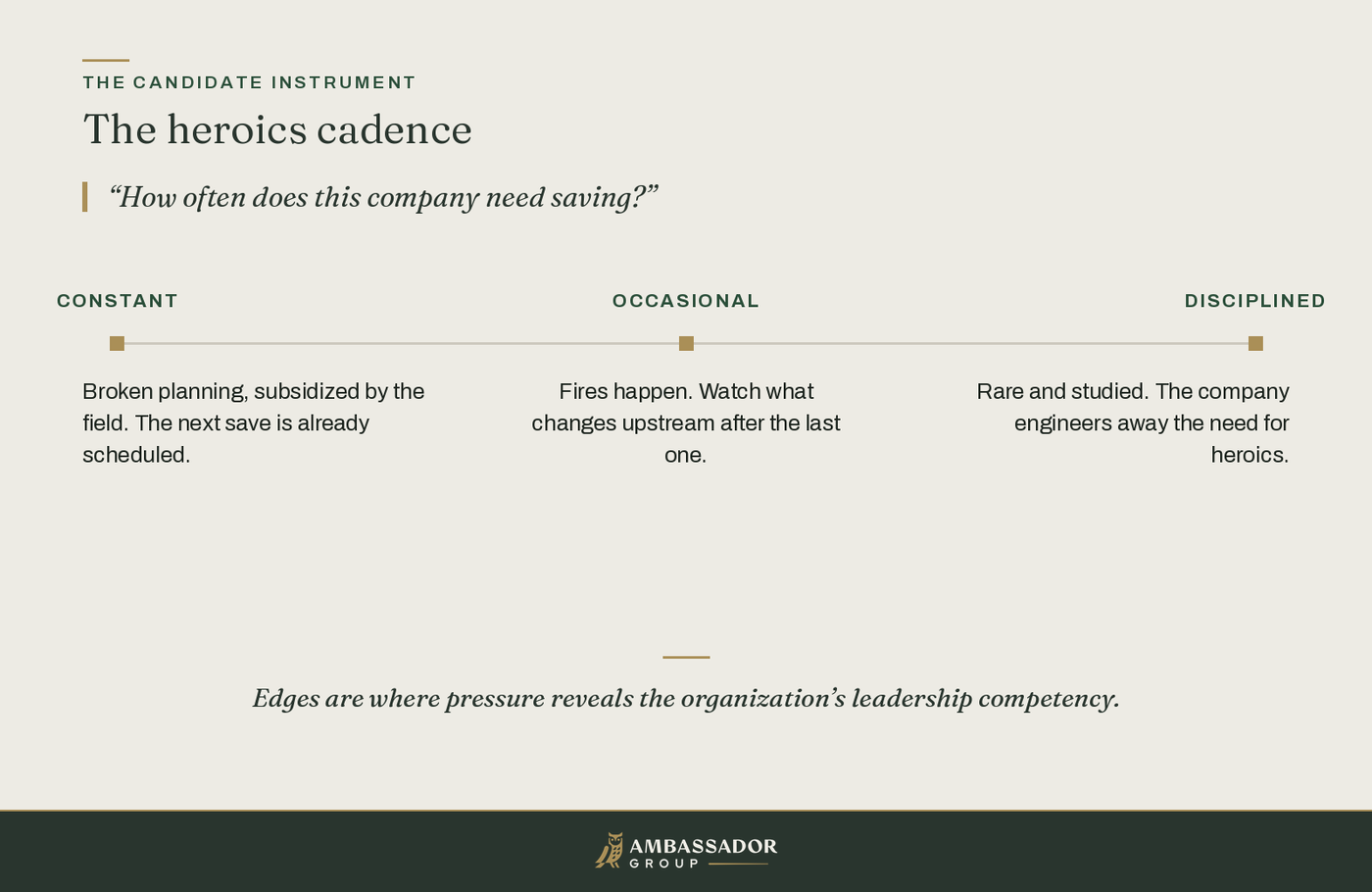
The edges of a role are where the support thins, the promises blur, and the job becomes whatever the organization's habits make of it. Edges are where pressure reveals the organization's leadership competency. The edges of this role carry more voltage than most; it is the role firms hand their trouble to. Most candidates find the edges in month three. Find them now, while the finding is free.
"Who sits around this role: who runs the numbers, who supports the pursuits, who staffs the jobs?"
- What you are listening for: whether the title comes with an organization or arrives alone. Some firms put real structure under a project executive: project accountants who close the month, a scheduler, a precon partner, project managers seasoned enough to run their jobs without rescue. At others the role is five jobs, three clients, and a laptop.
- Evasive tell vs. straight tell: the evasive answer lists departments that exist somewhere on an org chart. The straight answer describes who supported the current portfolio last month, by role, and what the executive carrying it could hand off.
- Follow-the-thread: ask what a project executive here spends time on that they should not have to. Ask what the firm has invested in around the role in the last two years: people, software, process. Investment is where priorities stop being talk.
- Evidence ask: the staffing plan for the portfolio, roles against jobs, on paper. The gap between the org chart and the staffing plan is the gap you will personally fill.
- Red flag: pride that executives here stay close to the work, offered as a substitute for support. That is understaffing described as culture.
"When did this firm last need an executive rescue on a job, and how often does that happen?"
- What you are listening for: the heroics cadence. Some companies require heroics constantly, some occasionally, and some are disciplined about avoiding the situations that require them. The concrete version: how often does a project executive get pulled out of their portfolio and into a burning job, and does the firm treat that as a planning failure or as the job description.
- Evasive tell vs. straight tell: the evasive tell is pride: turnaround stories worn as culture, the executive who saved the tower. The straight answer names the last rescue, what it cost the rest of the portfolio while attention was elsewhere, and what changed upstream in pursuit or staffing so it does not repeat.
- Follow-the-thread: ask what the go/no-go or the staffing model changed after the last rescue. If the answer is nothing, the next one is already scheduled, and you are interviewing for it.
- Evidence ask: the count, roughly: how many jobs needed executive intervention in the last three years, against how many ran. Precision matters less than whether the number is offered without flinching.
- Red flag: rescue framed as the role's purpose. A firm that plans on heroics has already spent yours.
"Which client relationships in this book belong to the firm, and which left with the people who held them?"
- What you are listening for: whether the client asset you are being hired to grow exists. Firms describe loyalty as institutional; clients experience it as personal. When an executive leaves, some relationships stay because the firm built structure around them. Others turn out to have been on loan.
- Evasive tell vs. straight tell: the evasive answer insists clients hire the firm, full stop. The straight answer can say which relationships survived the last departure, which wobbled, and who holds each key client today.
- Follow-the-thread: ask which clients came because of one person who is still here, and what the plan is when that person retires.
- Evidence ask: the tenure of the top relationships: how many years each goes back, and how many hands it has passed through. Contract values stay theirs; the age and continuity of what you would be responsible for is fair to know.
- Red flag: the book is described in the future tense: relationships to rebuild, clients to win back. That is a business development job wearing a portfolio title, and it should be priced as one.
Write it down before the offer shapes it
An offer at this level distorts more than most, because the number is larger and the courtship is better. The moment compensation is on the table, the distressed job becomes a stretch opportunity, the missing authority becomes a thing to sort out later, and the concentration risk becomes somebody else's problem. Underwrite the firm before the offer arrives.
- Write your read the same day. After each conversation, capture what you learned in the four directions: company, job, team, edges. By the third conversation your memory will be a blur of good dinners and one anecdote, which is exactly how bad decisions get made on both sides of hiring.
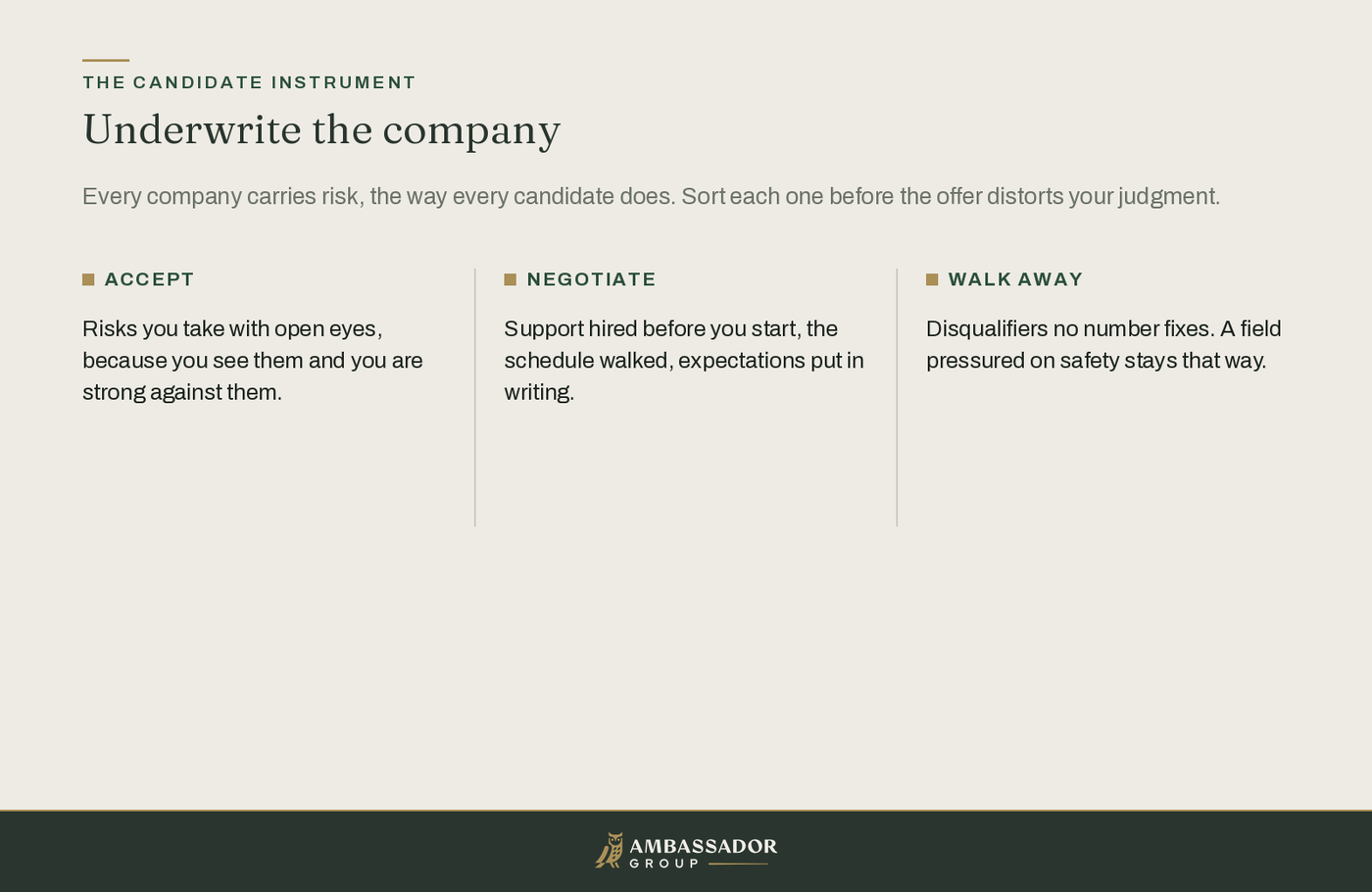
- Sort the risk: accept, negotiate, or walk. Every firm carries risk. Some you accept with open eyes: a concentrated client base you happen to have the relationships to widen. Some you negotiate: authority put in writing, the distressed job scoped and staffed before it becomes yours, support hired by a named date. And some are disqualifying at any number, because a firm that assigns accountability without authority does not become a different firm because it pays well.
- Name what you did not assess. If you never walked the portfolio, never met the operations leader, never heard how the last flagged pursuit died, write that down as a hole in your information, then go fill it. A firm that refuses the extra conversation has answered a question too.
- Price the offer against the market, not against your current pay. A raise on an underpaid year is still underpaid. Know your market from data rather than folklore: the compensation benchmark exists for exactly this.
- Decide against your life, not against your current job. The question is whether this portfolio, this authority, and this firm clear the bar for the career you are building, and almost anything clears the bar set by a job you already want to leave. The larger discipline of knowing that bar, your strengths, your direction, your worth, is a career's work, and Build to Last is a working manual for it.
The pre-offer checklist turns this into a worksheet you can run before you sign.
The other half of the decision
The firm across the table is running an interview to decide whether you can hold a portfolio. Somebody has to run the interview that decides whether the portfolio deserves holding, and nobody else in the process is going to do it. Ask plainly, follow the thread when an answer is thin, ask for the artifact instead of settling for the story, and believe what the edges tell you. The same four directions work one level up in a VP of Construction interview and one level down in a Senior Project Manager interview. The altitude changes. The discipline does not.
You already know how to underwrite a job you have to stand behind. Underwrite this one.
Ambassador Group represents construction leaders on both sides of the table and tells both sides the truth. If you want that kind of representation for your next move, send us your resume.
The short version.
- What questions should a project executive ask in a job interview?
- Ask in four directions: the company, the job, the team, and the edges of the role. Probe how the firm wins work, its client concentration, and the last job it should have declined. Probe the portfolio you would inherit and the authority the role carries over staffing and go/no-go. Then ask what happened the last time a project executive flagged a bad pursuit.
- What should a project executive candidate ask to see before accepting an offer?
- Ask for a summary-level portfolio walk: how many jobs, what phase each is in, and how each is staffed. Ask for the shape of the backlog, meaning how much is negotiated or repeat work and how much is signed. Internal financials are the firm's to keep; the shape of the load you would carry is fair to see.
- How can a candidate tell real authority from accountability theater in a project executive role?
- Ask which decisions the role owns outright: staffing, go/no-go, and stepping away from a client. Then ask for the last staffing call a project executive made that an owner disliked, and whether it held. Accountability for portfolio margin without authority over staffing or pursuit is a trap with a title on it.
- What are the edges of a project executive role, and why do they matter?
- Edges are where the support thins: whether real structure sits around the role, how often the firm needs executive rescues on distressed jobs, and whether client relationships belong to the firm or left with the people who held them. Edges are where pressure reveals the organization's leadership competency. Find them in the interview, while finding them costs you nothing.
- How should a project executive evaluate a job offer?
- Write down what you learned the same day, before the offer distorts it. Sort each risk into accept, negotiate, or walk away. Price the offer against the market rather than your current pay, and decide against the life you are building, not the job you are leaving.


