
The company across the table came with questions for you. If you are like most senior estimators, you have spent almost nothing on what to ask them back. The questions to ask in a senior estimator interview matter as much as the ones you will answer, because half of this decision is yours, and your half decides whether you are still glad you took the job 2 years in. The quality of your next move is principally driven by you, not by the company recruiting you. You price risk for a living, and this company is the largest risk you will price this year. The questions below are instruments. The discipline of listening is yours.
Most interview advice for candidates is about performing well: rehearse your stories, research the company, look engaged. This guide assumes you can already perform. It is about your other job in that conversation: deciding whether this company deserves your judgment on its numbers for the next 5 years. That is an underwriting decision, and underwriting takes evidence, not vibes.
They are bringing an instrument. Bring your own.
A rigorous interviewer does not wing it. They will probe the places a senior estimator breaks: whether your bid/no-bid judgment is a framework or a feeling, whether your cost data is a system or a memory, whether you will hold a number against an owner who wants a different one. They will push where your answer is thin and ask to see artifacts: a go/no-go scorecard, a win/loss log. You can read the exact instrument a disciplined interviewer runs on your role: senior construction estimator interview questions. Read it. Preparing for that level of judgment means arriving with specifics instead of adjectives.
And notice something in the conversation: how they interview you is evidence about them. A company that probes your judgment with real follow-ups is showing you how it makes decisions. A company that hires the person who sets the number it lives or dies on after one pleasant conversation about software is also showing you how it makes decisions. Both are free information. Most candidates never collect it.
You will not ask all of these, and you will not ask them all at once. Earn the right first: answer their questions well, then ask yours, in the tone of a builder walking a job rather than an auditor working a file. The company and job questions belong in the first real conversation. The evidence asks and the team questions belong after mutual interest is on the table, where asking how go/no-go decisions get recorded reads as seriousness instead of presumption. Spread the rest across the process and let each conversation carry 2 or 3, asked well.
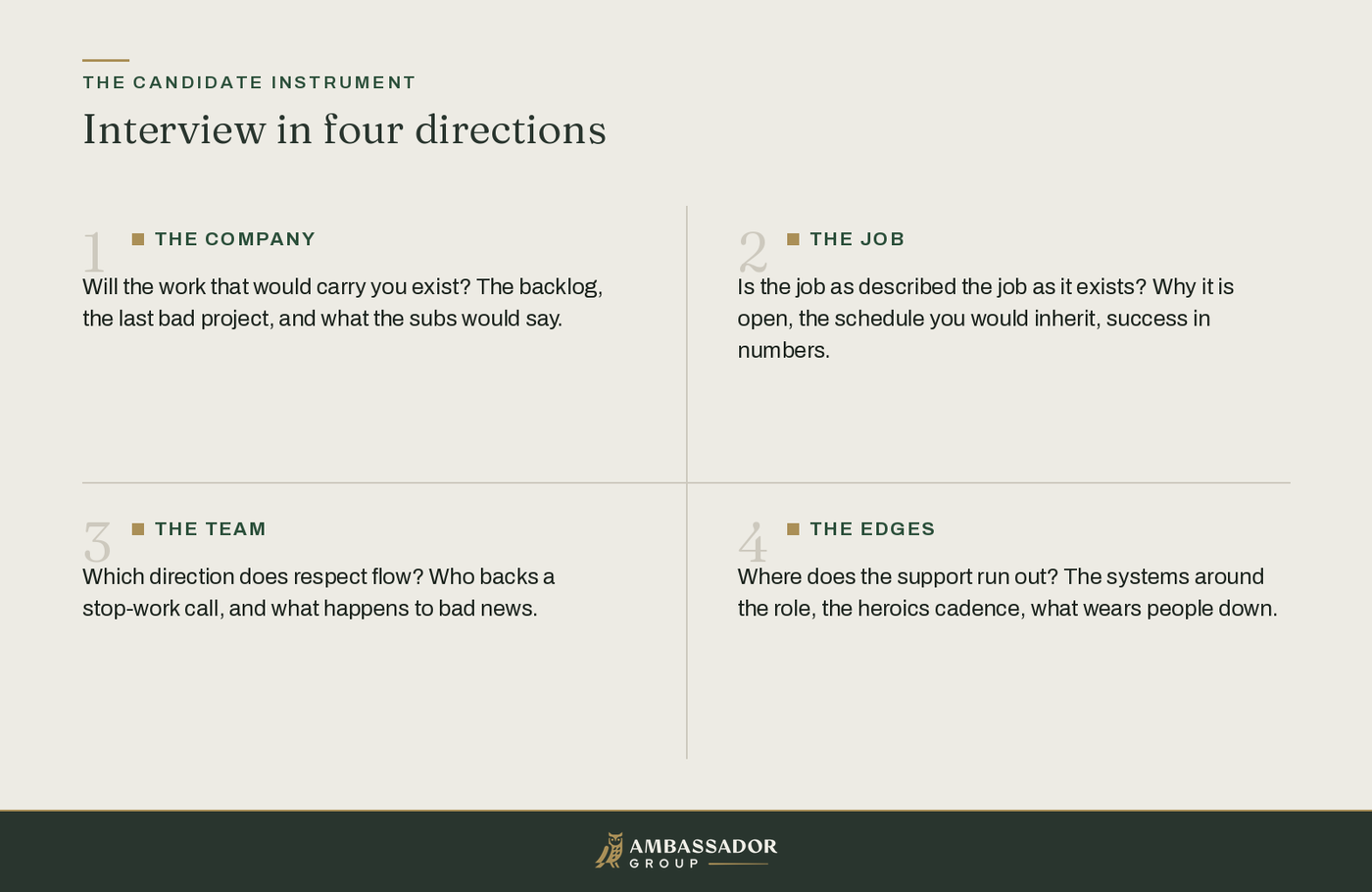
Your own questions run in 4 directions: the company, the job, the team, and the edges of the role. Take them in that order. Each question below comes with what to listen for, what an evasive answer sounds like next to a straight one, where to push, and what to ask to see. 4 questions you know how to read are worth more than 40 that fill the silence.
Interview the company
You are joining the machine that feeds the desk: the company decides what you price, how often, at what fee, and for whom. Senior estimators get ground down here more than anywhere: hired to lead a function, then run as a quote engine for pursuits nobody filtered.
"How many pursuits did this team price last year, and how many did you decline?"
- What you are listening for: pursuit economics. A disciplined company can tell you how many bids went out, the hit rate, and what it declined. A company that bids whatever arrives is spending your hours on other people's optimism.
- Evasive tell vs. straight tell: the evasive answer treats volume as virtue: "there is no shortage of work to chase." The straight answer names the count, the hit rate, and a pursuit they turned down, with the reason.
- Follow-the-thread: ask who sits in the go/no-go conversation and what a no sounds like. If estimating has no voice in what gets pursued, the desk absorbs every decision it never made.
- Evidence ask: how go/no-go decisions are recorded. Ask to walk the scorecard or memo from a recent pursuit, redacted. A real process has paper; a ritual has a meeting nobody can produce notes from.
- Red flag: bid volume set by whoever calls in a favor. A desk that prices everything wins by accident and loses by policy.
"How much of the backlog rides on your largest client and your largest market?"
- What you are listening for: concentration, and whether the company treats it as exposure or as loyalty. Precon is overhead on the P&L, and overhead is where the cutting starts when an anchor client goes quiet.
- Evasive tell vs. straight tell: the evasive answer is "we have a healthy mix" with no numbers. The straight answer names the share, calls it a risk if it is one, and can describe the plan for the next client.
- Follow-the-thread: ask what happened to estimating headcount the last time the market turned. The answer tells you whether the company carries its precon people through a trough.
- Evidence ask: the shape of the backlog: by client, by project type, and how much is signed versus pursued. You are asking whether the next 2 years exist on paper or in a business developer's forecast.
"When the backlog runs thin, what happens to your fee?"
- What you are listening for: margin discipline where it is hardest to keep. The character question is the lean quarter, because that is the exact pressure that will someday lean on your number.
- Evasive tell vs. straight tell: the evasive answer is "we get more competitive," which is fee-cutting wearing a suit. The straight answer names a floor, or admits the job it bought once and what that job cost to build.
- Follow-the-thread: ask about the last job taken below the company's own pricing policy: who made the call, and how the job built out.
- Evidence ask: the contract-type mix across the current backlog: negotiated, GMP, hard bid. Fee detail is confidential; the mix is a shape question, and drift from negotiated work toward hard bid tells you what your bid days become.
- Red flag: pride in never losing on price. A company that always wins the number is pricing below the market, and the field pays for it in overruns read back to your desk.
Interview the job
The title says senior estimator. Companies mean different jobs by it. At one, the desk runs the function: pricing strategy, a voice in go/no-go, a team to build. At another, it is the fastest takeoff in the building with a mentoring load stapled on and no authority past the spreadsheet. Your work here is to close the distance between the job as posted and the desk as it exists.
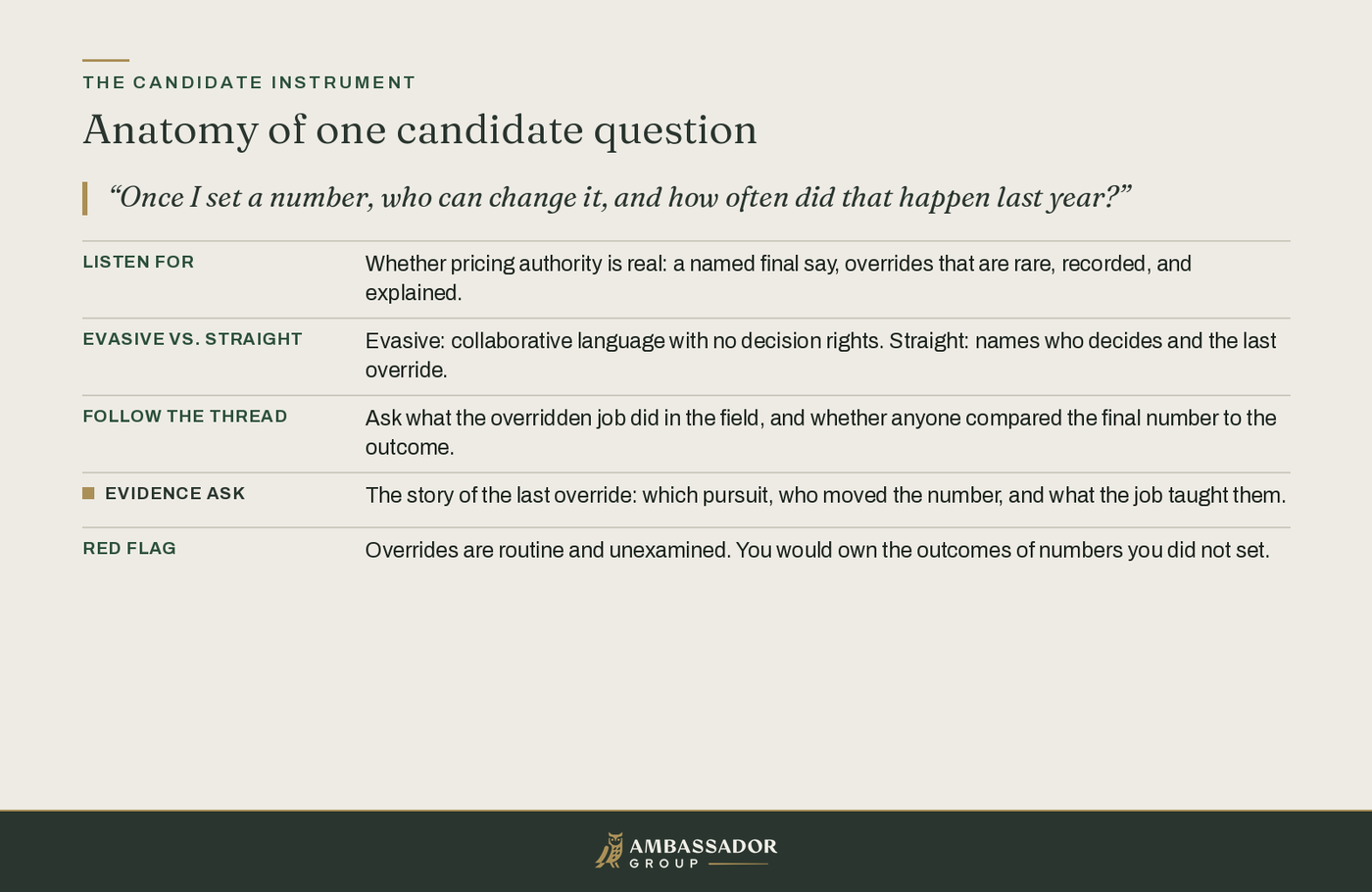
"Once I set a number, who can change it, and how often did that happen last year?"
- What you are listening for: whether the role carries authority or only responsibility. Executive review before a bid goes out is healthy. Listen for what happens inside it: a pressure-test of assumptions, or a hand that moves the number after your judgment is signed to it.
- Evasive tell vs. straight tell: the evasive answer is collaboration language with no decision rights: "we land on the number as a team." The straight answer names the final say, says how rare overrides are, and can tell you about the last one.
- Follow-the-thread: ask what the overridden job did in the field, and whether anyone went back to look. A company that moves numbers and never looks back will move yours monthly.
- Evidence ask: the story of the last override, with specifics. A named pursuit, a named decision, and a lesson mark a company that treats pricing as a discipline rather than a negotiation with itself.
- Red flag: overrides are routine, unrecorded, and unexamined. You will own the outcomes of numbers you did not set, and the record will say the estimate missed.
"Which of your cost data do you trust, and how does field actual get back into it?"
- What you are listening for: what you inherit. You will price on this data in month 1, and your first misses will be its misses. A closed loop between estimate and actual is a system; a database trusted because it exists is an inheritance nobody has audited.
- Evasive tell vs. straight tell: the evasive answer names a software platform and stops. The straight answer names the cost codes they trust, the ones they distrust and why, and who feeds buyout and closeout numbers back to the desk.
- Follow-the-thread: ask when a unit cost was last corrected because a job proved it wrong, and which trades the data runs thinnest on. If the person cannot answer, ask to meet whoever can.
- Evidence ask: the loop, walked on a recent project: how its actuals got back into estimating. You are not asking to read the database. You are asking whether the loop exists, and the specificity of the answer is the answer.
- Red flag: "our numbers are solid, they have 30 years in them." Confidence with no provenance means the data is a single retirement away from fiction, and the rebuild lands on you.
"What does a good first year at this desk look like, in numbers you already track?"
- What you are listening for: whether expectations exist in a form you can hit. Hit rate inside a band, estimate-to-buyout variance, pursuit volume the team can carry. A company that can state the scorecard is a company you can succeed at.
- Evasive tell vs. straight tell: the evasive answer is appetite dressed as strategy: "win work, keep the pipeline full, be a fit." The straight answer sounds like a scorecard and includes a trade-off, because hit rate and margin pull against each other.
- Follow-the-thread: ask how the last person at this desk was measured, and what the numbers were. Then ask which one this company blinks on when win rate and margin collide.
- Evidence ask: which estimating numbers leadership reviews monthly. A function with a scoreboard is a function that exists; one examined only when a job goes bad is being kept for blame.
- Red flag: win rate is the only number named. A desk graded purely on winning is being graded on cheap pricing, and the correction arrives at your review.
Interview the team
Estimators rarely leave companies over the work. They leave over what surrounds the desk: an executive who treats the estimate as an opening offer, an operations group that treats every overrun as the estimate's fault, trade partners who send one late number. The team is the job, and here it includes people who never appear on the org chart.
"What happens here when a job runs over the number?"
- What you are listening for: whether misses become feedback or ammunition. Every estimator misses. The machinery that processed the last overrun is the machinery that will process your first one.
- Evasive tell vs. straight tell: the evasive answer is that it rarely happens, or a story where the field did all the damage. The straight answer names a job, what the estimate missed and what execution missed, and something that changed afterward.
- Follow-the-thread: ask how operations feeds actuals and grievances back to estimating: a structured postmortem, or a hallway ambush. Ask what gets handed over with the number at turnover.
- Evidence ask: a conversation with a project manager who built a job to one of this desk's recent estimates, without a chaperone. A company confident in that seam hands you the introduction.
- Red flag: every overrun story has the same villain. If it is always the field, you are watching the office spend its credibility. If it is always the estimate, you are interviewing to be the villain.
"Tell me about the last time estimating gave leadership a number they did not want. What happened?"
- What you are listening for: whether the check against wishful pricing survives contact with revenue hunger. This role is the company's underwriting conscience, and a conscience only works if the people above it can hear a no without punishing it.
- Evasive tell vs. straight tell: the evasive answer is trust language with no story: "we hire good people and believe them." The straight answer is a specific bid, the tension named, and a decision that respected the number even though it hurt.
- Follow-the-thread: ask to meet the person this role reports to, and put the same question to them. Consistency between the answers is the real data.
- Evidence ask: that conversation itself. That person shapes the job more than any policy, and a company that will not arrange the introduction is asking you to price blind.
"In the trades that decide your jobs, how deep is your sub coverage on bid day?"
- What you are listening for: whether the company knows which 2 or 3 trades decide its work, and how many real numbers arrive in each on bid day. Your estimate is assembled from other people's numbers.
- Evasive tell vs. straight tell: the evasive answer is "we know everyone in this market." The straight answer names the trades where coverage runs thin and knows which subs price their work first and why.
- Follow-the-thread: ask whether subs get paid on time, because coverage follows payment behavior. Ask which sub stopped bidding their work in the last year.
- Evidence ask: which trades returned a single number on the last competitive bid. Sub pricing is confidential and asking marks you as green; the count of numbers by trade is a fair shape question.
- Red flag: coverage that lives in one person's cell phone, especially if that phone belongs to the person whose departure opened this role.
Find the edges of the role
Every role has edges: the places where the job is hardest, where the support runs out, where the organization's promises meet its habits. Edges are where pressure reveals the organization's leadership competency. Most candidates find them in month 3. The whole point of asking is to find them now, while the finding costs you nothing. A company that knows its edges and talks about them plainly is a company that manages them. A company that denies having any is asking you to find them alone.
"Walk me through who supports this role on a live pursuit, and what else the desk carries."
- What you are listening for: whether the title comes with a function or comes alone. Some companies put real structure around the desk: junior estimators who own trades, precon coordination. At others it is a one-person institution, and every load the company forgot to staff lands there: mentoring, precon meetings, marketing exhibits.
- Evasive tell vs. straight tell: the evasive answer lists departments that exist on an org chart. The straight answer describes the last major pursuit by name and role: who carried the takeoff, who worked sub coverage, what the senior estimator held.
- Follow-the-thread: ask how many estimators this role develops, and whether pursuit volume drops to make the teaching hours exist. A company that stacks a producing load on a mentoring load and acknowledges neither has already planned your evenings.
- Evidence ask: the precon org chart with names on it, and the shape of next quarter's pursuit calendar: how many bids, what size, how many hands. The gap between them is the gap you will personally fill.
- Red flag: pride that the last person "did it all." That workload is the real job description, and it is hiding under a compliment.
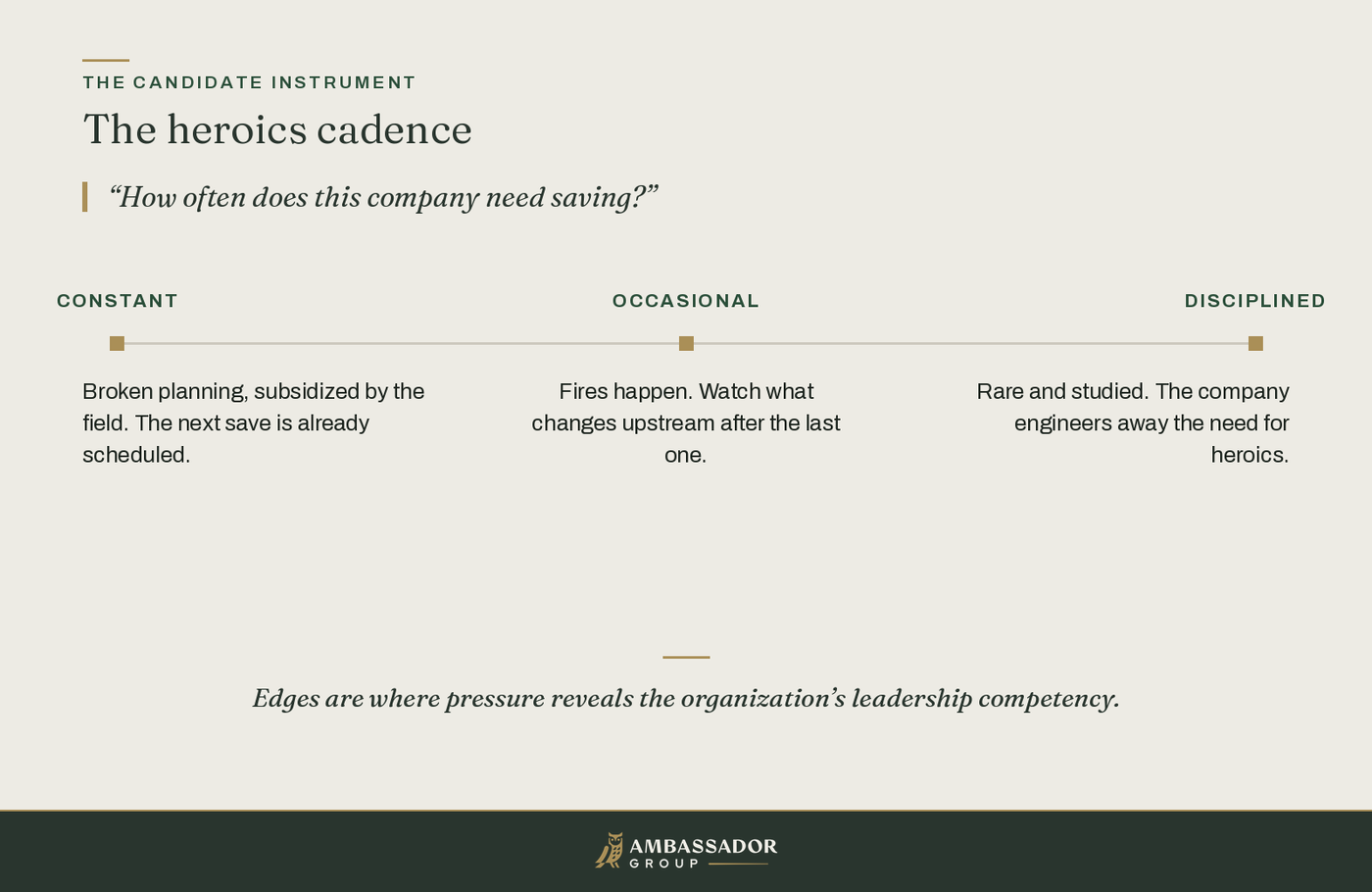
"Tell me about the last bid that turned into a fire drill. How often does that happen?"
- What you are listening for: the heroics cadence. Some companies require heroics constantly, some occasionally, and some are disciplined about avoiding the situations that require them. Which is this company? At this desk it looks like addenda absorbed at the deadline and all-nighters worn as culture.
- Evasive tell vs. straight tell: the evasive tell is pride: buzzer-beater bids told with a grin, the all-nighter worn as a badge. The straight answer names the last real fire drill, what triggered it, and what changed upstream so it does not repeat: a runway rule for invitations, a cap on concurrent pursuits.
- Follow-the-thread: ask how many bids went out last quarter and how many became overnight pushes, and watch whether the answer is a ratio or a shrug. Ask what the company declines because the timeline is irresponsible.
- Evidence ask: the last bid pulled late, and why. A company that can name a pursuit withdrawn because the number could not be built responsibly is showing discipline. One that has never pulled a bid ships whatever the deadline forces.
- Red flag: "bid week is a lifestyle here" delivered as a recruiting pitch. Constant heroics means the pursuit pipeline is unmanaged, and unmanaged pipelines consume senior estimators first.
"When did this company last honor a no-bid recommendation from this desk? Walk me through it."
- What you are listening for: whether the authority the job description promises survives revenue pressure. When the no came from this desk and the pipeline was hungry, did it hold? The difference is owning bid/no-bid judgment versus performing it.
- Evasive tell vs. straight tell: the evasive answer is respect in the abstract: "we take those recommendations very seriously." The straight answer is a named pursuit, the reasoning, the revenue walked away from, and the executive who backed the call.
- Follow-the-thread: ask about the reverse: the last no-bid that got overridden, and what the job did. A company that overrode a no and never studied the result will do the same to yours.
- Evidence ask: whether anyone tracked the declined job: who took it, and how it went. A company that follows its no-bids treats them as decisions rather than lapses of nerve.
- Red flag: nobody can name a single honored no-bid. The authority is decorative, and the job underneath the title is pricing whatever arrives.
Write it down before the offer shapes it
An offer distorts judgment. The moment a number is on the table, everything you heard gets re-graded on a curve, and the edges you found start reading like quirks. You would never let an owner's enthusiasm move a unit cost. Do not let an offer move your read. Underwrite the company before the offer arrives.
- Write your read the same day. After each conversation, capture what you learned in the 4 directions: company, job, team, edges. Specifics, while they are fresh. By the third conversation your memory will be a blur of good feelings and one anecdote.
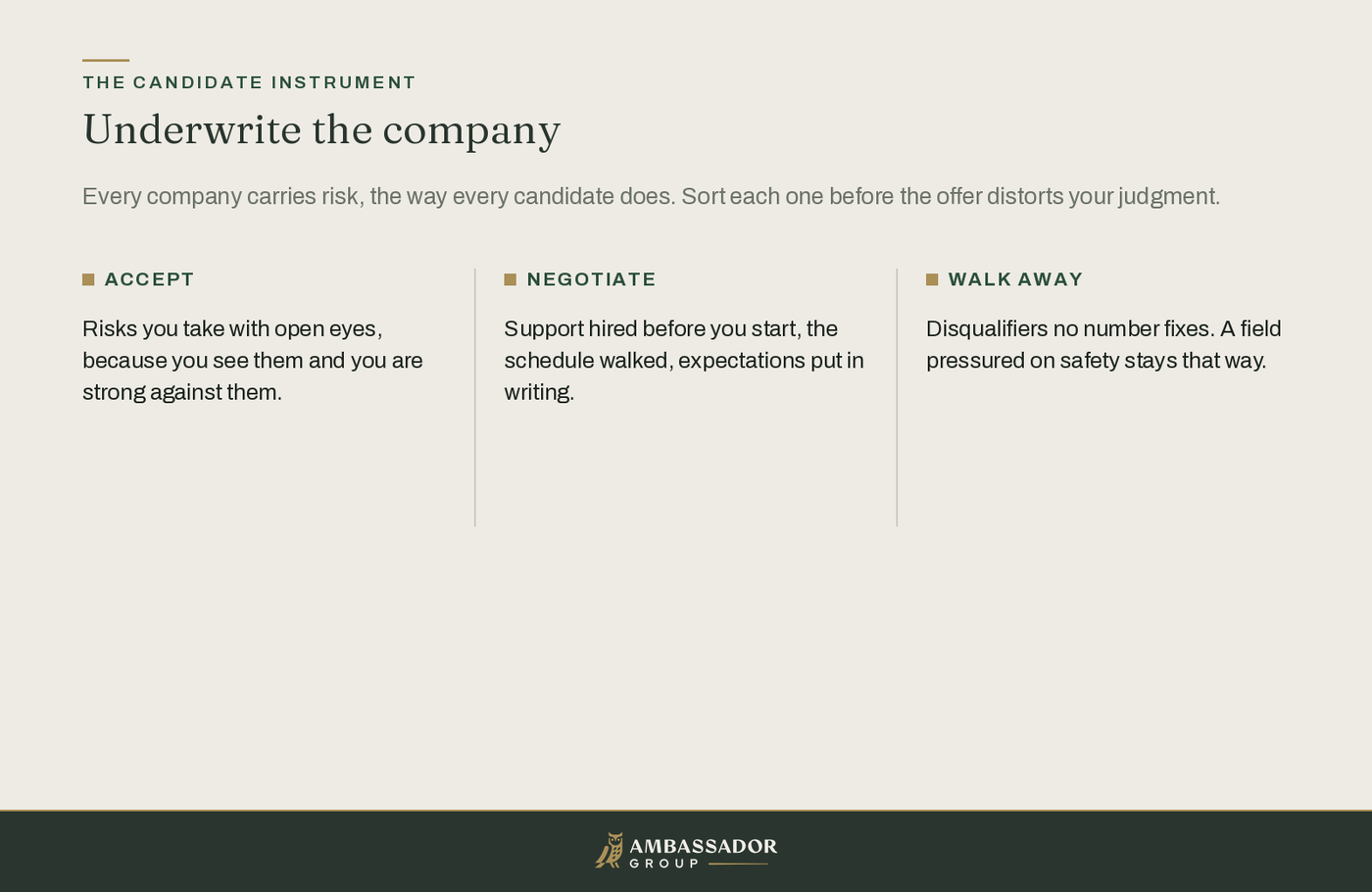
- Sort the risk: accept, negotiate, or walk. Every company carries risk, the way every bid does. Some you accept with open eyes: thin cost data you have the appetite to rebuild. Some you negotiate: a support hire, pricing authority defined in writing, a pursuit load with a number on it. And some are disqualifying at any salary, because a company that routinely overrides its estimators does not change because it pays well.
- Name what you did not assess. If you never met the executive this desk reports to, or never heard the coverage answer, write it down as a hole in your information, then go fill it. A company that refuses the extra conversation has answered a question too.
- Price the offer against the market, not against your current pay. A raise on an underpaid year is still underpaid. Know your market from data rather than folklore: the compensation benchmark exists for exactly this.
- Decide against your life, not against your current job. The question is whether this desk clears the bar for the career you are building, not whether it beats the one you are escaping. Almost anything beats a job you want to leave, which is why leaving is when estimators make their worst moves. The larger discipline of knowing that bar, your strengths, your direction, your worth, is a career's work, and Build to Last is a working manual for it.
The pre-offer checklist turns this into a worksheet you can run before you sign.
The other half of the decision
The company across the table is running an interview to decide whether you fit the job. Somebody has to run the interview that decides whether the job fits you, and nobody else in the process will. Ask plainly, follow the thread when an answer is thin, ask for the artifact instead of settling for the story, and believe what the edges tell you. A company reveals itself under a good question the same way a candidate does. If the title in front of you differs, the sibling guides for the construction estimator and the preconstruction manager run the same 4 directions.
You already price risk for a living. Price this one.
Ambassador Group represents construction leaders on both sides of the table and tells both sides the truth. If you want that kind of representation for your next move, send us your resume.
The short version.
- What questions should a senior estimator ask in a job interview?
- Ask in 4 directions: the company, the job, the team, and the edges of the role. Probe the company's pursuit discipline, its client concentration, and what happens to fee when the backlog runs thin. Probe who can override your number, the state of the cost data, and how success gets measured. Then find the edges: who supports the desk, how often bid week demands heroics, and whether a no-bid recommendation holds.
- How can a candidate tell if a construction company has real bid discipline?
- Ask how many pursuits the company priced last year, how many it declined, and how go/no-go decisions get recorded. Then ask for the last no-bid recommendation the company honored and what happened. A disciplined company names the pursuit, the reasoning, and the revenue it walked away from. One with a ritual instead of a process cannot produce a single example.
- What are the edges of a senior estimator role, and why do they matter?
- Edges are where the job is hardest and the support runs out: whether the desk carries a mentoring load on top of a producing load, how often bid week requires heroics, and whether a no-bid recommendation holds under revenue pressure. Edges are where pressure reveals the organization's leadership competency. Find them in the interview, while finding them costs you nothing.
- Who should have authority over the final number on a construction bid?
- The senior estimator should know exactly who holds the final say and how often it gets overridden. An executive review that pressure-tests assumptions is healthy, but routine, unexamined overrides mean the estimator owns outcomes of numbers they did not set. Ask for the story of the last override: which pursuit, what moved, and what the job did in the field.
- How should a senior estimator evaluate a job offer?
- Write down what you learned the same day, before the offer distorts it. Sort each company risk into accept, negotiate, or walk away. Price the offer against market data rather than your current pay, and decide against the life you are building, not the job you are escaping.


