
The company across the table came with questions for you. Their questions aim at whether your number survives from concept to GMP and whether the jobs you hand off arrive buildable. If you are like most preconstruction leaders, you have spent a career pricing risk on incomplete information and almost none of it pricing the companies you join. The questions to ask in a preconstruction manager interview matter as much as the ones you will answer, because half of this decision is yours, and your half decides whether the number you sign up to defend is defensible. The quality of your next move is principally driven by you, not by the company recruiting you. A bad company can be read by a sharp candidate and missed by a hopeful one. The questions below are instruments. The discipline of listening is yours.
Most interview advice for candidates is about performing well: rehearse your stories, research the company, have a few questions ready so you look engaged. This guide assumes you can already perform. It is about the other job you have in that conversation, which is deciding whether this company deserves the next 5 years of your judgment. That is an underwriting decision, and you underwrite for a living. Point the discipline at the employer.
They are bringing an instrument. Bring your own.
A rigorous interviewer does not wing it. They will probe the places a preconstruction manager breaks: whether your budget keeps its credibility as design evolves, whether you can deliver cost truth without burning the relationship it lands on, whether the job you hand operations is the job you sold the owner. They will push where your answer is thin and ask to see artifacts: a basis of estimate, a VE log, a reconciliation that carried a number forward. You can read the exact instrument a disciplined interviewer runs on your role: preconstruction manager interview questions. Read it. Preparing for that level of judgment means arriving with specifics instead of adjectives.
And notice something while you are in the conversation: how they interview you is evidence about them. A company that runs a disciplined interview, with real probes and real listening, is showing you how it makes decisions. A company that hires the keeper of its most consequential number after an hour of rapport is also showing you how it makes decisions. Both are free information. Most candidates never collect it.
You will not ask all of these, and you will not ask them all at once. Earn the right first: answer their questions well, then ask yours, in the tone of a builder walking a job rather than an auditor working a file. The company and job questions belong in the first real conversation. The evidence asks and the team questions belong after mutual interest is on the table, where asking to walk a reconciliation reads as seriousness instead of presumption. Spread the rest across the process and let each conversation carry 2 or 3, asked well.
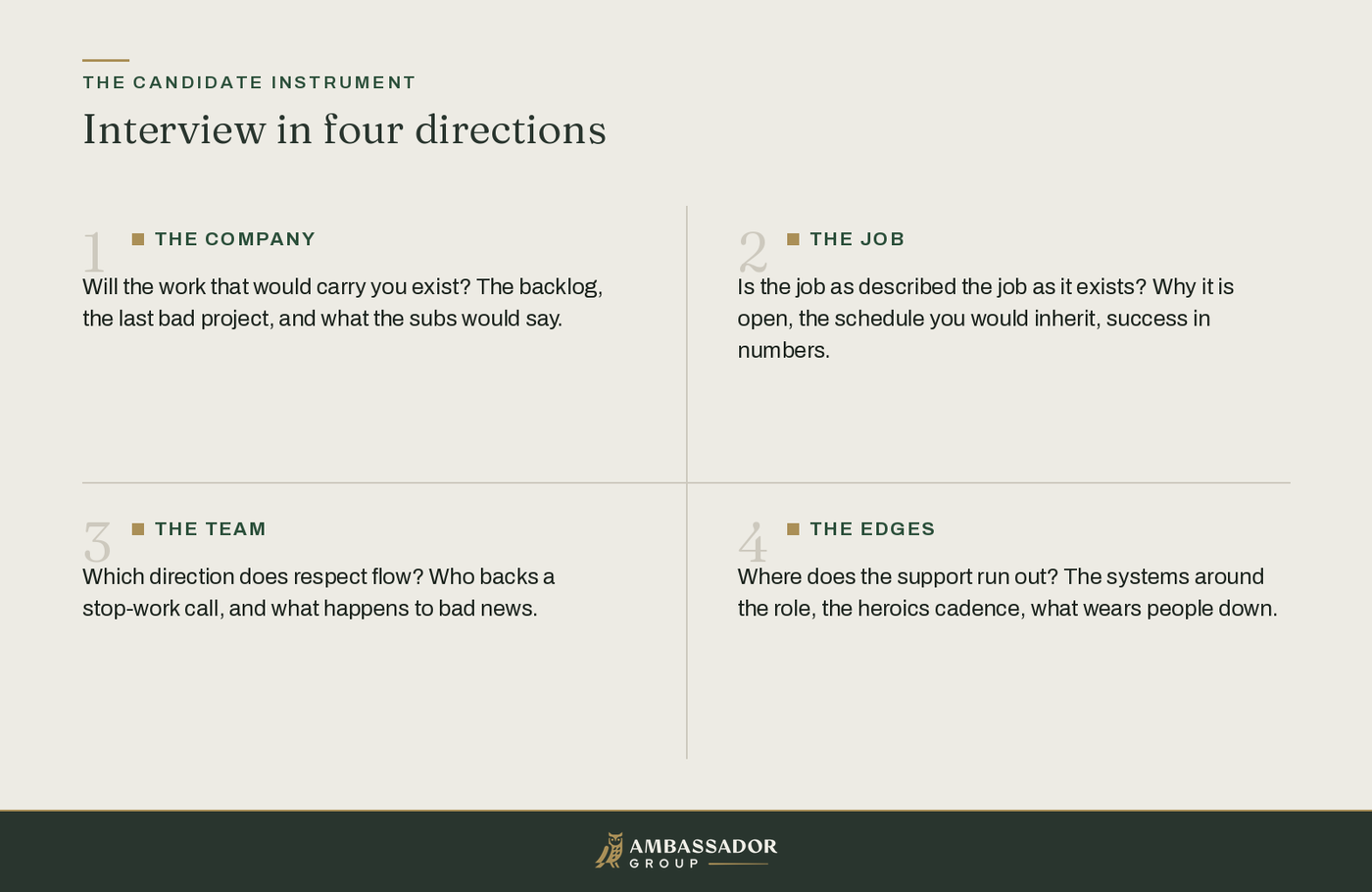
Your own questions run in 4 directions: the company, the job, the team, and the edges of the role. Take them in that order. Each question below comes with what to listen for, what an evasive answer sounds like next to a straight one, where to push, and what to ask to see. A handful of questions you know how to read is worth more than 40 that fill the silence.
Interview the company
Precon lives downstream of how the company wins work, and the company's honesty when a budget breaks decides what your name gets attached to.
"What is your mix of negotiated work versus hard bid, and which way is it moving?"
- What you are listening for: what the company is hiring precon to be. In a negotiated book, precon is the reason owners chose the builder. In a hard-bid book, precon is a pricing engine and margin gets won in buyout. The trend line tells you which of those jobs you are walking into.
- Evasive tell vs. straight tell: the evasive answer is "we do it all." The straight answer names the split, why it sits there, and what the direction asks of precon.
- Follow-the-thread: ask how the last 3 jobs were won, and what happens when a negotiated owner takes the GMP shopping anyway.
- Evidence ask: the current backlog by delivery method, and how much of it is signed versus pursued. You are asking for the shape; the dollars stay theirs.
- Red flag: a company that calls itself negotiated but wins by having the low number. That is hard bid wearing a relationship costume, and precon carries the gap.
"How much of your work comes from owners precon has served before?"
- What you are listening for: whether precon creates the next job. Owners return because someone told them the truth early and held a number they could plan against. If that is happening, the company can name it.
- Evasive tell vs. straight tell: the evasive answer is loyal-client language with no ledger. The straight answer names owners on their 2nd and 3rd project and what precon did to earn the return.
- Follow-the-thread: ask which owner did not come back, and why. Ask whether any owner has requested a precon person by name; reputation surfaces where it cannot be staged.
- Evidence ask: the project list with repeat owners visible. Companies publish half of this in their marketing already; the honest version has the sequels marked.
- Red flag: a backlog of all new logos at a company old enough to have sequels. Owners who do not return are a verdict on how precon's promises age.
"Tell me about the last time a budget broke early in design. When did the owner find out?"
- What you are listening for: honesty under bad news, measured in lag. Budgets break early on every builder's list. The company's character is the distance between the day the drift showed and the day the owner heard.
- Evasive tell vs. straight tell: the evasive answer dissolves the moment into process: "we manage that through the VE process." The straight answer names a job, the milestone where the number moved, and what the owner chose to do with the truth.
- Follow-the-thread: ask who delivered the news and what it cost them. Then ask whether the company has ever carried a known overage quietly into a GMP, hoping to buy it back later.
- Evidence ask: a conversation with an owner who lived through one of those budget conversations and hired the company again. Companies reference-check you; reference-check them where their honesty was tested.
- Red flag: a company proud that its budgets never break. Either the numbers are padded until the company cannot win work, or the breaks are carried silently into buyout, where you will meet them.
Interview the job
The title says preconstruction manager. The job is defined by where the number's ownership begins and ends, and every company draws those lines differently. Your work here is to find the lines before you are standing inside them.
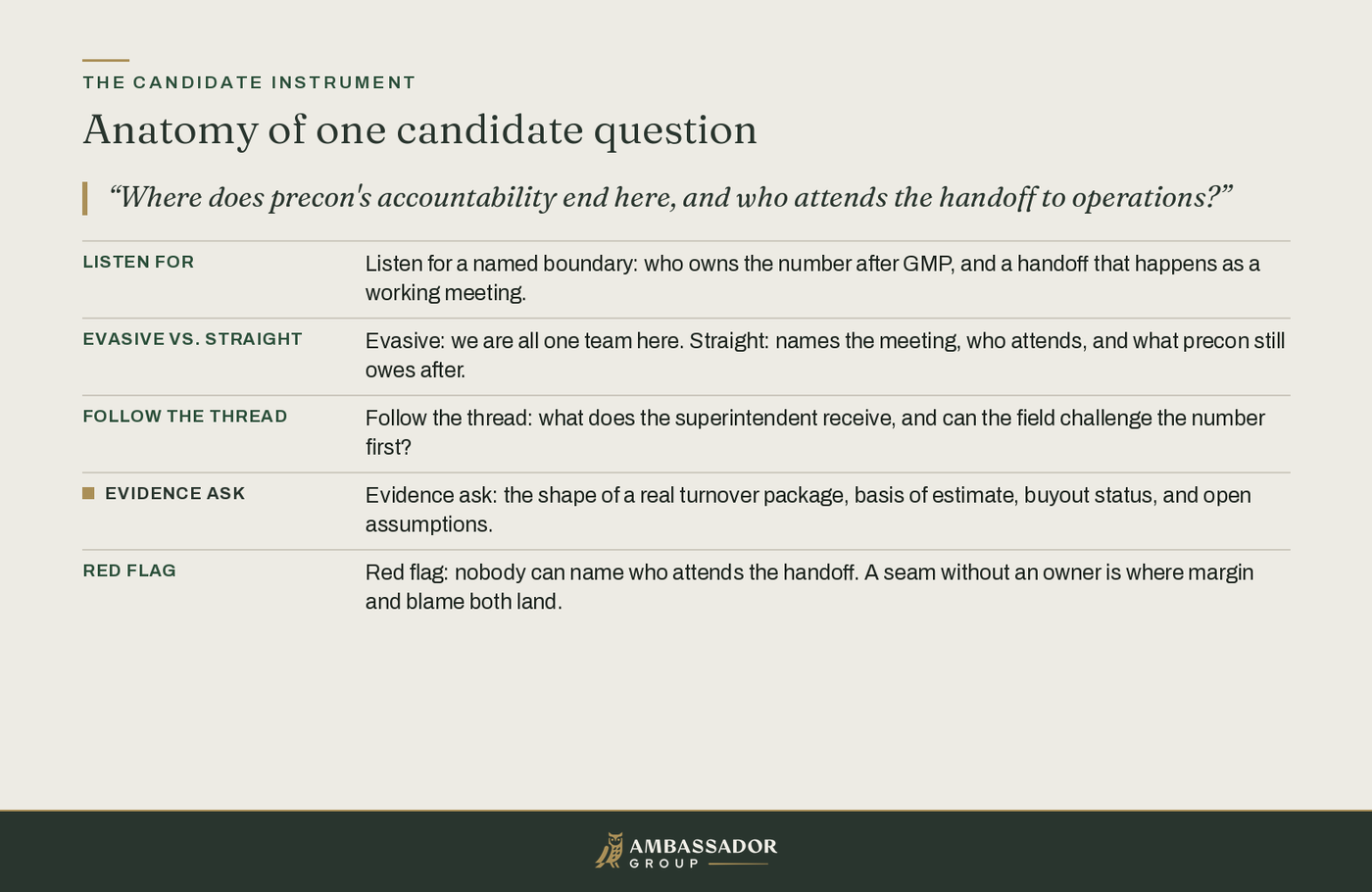
"Where does precon's accountability end here, and who attends the handoff to operations?"
- What you are listening for: a boundary the company can locate on purpose. Somewhere between GMP signing and closeout, ownership of the number transfers, and a company that has decided where says it plainly: through buyout, to the first reconciliation, or to GMP with a documented turnover. Who attends the handoff tells you whether the transfer is a working meeting or a folder drop.
- Evasive tell vs. straight tell: the evasive answer is "we are all one team here," which means the boundary will be drawn later, after a loss, by whoever tells the story best. The straight answer names the meeting, who sits in it, what changes hands, and what precon still owes afterward.
- Follow-the-thread: ask what the superintendent receives and whether the field can challenge the number before owning it. Ask what precon's involvement looks like in month 2 of buyout.
- Evidence ask: how the handoff is documented: the basis-of-estimate narrative, the buyout status, the open assumptions the field inherits, with the dollars removed. A company with a real seam has a real document.
- Red flag: nobody in the process can name who attends. A seam without an owner is where margin and blame both go to live.
"Walk me through how a number moves from concept to GMP here. What does the reconciliation cadence look like?"
- What you are listening for: whether the company runs one continuous number or a series of unrelated estimates. The discipline sounds like a reconciliation at each design stage showing the owner what moved, why, and what got decided. That cadence keeps a concept number credible at GMP, which is the entire role.
- Evasive tell vs. straight tell: the evasive answer is a software list, as if tools were a method. The straight answer walks the milestones on a recent project, including the one where the news was bad.
- Follow-the-thread: ask who runs the reconciliation meeting and whether the owner sits in it. Ask about the last milestone estimate that came in over: did the design change, the budget change, or the gap get parked in an allowance?
- Evidence ask: the reconciliation format from a recent project, dollars removed. A company that reconciles has a document it is proud of.
- Red flag: "we estimate at each milestone" with no story of a number moving. Every fresh estimate is a fresh chance for the last one to become your fault.
"What would a good first year look like in this role, in terms you could measure?"
- What you are listening for: expectations in a form you can hit: budgets holding inside a stated band through GMP, buyout landing against the estimate, a healthy hit rate. A company that can state the target is a company you can succeed at.
- Evasive tell vs. straight tell: the evasive answer is chemistry language: "we will know it when we see it." The straight answer sounds like a scorecard, because somewhere behind it there is one.
- Follow-the-thread: ask which failure gets a precon leader in trouble here: losing pursuits, or winning ones the company should have declined. That answer is the company's true risk appetite.
- Evidence ask: the measures on paper. If a review format exists, ask its categories; if not, ask them to name the 3 numbers they would check at month 12.
- Red flag: you cannot get a definition of success from anyone in the process. Undefined expectations do not stay undefined. They resolve, later, in someone else's favor.
Interview the team
Precon leaders rarely leave over estimating. They leave over the seams: an architect who hears every cost signal as criticism, an operations group that treats the estimate as a rumor, a principal who trims the number to win and leaves the gap for someone else to explain. The team is the job.
"Who owns the architect relationship here, and what happens when design outruns the budget?"
- What you are listening for: whether precon has standing with the design team or negotiates through intermediaries. Design outruns budget on most projects. The question is machinery: cost feedback the architect sees early enough to change the drawings, or a collision at DD that everyone pretends is a surprise.
- Evasive tell vs. straight tell: the evasive answer is "we have great design partners." The straight answer names who calls the architect when SD pricing comes in hot and tells a story where the drawings changed because precon spoke early.
- Follow-the-thread: ask whether precon sits in design meetings or receives sets afterward. Ask what happens when precon and the architect disagree about what the owner can afford.
- Evidence ask: which design firms the company has worked with on 3 or more projects. Repeat architects return to builders whose cost feedback made them look good.
- Red flag: an interviewer who describes architects as the enemy of the budget. If precon is the design team's adversary, you will spend your tenure pricing drawings you never influenced.
"Would the operations team say precon hands them buildable jobs?"
- What you are listening for: the seam's reputation from the side that inherits it. Operations experiences precon's true quality: allowances sized honestly, scopes bought or flagged, schedule assumptions that were real.
- Evasive tell vs. straight tell: the evasive answer is "the groups get along great here." The straight answer carries specifics: a PM who asks for a particular estimator's jobs, a turnover meeting operations takes seriously, a field complaint that got fixed.
- Follow-the-thread: ask what operations complains about most in what precon hands them; self-aware companies answer fast. Ask about the last handoff that went badly and what changed.
- Evidence ask: a conversation with the PM or superintendent who received the most recent handoff, without a chaperone. A confident company hands you a phone number. One that hesitates has a reason.
- Red flag: operations people in your interview loop joking that precon lives in a spreadsheet. Jokes in interviews are policy in month 6.
"When precon's number threatens to lose a pursuit, what happens?"
- What you are listening for: whether cost truth survives sales pressure. Somebody in every company sometimes wants the number smaller. Disciplined companies walk away, or hold the number and sell the certainty behind it. Undisciplined ones shave contingency, convert allowances to hope, and book the win.
- Evasive tell vs. straight tell: the evasive answer is "we bid to win, but we stay disciplined," which salutes both flags and serves neither. The straight answer names a pursuit lost on price without regret, or one where leadership pushed and precon's number stood.
- Follow-the-thread: ask when leadership last overrode a precon number and how the job performed. Ask who owned the gap when a trimmed number won.
- Evidence ask: the hit rate the company considers healthy, and whether they know their own. A company that wins most of what it prices is buying work.
- Red flag: "we do not lose jobs over price." Every disciplined builder loses jobs over price. A company that never does is winning with numbers somebody else has to build.
Find the edges of the role
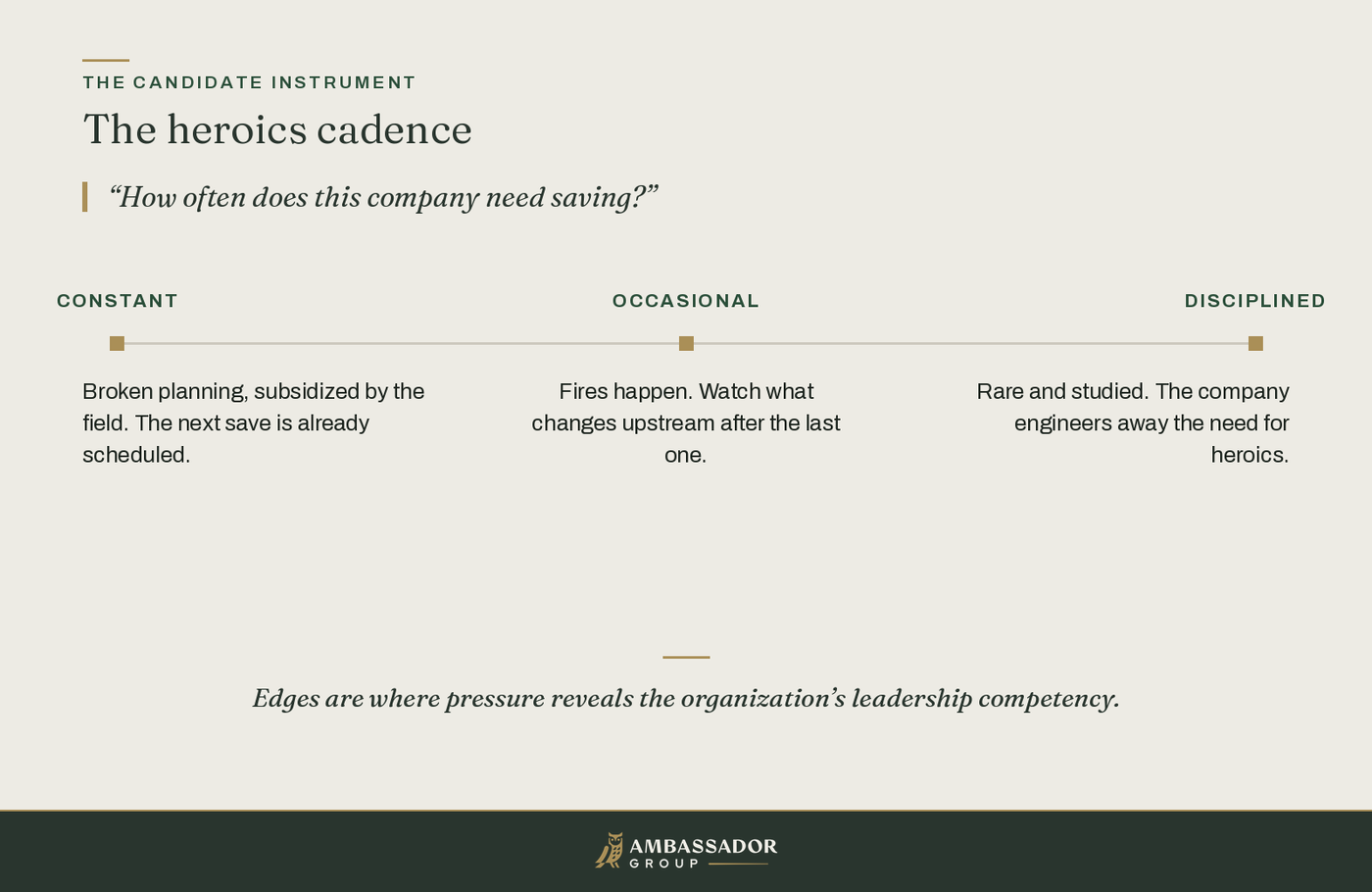
Every role has edges: the places where the job is hardest, where the support runs out, where the organization's promises meet its habits. Edges are where pressure reveals the organization's leadership competency. In precon the pressure arrives in pileups: pursuit deadlines stack, a GMP date moves up, design packages land late while the date holds still. Most candidates discover the edges in month 3. Ask now, while the finding costs you nothing.
"Walk me through who supports precon on a typical pursuit here."
- What you are listening for: whether the role comes with a bench or comes alone. Some companies put real structure around precon: estimators who own takeoffs, a precon engineer, proposal support. At others, the preconstruction manager is a department of one with a department's name.
- Evasive tell vs. straight tell: the evasive answer lists functions on an org chart. The straight answer describes who worked the last comparable pursuit, by role, and what the precon manager personally carried.
- Follow-the-thread: ask what happens when 3 deadlines land in the same month: who moves to help, what gets thinner, whether a pursuit ever gets declined. Ask what the company has invested in precon in the last 2 years. Investment is where priorities stop being talk.
- Evidence ask: the precon org chart with names on it, and which pursuits each person carried last quarter. The gap between the chart and the pursuit list is the gap you will personally fill.
- Red flag: pride that the precon manager "touches everything." A bottleneck is being recruited, and the compliment is the bait.
"Tell me about the last GMP that took all-nighters to land. How often does that happen?"
- What you are listening for: the heroics cadence. Some companies require heroics constantly, some occasionally, and some are disciplined about avoiding the situations that require them. Which is this company? Constant heroics means the pursuit calendar is written by optimism and paid for by your nights. You have finite heroics in you; spend them where they are the exception.
- Evasive tell vs. straight tell: the evasive tell is pride: deadline war stories told with a grin. The straight answer names the last real sprint, what it cost, and what changed upstream so it does not repeat: a go/no-go gate with teeth, an estimator added before the breaking point.
- Follow-the-thread: ask what the company declined lately because precon was at capacity. A company that can name one manages the cadence. One that never declines has made the pileup your work-life plan.
- Evidence ask: the pursuit load, in numbers: how many active pursuits per estimator the company considers normal, and how many the team is carrying now.
- Red flag: "deadline season is just how precon works" delivered as a recruiting pitch. The people scheduling the pileups do not spend their nights on them. You will.
"When buyout comes in over the estimate after handoff, how does this company decide whose miss it was?"
- What you are listening for: whether the seam has a referee or a memory contest. Buyout lands over on some job at every builder. The tell is whether the company can separate a precon miss (a scope gap, a stale unit cost, a thin qualification) from an operations re-price (different means and methods, a sub market that moved), and does it with a document instead of a story.
- Evasive tell vs. straight tell: the evasive answer is "we do not point fingers here," which means the fingers get pointed where you cannot see them. The straight answer describes a reconciliation against the basis of estimate and can name a miss that was precon's and one that was buyout's.
- Follow-the-thread: ask whether operations honors precon's buyout plan or re-prices the job on day 1. Routine re-pricing means the estimate is a sales document, and every gap gets named after you can no longer defend it. Ask what happened to the last precon leader whose number took a visible loss.
- Evidence ask: whether the basis of estimate survives into operations as a live reference or dies at GMP signing. If the answer is a document, the edge is managed. If it is a debate, the edge wins.
- Red flag: short precon tenure while operations tenure runs long. Blame flows toward the department with the turnover.
Write it down before the offer shapes it
An offer distorts judgment. The moment a number is on the table, everything you heard gets re-graded on a curve, and the edges you found start looking like quirks. You have watched owners do this to budgets. Underwrite the company before the offer arrives.
- Write your read the same day. After each conversation, write what you learned in the 4 directions: company, job, team, edges. Specifics, while they are fresh. By the third interview your memory will be a blur of good feelings and one anecdote, which is exactly how bad decisions get made on both sides of hiring.
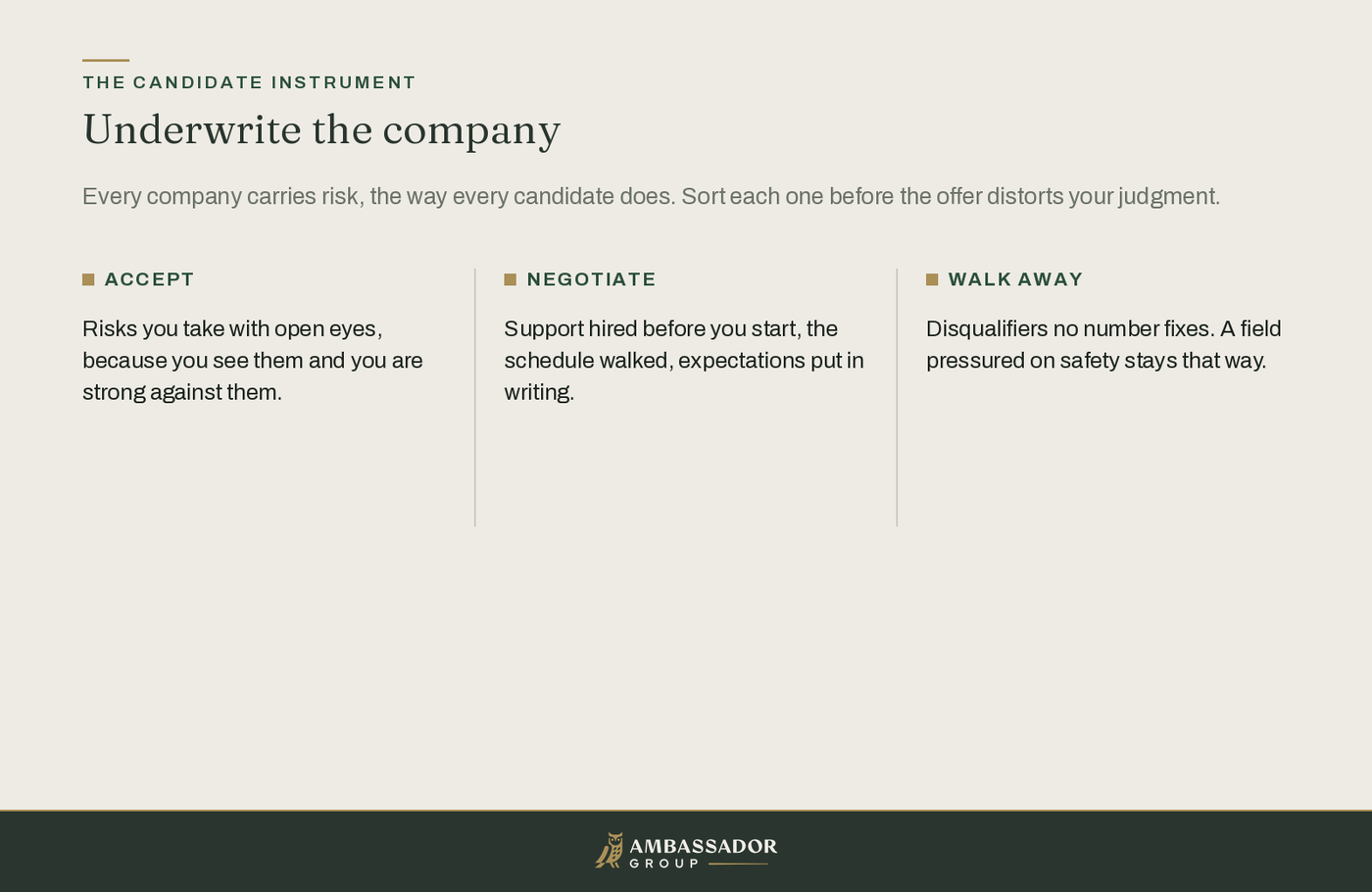
- Sort the risk: accept, negotiate, or walk. Every company carries risk. Some you accept with open eyes: a thin bench you know how to build. Some you negotiate: an estimator hired before the next pileup, the handoff boundary put in writing. And some are disqualifying at any salary, because a company that shaves contingency to win does not become a different company once your name is on the estimate.
- Name what you did not assess. If you never saw a reconciliation format, never met the operations side of the seam, never heard how a budget break reached an owner, write it down as a hole in your information, then go fill it. A company that refuses the extra conversation has answered a question too.
- Price the offer against the market, not against your current pay. A raise on an underpaid year is still underpaid. Know your market from data rather than folklore: the compensation benchmark exists for exactly this.
- Decide against your life, not against your current job. The question is whether this role clears the bar for the career you are building, not whether it beats the one you are escaping. Almost anything beats a job you already want to leave, which is why leaving is when people make their worst moves. The larger discipline of knowing that bar, your strengths, your direction, your worth, is a career's work, and Build to Last is a working manual for it.
The pre-offer checklist turns this into a worksheet you can run before you sign.
The other half of the decision
The company across the table is running an interview to decide whether you fit the job. Somebody has to run the interview that decides whether the job fits you, and nobody else in the process is going to do it. Ask plainly, follow the thread when an answer is thin, ask to see the artifact instead of settling for the story, and believe what the edges tell you. If your path runs through estimating, the Senior Estimator guide points this method at that role. If it runs toward operations leadership, the Project Executive guide does the same at a wider span.
You keep one number credible from concept to GMP for a living. Bring that discipline here: run the decision on evidence.
Ambassador Group represents construction leaders on both sides of the table and tells both sides the truth. If you want that kind of representation for your next move, send us your resume.
The short version.
- What questions should a preconstruction manager ask in a job interview?
- Ask in 4 directions: the company, the job, the team, and the edges of the role. Probe the negotiated versus hard-bid mix, how much work comes back from owners precon served, and how honestly the company handled its last broken budget. Then probe where precon's accountability ends, who attends the handoff to operations, and how a number gets reconciled from concept to GMP.
- Why should a preconstruction manager interview the company as hard as it interviews them?
- Because half the hiring decision belongs to the candidate, and that half decides whether the number you defend is defensible. A precon leader prices risk on incomplete information for a living, and the company across the table is exactly that. The company is pricing risk on you; price risk on them.
- What can a preconstruction manager candidate ask to see before accepting a job?
- Ask for the shape of the backlog by delivery method and how much of it is signed. Ask to walk the reconciliation format from a recent project with the dollars removed, and to see how the handoff to operations is documented. Ask for a conversation with the project manager who received the last handoff. Confident companies share the shape of these quickly.
- What are the edges of a preconstruction manager role, and why do they matter?
- Edges are where the job is hardest and the support runs out: who else prices work when 3 deadlines land in the same month, how often GMPs demand all-nighters, and whose miss it is when buyout comes in over the estimate. Edges are where pressure reveals the organization's leadership competency. Find them in the interview, while finding them costs you nothing.
- How should a preconstruction manager evaluate a job offer?
- Write down what you learned the same day, before the offer distorts it. Sort each company risk into accept, negotiate, or walk away. Price the offer against the market rather than your current pay, and decide against the life you are building, not the job you are escaping.


