
Most bad hires are decided before the first interview. The candidate walks in, the leader improvises, and everyone leaves with an impression instead of a judgment. Six months later the hire is failing and the story becomes "they interviewed well."
They did not. Nobody had defined what a good interview would reveal, so there was nothing to interview against.
A bad hire is a design failure. The candidate brings themselves. The leader brings the rubric, the interviewers, the questions, the sequence, and the standard for a decision. Almost every one of those is the leader's to set, and set before anyone shakes a hand. Leaders who cannot see their own process clearly cannot see a candidate clearly through it. The fix is not better candidates. It is a better process that a leader owns on purpose.
An interview process is a system you design, not a series of conversations you have. What follows is how to design one, in the order the decisions depend on each other.
You can run all of it by hand. None of it needs a week or an HR department, and if the paperwork is the part that stops you, our interview designer carries the same goals-and-risks register for you. The design decisions stay the same either way, and they stay yours. For one hire with two interviewers, the goals-and-risks work is an hour of thinking, the prep is a page each, and the reflection form is fifteen minutes after the interview. Weigh that against the wrong superintendent for eighteen months, and the discipline scales down to a two-person panel without losing its teeth.
Hold a hiring strategy meeting before anything else
Before you can hire the right person you need a process built to attract, screen, and select on purpose. That is what the hiring strategy meeting produces, and it happens before a single candidate conversation.
Who has to be there: the role's direct boss, without exception, plus the stakeholders and anyone with real insight into the work. What the meeting asks of them is detail. Honesty, transparency, and the willingness to answer comprehensively, because this role and this company are unusual even next to companies that build identical structures. It runs as short as twenty minutes for a client we know well and as long as two hours across two sittings for a new one. We do not rush it, because the clarity it produces is what makes the search fast later.
The meeting has three outputs.
An attraction strategy. Clarity about why the right person would want to join you. What business problem does this hire solve? Why is the role meaningful to where the company is going? What does success look like at six, twelve, and twenty-four months? Who will they report to, and how would that person describe their own management style? When you can tell the story of the opportunity, you stop posting a job and start inviting impact. The output is a hiring brief that sells the opportunity honestly while setting clear expectations for performance and culture.
A screening strategy. What to look for, so the search stops collecting noise. Which credentials and experience are genuinely non-negotiable? Which project types and company environments mirror yours closely enough to transfer? Which past hires succeeded or failed in this role, and why? How do you want trade-offs handled between raw experience, leadership maturity, and alignment with how you operate? The goal is a strong filter rather than a wide net. The output is a screening profile that governs sourcing language, outreach, and early assessment, so every person evaluating knows what qualified means here.
An interview strategy. How your team will test capability and alignment. Without structure, interviews become opinion polls. This is the part the rest of this piece builds out, and it is where experienced interviewing separates itself from confident interviewing.
Run all three and you leave with a documented process you can reuse and sharpen, which is worth more than any single hire it produces. It also happens to be a process that works in both directions, which the candidates you most want will notice.
Use the job description as your rubric
You cannot score an interview without an answer key. The job description is that answer key. Before it defines a role to a candidate, it defines a standard to your interviewers: here is what this role must produce, and here is what meeting that standard looks like.
Most job descriptions cannot do that work, because they list tasks rather than outcomes. "Manages subcontractors" is a task. It generates no test. What does managing subcontractors well produce twelve months in? Fewer schedule slips, cleaner buyout, subs who take your calls on the next project. Those are measurable. A description written around outcomes becomes an instrument your team can interview to. A vague one becomes the first thing you fix.
If the description says "strong leader" and you cannot turn that into a testable question, the description is not finished. That gap is not a nuisance to route around. It is the first mirror. A role you cannot describe precisely is a role you are not ready to interview for, and no amount of candidate quality rescues a search built on a vague target.
Turn the outcomes into goals, then name their inverses
Read the description and extract what this person must accomplish. Not what they will do; what they must produce. Those are your hiring goals, and they are the spine of everything downstream.
Write them as outcomes with a horizon. What does this hire own at day thirty, day sixty, day ninety, and at one year? "Runs the two-tower project to schedule and margin with only weekly oversight by month six" is a goal. It is concrete enough to interview against and concrete enough to hold the hire to later. Define these before the search begins, in writing, so the target does not drift to fit whichever candidate you happen to like.
Then do the move most leaders skip: name the risk attached to each goal. Every hiring goal has an inverse, and the inverse is what sinks the hire.
- "Leads the field crew without burning them out" carries the risk "cannot hold authority without friction."
- "Holds schedule when a major sub falls behind" carries "freezes or hides bad news instead of driving recovery."
- "Keeps the owner informed without being chased" carries "goes quiet exactly when the project is sliding."
The goal is what you want. The risk is what you are underwriting against. Hiring is underwriting, and this register is the ledger. Each interview exists to move one of these risks from unknown toward known.
Some risks a well-built interview retires outright. Others, like character, motivation, and the odds a strong hire leaves inside a year, it can only narrow. Those need references and time, not a sharper question.
That register is not disposable. The accepted risks become your onboarding targets. The goals become your performance criteria. You build it once to run the hire, and it keeps paying out through onboarding, training, and the first year of managing the person. Most leaders throw this thinking away at the offer. Keep it.
Assemble the team and give each person a lane
Picture a freeway with no lane dividers. Cars swerve, nobody gets anywhere safely. A panel with no defined responsibilities is the same mess: interviewers overlap, the questions that mattered never get asked, and the candidate leaves confused about who was assessing what.
An interview panel without assigned responsibilities is four people forming the same impression and calling the agreement confidence. If everyone assesses everything, nobody assesses anything well. The team is a design decision, and you make it by matching your risks to your people's strengths.
Take the goals-and-risks register and assign each risk to the interviewer best equipped to probe it. Your sharpest field operator carries the crew-leadership risks. Your estimator carries the numbers. You, as the hiring authority, carry ownership, judgment under pressure, and whether this job fits this person's real trajectory. Coverage without redundancy: every risk owned by someone, no risk owned by everyone.
These are hats, not headcount. If your bench is you and one other person, the two of you split the risks between you, and the logic does not change. If you want a running start on the division of labor, our Team Interview Strategy Designer is free to use.
Train anyone who has never been trained
Interviewing is a skill, not a personality trait, and treating it as a gut checkbox is how weak interviewers convince themselves they are strong ones. Handing a new interviewer a candidate and hoping is the same as handing someone blueprints and expecting a skyscraper. The quality of an assessment cannot exceed the skill of the assessor, so train the assessor before you put a hire in their hands.
Four things a first-time interviewer needs, none of which take long.
A defined goal. Is this a technical screen, an alignment conversation, or a decision-maker's interview? What should they walk out holding? Which questions are must-asks, tied to the description and the risks they own? Without that clarity they default to "tell me about yourself" and "what are your strengths and weaknesses," which tell you nothing.
A structure. One to two minutes to introduce themselves and set the tone. Five to ten on background. Ten to twenty on the structured questions they own. Five for the candidate's questions. One to wrap up and explain what happens next. The frame prevents awkward silence, tangents, and interviews that run off the rails.
Permission to dig. New interviewers take answers at face value. "Are you good at managing people" is a wasted question; "tell me about a time you had to address a performance issue on your team, and what the outcome was" is a real one. "Do you have experience with project scheduling" is wasted; "walk me through how you planned and tracked a schedule on a past project" is not. Then teach three follow-ups: can you give me an example, what was the result, what would you do differently. That is where surface answers break open.
A practice round. You would not let someone run heavy equipment cold. Have them shadow a good interviewer so they see what good looks like, run one mock interview with a teammate playing the candidate, and give them feedback before they go live. One round is enough to change the outcome.
Teach them to write down what the candidate said rather than how it felt, rate the competencies they own on a simple scale, and note specific strengths and concerns. Then debrief them after their first real interview: what went well, what was hard, did they get what they needed, would they recommend hiring this person and why. That conversation is what turns one interview into a skill.
Choose interview types that fit the risks
Different risks need different instruments. A behavioral question shows you how someone acted before. A scenario shows you how they think when the ground shifts. A working session shows you whether the resume matches the hands. A reference conversation gets at what the last three bosses will not put in writing.
You choose types by asking what each risk requires in order to be tested, not by defaulting to "we'll do two rounds and see how it feels." Map the interview types available to you against your register. A risk about technical judgment wants a scenario or a live problem, not a chat about strengths and weaknesses. A risk about how someone handles authority wants a structured behavioral dig into a real conflict, with follow-ups that go past the rehearsed answer.
When the type matches the risk, the interview earns its place in the sequence. When it does not, you are collecting impressions and calling them data.
Then place your people into the interviews and write down what each one is responsible for surfacing. A superintendent hire might run a phone screen you own for basic alignment, then a scenario interview your senior super runs for field judgment, then a panel where your PM probes cross-trade coordination while you probe ownership and motivation, then reference calls run against whichever risks are still open. Each block has an owner, a target set of risks, and a clean handoff. The candidate experiences one coherent process. Your team experiences a division of labor. You experience a hire you can reconstruct afterward, because you know who was testing what.
Build a scenario for the risks a question cannot reach
Every superintendent you interview this year has already answered your best question. "Tell me about a time you handled a conflict with a sub" has been put to them a dozen times, and the story you get is the one that worked the last eleven. That answer measures how well they interview.
Every candidate arrives with a prepared surface: polished stories, safe opinions, a resume they can narrate in their sleep. Standard interviews never leave that surface, because predictable questions produce prefabricated answers, and prefabricated answers track interview skill rather than job skill.
So put them somewhere they cannot touch bottom. A situation they could not have rehearsed, with a clock running, and the prepared surface gives out. You see the defaults underneath: how they triage, what they say when they do not know, whether they own a problem or talk around it. You cannot get there by asking harder questions, because a hypothetical still returns a hypothetical, which is why real problems beat experience assumptions. You get there by building a world and putting the candidate in it.
Here is the shape of one we use for superintendent hires, adapted per client and project.
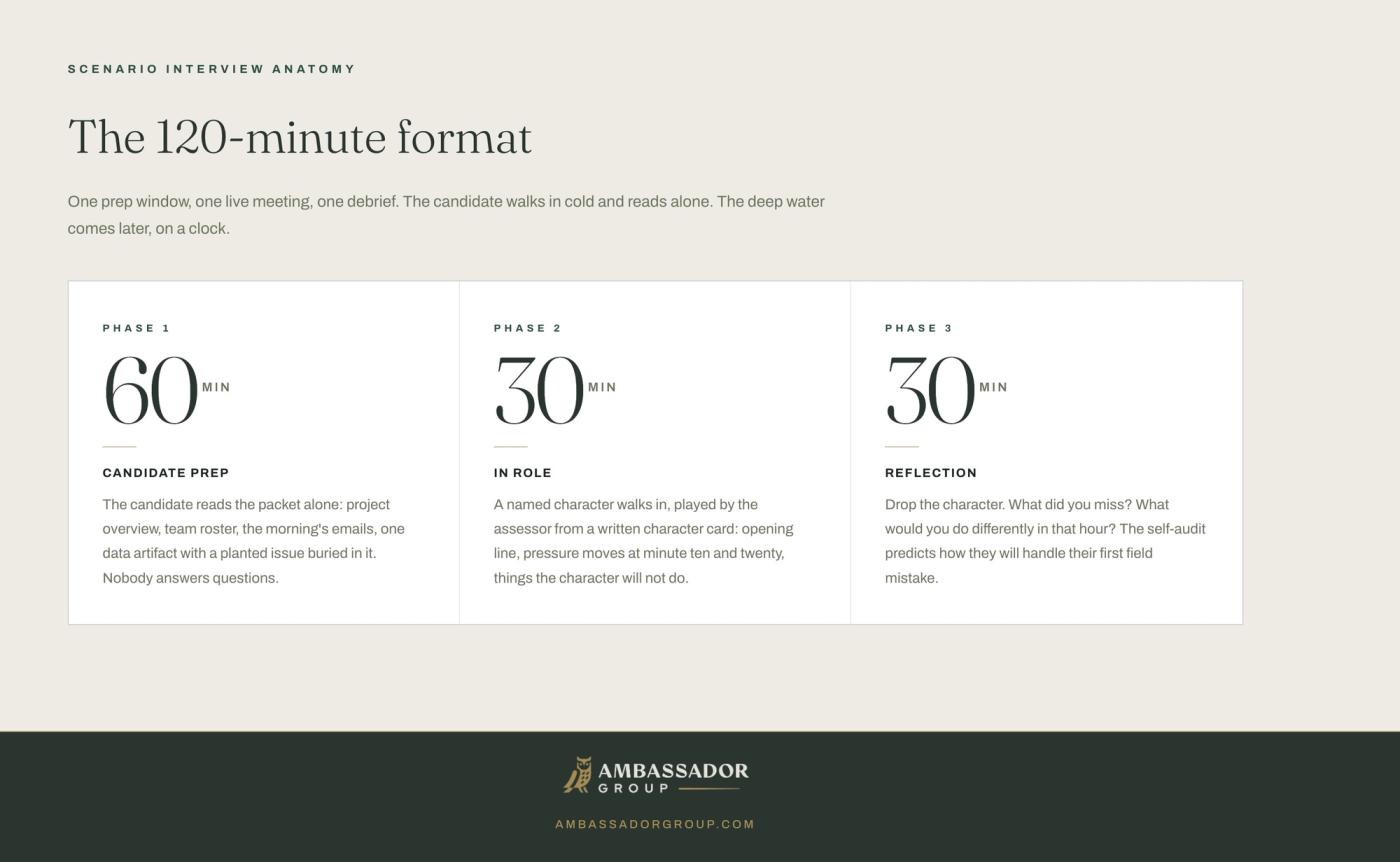
The candidate arrives and receives a packet. They are three days into the job as superintendent on a mid-rise, taking over from a super who left abruptly. The packet holds the project overview, a team roster, a status table, the morning's emails, and an RFI log. They get sixty minutes alone with it. At the sixty-minute mark a steel foreman with thirty years in the trade walks in for a meeting the candidate knows is coming. Tomorrow there is a crane pick.
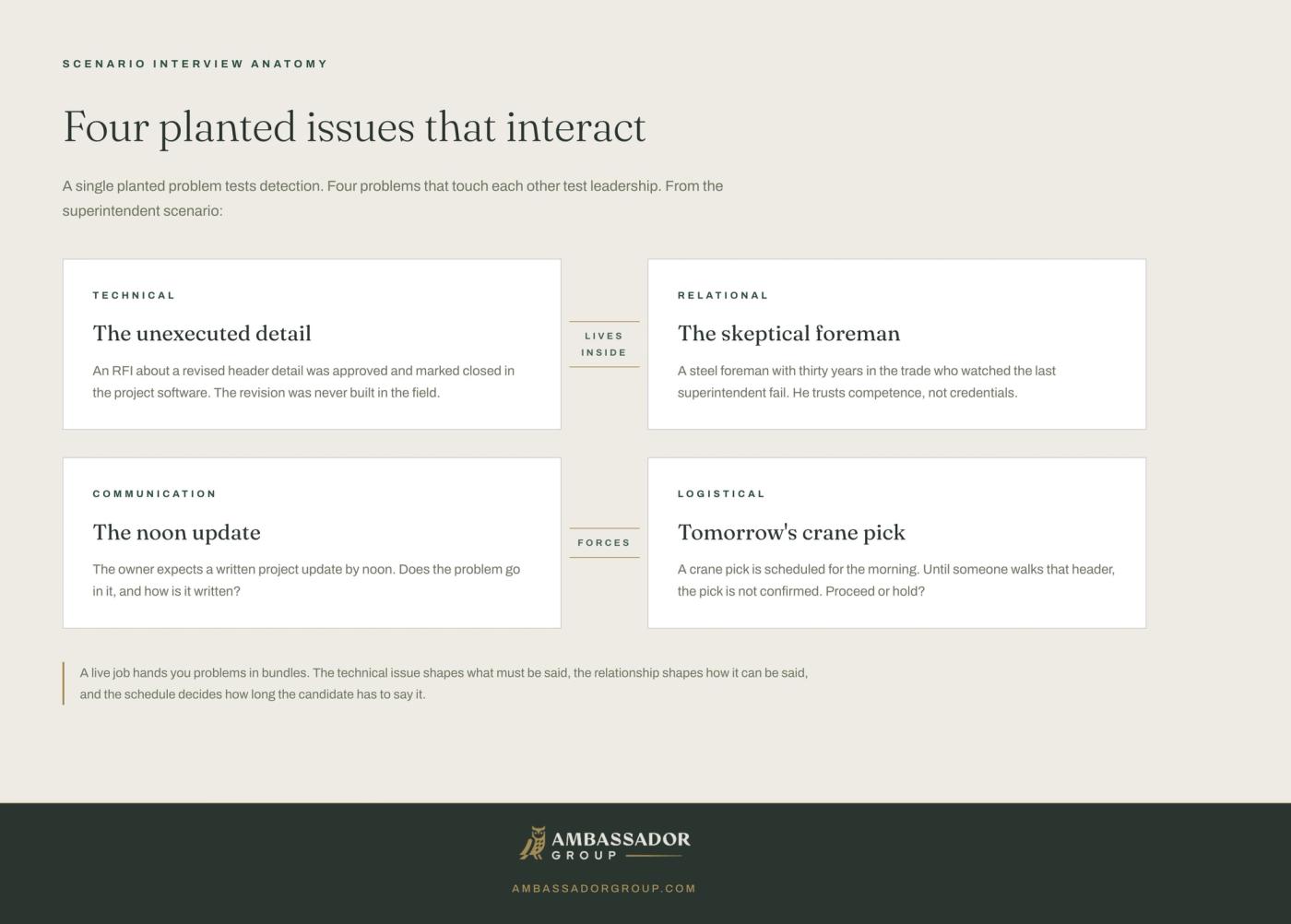
Buried in the materials is a problem. An RFI about a revised header detail was approved by the architect and marked closed in the project software, and the revision was never executed in the field. The paperwork says one thing and the building says another. A careful reader can triangulate it from the RFI log and one line in an email. Nobody announces it.
Now watch what happens. One candidate walks in and works the foreman with war stories. Another hedges every answer toward "I would check with the PM." A third says, in so many words: the log shows this closed three weeks ago, but closed in the software is not the same as executed in the field, and until someone walks that header, tomorrow's pick is not confirmed. Same packet, same hour, three different superintendents. No behavioral question would have separated them.
That hour is engineered, and the engineering follows five principles any hiring leader can apply.
Put them early in the job, not outside it
Day two to day ten of employment is the honest setting: the candidate has ownership but not knowledge. That is the exact position leaders get tested in on live jobs, and it removes the escape hatch of "I would need more context." Limited context is the test.
Give the morning a forcing function
A specific meeting with a specific person at a specific time. A bid due in forty-eight hours. A ten o'clock owner call. Open-ended scenarios produce open-ended musing. A clock produces decisions, and decisions are what you came to see.
Plant issues that interact
A single planted problem tests detection. Four problems that touch each other test leadership. Above, the technical issue lives inside a relational one, a skeptical foreman who watched the last super fail, which shapes a communication problem, an owner expecting a written update by noon, which forces a logistical call about whether tomorrow's pick proceeds. A live job hands you problems in bundles. Your assessment should too.
Play a person, not a panel
The candidate should meet a character with wants, history, and a temperament, played by an assessor working from a written character card: opening line, pressure moves at minute ten and minute twenty, things the character will not do. A skeptical foreman who lets silences sit teaches you more in five minutes than a conference table of smiling interviewers learns in an hour.
Make missing it informative too
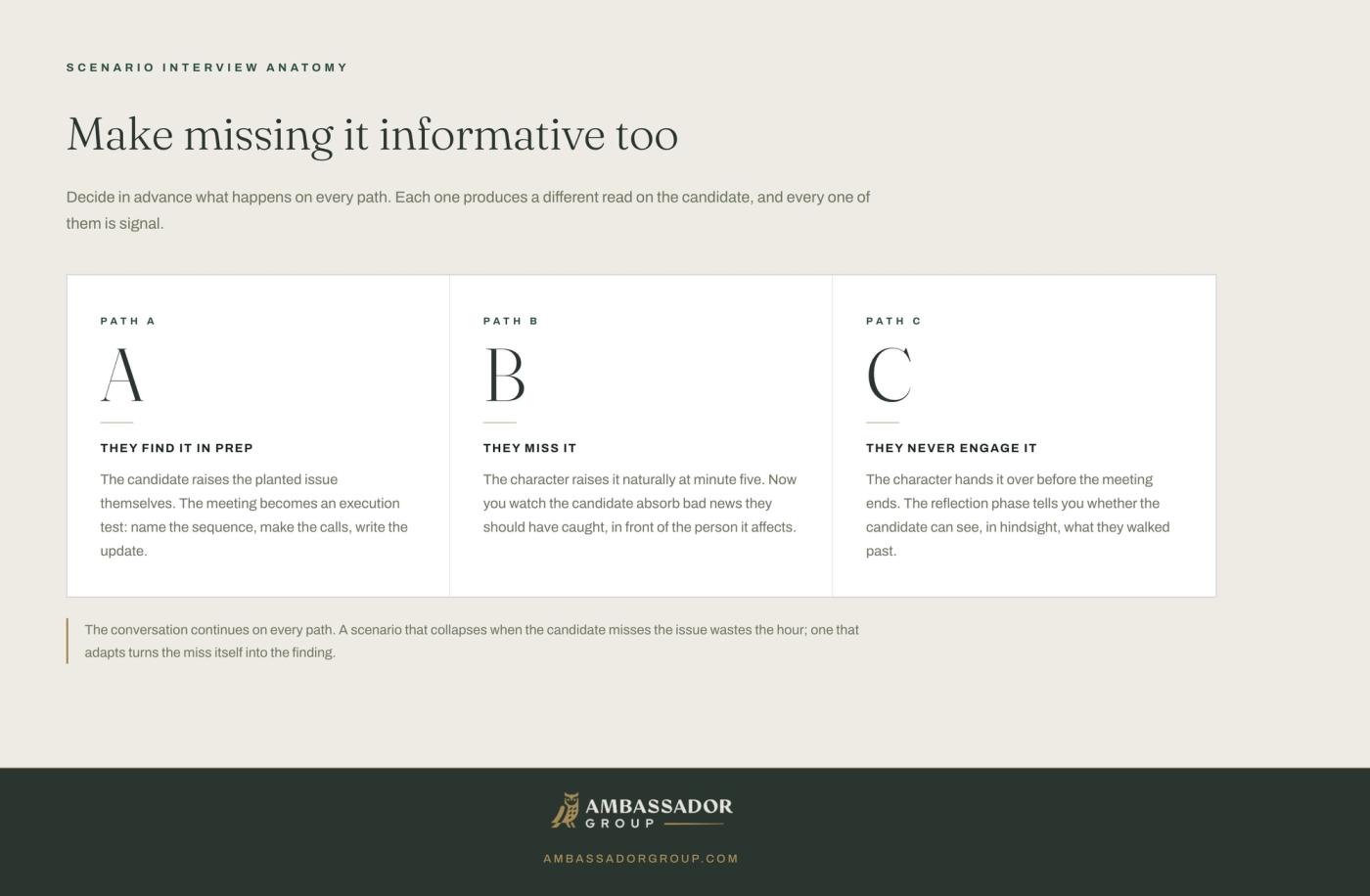
Decide in advance what happens on every path. If the candidate finds the issue in prep, the meeting becomes an execution test. If they miss it, the character raises it naturally at minute five, and now you watch them absorb bad news they should have caught. Either way you learn something true, and either way the conversation continues instead of collapsing.
Surfacing the planted issue is the midpoint. The deepest water is the follow-up sequence that runs past the candidate's last prepared thought. What do you do in the next thirty minutes? Who do you call first, and what do you say? The owner needs a written update by noon; does this go in it, and how do you write it? If the mistake happened three weeks ago on someone else's watch, why does the fault matter less than the fix?
Each question forces a commitment. Strong candidates name a sequence out loud and defend it. Weak candidates fill silence, hedge in probabilities, or reach for whose fault it was. You are no longer evaluating an answer. You are watching someone run a job.
Then close with reflection, because reflection shows you what a candidate does with their own mistakes minutes after making them. Drop the character and ask what they missed, what they would do differently in that hour, where they felt themselves reaching. A candidate who can audit their own performance will audit it on your project too. A candidate who reports a flawless hour has told you how they will handle their first field mistake. If you want a longer list of questions for that part of the conversation, we keep forty post-interview reflection questions for exactly this.
You do not need software or a consultant to start. Pick a project you know intimately, ideally one with a problem you lived through. Write the packet a candidate would read cold: the situation, the roster, the morning's emails, one data artifact with the issue buried in it. Write the character card and the follow-up questions before anyone interviews, and decide what strong and weak look like for each competency in advance, so you are grading against a standard rather than a mood. Then run it: sixty minutes of prep, thirty in role, thirty in reflection.
Tell candidates the format in advance. There is no trick here. The strongest candidates prefer showing their work to selling it, and a scenario respects them more than a pop quiz ever will. Write it once and run every finalist through the same hour, because identical water is what makes the comparison honest.
Two hours is a serious investment. So is a mis-hire who interviewed beautifully.
Write a prep for each interviewer
An interviewer who walks in cold improvises, and improvisation is where bias fills the vacuum. The prep is the fix, and it is short. Here is the risk you own. Here are the questions that test it. Here is what a strong answer looks like and what a weak one looks like. Here is the evidence to ask for.
Individualized prep is what separates a panel that compounds insight from one that repeats it. When each interviewer knows their lane and comes armed for it, the interviews stack instead of overlap. This is the practice behind equipping each interviewer for the specific role they play. Write the prep the day before, not in the hallway five minutes prior.
The prep is also an accountability instrument. A named interviewer, assigned a named risk, handed the questions that test it, has been put on the record. Being assigned the risk changes how carefully they run the conversation.
Record the interview, because memory is not one
Your hiring process produces the appearance of rigor. Multiple interviews, structured debriefs, written assessments, a decision made by committee. What it does not reliably produce is accuracy, and accuracy is the only part that matters.
The gap comes from one habit: nobody keeps the interview. The richest behavioral data you will ever collect on a candidate is thrown away within hours of collecting it.
Most interviewers believe they remember what happened. They do not, not accurately and not for long. Hermann Ebbinghaus established the forgetting curve more than a century ago: within an hour of learning something new, people lose roughly half of it. Within twenty-four hours, about seventy percent. Within a week, nearly ninety. Elizabeth Loftus spent decades showing that memory does not retrieve stored information the way a computer retrieves a file. It reassembles fragments, fills the gaps with inference and expectation, and hands you the result with total confidence regardless of accuracy.
So the interviewer writing feedback three hours later is not documenting what the candidate said. They are documenting a story their brain has already started editing. Details that confirmed the first impression get sharper. Details that complicated it quietly disappear. A candidate who opened strong gets a halo over everything after; one who stumbled early gets evaluated through a lens that makes the rest look worse.
Four failures follow from that, and they are structural rather than personal.
Debriefs become opinion collisions. Interviewers are not synthesizing shared data. Each is arguing from a partial, degraded recollection of a different slice of the candidate. There is no ground truth on the table, so the loudest voice wins and the most senior person anchors the group.
Assessments are not earned. "I probed deeply on judgment under pressure and had real concerns" may describe one surface question, a vague answer, and a pivot. Nothing checks it. The assessment stands, the candidate is rejected, and the organization never learns it passed on someone strong.
Loops have holes nobody can see. In a sequential process, no interviewer knows what the others covered. Whole competency areas go uninvestigated by accident. Six months later the hire fails in exactly the dimension nobody examined, and the postmortem blames the candidate.
Your worst interviewers are invisible. Your least effective interviewers generate the same volume of signal as your best, and it enters the decision at equal weight. There is no calibration and no correction, so an interviewer who asks leading questions asks them more fluently every year.
Now hold that against how construction handles every other consequential decision. A GC bidding a fifty-million-dollar project does not rely on the estimator's memory of the walkthrough; there are marked-up drawings, documented scope clarifications, written exclusions, recorded RFIs. A PM does not ask an owner to trust the team's recollection of a preconstruction meeting; there are minutes, action items, submittal logs, decision records. A safety officer does not reconstruct an incident from impression. A construction professional who ran a project from memory and documented nothing would be considered a liability, not an experienced hand.
A hiring decision for a mid-level leadership role touches several hundred thousand dollars in first-year compensation, onboarding, ramp, and opportunity cost, before you count the projects they will touch and the owner relationships they will keep or damage. The data behind that decision is collected in a few hours of conversation and then discarded. No other domain in construction would accept it.
The fix is unglamorous: record and transcribe the interviews. Transcription tools make it operationally trivial, and what it changes is not paperwork but capability. Assessors review the transcript before writing, so feedback is grounded in what was said. A claim can be checked against the record, which disciplines the claims. Transcripts across a full loop reveal patterns no single interviewer could see, including the contradictions. You can map what was investigated against what you planned to investigate and fix coverage gaps before the decision rather than six months into someone's tenure. Later interviewers get a real summary of what is already covered and what remains open, so the loop becomes a coordinated investigation instead of a series of independent auditions. And when a hire turns out exceptionally well or badly, you can go back to what the interview showed, what it predicted, and what it missed. That is how a company builds real knowledge of what strong leadership looks like in its own roles rather than folklore passed between hiring managers.
Do it legally or do not do it
Recording is legitimate and increasingly common. It has to be implemented correctly.
- Consent is required and must be documented. Depending on jurisdiction you may need one-party or all-party consent, and in many states recording without the candidate's explicit knowledge is illegal. Disclose in writing before the conversation begins: that the session will be recorded, how the recording will be used, who has access, how long it is retained. Get the acknowledgment.
- Apply it consistently. Record every interview for a role or none of them. Recording some candidates and not others creates the appearance, and potentially the legal reality, of differential treatment.
- Store it securely. Recordings and transcripts are employment records. Limit access to documented legitimate need. The EEOC recommends retaining employment records at least one year from the date of the decision, and some states require longer.
- Transcripts are discoverable, which cuts both ways. In a discrimination claim they may be subject to discovery. Consistent, professionally conducted records put you in a far stronger position than sparse subjective notes.
- A recording does not protect you from a bad question. It makes impermissible questions about age, family status, national origin, religion, or disability more visible. Treat that as a reason to sharpen interviewer training alongside recording, not a reason to skip recording.
Collect written feedback before anyone talks
One rule here matters more than the rest. Every interviewer submits written feedback on a structured reflection form before the group debriefs. Written first, discussion second. Reverse the order and the most senior or most confident voice sets the anchor, and every other honest read bends toward it. You will call that agreement consensus. It is groupthink.
The form is not a comment box. It maps to the register: for each risk you owned, what did you see, what is your read, how confident are you, and what evidence supports it. A disciplined feedback system forces an evidence-backed judgment instead of a gut vote, and it makes each interviewer's assessment inspectable later against how the hire performed.
Require the form before the debrief and you get independent signals. Skip it and you get one signal, amplified.
Review the evidence risk by risk
You now have something most hiring processes never produce: a body of structured evidence tied to a defined set of risks. Analyze it as a system.
Walk the register risk by risk. Which risks did the process retire, meaning you have real evidence they are low? Which are still open? Where did two interviewers see the same person differently, and what does that disagreement tell you?
The goal is not a score that hides the reasoning. It is a clear read on which risks remain and whether you are willing to fill this role while carrying them, engineer around them, or walk away. A risk you accept knowingly becomes a day-one onboarding priority.
A column of risks you never assessed is a diagnosis of your process rather than the candidate. It means your interviews had gaps, and you fix the design before the next search. That is also the difference between diagnosing a bad hire and explaining one.
The process is the leadership work
Every step here happens before the decision, and every step is yours. The rubric, the goals, the risks, the team, the types, the seating, the prep, the record, the written feedback, the analysis. None of it is the candidate's to supply and none of it is HR's to own. It is the design of a decision you will live with for years, and it is the clearest place a leader's judgment either shows up or does not.
Run it once with this discipline and the interview stops feeling like a gamble you brace for. It becomes a system you trust, and the calm that produces is not a soft benefit. It is what owning an outcome feels like, as opposed to hoping for one.
Hiring feels random when the process does not generate the data that would make it less so. The randomness was never inherent to the work.
You already know a bad hire was never about the candidate. What is still open is whether you design the process that proves it.
The short version.
- What should you decide before the first interview?
- The rubric, the hiring goals, the risk attached to each goal, who interviews for what, which interview type tests which risk, and the standard for a decision. All of it is the leader's to set, and setting it after the candidate arrives is how improvisation fills the gap.
- How do you turn a job description into interview questions?
- Rewrite the description around outcomes rather than tasks. "Manages subcontractors" generates no test. "Runs the two-tower project to schedule and margin with only weekly oversight by month six" is concrete enough to interview against and concrete enough to hold the hire to later.
- What is a hiring risk?
- The inverse of a hiring goal. The goal "leads the field crew without burning them out" carries the risk "cannot hold authority without friction." The goal is what you want; the risk is what you are underwriting against, and each interview exists to move one risk from unknown toward known.
- Why does written feedback have to come before the debrief?
- Whoever speaks first sets the anchor, and every other read bends toward it. Written first, discussion second, gives you independent signals instead of one signal amplified by seniority.
- What is a scenario interview?
- An engineered situation the candidate could not have rehearsed, run with a clock and a character, so you watch them think instead of recite. The format runs about sixty minutes of prep, thirty in role, and thirty in reflection.
- Should you tell candidates the interview format in advance?
- Yes. There is no trick in a scenario interview, and the strongest candidates prefer showing their work to selling it. Run every finalist through the same hour, because identical water is what makes the comparison honest.
- Is it legal to record job interviews?
- Yes, when implemented correctly. Depending on jurisdiction you may need one-party or all-party consent, so disclose in writing before the conversation begins, covering how the recording will be used, who has access, and how long it is retained. Record all interviews for a role or none of them, and store recordings securely as employment records.
- How do I train someone for their first interview?
- Define what success looks like, give them a question list tied to the description and the risks they own, teach a simple time-boxed flow, show them how to probe past surface answers, and run at least one practice round before they go live.


