
Eight months in, the hire is not working. The schedule slips in ways you hear about late. The crew has quietly stopped bringing them problems. You have started rehearsing a conversation in the truck on the way home.
The explanation that arrives first is about the person. Wrong attitude. Not coachable. Not cut out for this work. That story has one great advantage, which is that it costs you nothing, and one disqualifying flaw, which is that it teaches you nothing. This hire was a decision you made, inside a process you built, into an environment you run. The useful question is never who this person turned out to be. It is which part of your system produced this result, because that part is still running and it is pointed at your next hire.
Every earlier step in this arc ended in a decision you got to make on your own timeline. This one arrives on its own schedule and asks whether you meant any of it. It is the last step, and it is the one that decides how much the previous eight were worth.
A failed hire is an output, not an accident
W. Edwards Deming put it in a sentence that should be uncomfortable to read: "Every system is perfectly designed to get the results it gets." If your company produces mis-hires at a steady rate, you do not have a run of bad luck. You have a process working exactly as built.
Akio Morita, who founded Sony, said something similar about his own role: when an employee turned out to be wrong for the job, he counted it his fault, because he made the decision to hire them. That posture is the only one from which anything improves, because the person is gone and the process is still yours.
This connects to a claim made in the first step of this arc: the outcome of a hire belongs to the leader who made it. A failed hire tests whether that was a sentiment or a working belief. The test is simple. Watch which direction your first explanation points.

Diagnose before you decide anything
When a slab cracks, you do not patch it and move on. You go upstream. Was the mix wrong? Was it poured too late in the day? Did somebody miss rebar spacing? Was there a handoff between field and office that never happened? You trace it because patching a symptom guarantees you will meet it again.
People problems deserve the same discipline and almost never get it. The person underperforms, the leader concludes the person is the problem, and the diagnosis ends at the first available answer. Then the next hire fails in the same place and nobody connects them.
So before you decide anything, run the diagnosis. Not to build a case for or against the person. To find out which part of the system moved.
Start factually. Write one sentence with no adjectives in it. "The project coordinator resigned six weeks into onboarding." Not "the coordinator we took a chance on flamed out." The first sentence can be investigated. The second one has already reached its verdict.
Work the six boxes, in order
The six boxes of performance give you the order to ask in, and the order is the whole value of the tool.

- Information. Did they know what success looked like, in specifics, not in spirit?
- Resources. Did they have the tools, access, and systems to do the work?
- Incentives. Was good performance rewarded, ignored, or quietly punished?
- Training. Were they taught this company, or handed a login and wished well?
- Capacity. Were they capable of the work as it exists here?
- Motivation. Did they want to?
Nearly every leader I talk to starts at box six. They did not care enough. They were not hungry. It is the most emotionally available answer and the least often correct one. Most failures trace back to the first three boxes, and the first three are the ones you control outright.
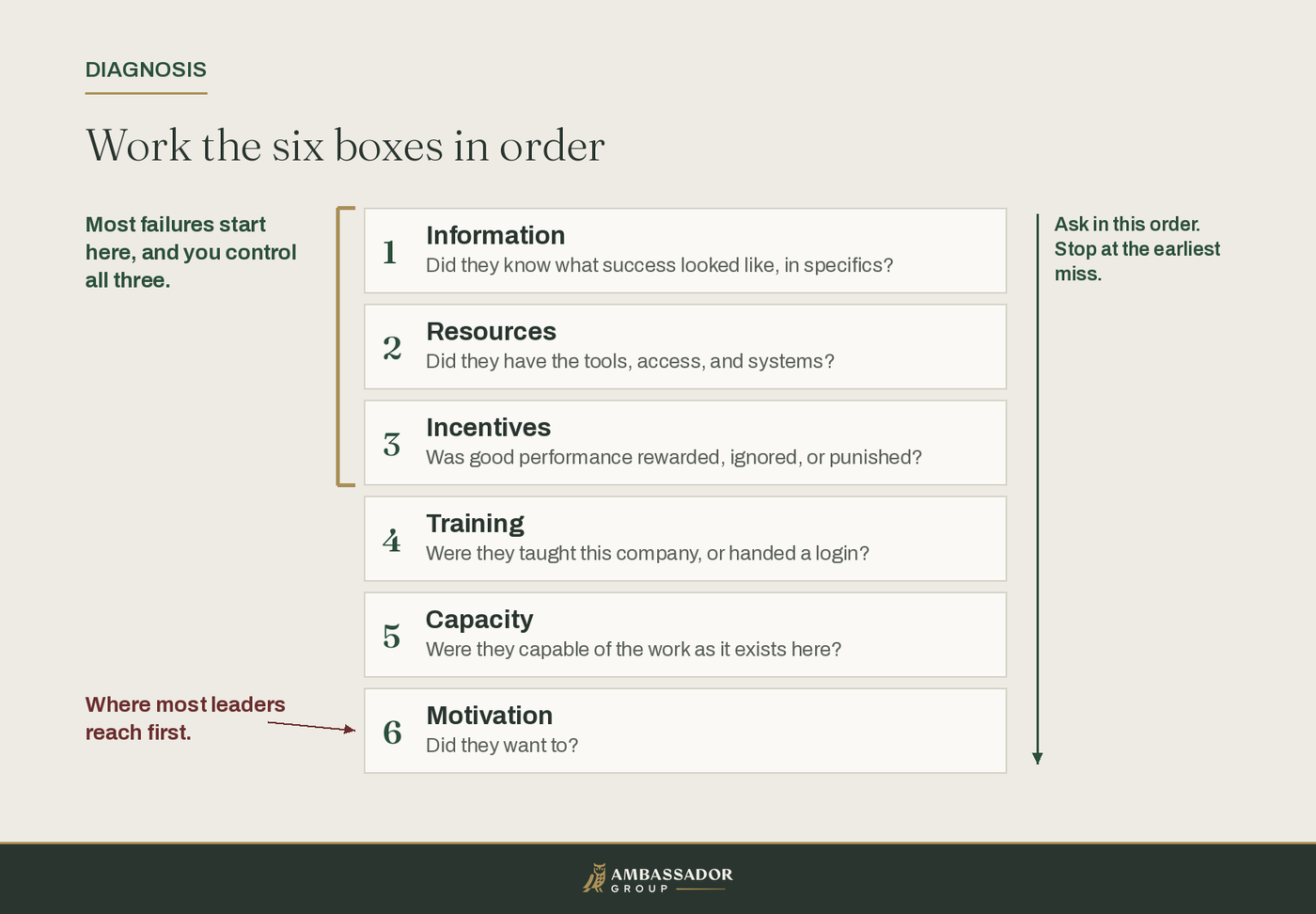
Work them in order and stop at the earliest miss. That is where the system failed. The day the person quit or the day you lost patience was the last symptom, not the cause.
Consider how that plays out. An assistant project manager leaves at ninety days. The available conclusion is that they were not cut out for construction. Run the boxes and a different picture appears: expectations were never written down, they had no access to the project folder structure for the first three weeks, they got no feedback until they were already behind, and their schedule never lined up with the superintendent's. That is not a people problem. That is an environment problem, and the next hire into that environment will fail in the same four places.
Will problem or way problem
There is one question that separates the two kinds of failure, and it is worth asking out loud in front of the people who interviewed this person: was this a will problem or a way problem?
A way problem means they could not. Something in the first five boxes was missing. A will problem means they would not, with everything in place. Both are real. They lead to completely different decisions, and confusing them is how good people get fired and how genuinely misaligned people get coached for another eleven months.
Humans are built to get this wrong in one specific direction. People over-assign failure to a person's character and under-assign it to their circumstances, so reliably that the tendency has a name. Asking the will-or-way question is a forcing function against it. If nobody on the panel can point to which box was missing, you are looking at a will problem or an incomplete diagnosis, and you should be honest about which.
Five places alignment breaks
When the diagnosis lands on alignment, it helps to know the specific places alignment gives way, because "not a fit" is a conclusion pretending to be a finding.
Values and standards. Skill without shared standards creates drag. Integrity, decision cadence, conflict style, and craftsmanship matter as much as technical pedigree. This is not code for sameness. Define the few non-negotiables that protect the company, then welcome the styles that strengthen it.
Role and expectation clarity. Misalignment usually hides inside the promise the job made. If success metrics, constraints, and interfaces were vague, disillusion follows on schedule. The job description was supposed to settle this, which is why a failed hire so often reads like a document problem in disguise.

Manager and team fit. Fit lives locally. Someone can believe in the mission and still clash with a manager's feedback style or a crew's norms. This is testable before you hire, with peer panels and real working sessions, and it is almost never tested.
Operating tempo. Pace tolerance, risk appetite, and decision hygiene vary by company and by project. Construction sharpens all three: sequencing, inspections, neighbors, safety documentation, budget rhythm. Someone excellent at a deliberate pace can drown in a fast one and the reverse is equally true.
The motivation contract. People join for a mix of challenge, autonomy, recognition, craft pride, and growth. When that mix is misread on either side, disengagement arrives without anyone breaking a promise they knew they made.
What made you miss it the first time
The diagnosis is not finished until it includes the interview. Something let this through, and the something is usually a bias with a well-documented shape.
Confirmation bias and the halo effect. Early charm, a recognizable logo on the resume, or a shared background can blind a panel to contradictory evidence for a full hour. The countermeasure is structural: require disconfirming evidence before a yes, in writing.
Sunk cost. Time and training already invested make leaders hold on well past the point of clarity. Name the sunk cost out loud in the review and it loses most of its pull.
Overconfidence and hindsight. Managers frequently recall, after the fact, that the warning signs were visible in the interview and got minimized under time pressure. If that is true here, the fix is calendar discipline, not sharper instincts.
Similarity dressed as culture fit. Teams routinely equate fit with personal resemblance, which quietly narrows the company and clouds the read. Fit means alignment to values and working practices. It does not mean hobbies, alma maters, or an easy first ten minutes.
None of this is a reason to distrust your judgment. It is a reason to build a process that does not depend on your judgment being unusually good on a Thursday afternoon.
An early exit is a leadership gap more often than a character gap
I spoke with a construction leader who was worn down by short-tenure turnover. "I cannot get people to stay," he said. "They are gone in three months for a dollar more. So now I am interviewing for character."
I walked him through the people who had left: where they went, why they left, how they exited. The pattern was not disloyalty. Nobody had invested in them. They did not feel seen, developed, or prioritized. Leadership was thin and clarity was missing. In that context, leaving for a dollar more makes complete sense, because the dollar is not the point. The dollar stands in for value, direction, and progress.
He was reading a leadership problem as a character problem in his candidates. That is the most expensive misdiagnosis available, because it sends you to fix the filter when the gap is in the work after the hire.
If you keep getting the same result with different people, there is a good chance you are the common factor. Read that as a diagnostic, and read it as good news, because your own habits are the one variable fully inside your authority. You cannot screen your way out of underinvestment. No character interview compensates for an environment that does not develop anyone, and keeping people is where that work lives.
Three outcomes, and only one of them is the door
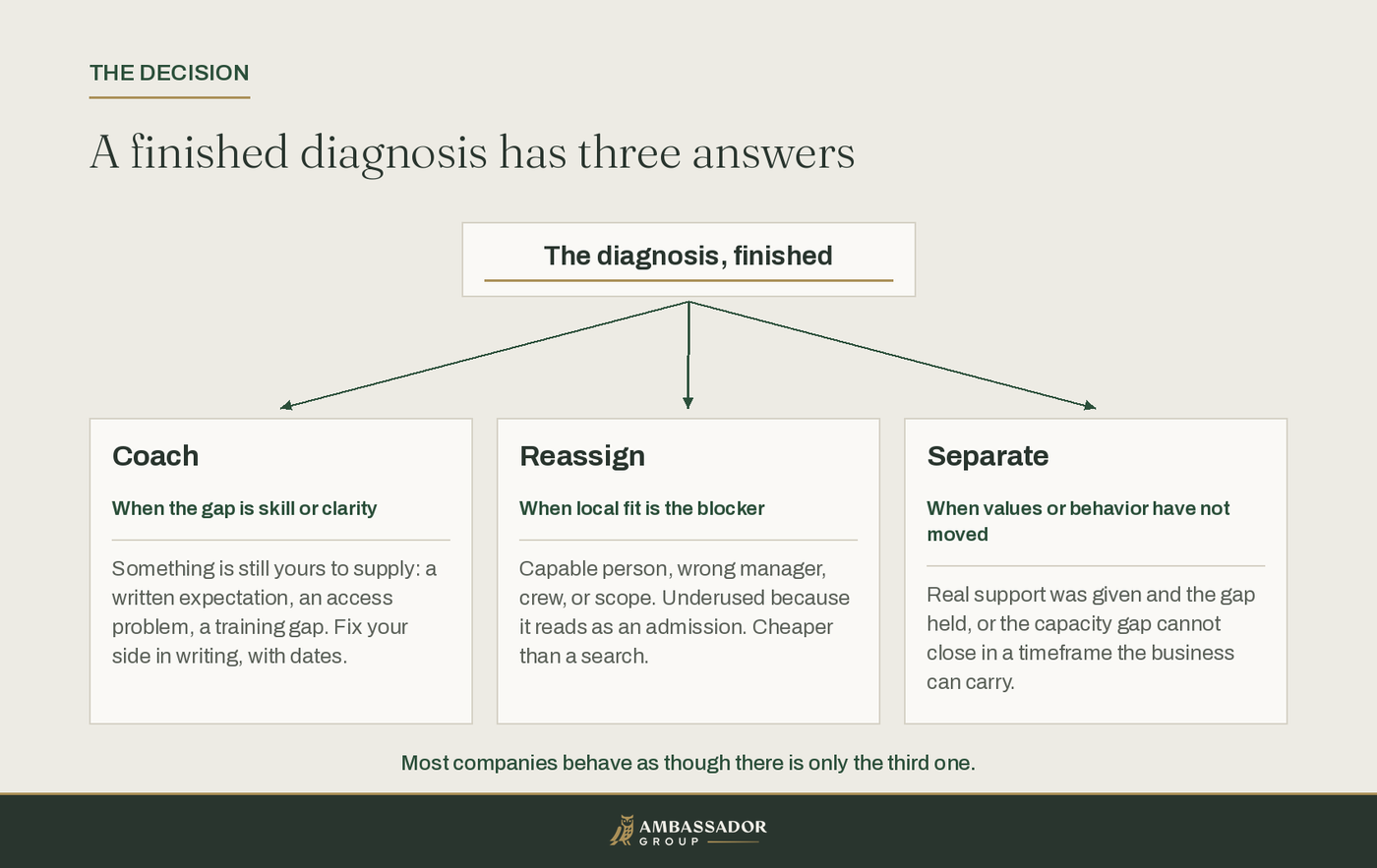
A finished diagnosis produces a decision, and the decision has three branches. Most companies behave as though it has one.
Coach when the gap is skill or clarity. What was missing is something you can still supply: a written expectation, an access problem, a training gap. This is the right answer far more often than firing, and it requires you to fix your side in writing, with dates, so that "we gave them a chance" means something checkable.
Reassign when the person is capable and the local fit is the blocker. Different manager, different crew, different scope. This is underused because it feels like an admission, and it is one. It is also cheaper than a search and it keeps someone who already knows your company.
Separate when values are misaligned, when behavior has not moved despite real support, or when the capacity gap cannot be closed in a timeframe the business can carry. Firing someone is a just act under those conditions, and I want to be plain about that, because leaders who believe firing is always a failure end up doing the crueler thing, which is nothing.
Dragging it out is its own decision, and it has a bill. Your best performers watch you tolerate a standard nobody meets and draw the obvious conclusion. Accountability stops meaning anything. And the person in the role stays stuck in a job they are failing at, which is a worse thing to do to someone than telling them the truth.
Nobody should ever be surprised
The standard worth holding is absolute: unless there has been an ethical breach, no employee should ever be shocked to be fired.
A surprise firing is a management failure that gets recorded against an employee. Leading up to it, the person should have been told where they stood, coached, and given goals with dates. If none of that happened, the termination is not the conclusion of a process. It is a substitute for one.
Worse, it usually indicts the hire as well as the coaching. The same absence of clarity shows up in both places. Job descriptions written as compliance checklists instead of problem statements. Interviews run on feel. Culture assessed as vibes. If you could not interview to the job description, you were never going to be able to manage to it either, and the surprise was planted before the person started.
The bill comes twice. Once for the preventable mis-hire, and once for the cultural damage of a firing handled without preparation or dignity. The people who stay take careful notes. Performers you want to keep start watching for the ambush and quietly keeping their options warm, because leaving on your own timing beats leaving on someone else's. Outside the company, whatever the former employee believes about you percolates into an industry where everyone knows everyone. Whether their version is fair does not matter much to how it travels.
The aspiration is a specific sentence. Even in termination, the person should be able to say: I knew where I stood, I was given real chances, and I was not blindsided.
How to separate without wrecking your culture
When separation is the answer, three things have to be true in order.
Clarity before compassion. If expectations were never clear, you are not ready to fire. The role has to have been defined, the feedback specific, the chance to improve real. Without those, you are firing from frustration and calling it a standard. Fix your side first, even if it delays this by six weeks.
Compassion without compromise. When it is time, be direct and be human. The conversation is short and it does not negotiate: we have talked about this repeatedly, we tried these specific things to help, this role is not a fit, and today is your last day. Do not soften it into ambiguity, and do not pad it with grievances you never raised before. Let them keep their dignity. Offer a reference if you can give one honestly. Offer resources if you have them.
Closure with purpose. Do not disappear after the meeting. Talk to the team, share only what is theirs to know, and do not sugarcoat it into something they can tell is false. Something close to: this was a hard decision, made to protect our standards and the people holding them, and our commitment to being clear with people does not stop here.
Done that way, a firing is clean. It sharpens the standard, it tells your team you are fair instead of unpredictable, and it opens the role to someone who can carry it.
Run the review while it still stings
Most companies celebrate good hires, complain about bad ones, and extract nothing from either. The fix is an after action review, borrowed from the military, and it is four questions:
- What was the goal?
- What happened?
- Why did it happen that way?
- What will we do differently next time?
Run it on hires at ninety to one hundred eighty days, and on exits within two weeks, while memories are fresh and the emotion has settled just enough to be useful. Keep it blameless and aim it at the system. The moment it becomes a search for who to blame, people start managing their exposure and the data stops being worth collecting.
A worked example. Goal: hire a project manager for upcoming multifamily work. What happened: they struggled with field-to-office communication and had never worked with self-perform crews. Why: the panel over-weighted resume experience and never probed daily habits or team handoffs. Change: add behavioral questions on handoffs, and put a superintendent in the interview loop.
That last line is the point of the whole exercise. Every review should end in an edit to how you hire. Recurring findings become qualifying questions. Repeated red flags become reference questions. The interview process gets sharper because something expensive taught it something, and the interview itself gets better questions than the ones that missed.
Keep the reviews somewhere shared, tagged by role, by team, and by which box broke. Two years of that is an internal playbook of what works at your company, which is worth more than any general hiring advice, including this article.
A few questions worth adding to the post-exit version: were expectations set clearly at onboarding, did regular check-ins happen, were issues raised directly before the decision, was this a mis-hire or mismanagement or both, and what did it cost to keep them too long?
The filter gets sharper or it repeats
A bad hire costs money you can calculate and trust you cannot. Both are already spent. The only variable left is whether the company learns something durable or files it under bad luck and runs the same process again.
That choice is not made in a meeting. It is made in the first sentence you say out loud when someone asks what went wrong. Point that sentence at the system and you will find something you can fix. Point it at the person and you have bought the same failure at full price, and you will meet it again with a different name on it.
Pick the last hire that did not work. Write down the reason you gave at the time, and the earliest box you can honestly say was missing. If those two are not the same, you already know where your next mis-hire is forming, and it has been yours to close the whole time.
The short version.
- How long should I give a struggling hire before deciding?
- Long enough to have fixed your own side and seen the result, which usually means thirty to sixty days after expectations, feedback, and support are genuinely in place. The clock does not start when you first felt uneasy. It starts when the person had a real chance. If you cannot point to written expectations and specific feedback with dates, the honest answer is that the decision is not ready and the delay is yours, not theirs.
- Is firing someone for culture fit legitimate?
- It is legitimate when culture means defined values and working practices that were communicated and are demonstrably unmet. It is not legitimate when culture means the person is unlike the rest of the team, which is where similarity bias hides. The test: can you name the specific value, describe the behavior that conflicted with it, and show that it was raised directly before this conversation? If not, you have a preference, not a standard.
- What is the difference between a bad hire and a mis-managed one?
- Work the six boxes in order. If information, resources, incentives, or training were missing, it was mis-managed, whatever else was also true. If all four were in place and capacity or willingness was the gap, it was a mis-hire. Most cases contain some of both, and the useful move is to fix the system part regardless of how you decide about the person, because the system part is still there after they leave.
- Should I tell the team why someone was let go?
- Tell them enough to see that the decision was principled, and no more. Confirm it was a difficult decision made to protect the standard, that it followed a fair process, and that you are not going to discuss the specifics. Silence invites the worst interpretation, and detail invites a trial. Naming the principle without naming the particulars is what lets the people who stay trust the process the next time it runs.


