
They're trying to solve leadership problems with recruiting solutions.
It took me years, and hundreds of construction leaders, to see this pattern. The first call often opens with a request for better candidates, or a better recruiter, because the last hire didn't stick. What I've learned to listen for is how the leader defines recruiting. Whatever they put inside that word is where they'll look when a hire misses.
Hiring is where a leader's judgment becomes, sometimes excruciatingly, real. The leader defines the role, runs the interviews, sets the pay and the expectations that go with it, and lands the new person. Recruiting is one stage of that work. When a hire misses, the stages the hiring leader owns are the first place to look. That is the argument underneath hiring in full resolution, and this piece is the practical version of it: seven stages, who owns each one, and why recruiting can't carry the other six.

There are a couple of ways to define recruiting, and the one you pick makes a BIG DIFFERENCE in hiring results.
Two definitions of recruiting
The common way treats recruiting as the entire process of getting someone on the team.
The other way treats recruiting as the process of attracting interest to interview.
There is a spectrum between them. The distinction seems subtle to many, but the mindset shift and the results are massive.
Pick the first definition and recruiting covers everything from the first phone call to the person still being here in two years. A miss anywhere in that span becomes a recruiting failure, and the obvious fix is a different recruiter or a bigger candidate pool. Pick the second definition and recruiting covers a narrower job: getting the right people interested enough to have a real conversation. After a miss past that point, you look at the stages that follow, and the hiring leader owns most of them.
I've written about the twelve workstreams that fall under the first definition, from role clarification to post-hire check-ins, in Recruiting is more than just finding a candidate. This article sorts that work into seven stages and says who owns each one.

And before either definition starts, there's a stage I often see skipped: defining the role.
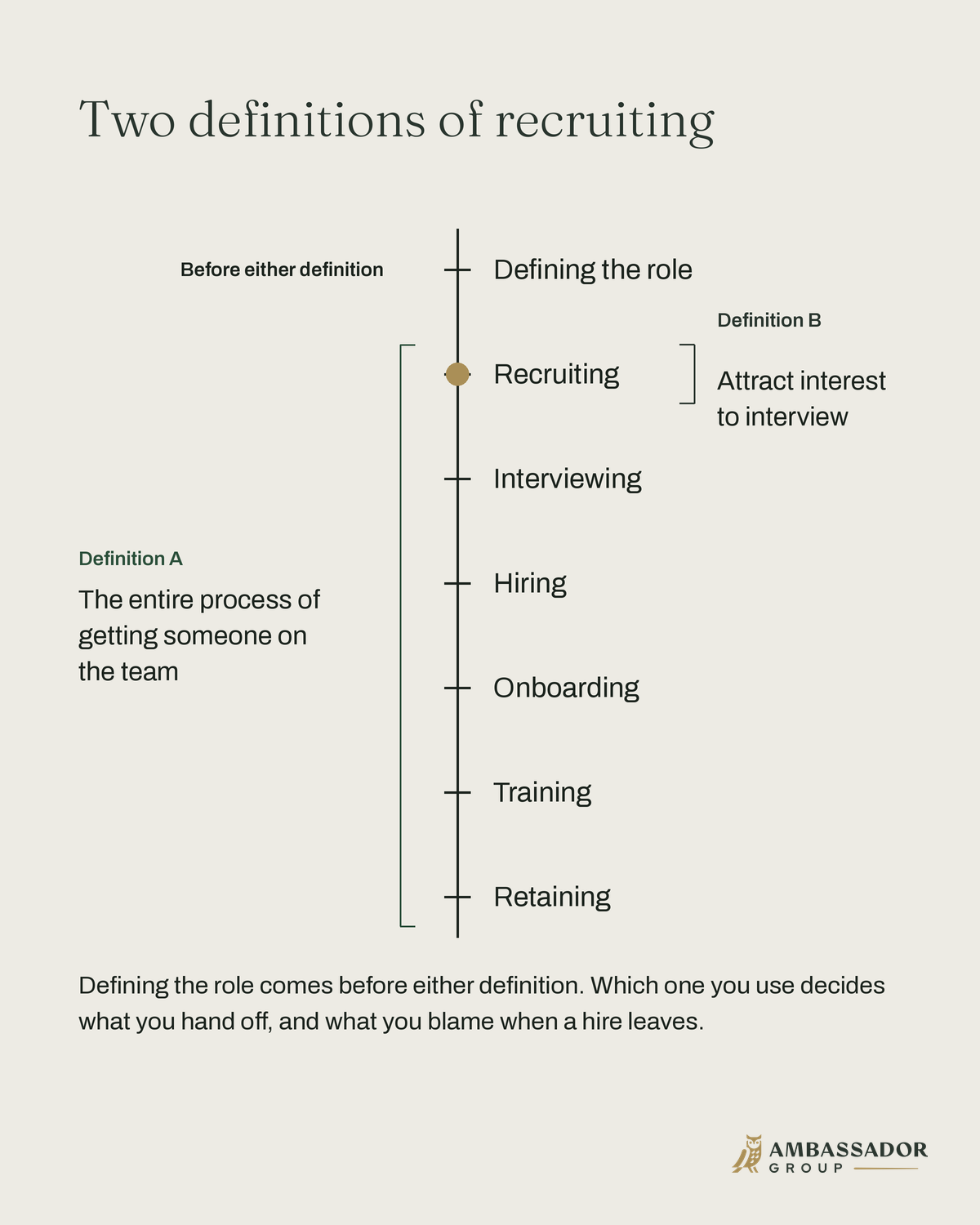
I've watched people use the same word for two very different jobs. The definition they pick decides what gets handed off and what gets blamed later, and neither one covers defining the role.
Two hiring processes, exaggerated on purpose
The leaders I work with are successful, sincere, and know a tremendous amount about construction. I've watched many of them run a hiring process they were never taught. I'll describe two processes, exaggerated on purpose so the contrast is clear.
Hiring by title and years
The role is a title. A project manager is a project manager, and candidates get sorted by years of experience. Hiring by title and years is a crude instrument. It treats people with the same title as interchangeable.
This process has no step for understanding the problem the role solves, managing the employment brand, building relationships, investing in the interview process, reducing hiring risk, making an onboarding plan, or underwriting the success of the hire.
Recruiting gets treated as the whole job. The person running this process wants the problem solved soup to nuts, which makes sense when the stages were never shown to them. Interviews happen because they have to. If someone promised the fool's gold of perfect candidates who didn't need interviewing, that pitch would be tempting.
Under this process, a recruiter gets hired to play the pick-up artist (the type of recruiter the market justifiably loves to hate) instead of a professional matchmaking partner.
The process is unpredictable, slow, imprecise, inhospitable, and unaccountable. You hear things like "no one wants to work anymore." The number of interviews done, or years spent interviewing, gets confused with insight.
What the crude instrument costs
A title and a number of years measure exposure. They say nothing about whether a person has solved the problem this role exists to solve, with the people this role answers to. A PM with 10 years of ground-up retail work and a PM with 10 years of occupied hospital renovations both read "project manager, 10 years" on a resume, and they are different careers.
So the instrument fails in both directions. It passes people who carry the title and the tenure but have never faced this job's hardest problem, and it screens out people who have solved that exact problem under a different title or in fewer years. The interviews that follow test general competence, because the role's specific demands were never written down. The offer gets built from market rate for the title, because the performance the pay is buying was never named.
When that hire misses, the cost lands well past the fee and the salary. Count each of these:
- The project that ran without the right leader.
- The client relationship that absorbed it.
- The team that watched it happen, and what that did to their trust in the next hire.
- The months spent starting over, with the same role still open.
Now put a number on each one. What did your last miss cost you?
None of this makes anyone a bad person. The stages (defining the role, recruiting, interviewing, hiring, onboarding, training, and retaining) blur into one confusing, soupy mess, and it's hard to see the relationship between inputs and outputs. Turnover usually gets blamed on candidate quality.
Recruiting inside this process is pure futility. It's an attempt to solve leadership problems with recruiting solutions.
Hiring by defined role
Every position, even one with a similar title, has its own challenges and relationships. A project manager running tenant improvements for a hands-on owner and a project manager running a hospital job for a health system's facilities team are two different jobs. The candidate has to bring qualities that match those challenges.
The hiring leader knows their non-negotiable priorities, IN ORDER. That order usually comes from painful experience and hard work. The order matters because priorities collide. A candidate who is strong on client relationships and thin on schedule discipline is a good hire for one of those two PM jobs and a risky hire for the other, and only a ranked list tells you which. The hiring leader owns the definition, and the recruiter pressure-tests it with questions and market data.
From there, the hiring leader shows up to interviews prepared and sober about their responsibility to interview each uniquely complex human and build a relationship that makes space for collaboration, trust, and vulnerable honesty. The recruiter cannot build that trust for them. The hiring leader is the hiring decision leader and underwrites the hiring outcome. The work is detailed and disciplined, and the people doing it are refreshingly humble.
The process is predictable, fast, precise, hospitable, and accountable. Candidates feel the difference before the offer.
When surprises come up, there's no blame-shifting. When a hire goes south, the team does careful, humble, accountable root cause analysis, and the same mistake rarely happens twice. It's the archer, not the arrow.
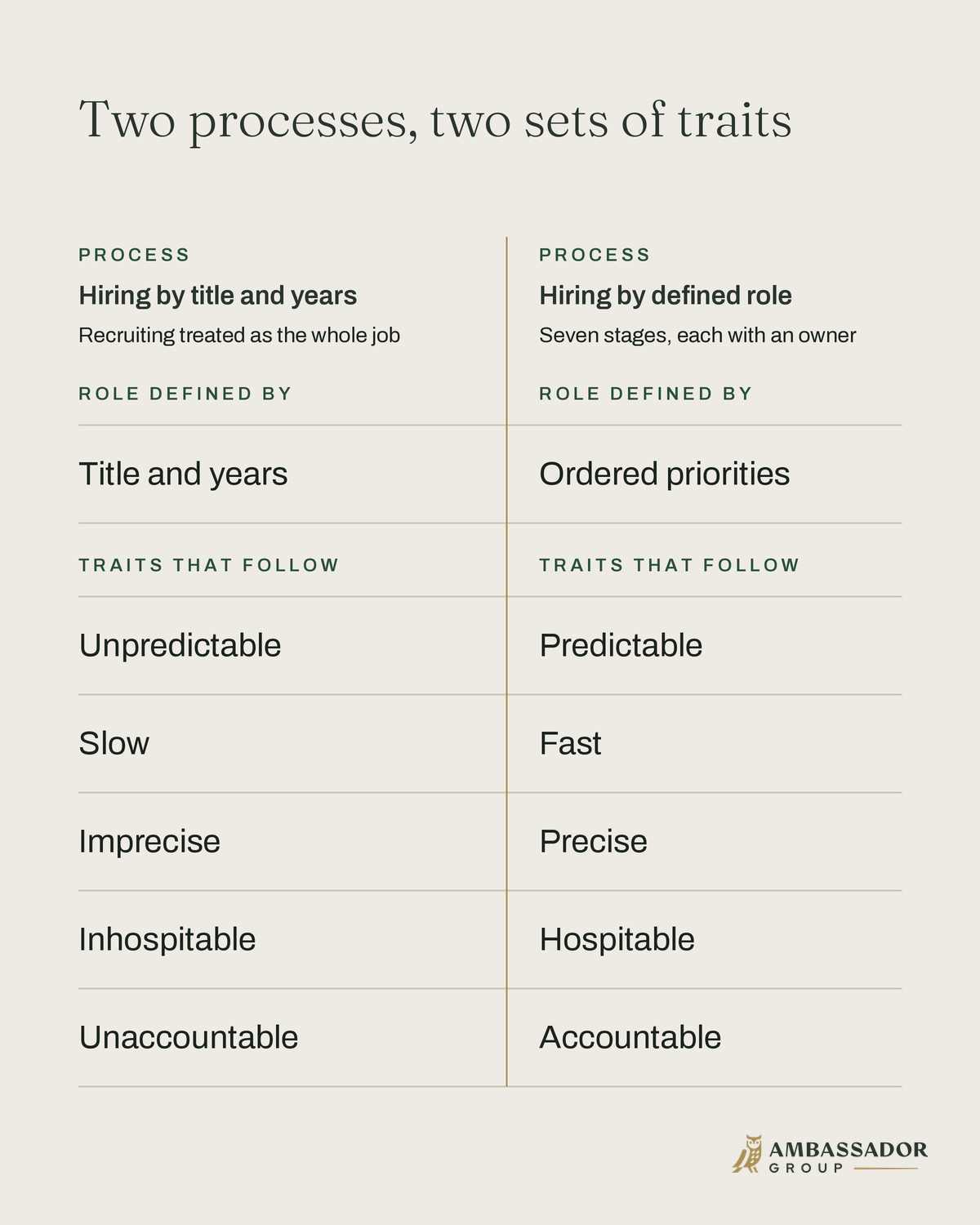
I can usually tell which process a company runs by how they describe the role on a first call. A title and a number of years tells me one thing. A short list of priorities in order tells me another.
Recruiting is one stage of hiring
Every stage has an owner. The hiring leader defines the role and holds final accountability for the hire, because only they can steward it.
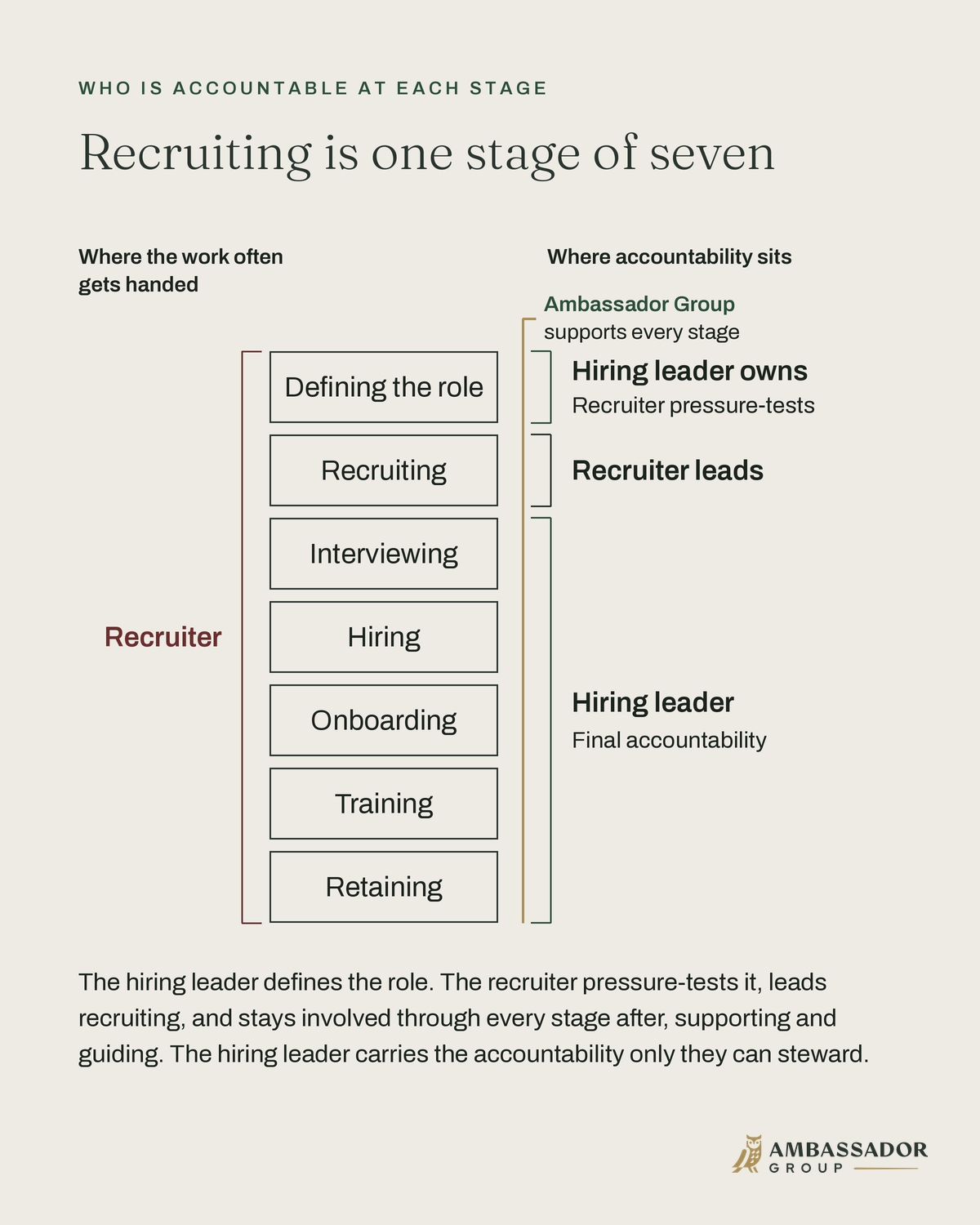
My team and I lead recruiting and support every other stage, starting with pressure-testing the role definition.
Defining the role
Name the problem the role solves, the challenges and relationships unique to this position, and the non-negotiable priorities IN ORDER. The hiring leader owns this. The recruiter pressure-tests it with questions and market data.
A useful definition answers a few plain questions. What does this person have to fix or build in the first six months for the hire to count as a success? Who will they answer to, and who will they have to win over? When two priorities conflict, which one gives? What does the market pay for the person who can do this, and does the budget agree? If the hiring leader can't answer those yet, the search isn't ready, and recruiting against a fuzzy role only brings in more of the wrong people. Role clarity on a leadership hire goes deeper on building the role backward from outcomes.

Recruiting
Attract unique interest and screen for interviewing suitability.
This is the stage a recruiter should lead. It covers telling the company's story honestly to people who aren't looking, screening out the ones who can't do the job or don't want it, and bringing the hiring leader a short list of people worth a serious conversation. Recruiting can't make the commitment for either side.
Interviewing
A structured process. Build the relationship: trust, collaboration, conceptual agreement on the job, evaluation of skill and philosophy, and ultimately an informed commitment to succeeding in the job's specific demands.
The hiring leader owns this stage because the relationship is with them. A recruiter can prepare both sides, design the questions around the ranked priorities, and collect written feedback before anyone compares notes. How to design an interview process covers the structure in detail.
Hiring
Build an appropriate compensation package and clear performance expectations for that pay. 100% compensation for 100% performance.
An offer is an agreement about what the pay is buying. If the expectations aren't written down at the offer, the new hire and the hiring leader will each carry their own version of them, and the gap shows up months later as a performance conversation neither side prepared for.
Onboarding
Intentional, phased, and hospitable teaching of values and culture. Culture is taught, not caught (or missed). Standards and expected behaviors are clear.
A new hire who can do the work can still miss at the landing: unclear early wins, conflicting priorities, a leader who goes quiet after day one. How to onboard a new hire lays out the 90-day landing plan and who owns each part of it.
Training
Recognize the individual's current level, gaps, and needs, and tailor training to empower their accountability to the role's standards. Taught, not caught (and then often missed).
The interviews already surfaced the gaps. Training is where the hiring leader decides who closes each one and by when, so a gap named in the interview doesn't resurface as a surprise in month four.
Retaining
Leadership focused on the success of customers, the team, and each team member. Cast a meaningfully better vision for the world. Hold accountability, starting with yourself. Build clear processes and role expectations. Set the high standards that high performers appreciate.
The leader the person works for decides retention, day after day, long after recruiting is over. How to keep the people you hired takes that stage apart.
A free competitive advantage
It starts before recruiting, with a role defined well enough to recruit against. Recruiting fills the funnel. A good recruiter stays in the work after that, supporting and guiding, but the hiring leader carries the accountability only they can steward. That's where you win or lose the hire. Study the depths of building teams, recruiting, and hiring, and you'll win more.
The advantage is free because everything it takes is already in the hiring leader's control: a ranked list of priorities, prepared interviews, a written set of expectations at the offer, and a landing plan. I've watched plenty of contractors skip those steps, which is why doing them sets a company apart in the hiring market.
How Ambassador Group supports each stage
My team and I work with Ambassador Group clients through all seven stages. We pressure-test the role definition with questions and market data, then lead recruiting. After that, we support the stages the hiring leader owns: we prepare the interview team and the candidate before each interview, check references, help build the compensation package and the performance expectations that go with it, draft a 90-day landing plan that names the new hire's training needs and who owns each one, and check in with the new hire and the hiring leader at months one, two, three, six, and twelve. Ambassador Group represents the candidate and the client, so both own the outcome. The hiring leader makes the hire and keeps the accountability for it.
Look at the archer first
The competence crisis is getting worse, and attracting and selecting people are only getting harder. In a tighter market, every skipped stage costs more.
When a hire misses, I look at the archer first. That's usually where I find the answer.
The next time a hire misses on your team, you choose where to look first.
The short version.
- What is the difference between recruiting and hiring?
- Recruiting is attracting interest to interview and screening for who is worth a serious conversation. Hiring is the larger process around it: defining the role, interviewing, building the offer, onboarding, training, and retaining. The hiring leader owns most of that process, and treating recruiting as the whole job is where many misses start.
- Who should own each stage of the hiring process?
- The hiring leader owns defining the role and holds final accountability for interviewing, the offer, onboarding, training, and retention. A good recruiter pressure-tests the role definition, leads recruiting, and supports every stage after it. The recruiter can prepare both sides, but the trust that leads to a commitment has to come from the person the candidate will work for.
- Why doesn't hiring by job title and years of experience work?
- Title and years measure exposure. They say nothing about whether someone has solved the problem this specific role exists to solve. Two project managers with the same title and tenure can have run different work for different clients. Ranking the role's non-negotiable priorities in order gives you something to recruit and interview against.
- What should a hiring leader define before recruiting starts?
- The problem the role solves, the challenges and relationships unique to the position, and the non-negotiable priorities in order. It also helps to name what success looks like at six months and what the market pays for someone who can deliver it. If those answers aren't clear yet, the search isn't ready to start.


