
You found the person, priced the risk, and landed them well. Two years later they resign, and the story you tell yourself is that the market got hot.
Sometimes it did. Mostly the market only set the temperature. Who stays is decided by the person they work for, and the company is a reflection of the person at the top, which means the lever you are reaching for is yourself. That is uncomfortable, and it is also the good news, because a market you cannot move is a worse problem than a leadership habit you can.

This is the step of the work with no finish line. Every earlier step ended in a decision. This one ends in a relationship you either tend or lose, and it runs from the day the landing plan closes out until the day you hand the company to someone else.
The market did not take your best people
Look at a finished building and it feels permanent. The concrete is hard, the steel is bolted tight, and it is not going anywhere. It is easy to look at a company the same way. You see the trucks, the office, the contracts, and you think you are built to last.
A company is not a structure. It is a collection of agreements, made of people choosing to show up today. That choice can change in an afternoon, and it changes fastest under a leader who has started to feel entitled to it.
Fifty years ago leaving a job was hard. You needed the pension. You stayed for safety. Now four forces run the other direction and none of them is going to reverse.
- Somebody within driving distance wants exactly the person you have. A general contractor, a specialty sub, a developer, and construction is busy.
- Office roles went portable. Estimators, project managers, and even some superintendents can change companies without moving their families.
- The outreach reaches deeper. A decade ago only executives got the call. Now project engineers, field managers, and foremen get them too. If your people are good, their phones are ringing, and the only question is whether you have given them a reason to let it go to voicemail.
- Pay is no longer a secret. Your team knows the market rate and so do your competitors. Vague or inconsistent compensation stopped being a policy and became a flashing sign.
Add a workforce that expects development and purpose alongside the paycheck and the arithmetic is simple. People who are not led well get led away.
The cost of ignoring this rarely appears as a line item, which is exactly why it goes unaddressed. Losing a skilled superintendent or project manager runs into six figures once you count lost productivity, retraining, and the search to backfill. Projects slip, because you cannot hit deadlines while you are constantly replacing the people who hit them. And a company known for churn gets avoided the way a bad subcontractor gets avoided.
Most companies are measuring retention wrong
Before any of this can be fixed it has to be seen, and two habits keep it hidden.
The first is cherry-picking. A company points at three people who joined fourteen years ago under entirely different circumstances and calls that low turnover, while quietly churning through everyone hired since. Those three are evidence about 2012. Retention is what is happening now, in the cohort you are currently hiring, and any smart candidate knows every company has a few people who will stay through anything.
The second habit is trusting your own read on morale, which is consistently wrong in one direction. In one Deloitte study, 89 percent of senior executives believed their workers were thriving while only 65 percent of employees rated their own health positively; 91 percent of executives thought they cared about their employees, and 56 percent of employees felt cared for. An EY survey found 77 percent of leaders believed their people felt trusted and empowered, against 57 percent of the people themselves.
The gap is not that leaders are lying. Optimism from the corner office is not a measurement, and a leader who paints a picture the crew does not recognize teaches the crew to stop reporting.
So measure it, and use numbers you did not generate by feel. Tenure has been falling for years: average job tenure across all workers sits near four years, and for workers aged 25 to 34 it is closer to under three. Read that as a design constraint on how you build a company, not as a character flaw in a generation.
The mechanics are cheap. One form filled out at every hire recording why you hired the person. A second form at every departure recording why they left, with the reason sorted into categories you defined in advance, such as ethics, performance, teamwork, compensation, or leadership. Push both into a dashboard so you can see average tenure, average tenure by manager, and the collated reasons at a glance. You cannot improve what you do not measure, and within a quarter or two the dashboard will tell you whether you have a hiring problem, an expectation-setting problem, or one manager problem wearing several disguises.

Then be honest with it. If your tenure is genuinely strong, it belongs in your recruiting. If it is not, do not tell candidates about the person who has been there nineteen years. Tell them the average and the average reason people go. Nothing motivates a leadership team to fix the underlying issue faster than having to say it out loud to a candidate.
Pay stops people leaving angry; it does not make them stay
Frederick Herzberg found that satisfaction and dissatisfaction at work are not two ends of one scale. They run on separate tracks, driven by different things, and confusing them is the most expensive mistake in retention.
Hygiene factors prevent dissatisfaction and do not create motivation. Fair and competitive pay. Job security. Safe conditions. Clear policies, clean payroll, no favoritism. Quality of supervision. A schedule that leaves room for a life. When these are missing, people leave. When they are present, people feel neutral. They stop complaining. That is the whole return.
Motivators are what create engagement and commitment. Growth and a visible path. Recognition that names something specific. Work whose purpose the person can see. Increasing responsibility. A team they feel they belong to.
Both are load-bearing, and the order matters. Fix hygiene first, because those are deal-breakers and no amount of purpose survives an unsafe jobsite or a payroll that runs late. Then build the motivators, because hygiene alone only stops the bleeding.

Which is where most leaders go wrong on pay. Compensation is a hygiene factor. It sets the baseline, keeps the lights on in the relationship, and once it is good enough it recedes into the background. If your culture has no motivators, more money will not manufacture loyalty. It will raise the price of the eventual exit. Money is an excellent reason to say yes and a poor reason to stay.
None of that argues for paying less. It argues for pricing the role deliberately and then stopping, because past the point of fairness the next dollar buys almost nothing you wanted. Structure beats generosity here: clear pay-for-performance, a visible path to higher income, and a raise that arrives before it is requested. If someone has to threaten to leave to get paid correctly, they are already halfway out the door and the raise you just approved bought you a few months.

The corollary is the one leaders like least. If people do not leave bad jobs so much as bad bosses, and loyalty is earned by competence rather than personality, then supervision is the hygiene factor you control most directly and audit least. A micromanaging or disrespectful supervisor will empty a crew faster than any competitor's offer, and the leadership skill of the person setting the daily tone is the part of culture you can genuinely engineer.
You can buy attendance, and that is all
There are two kinds of effort on a jobsite and you get exactly one of them for free.
Mandatory effort is the baseline: showing up on time, wearing the right PPE, doing what the job description says. You can buy it with a paycheck, enforce it with management, and threaten a job for it.
Discretionary engagement is the other one, and no paycheck reaches it. It is double-checking a measurement so the crew does not rework it next week. Staying ten minutes late to organize the gang box. Mentoring the greenhorn without being asked. It is the distance between having to do this and wanting to.
You cannot demand that someone cares. Care is given freely, and people give it once they have been enlisted and not merely hired. Most hiring never gets there. The company offers money, the candidate offers skills, and a relationship that stays on those terms produces mandatory effort and nothing else. When the clock hits zero the work stops. When an offer arrives for a dollar more, there is nothing holding.
Leaders who struggle with turnover tend to blame the workforce for this. Treat people like line items on a budget and they will treat you like a source of funds. That is a fair trade, and it will not build a company worth working for.
Enlisting is the alternative, and it is an act of leadership rather than a program. It invites the person to own something and connects their daily work to whether the whole crew wins.
Management controls compliance and asks, "Did you do it?" Leadership inspires contribution and asks, "How can we do this better together?"
You cannot expect high engagement from a crew you are barely engaged with yourself. If you want them to go past the job description, you go first, and you prove you are fighting for them and not simply profiting from them. It is easy to hire hands and hard to enlist hearts, and the care you want from your people is waiting on the care you are willing to show first.
Loyalty went dormant, not extinct
People say nobody is loyal anymore as though it were a generational defect. Consider the other reading: loyalty is still there, and we stopped earning it.
Loyalty is the thread that keeps someone committed when the quarter is hard. It is trust accumulated over time, multiplied by sacrifice. It does not come standard on a hire. Leaders install it, and it goes dormant under predictable conditions: leadership that feels transactional, a culture that rewards individual gain over collective success, communication that spends trust faster than it builds it. Under those conditions loyalty is not absent. It is suppressed. When a leader says people just are not loyal, the sharper question is what they have built for people to be loyal to.
Job-hopping is not the proof it appears to be. Previous generations stayed partly because leaving was risky and mobility was low. The friction of switching has collapsed, which does not make anyone disloyal. It makes them less willing to tolerate poor leadership. The irritation threshold for leaving dropped, so the leadership bar has to rise to meet it. Blaming the generation is a way of declining that.
There is also a quieter version of this problem. When a role gets treated as interchangeable, a project manager here or a project manager there, whoever costs less, loyalty becomes irrational for the person in it. Nobody stays out of devotion to a company that has told them they are a cost center, and people are not inventory no matter how the org chart is drawn.
The hardest place to build this is the line level: the field laborers, the assistant supers, the admin staff. Those are the roles most companies treat as rotational, and because they turn over more, the investment gets skipped as unjustifiable. The difficulty is the signal, not the excuse. Build loyalty where it is hardest and it becomes contagious where it is easiest to lose. Skip those layers and you are not building loyalty at all. You are enjoying the tenure you inherited.
The person you hired is not the person you have
Assume your people are the same as the day you hired them and you will be wrong about every one of them.
A project manager who had a baby now wants less travel. A veteran superintendent has had enough of cold winters and is looking south. A quiet estimator has decided she wants to lead a team and has not found a way to tell you. None of that shows up in a performance review. All of it shows up in a resignation.
So become a student of your people, and be fastidious about it. Know what specifically drives each of them, not the generic answer of money or work. Know what is heavy in their life right now and what they are dreaming about. If you are not studying your people, someone else is; headhunters are calling and competitors are watching, and an inattentive leader loses to an attentive stranger.
What you do with that knowledge is where most leaders stop short. The common move is to hold the role fixed and require the person to fit it: this is the job, take it or leave it. That is a brittle way to build. The better and much harder move is to shape the organization around the people in it. A star who needs flexibility gets it in a way that does not break the business. A leader who wants to try a new market gets a way to build it. You bend the rigid structure of the company to catch the strengths of the human.

This has ditches on both sides. An organization can be distorted around a person until the mission bends to serve one career, and finding the thread where a person's goals and the company's goals lock together is delicate work. It takes real emotional intelligence and perceptiveness, often about things the person cannot yet see about themselves. If the search included a bilateral assessment, it is still useful years in, because working style and friction points do not expire when the hire does.
The practical form of all this is a conversation most companies never have. Ask the person how they want to be retained. Give them the floor to say what they need from the arrangement, then build it around their answer and what the company can carry. A single package applied to everyone is on its way out for a reason: it optimizes for administrative ease and treats a group of specific people as one average one. Beginning with the question changes what happens next, because now the two of you are designing something rather than negotiating over a number.
Run those as standing one-on-ones and treat them as stay interviews. Step 7 gave you a check-in cadence through the first year; this is what replaces it afterward, and it is not a performance review. Three questions carry most of the freight: what is getting in your way, what do you want next, and what would make you take a call from a recruiter. The answers arrive years before the resignation does.
The environment grades the person
A project is never only the person or only the company. It is the combination, and the same project manager produces different outcomes in different buildings.
Sort both onto a rough A, B, and C scale and the pairings tell you most of what you need to know.
- An A-grade manager in an A-grade company compounds. Projects run ahead of problems, conflicts get resolved before they calcify, and the reputation flywheel starts: talent wants in, clients come back.
- An A-grade manager in a B-grade company becomes the glue. Projects still succeed, on that person's energy, while leadership stays reactive and decisions lag. This is the classic burnout pairing, and the company reads its own survival as proof the system works while it slowly bleeds its A-players.
- An A-grade manager in a C-grade company leaves. They spend their days fighting fires in a broken system, and the company cycles through good people while blaming individuals for what is structural.
- A B-grade manager in an A-grade company usually succeeds, scaffolded by strong systems and real oversight, with their ceiling set by whether they level up.
- A C-grade manager in an A-grade company resolves quickly, because strong companies do not let a C-player linger and their high performers will not tolerate it.
Most companies and most managers grade at the same level, and the reason is not coincidence. Talent gravitates toward environments where it can thrive, and a company attracts the caliber it is structured to sustain. So the question is only half about whether you have the right person. Hiring an excellent project manager into a weak company is a Formula 1 driver with no tires on the car, and the failure gets recorded against the driver.
The implication for retention is direct. If you are losing good people from one department, look at the department before you look at the people. And if your hiring is strong while your retention is not, you have found the place where you keep paying to import talent into an environment that exports it. That is a cost you own along with the decisions that produced it.
Burnout is a design choice, and the design is yours
Burnout rarely comes from working too hard on something that matters. It comes from pouring energy into a long horizon with nothing nearer that pays the effort back.
Call the distance between spending energy and feeling a return a gratification window. Cook dinner and the window is an hour. Run a three-year job and a superintendent can feel almost nothing until the owner walks the finished building, which is a long time to operate on faith. Neither length is wrong on its own. The trouble starts when too many windows are long at once and nothing closer hands the work back to the person doing it.
Humans run on cycles of effort and reward, and stretch the cycle far enough and the mind stops believing the reward is coming. Burnout is more than tiredness. It is the point where output stops connecting to anything you can feel, which is why the most committed person on the crew is often the closest to the edge. They invested the most against the same distant return.
You cannot always move the finish line. You can build markers before it.
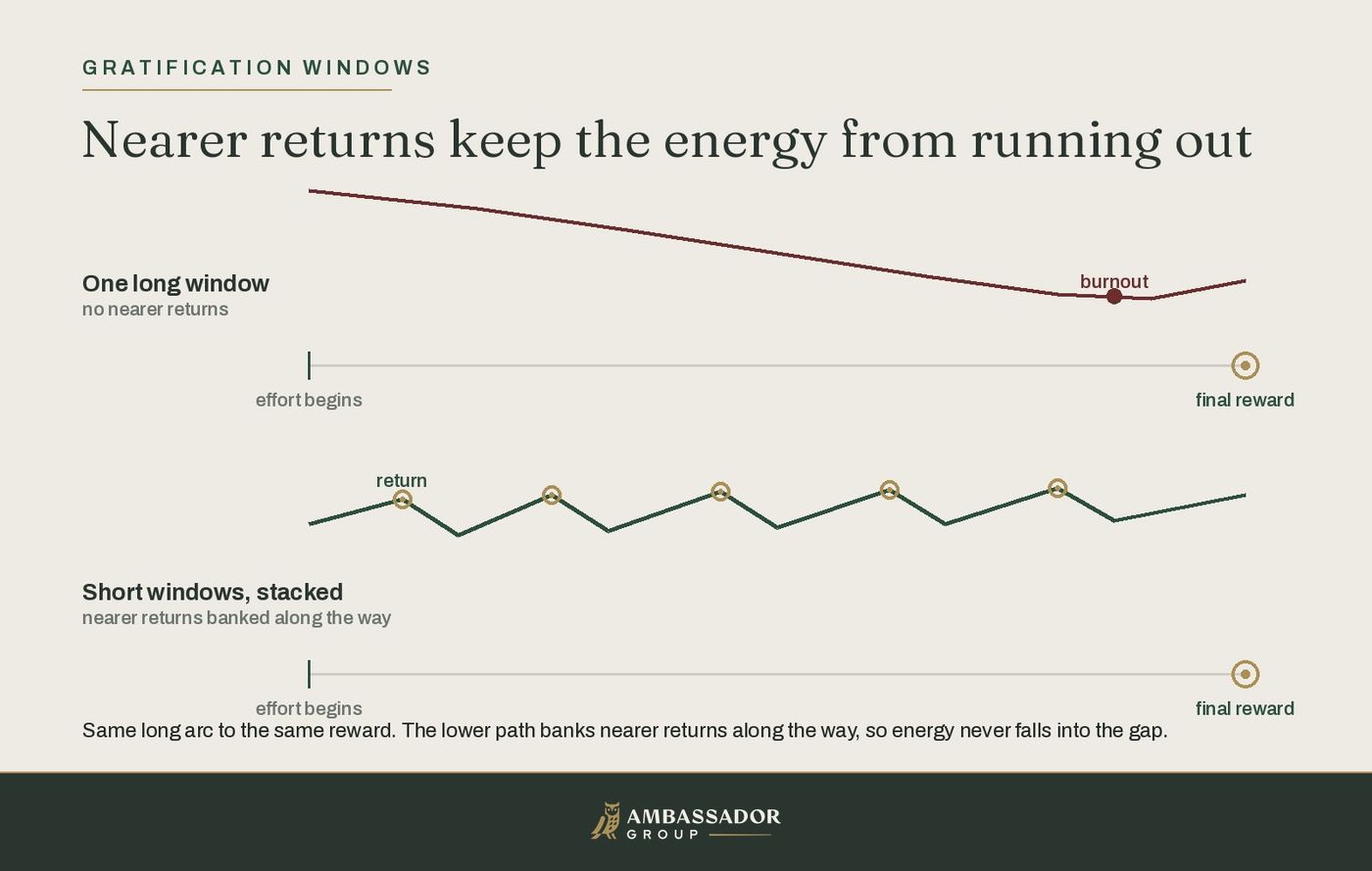
- Break the long arc into milestones you stop and mark. A permit approved, a foundation poured, a design accepted. Register them as wins, not as waypoints on the way to the ribbon cutting.
- Count relational returns. A client's thank-you, a quiet save by a teammate, an apprentice who finally gets it. Treating those as too small to count is how people starve between the big payoffs.
- Stack short windows under the long one. Pair the multi-year build with returns the person controls weekly: a hard problem solved, a skill sharpened, a ritual at home kept.
Then own your team's windows, because most of the crew never chose the length of theirs. If the only thing a crew feels is grind with the payoff parked eighteen months out, they will flame out before they reach it and you will file it as a people problem. It is a design problem and it belongs to you.
There is a second way a leader manufactures burnout, quieter than the long window. Heroics come easily to you, so you expect them from everyone without ever deciding to. What reads to you as an ordinary week reads to your team as a sprint they can never stop running. The window problem is about time; this one is about calibration, an outlier setting the pace for people who were never built to hold it. Both empty the same tank, and neither is intentional, which is exactly why you have to look for them deliberately.
The cheapest available fix costs nothing. End the week by naming, out loud and to the person, one return that already came in: the save they made, the problem they solved, the standard they held. And stop treating exhaustion as a badge. If staying with you means being permanently overworked, someone else will offer to treat them like a person, and the badge costs you your strongest people first.
Pride is the gauge worth watching
Pride in the work is not a luxury. It is an instrument, and it tells a person whether the effort they pour out is returning something worth having.
You cannot coach pride into anyone. You can protect the conditions that let it grow, and there are five: expectations are clear, quality is respected, shortcuts go unrewarded, feedback is consistent, and effort gets seen. Take any one of those away and pride starts to drain, quietly, from the people who had the most of it.
So when morale sinks or your best performers begin detaching without complaint, check the pride reading before you diagnose motivation. A person who has stopped respecting the work will keep doing it for a while, worse each month, caring less that it is worse. That is not a discipline problem to be managed. It is a signal that something in the standards or the conditions broke, and the person noticing it first is usually the one you least want to lose. Stop managing as though everything is urgent and start building as though everything is important.
The two moves leaders skip
Almost everything above is available to any leader who decides to do it. Two of the moves get skipped almost universally, and they are the two with the highest yield.
The first is removing the high performer who is wrecking the culture. The fastest way to lose good people is to protect the wrong one. A culture killer with strong numbers does more than dent morale; they drive out precisely the team members you most want to keep, and they do it quietly enough that you will credit the departures to the market. Find the person who creates friction, spreads negativity, or puts their own number ahead of the crew. If they are undermining the culture, they are a liability whatever they bill. Your best people are watching what you tolerate, and they have already drawn a conclusion about it.
The second is naming flight risk before it flies. Not everyone is equally likely to leave, and the information is available if you are looking: who is getting recruited, who has gone quiet in meetings they used to run, who is carrying more stress than the job should require, whose enthusiasm has flattened. A resignation that arrives as a surprise is not a surprise. It is a report on how long it has been since you asked. If the only time you talk to someone is when something has already gone wrong, you are not managing flight risk. You are confirming it.
Keeping people is how succession happens
Run retention well for long enough and it stops being about keeping people and starts being about who can carry the company. That is the far end of this step, and it is where a leader's ownership either compounds or collapses.
Many founders are the most important part of their company. They are the single steel beam holding up the roof. It works for a long time, and it feels like service. It is fragility wearing the costume of strength, because if you are the only member carrying load, you cannot leave and cannot even move. Most founders believe their greatest contribution is doing the heavy lifting themselves. The greater contribution is building a team that can carry it, and a founder who never develops anyone to take the weight guarantees the structure fails on the day they finally get tired.
Good succession does not begin when you are ready to retire. It begins now, and the work is raising the leadership capacity of everyone around you.
- Develop leaders before you need them. Start at the foreman and superintendent level, expose people to higher-level decisions early in their careers, and hand rising leaders small real responsibilities so they can grow into large ones. Training leaders only once a transition is imminent is how companies discover nobody is ready.
- Make leadership a skill and not a title. Train conflict resolution, problem-solving, and delegation. Normalize ownership at every level. Ask people to mentor and train others, which builds the pipeline and exposes who can teach.
- Institutionalize what is in people's heads. When a key leader goes, the loss is not their presence, it is their knowledge. Document the decisions, the relationships, and the strategies. Cross-train so more than one person understands each critical function. Run debriefs where leaders hand their thinking to their teams.
- Practice absence. Step back from making every call occasionally and let other leaders fill the vacuum under supervision. A strong, decisive leader who always has the answer unintentionally prevents anyone else from learning to find one.
A useful way to think about the result is how widely leadership is distributed. A company that depends on a handful of decision-makers experiences every transition as a crisis. A company where leadership is embedded at every level experiences transitions as events.
Selecting a successor is where good intentions produce bad outcomes, and the mistakes repeat: promoting on tenure instead of capability, choosing the most confident person over the most competent, and overlooking alignment with the company's values because the technical skill looked convincing.
Growing the successor from inside is almost always the stronger move, since an outside hire arrives without the history and the tribal knowledge your culture runs on. When you must go outside, understand what you are doing: it is a heart transplant, and the body often tries to reject the organ. Hire for chemistry and values, because technical skill is the common part and alignment is the rare one. And plan a season of overlap where you stay present enough for the team to trust the new leader and step back far enough that they can lead.
Hold onto one thing through all of it. There are no replacements. You can hire someone to do your job and they will never be a copy of you, and a founder who has been in the dirt for thirty years is not reproducible. Expecting a new leader to step into your exact skin forces a square peg into a round hole and sets everyone up to fail.
You cannot hire a replacement, but you can hire a successor who solves the same problems in a brand new way.
The shape of the leadership will change and the chemistry of the office will shift. That is the point of it. The goal is to make yourself unessential, which is not a loss of identity but the deepest version of the work: you built something that outlasts you. Most founders who manage it find their successor's strengths exceed their own in ways they could not have predicted. You will know it is done not when nobody needs you, but when the building stands whether or not you walk in the door.
So ask the plain version of the question. Do you trust the people who report to you to replace you? If the answer is no, is that a fact about them or a report on what you have invested? When a company goes multi-generational, inside a family or not, the second generation's success is bought with the first generation's investment in people, and there is no way to make that purchase late.
The exit is part of the retention system
People will leave anyway. Retention is a reason to stay and never a wall, and sometimes the reason on the other side is genuinely better for that person's life. How you handle the leaving is the last retention decision you make, and it is aimed at everyone who stays.
Every exit sends a message and your team reads it accurately. Three situations, three different messages.
An integrity violation calls for speed. Fraud, theft, or serious dishonesty has no gray area, and the team should see that ethics are not negotiable even while the specifics stay confidential. Document it properly. Compromising here costs you the trust of your best people, who are watching to see whether the stated values hold when they are expensive.
Underperformance calls for a look in the mirror first. Before anyone moves toward separation, answer whether the role was clearly defined, whether the person was trained, whether they got real feedback, and whether they had a fair chance to improve. If the gaps are on your side, fix them, both for this person and for the next one. Performance problems should never arrive as a surprise, and an early exit is usually not a character problem. When separation is genuinely right, diagnose what went wrong before you decide, and then do it the just way.
A high performer leaving for a better opportunity calls for grace, and this is the one leaders fumble. React with resentment and you have told the whole team that loyalty is punished on the way out. Acknowledge the contribution in front of everyone. Offer the reference. Keep the door open.
Then keep them. Companies in sports, universities, and elite firms treat departures as graduations and build alumni networks that pay for decades, because this is a relationship-driven business: former employees refer trusted peers, vouch for you to clients since people believe an insider even a former one, and occasionally come back. A returning employee onboards fast, already knows the culture, and is usually glad to be there. None of it works unless the last impression was a good one. The system to run this is not a program: a contact list of former employees, a quarterly note with project wins and open roles, and a stated policy on how someone comes back.
Finally, use the exit interview, which is a goldmine almost nobody mines. Approach it with an open mind even when the feedback stings, because the relationship soured under your watch and there is something in there you paid for and may as well collect. Feed what you learn into the same dashboard you built earlier, and the pattern across a year of departures will tell you more about your company than any engagement survey.
Pick the last good person who resigned on you. Write down, honestly, the reason they gave and the reason you believe. If those two are different, that gap is where your next resignation is already forming, and it has been yours to close the whole time.
The short version.
- Why do good employees leave even when the pay is competitive?
- Because pay is a hygiene factor. Herzberg found that satisfaction and dissatisfaction run on separate tracks: competitive pay prevents dissatisfaction but does not create commitment, so once it is good enough it recedes into the background. Staying comes from motivators like growth, recognition, meaningful work, increasing responsibility, and belonging. If a culture lacks those, more money only raises the price of the eventual exit. Money is an excellent reason to say yes and a poor reason to stay.
- Is retention really a leadership problem rather than a market problem?
- The market sets the temperature, and the leader decides whether people have a reason to stay in the building. Workforce mobility is genuinely high and switching costs have collapsed, but almost everything that makes a good person stay sits inside a leader's authority: the quality of supervision, whether growth is visible, whether the culture is worth being in, and whether burnout gets rewarded. The company reflects the person at the top. When a great person leaves, the market is the easy story and the leadership habit is the useful one.
- How should a construction company measure retention?
- With data you did not generate by feel. Fill out one form at every hire recording why you hired the person, and a second at every departure recording why they left, sorted into predefined categories such as ethics, performance, teamwork, compensation, or leadership. Feed both into a dashboard that shows average tenure, average tenure by manager, and collated reasons for leaving. Within a quarter or two it will tell you whether you have a hiring problem, an expectation-setting problem, or one manager problem in several disguises.
- Does pointing to a few long-tenured employees prove we have low turnover?
- No, and it is the most common way companies hide a retention problem from themselves. Holding up three people who joined fourteen years ago under different circumstances while churning through everyone hired since is cherry-picking, not retention. Retention is what is happening in the cohort you are hiring now. Candidates know every company has a few people who will stay through anything, so tell them the average tenure and the average reason people leave.
- What is discretionary engagement, and can you pay for it?
- It is the effort no paycheck reaches: double-checking a measurement so the crew avoids rework, staying ten minutes late to organize the gang box, mentoring the greenhorn without being asked. A paycheck buys mandatory effort, meaning attendance, PPE, and what the job description says. Care is given freely and only by people who have been enlisted in a mission rather than merely hired for a wage, and you cannot expect it from a crew you are barely engaged with yourself.
- Is job-hopping proof that younger workers are disloyal?
- No. Earlier generations stayed partly because mobility was low and leaving was risky, and the friction of switching has since collapsed. That does not make people disloyal; it makes them less willing to tolerate poor leadership. The irritation threshold for leaving dropped, which means the leadership bar has to rise to meet it. Loyalty goes dormant under transactional leadership and a culture that rewards individual gain, and it returns when a leader gives people something worth being loyal to.
- How do I keep a good employee whose life has changed?
- Notice first, then bend the role rather than holding it fixed. People change after you hire them: a project manager wants less travel after a baby, a superintendent tires of cold winters, a quiet estimator decides she wants to lead. Most leaders require the person to fit the role, which is brittle. Shaping the organization around the strengths and needs of the person is harder and more durable, though it has ditches, since a company can be distorted around one career. The direct route is to ask the person how they want to be retained and build around the answer.
- Why does a strong hire sometimes fail to stick?
- Often because of the environment they joined. An A-grade project manager inside a B-grade company becomes the glue holding it together and succeeds on their own energy until they burn out, and inside a C-grade company they leave while the company blames individuals for what is structural. Companies and managers tend to grade at the same level because talent gravitates to where it can thrive. If your hiring is strong and your retention is not, you are paying to import talent into an environment that exports it, and the audit starts with the environment and the landing you gave them before it reaches the person.
- What causes burnout on a construction team, and what can a leader do about it?
- Long gratification windows, meaning a large gap between spending energy and feeling any return. A superintendent can give three years to a job and feel almost nothing until the owner walks the finished building, and the most committed person is usually closest to the edge. Build markers before the finish line: mark milestones as wins, count relational returns, and stack short weekly returns under the long arc. Watch for the quieter failure too, where heroics come easily to the leader and become an unspoken standard, so an ordinary week for you is a sprint nobody else can sustain.
- When should succession planning start?
- Now, not when retirement approaches. A founder who is the only load-bearing member has built fragility, not strength, and cannot leave or even move. Develop leaders before you need them at the foreman and superintendent level, make leadership a skill instead of a title, document what lives in key people's heads, and practice absence so others learn to decide. Growing a successor inside is usually stronger than hiring outside, where the culture often rejects the new leader. And there are no replacements, only successors who solve the same problems in a new way.
- How should I handle it when a high performer resigns?
- With grace, because the message lands on everyone who stays. Acknowledge their contribution in front of the team, offer the reference, and keep the door open; reacting with resentment tells your team that loyalty is punished. Then stay in touch on purpose with a contact list, a quarterly note, and a stated welcome-back policy. Former employees refer trusted peers, vouch for you to clients, and sometimes return, and a returning employee onboards fast and already knows the culture.
- Are exit interviews worth the discomfort?
- Yes, and they are the most underused source of truth about a company. Approach one with an open mind even when the feedback stings, since the relationship soured under your watch and there is something in it you already paid for. Log what you hear in categories and read the pattern across a year of departures. It will tell you more about your company than an engagement survey, because the person answering has nothing left to protect.


