
Interviewing feels like a minefield, and in construction the stakes make it worse. You need somebody who can run a job, hold a crew, and hit a schedule, and you have one hour to find out. Then somebody on your panel asks a friendly question about the candidate's kids and the whole conversation is now evidence.
Most people meet this as a list of forbidden questions and read the list as red tape. That reading costs you twice. It leaves you exposed, because a rule you resent is a rule you break under pressure. And it costs you the read, because a leader who cannot see their own assumptions cannot see the candidate in front of them, and an interview is where that becomes visible and expensive.
Nearly every prohibited question is prohibited for the same reason it was useless: it asks about the person instead of the work. So what follows is the list, all 22 of them, with a better version of each. Then the part a list cannot carry on its own: why the prohibition sharpens an interview, where the liability comes from, and what you owe the person across the table.
One habit covers almost all of it
Ask about the job, not the person.
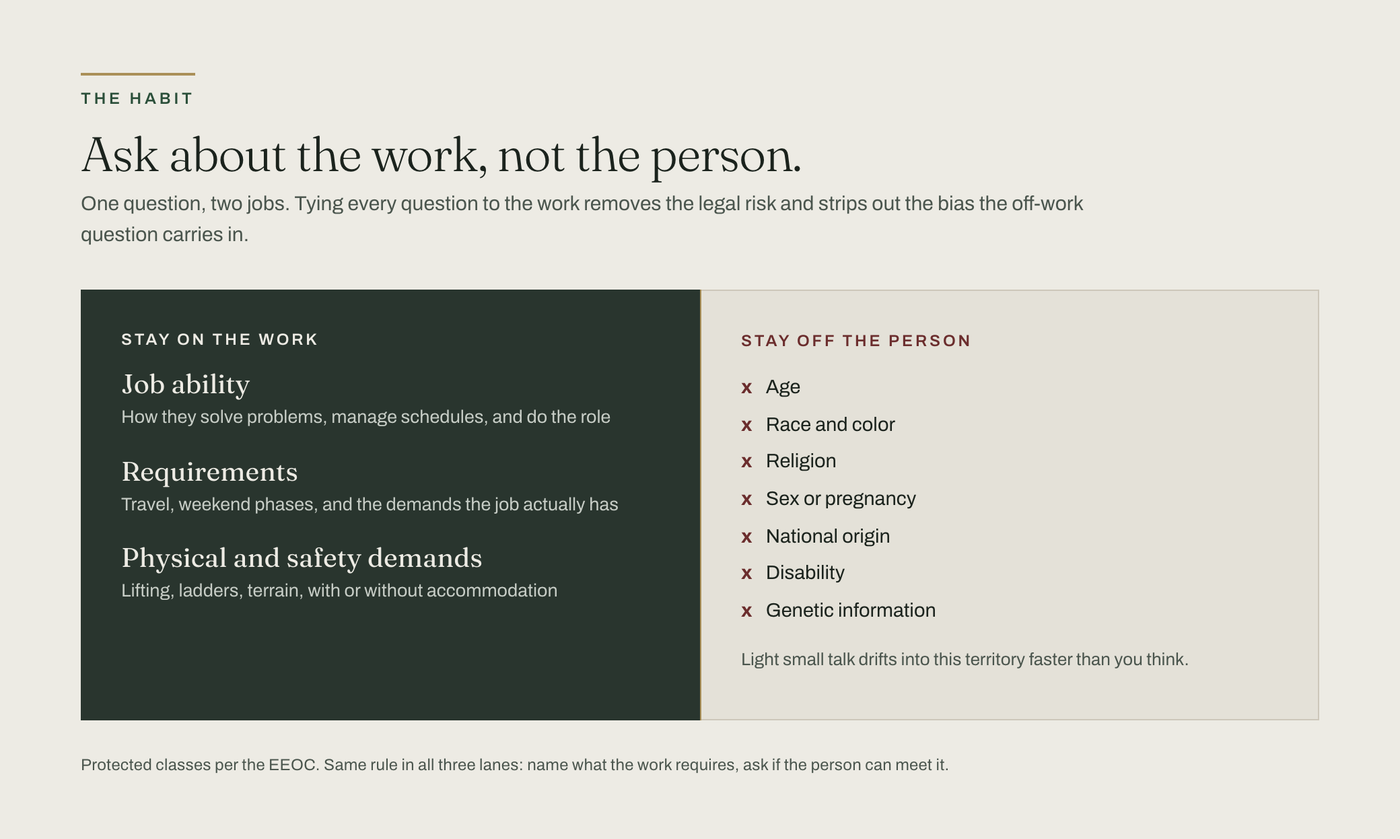
That single habit does two jobs at once. It removes the questions that create legal risk, and it strips out the bias those questions quietly carry in. Three lanes cover nearly everything worth asking, and in each lane the safe version and the strong version are the same question. The risky version is the one that wandered off the work.
Job ability. Tie the question to how the person will do the work. Tell me about a time you solved a hard problem on a project. What parts of this role fit your strengths? How do you manage tight schedules and changing demands? What support helps you do your best work?
Requirements. Be direct about what the job demands. This job needs weekend work during peak phases, can you meet that schedule? This role requires travel between job sites, can you meet that with or without accommodation?
Physical and safety demands. The job's requirements are fair game. This role requires lifting up to 50 pounds, are you able to do that with or without accommodation? Are you able to climb ladders and walk uneven terrain with or without accommodation?
The pattern holds in all three. Name what the work requires, ask whether the person can meet it, and stay out of who they are.
Construction makes the discipline harder than it sounds. The trades run on relationships, on shared job sites and long days, and the instinct to size a person up over a cup of coffee is the same instinct that gets a leader in trouble. "Would I want this guy in my trailer" feels like judgment. Half the time it is bias wearing judgment's jacket. The fix is to move the warmth onto the work, where it belongs and where it is safe.
The 22 questions, and what to ask instead
Illegal or discriminatory questions
These reach protected characteristics. Avoid them entirely.
- What is your age, or your birthdate? Age discrimination is against the law, and the year somebody was born tells you nothing about whether they can do the work. There is no better version. Skip it unless age ties directly to a specific safety requirement.
- What is your religion? Religious belief has no bearing on job performance and is protected. Ask about availability: are you able to work the hours this role requires?
- Are you married? Marital status is unrelated to the work and invites bias. No better version. Stay on job-related topics.
- Do you have children, or plan to have them? Asking about family plans reads as bias against parents and caregivers. Ask instead: can you meet the schedule and travel requirements of this position?
- What is your nationality or citizenship? This is discriminatory territory. Ask instead: are you authorized to work in this country?
- Do you have a disability or health issues? The Americans with Disabilities Act protects against this. Ask instead: can you perform the essential functions of this job with or without accommodation?
- What is your sexual orientation or gender identity? Protected, and irrelevant to the work. No better version. Avoid entirely.
- What is your political affiliation? Irrelevant and divisive. No better version.
Irrelevant or poorly framed questions
These are legal. They are also close to worthless, which is why they belong on the same list.
- What do you know about our company? It plays as a gotcha and tells you nothing about fit. Ask instead: what interests you about the opportunity to work here?
- Why should we hire you? Overused, and it puts the candidate on the defensive when you want them thinking. Ask instead: looking at this role, where do you see yourself adding the most value based on your past projects?
- What is your biggest weakness? You will get a rehearsed answer, because everybody has one ready. Ask instead: what skill or habit have you had to work hardest to improve, and how did you go about it?
- What would your previous boss say about you? Hard to answer honestly, and you can get the same information from a reference call. Assess the skill directly or ask the reference.
- Where do you see yourself in five years? It rewards the candidate with the tidiest story and penalizes the one who values adaptability. Ask instead: what are you looking to achieve in your next role?
Inappropriate or unprofessional questions
These cross into personal territory, and the record does not care that you meant well.
- What is your social media handle, or can I add you? Intrusive and irrelevant unless the role involves managing social accounts. No better version.
- How much debt do you have? Private, and unrelated to the work. No better version.
- What do you do in your free time? It sounds like small talk and invites bias about lifestyle, income, and family. Ask instead: what motivates you in your work?
- Do you get along with your coworkers? Vague, and nobody answers no. Ask instead: can you share an example of working through a disagreement with a teammate?
- Are you willing to work overtime without additional pay? This raises wage and hour problems before it raises anything else. Ask instead: are you open to overtime when the schedule requires it, under company policy?
Leading or biased questions
These put the answer in the candidate's mouth, so whatever comes back is yours, not theirs.
- We need somebody who works well under pressure, would you say that is you? Nobody says no. Ask instead: tell me about a time you handled a high-pressure situation on a project. What did you do first?
- Do you think you are a cultural fit here? Too subjective to score and an open door for bias. Ask instead: what kind of work culture helps you do your best work, and what role do you take when a job gets hard?
Questions that waste the hour
These are not illegal. They just spend a minute you needed.
- If you were a tree, what kind would you be? It yields nothing you can score and makes the process feel unserious. No better version.
- What is your favorite movie or song? Same problem. Ask about work habits, judgment, and goals instead.
Twenty-two questions, one pattern. Every safe alternative follows the same rule: ask about what the job requires, not about the person's life. The download above is the same list on one page, for the panel that needs it in hand.
What the EEOC covers, and when it starts
The Equal Employment Opportunity Commission enforces the federal laws that keep candidates from being judged on things that have nothing to do with the work. The protected characteristics are:
- Race, color, and national origin
- Sex, including pregnancy, sexual orientation, and gender identity
- Age, for people 40 and over
- Religion
- Disability
- Genetic information, including family medical history
- Citizenship and immigration status
Two things about that list get missed. The first is what kind of list it is: a catalogue of things that do not predict performance. That is why a good interviewer had no use for any of them to begin with.
The second is when the protection starts: at first contact. Job ads, emails, phone screens, the interview itself, reference calls. There is no warm-up period where the rules have not switched on yet. That is usually where the trouble comes from, because nobody rehearses the walk from the parking lot to the conference room.
The demographic is standing in for a requirement
Almost nobody sets out to discriminate. What happens instead is that a leader has a genuine requirement, never writes it down, and reaches for a demographic shorthand that feels close enough.
Listen to what these mean underneath:
- "We need somebody young" translates to comfortable with new software, willing to be taught.
- "We need an older, seasoned professional" translates to deep field knowledge and the patience to mentor.
- "We need a woman for this client" translates to strong client communication.
- "We need somebody aggressive in negotiations" translates to confident and strategic.
- "We need somebody who fits our culture" translates to works well with this team.
Each shorthand is a guess dressed up as judgment, and the guess is wrong often enough to be useless. Plenty of 28-year-olds are rigid and unteachable. Plenty of 62-year-olds are humble, curious, and better with a tablet than the superintendent who hired them. Not every woman is a strong communicator and plenty of men are excellent with clients. Age, gender, and background do not carry the traits people assign them, which is the whole reason the law treats them as off limits.
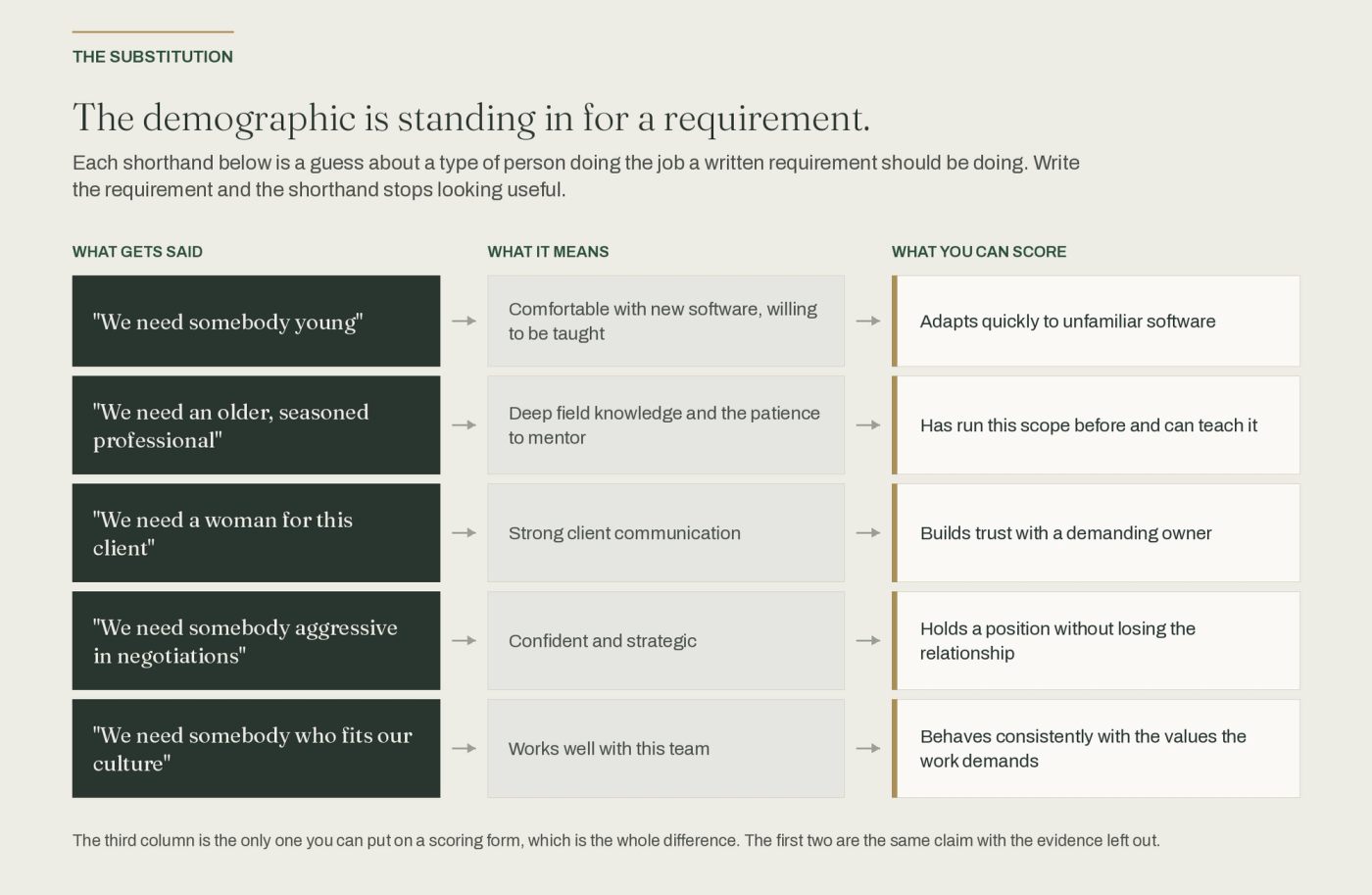
The fix is mechanical. Write down the trait you are really after, in words you could score. Not "young" but adapts quickly to unfamiliar software. Not "a woman" but builds trust with a demanding owner. Not "older" but has run this scope before and can teach it. Then screen for the written version, and the demographic version stops being tempting because you can see it is a worse instrument. The job description is where that work belongs, before anyone is in front of you.
The bias under the bad question
The risky question is the symptom. Under almost every protected-class slip sits a bias nobody examined, and naming the bias tends to make the question disappear on its own. Four of them do most of the damage in construction hiring, and a fifth arrives on any week with back-to-back interviews.
Affinity bias. You warm to the candidate who reminds you of yourself: same background, same trade school, same way of carrying a conversation. It feels like chemistry. On paper, a steady preference for people who share your origin, your age, or your way of talking reads like exactly what the EEOC was written to catch. The candidate who would have stretched your team is often the one who felt least familiar in the first ten minutes.
The halo, and the first impression. A firm handshake and a confident open, and the brain fills in competence it has not checked. The halo is what makes an interviewer ask easy questions of the candidate they already like and hard ones of the candidate they do not. Unequal questioning is unequal treatment, and it produces a worse read on top of the legal exposure.
Cultural fit. "Fit" is the most dangerous word in hiring, because it sounds like judgment and behaves like preference. When a team cannot define what fit means, fit quietly becomes people like us. A rejection note reading "not a cultural fit," written by a company that cannot define the term, is a settlement waiting to happen. Hire for the values and behaviors the work demands, and say those out loud.
Confirmation bias. Once an interviewer forms a view in the first few minutes, the rest of the hour becomes a hunt for evidence that supports it. The questions stop testing the candidate and start confirming the interviewer. It looks like diligence and works like a rubber stamp.
The contrast effect. Interview a weak superintendent at ten and an average one at eleven, and the average one looks like a star. Interview a standout first and a solid candidate behind them looks thin. The candidate gets measured against whoever sat in the chair before them instead of against the work, which scrambles the order in which good people get advanced or cut.
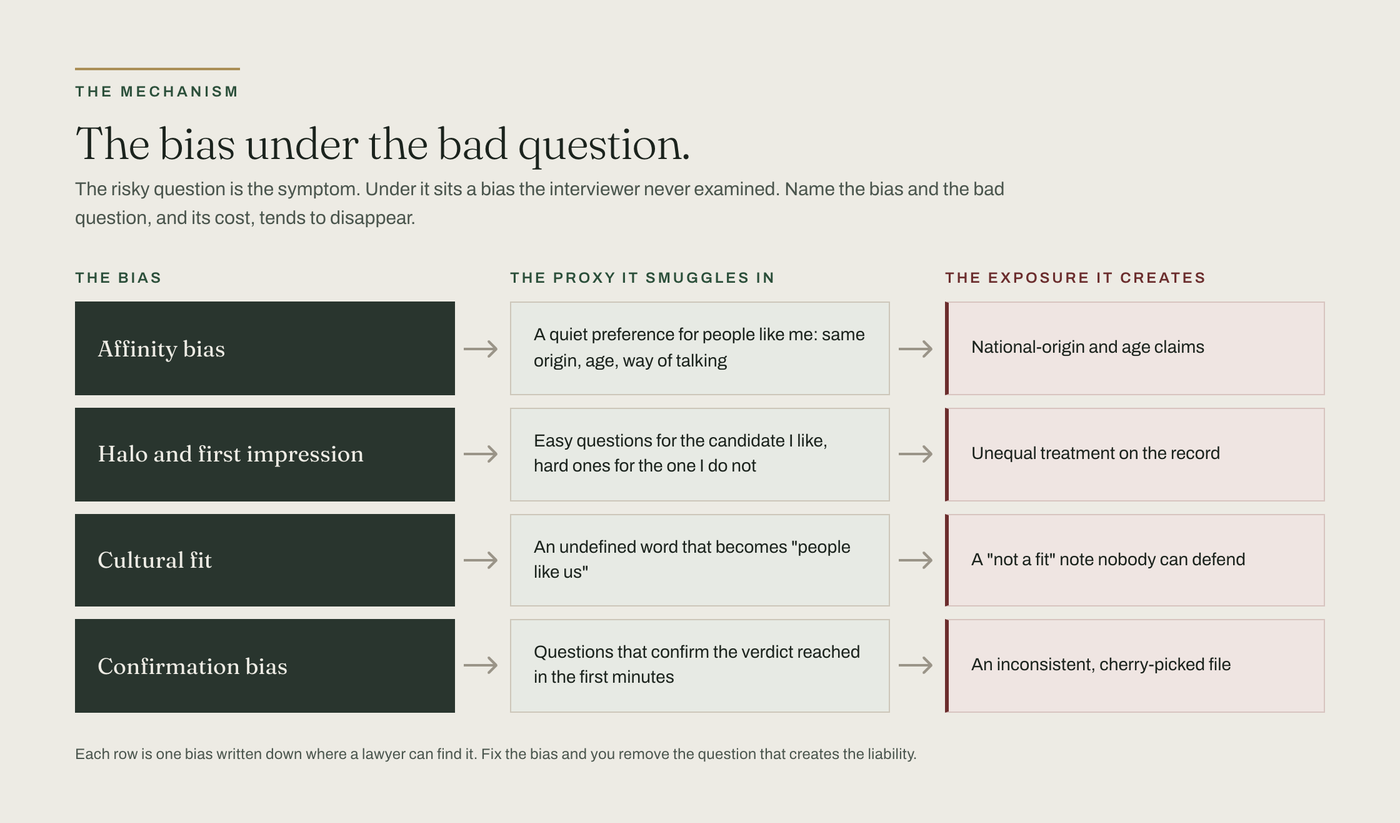
Every one of these is a failure of self-awareness before it is a failure of compliance. The bill arrives as legal risk, but the root is a leader who never checked their own thumb on the scale.
Where the liability comes from
Companies rarely get in trouble for a decision. They get in trouble for a sentence.
Once a personal detail is in the record, it can be used against you even when the decision had nothing to do with it. Staying disciplined removes three separate exposures. Evidence: one comment can become the candidate's whole case. Settlement pressure: weak claims still get expensive, because defense costs are high. Pattern exposure: repeated sloppy steps start to look like bias even when they are not.
Real examples, and every one of them is a bias from the last section written down where a lawyer could find it.
- A manager wrote "seems older, might not keep up." The concern was software skill. That is age bias on the page. The company settled.
- A manager told a rejected candidate, "you might be happier in a less physical role." They meant it kindly. It read as an assumption about disability. The company paid.
- Interview notes mentioned family plans while HR told the EEOC the decision rested only on certifications. The mismatch between the two explanations pushed the case forward.
- "Your English is great, by the way" tied directly to national origin. After the rejection, it became the heart of the claim.
- "We need somebody with real adulting skills" became a younger manager's evidence of age bias. The case survived, and a settlement followed.
- A rejection note read "not a cultural fit," and the company could not define the term. Optics beat intent.
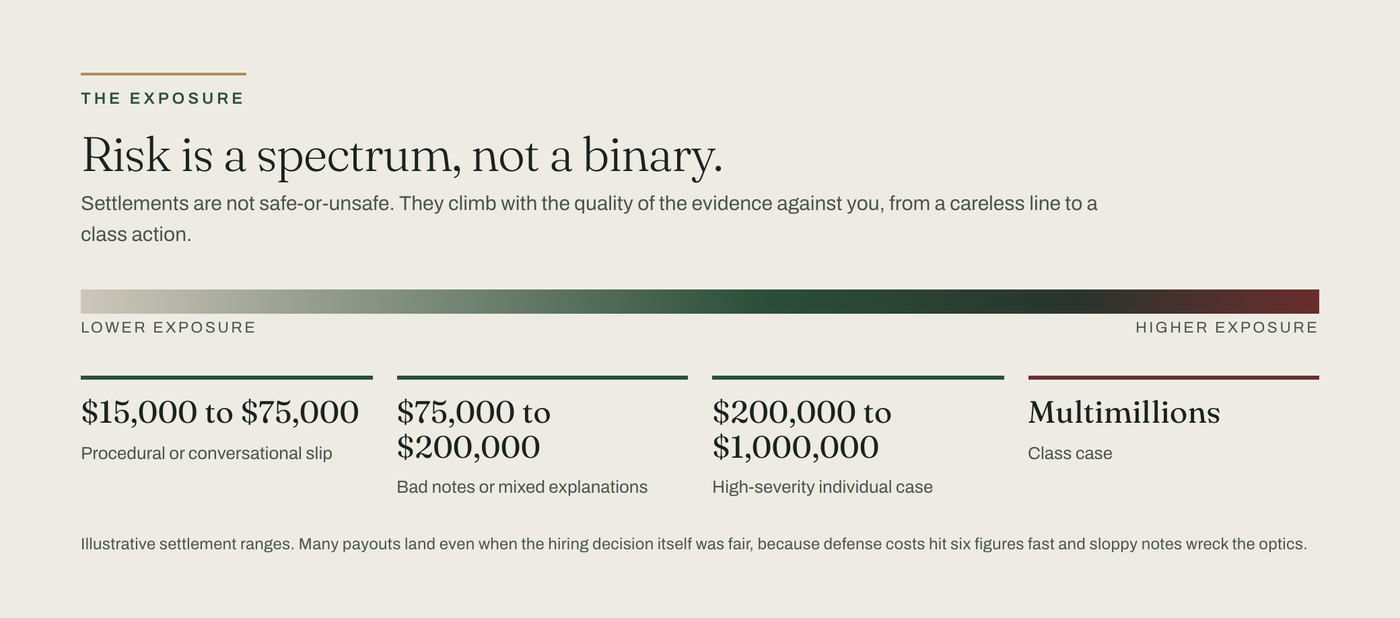
The hard part to swallow is that many of these payouts happen even when the hiring decision itself was fair. Companies pay because defense costs reach six figures fast, because sloppy notes make the optics terrible, and because inconsistent explanations weaken an otherwise good defense.
Construction adds its own accelerant. A project is short-staffed, a start date is slipping, and the hire gets rushed. Rushed interviews skip the form, lean on first impressions, and produce notes written fast and loose. The same schedule pressure that makes a manager want to fill the role today is the pressure that writes the sentence a lawyer reads next year.
Structure is what makes warmth defensible
There is an objection to all of this worth taking seriously. Good interviews run on real connection. Working relationships grow out of honest stories and human warmth. Open up and you expose the company. Guard everything and you lose the connection you needed to hire well.
Structure dissolves that tradeoff instead of splitting it. A structured interview keeps personal topics off the table and still lets a candidate tell you how they think, what they value, and how they solve problems. That is where the connection lives, and it happens to be safe ground.
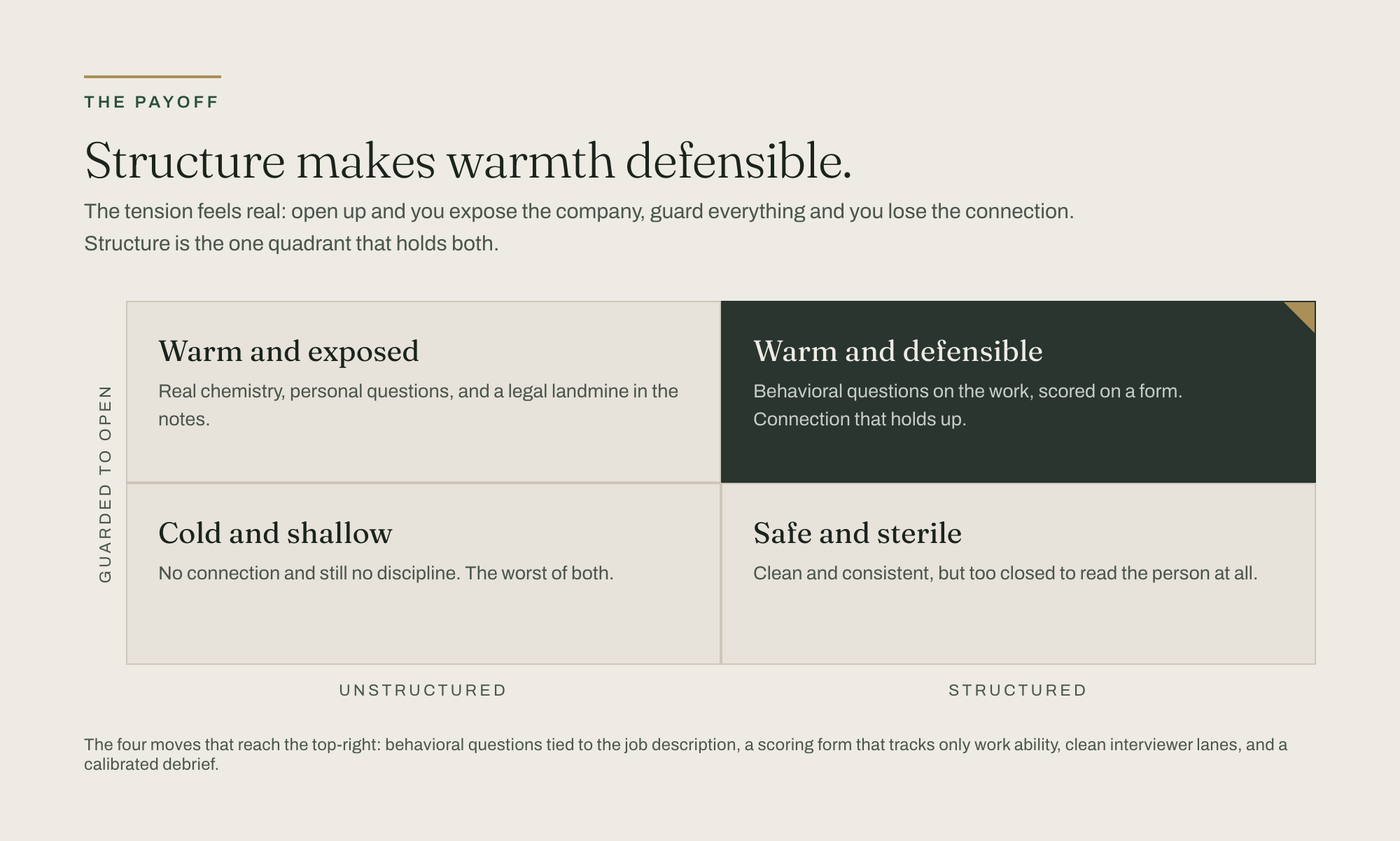
Four moves get you there, and all four are the working parts of a process this site covers in full elsewhere: behavioral questions anchored to the job description, a scoring form that tracks only work ability, clean interviewer lanes so nobody freelances into personal territory, and a debrief where everyone writes their read before anyone speaks. If you want the mechanics, how the questions themselves should work and how five reads become one decision are the two to read next. Those four moves are only the parts. What they add up to is a structure that carries the risk so the conversation does not have to.
Exposure runs on a gradient. It moves with context, with the quality of the documentation, with interviewer discipline, and with the strength of the process, which is why a rigid rule makes a poor substitute for judgment. The best leaders know where the exposure sits and reduce it without killing the human side of hiring.
There is a dignity argument underneath the legal one and it is the more important of the two. A candidate who is judged against a clear standard, asked the same real questions as everyone else, and scored on the work has been treated as a professional. A candidate who is sized up on background, accent, age, or how much they remind the panel of themselves has been treated as a category. Structure is how a leader extends the same respect to every person who walks in.
The questions you are afraid to answer
An interview has two people in it, and only one of them is being handed a list of things not to say.
Companies demand vulnerability from candidates. What is your weakness, where did you fail, what are you working on. Then the same companies withhold the things a candidate would need to decide well: the understaffing, the client relationship going sideways, the subcontractor nobody can manage, the last person who held this job and why they left. That is a double standard, and it produces exactly what you would expect. The hire arrives, finds out, and feels misled. They were never vetted against the real conditions, so nobody can be surprised when they do not hold up in them.
No recruiter can fix that gap after the fact. Hiding a leadership problem, a turnover pattern, or a toxic crew does not make it survivable. It just moves the discovery to a point where the person has already resigned somewhere else.
The candidate side is the mirror image. Overstating a capability to get past the interview lands you in a job engineered around a skill you do not have. Real courage in an interview sounds like "I have not done that directly, but here is the closest thing I have done, and here is how I would learn it." That answer builds more trust than a polished resume does, and any interviewer worth working for knows it.
So the standard runs both ways. Ask about the work and nothing else, answer honestly about the work including the parts that are hard, and the interview stops being a sales pitch pointed in two directions. That is when it becomes what it was supposed to be, which is a decision two people make together.
You cannot own a person
Widen the lens one more step and the same error shows up in how companies treat the people they already have.
Every recruiter in construction has taken the call: "I heard you are talking to one of our people." The word that follows is usually poaching, and the word does not survive scrutiny. You cannot steal a person. They are not property. If somebody leaves, it is because something about the other opportunity aligned better with what they were trying to do with their life. If hiring an employed person counts as theft, then so does bidding on a job another firm wanted, and nobody in this industry believes that.
It is also worth knowing that agreements between companies not to recruit each other's employees are illegal. The Department of Justice has been explicit. They suppress wages, limit mobility, and hurt the workers whose careers they quietly cap. There is no backroom version of retention.
What is left is the work itself, and it is the same discipline as everything above. Compete honestly. Target for genuine alignment rather than spraying every assistant superintendent within 50 miles. Assume the person is doing good work where they are, and do not trash their employer to make yourself look better. Tell the truth about the opportunity, including the hard parts. Stay accountable after the hire instead of disappearing. And if there are relationships you need protected, name them and they come off the list.
If your people are getting recruiter calls, the market is telling you what they are worth. Your job is to deserve their loyalty, not to demand it, and certainly not to arrange for nobody to be allowed to offer them anything better.
Compliance is a description of good hiring
Strip away the legal language and the spirit of all of this is one sentence: do not assume somebody's ability from what they look like.
Read that as a constraint and you will spend your career resenting it and occasionally violating it. Read it as a description of the job and it turns into the most useful hiring advice anybody will give you, because it is the same discipline that produces a good read. Hiring is an underwriting problem: you are pricing risk on a person you do not yet know, and the only honest way to do it is to evaluate the things that predict performance. Decision-making under pressure. Communication, not charm. Coachability. Problem-solving approach. Whether what they want next matches what this role is.
None of that appears in a birth year. The leader owns the outcome of the hire, and the leader who underwrites on evidence is already doing what the law assumes was happening all along.
So before your next interview: know what you are measuring and write it down, ask every candidate the same job-anchored questions, keep your notes about the work and nothing else, and say out loud the things about the job a reasonable person would want to know before saying yes. Do that and the liability question takes care of itself, because you removed the assumptions that create liability in the first place.
The bias you cannot see is the one writing your offer letters. Go look in the mirror before you look at the resume.
The short version.
- What interview questions are illegal to ask construction candidates?
- Anything reaching a protected characteristic: age or birthdate, religion, marital status, children or family plans, nationality or citizenship, disability or health, sexual orientation or gender identity, and political affiliation. Protections also cover race, color, national origin, pregnancy, and genetic information including family medical history. Where a legitimate need exists, ask the job-related version instead: whether the candidate is authorized to work in the country, or can perform the essential functions of the job with or without accommodation.
- When do EEOC protections start in the hiring process?
- At first contact. Job ads, emails, phone screens, the interview itself, and reference calls are all covered, so there is no warm-up period where the rules have not switched on. Most trouble starts in the unrehearsed moments, like the walk from the parking lot to the conference room.
- What should I ask instead of the overused classic interview questions?
- Replace each with a version anchored to the work. Instead of why we should hire you, ask where they see themselves adding the most value in this role based on their past projects. Instead of their biggest weakness, ask what skill or habit they have worked hardest to improve and how. Instead of where they see themselves in five years, ask what they are looking to achieve in their next role. The mechanics of asking and following up go deeper than a substitution list can.
- How do I ask about availability, schedule, or physical demands without crossing a legal line?
- Name what the work requires and ask whether the person can meet it. Say this job needs weekend work during peak phases, can you meet that schedule, rather than asking about kids or routines. Say this role requires lifting up to 50 pounds, are you able to do that with or without accommodation, rather than asking about injuries or health history.
- Why do companies pay settlements even when the hiring decision was fair?
- Because defense costs reach six figures fast, sloppy interview notes make the optics terrible, and inconsistent explanations weaken an otherwise good defense. One careless comment becomes the candidate's whole case once it is in the record, and repeated sloppy steps start to look like a pattern even when they are not.
- What biases cause most interview problems?
- Affinity bias, warming to the candidate who mirrors your background. The halo effect, letting a confident open stand in for competence you have not checked. Cultural fit used as undefined preference for people like us. Confirmation bias, spending the hour hunting evidence for a view formed in the first minutes. And the contrast effect, judging a candidate against whoever sat in the chair before them. The risky question is usually the symptom of one of these.
- How can an interview stay warm and human without creating legal exposure?
- Let structure carry the risk so the conversation does not have to. Behavioral questions anchored to the job description, a scoring form that tracks only work ability, clean interviewer lanes, and a debrief where everyone writes their read before anyone speaks. A candidate judged against a clear standard has also been treated as a professional, which is the point of fair hiring before compliance ever enters it.
- Is recruiting somebody from another construction company poaching?
- No. You cannot steal a person, because people are not property, and if somebody leaves it is because the other opportunity aligned better with their goals. Agreements between companies not to recruit each other's employees are illegal, because they suppress wages and limit mobility. If your people are getting recruiter calls, that is the market valuing them, and the answer is to deserve their loyalty rather than demand it.
- What should a company disclose to a candidate during interviews?
- The conditions a reasonable person would want before saying yes: understaffing, strained client or subcontractor relationships, why the last person in the role left, and what is genuinely hard about the job. Demanding vulnerability from candidates while withholding your own problems produces mismatched expectations and quick departures, and nobody can be vetted against conditions they were never told about.


