
Most hiring teams collect interview feedback the way they pick a lunch spot: a shrug, a vibe, a quick "I liked them." Then the debrief opens, the most senior person speaks first, and four interviewers walk out repeating what one of them saw. Leaders who can't see themselves clearly can't see candidates clearly, and a team that never captures its own independent judgment can't see either. The fix isn't better candidates: it's better leaders who own the process.
Written interview feedback is the cheapest piece of that process and the one most teams skip. I ask every interviewer on an Ambassador Group search to do one small thing: write down an evidence-backed judgment before talking to anyone. This guide covers how the process runs, how to prepare, how to rate, what to write, and what the written record exposes that a conversation never will.
What happens on every Ambassador Group search
- A prep packet arrives before you interview. It names your assessment lane, the goals for the conversation, suggested questions, and specific things to listen for. You never walk in cold.
- You run the interview. Ask, probe, listen. Ambassador Group records and transcribes the conversation, so nobody has to interview and take court-reporter notes at the same time.
- You write your feedback before you talk to anyone. A short form, finished in a few minutes while the conversation is fresh. This is the one firm rule in the process.
- The team debriefs. Discuss freely and disagree freely. The debrief is sharper because everyone arrives holding a position of their own.
- A fit analysis comes back. Ambassador Group lays the written perspectives side by side and checks them against what was said in the interview.
The written forms also tell the next round of interviewers what has been covered, what is still open, and where the team's read stands so far. Each interview builds on the last.
Prepare for your lane before the interview
The prep packet assigns you a lane: a slice of the job description you are responsible for assessing. Your minimum contribution is a real read on that lane. Anything you can add beyond it is a bonus.
Lanes exist because when everyone assesses everything, coverage is an inch deep across the board. Give each interviewer a defined focus and they go deeper, ask sharper questions, and return feedback a team can act on. The job description stops being a document and starts being a test. (Building the lanes is design work; How to Design an Interview Process covers it.)
Before you walk in, review three things: the job description, the interview strategy, and the competency areas on the feedback form you own. Then answer one question for each area: what does good look like in this role? You can't capture evidence against a standard you never defined.
Listen for evidence, not stories
Use behavioral prompts ("Tell me about a time...") to get real examples, and in your notes capture three things: what the candidate did, why they did it, and what happened. "Created a project checklist to improve team handoffs, reduced rework by 40%" is evidence of ownership. "Great presence, very confident" is evidence of nothing.
Write your feedback before you talk to anyone
Your independent read is the most valuable thing you produce in the hiring process, and it lasts a few hours. Once the debrief opens, it is gone: anchored to the boss, the loudest voice, or whoever spoke first. Written-first feedback keeps four independent reads alive long enough to compare them.
Writing first also turns disagreement from friction into signal. When written reads conflict, the cause is usually that interviewers noticed different things, weigh risks differently, or hold different definitions of the role. Every one of those is worth finding before an offer goes out.
And it changes how you listen. Knowing your judgment goes on paper with your name on it, you probe for evidence and stop running out the clock on a pleasant conversation. A reflection you have to sign is one you think harder about. An interviewer who resists putting anything in writing is usually telling you nobody ever taught them to interview.
The habit that makes this easy: take two minutes the moment the interview ends and jot the top two strengths, any concern or unclear area, and whether you would want to work with this person. With those notes in hand, the form takes five minutes, and nobody is reconstructing the interview from a fading memory.
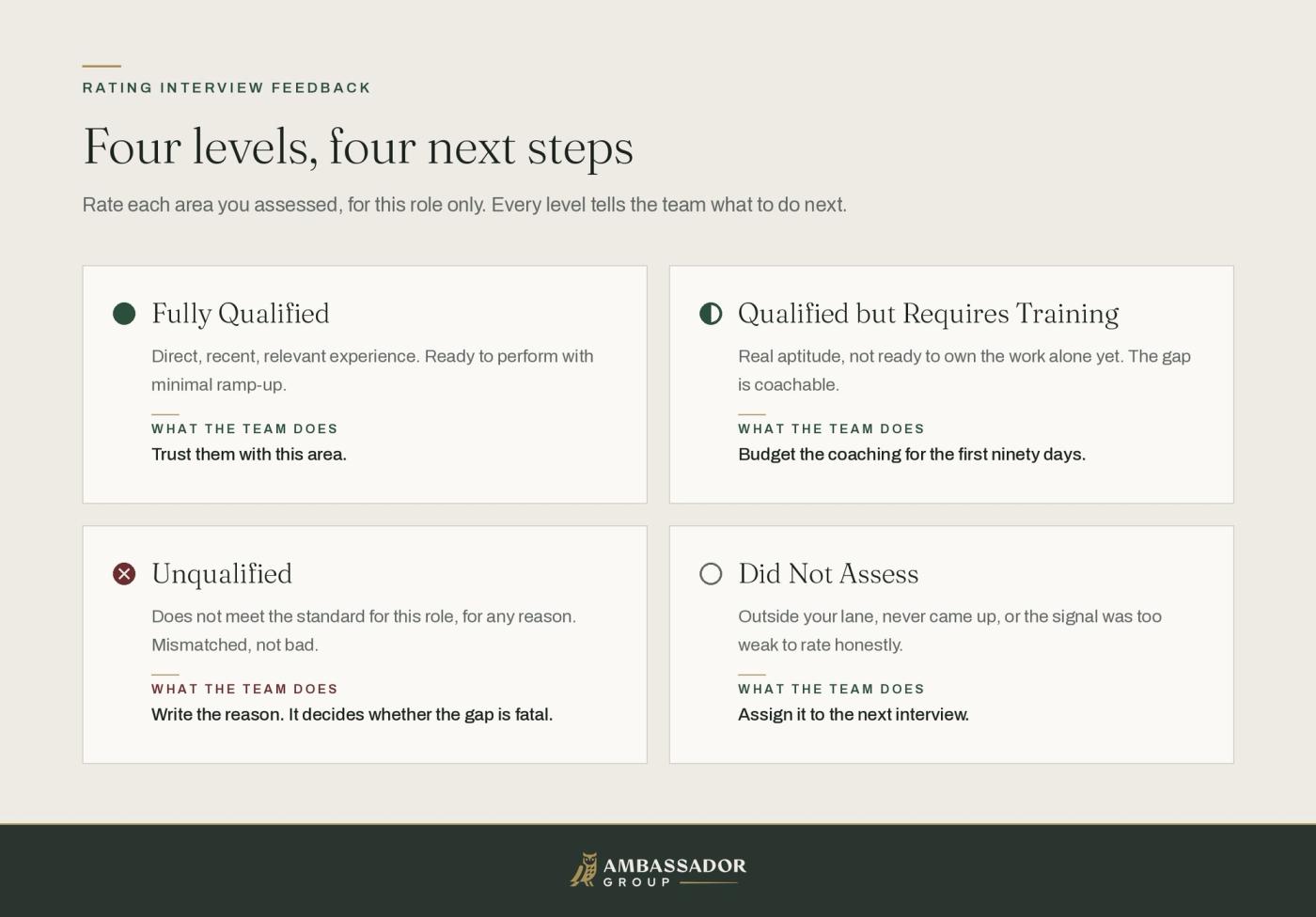
Rate each area in one of four levels
The form asks you to rate the candidate on each competency you assessed. Each rating covers this position only, not the candidate's general talent or worth.
- Fully Qualified. Direct, recent, relevant experience. Ready to perform with minimal ramp-up. Evidence looks like: "Described rebuilding accountability after a team turnover, tied specific actions to outcomes, handled resistance directly."
- Qualified but Requires Training. Real aptitude or transferable skill, but not ready to own the work alone yet. The gap is coachable. Evidence looks like: "Unfamiliar with Procore but adopted new project software quickly at the last company, with examples."
- Unqualified. Does not meet the standard for this competency in this role, for any reason: a skills gap, too much training required, or a philosophical mismatch. Evidence looks like: "Could not describe a specific dispute with a subcontractor or how it was resolved; answers stayed general."
- Did Not Assess. The area was outside your lane, never came up, or the signal was too weak to rate honestly. An honest Did Not Assess tells the team exactly what to follow up on. A half-informed guess hides it.
Why not a 1 to 5 scale
A numeric scale feels rigorous and produces noise. Nobody can define the difference between a 3 and a 4, one interviewer's 4 is another's 2, and the middle of the scale becomes a place to avoid deciding. Four plain levels need no calibration training and force a stance: ready, trainable, not a match, or not assessed. That produces data leadership can compare across interviewers and across candidates.
Unqualified means mismatched, not bad
Interviewers hesitate to write "Unqualified" because it sounds like a verdict on the person. A candidate can be excellent and still wrong for this role, and candidate quality is not the same as alignment. If someone is well qualified in general but not suited to this position's need, the honest rating is Unqualified, with your reasoning. The reasoning is what tells the team whether the gap is fatal or whether the person fits a different role.
A training rating is a budget line
Qualified but Requires Training is not a soft no. It names an investment: if you hire this person, they need coaching in a specific area during the first ninety days. Write what the training is, and say whether you believe the company has the time and people to deliver it. That sentence becomes the first line of the onboarding plan.
What to write, and what to leave out
Beyond the ratings, the form asks four short questions. Each one has a useful answer and a useless one.
What strengths stood out? Attach the evidence. "Clearly described leading a 12-person team through scope changes, stayed on schedule, built trust with the client" is usable. "Seems like a good leader" is not.
What, if anything, gives you pause? Surface uncertainty with context, not a verdict. "Struggled to describe how they handle critical feedback; may need coaching here" names the observation and its implication without condemning anyone. This is a question about open risks worth resolving, not a hunt for flaws.
What would they need to succeed? Listen during the interview for gaps in experience, a learning mindset, and whether they can ask for help or describe the conditions they work best in.
Would you hire them onto your team? Say yes, no, or yes with conditions, and why. If you are hesitant, write what would need to be true to change your vote. That line often becomes the next interviewer's assignment.
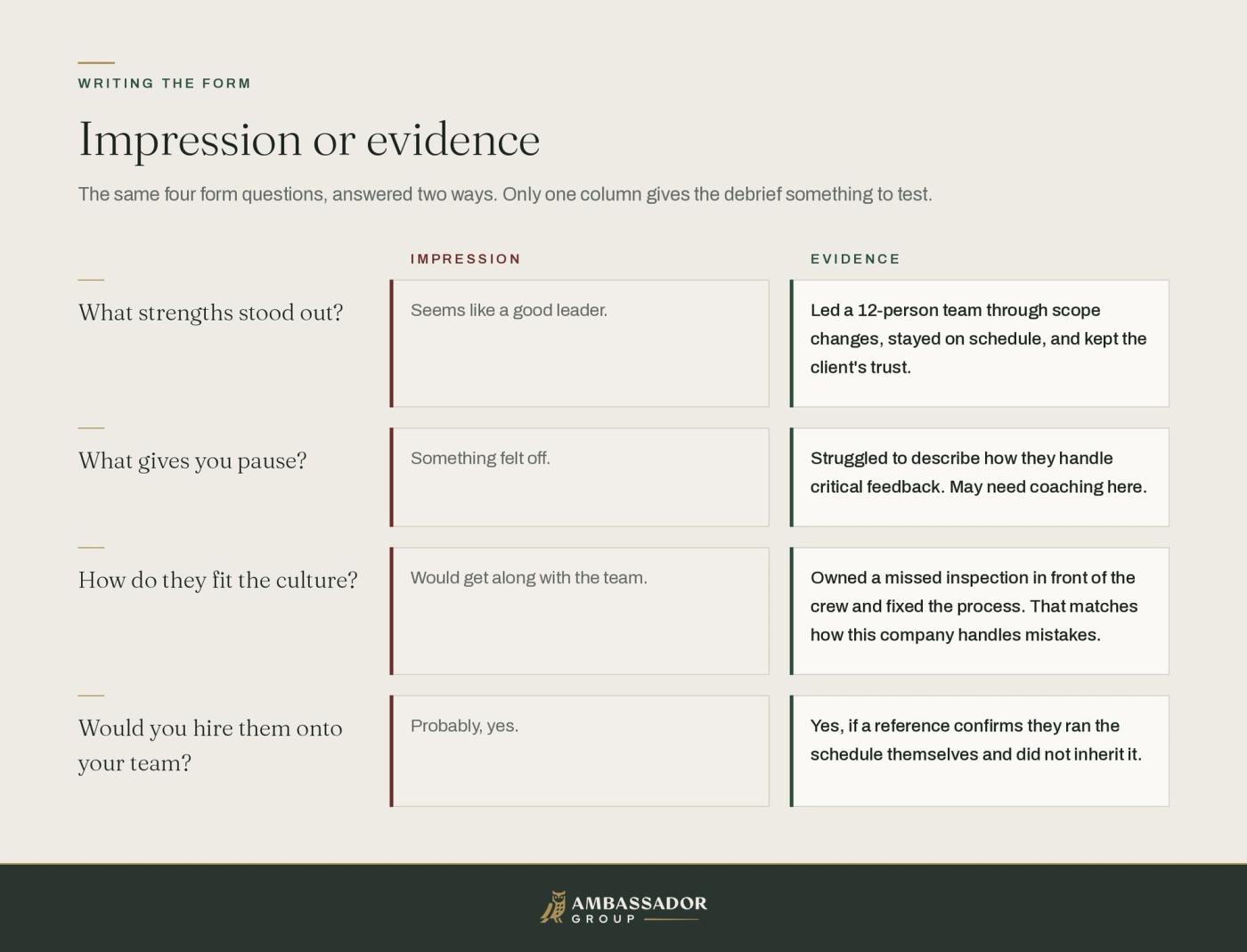
Culture deserves its own warning. The weakest feedback I see is about culture fit: "seems like a good fit," "would get along with the team." Those comments rarely reference a company value, a behavioral pattern, or a specific team dynamic. Culture gets felt, not defined, and a feeling cannot be underwritten. If you are assessing culture, name the value and the behavior you saw that supports or contradicts it. Fit is a verb, not a score.
What writing it down exposes
I started asking for written verdicts to get better reads on candidates. What the forms showed me more often was the team's own thinking.
Parts of the job nobody assessed
The moment an interviewer has to check Did Not Assess, the holes show. Nobody asked about schedule ownership. Nobody touched safety. Documentation never came up. Critical parts of the role disappear inside a pleasant conversation. That is a process problem, not a people problem, and the written form is what makes it visible while there is still time to schedule another conversation.
Hesitation means the standard is undefined
When interviewers hedge, over-explain, or stall on a rating, the cause is usually upstream: the team never agreed on what success in the role looks like or how to assess it. The written decision drags that absence into the open. The discomfort is the diagnosis.
"I talked about it" is not "I assessed it"
Newer interviewers check every box. Assessed? Yep. Read the notes and what they mean is that the topic came up. Talking about schedule ownership does not test whether this person can own a schedule when the job starts slipping. Catching that gap is one of the most useful coaching moments a hiring leader gets, and it only shows up on paper. (How to Interview covers the difference between investigating and observing.)
The team disagrees about the role
Written feedback exposes how differently the team understood the job. One person assessed strategic leadership; another graded task execution. One assumed field time; another assumed a desk. When two interviewers put the same candidate in different levels, that is rarely about the candidate. Caught at the interview, it costs a conversation. Caught after the offer, it costs a mis-hire and a year.
How the debrief runs once the forms are in
The debrief opens only after every form is submitted. Then it follows the forms, not the personalities.
- Reread your own notes first, so you speak from what you wrote while it was fresh.
- Go around the table before any debate. Each interviewer summarizes their read on their lane.
- Call on the quiet voices. The facilitator asks each interviewer for input before the floor opens, so the agreeable and the junior get heard.
- Senior leaders speak last. Their opinion moves everyone else's, so it waits until the independent reads are on the table.
- Compare evidence, not impressions. Where the forms agree, you have real signal. Where they split, dig into the specific answer each person heard. Where several say Did Not Assess, you have found a hole in the interview, not in the candidate.
- Close with agreements, open concerns, and next steps, written down.
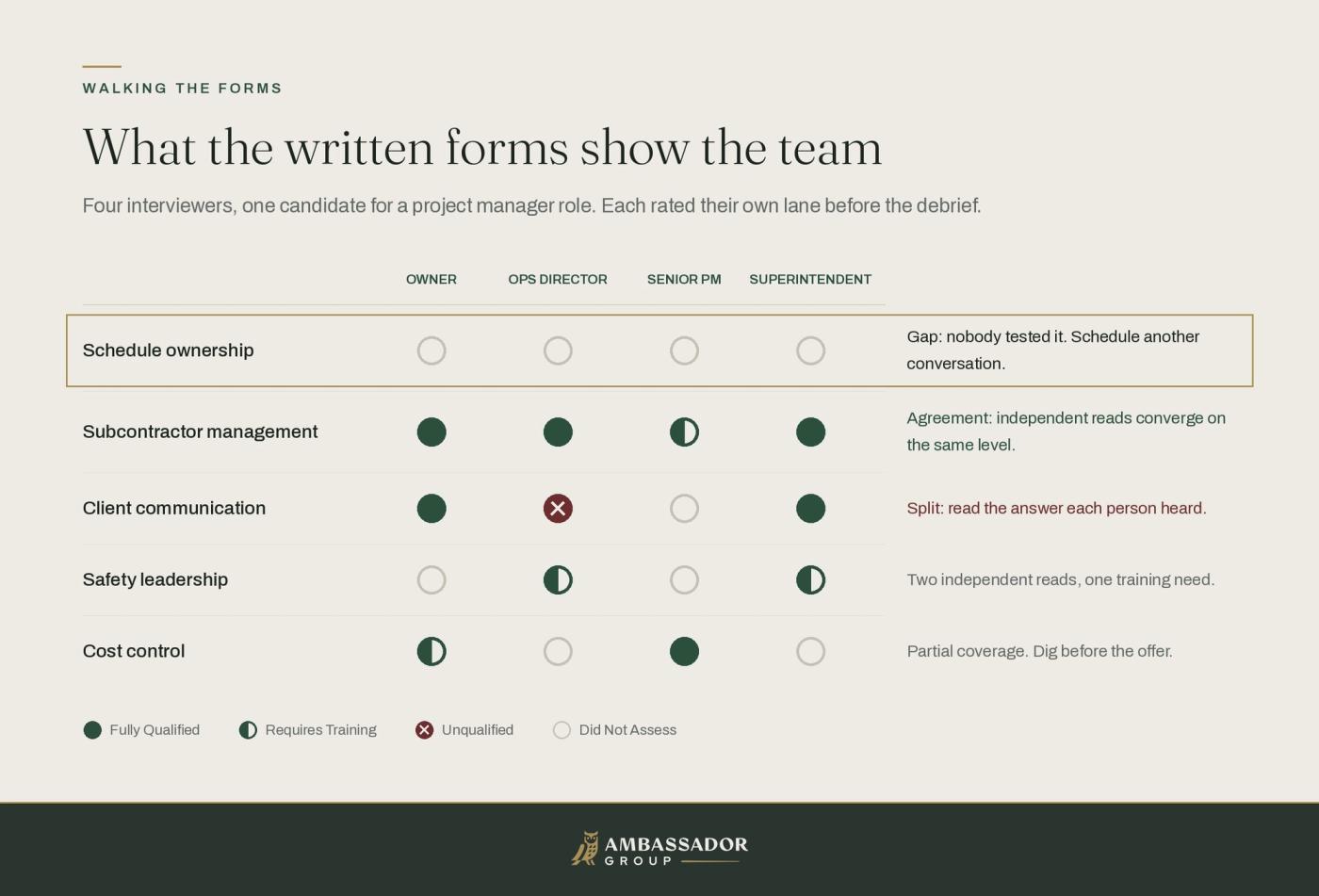
The debrief exists to stress-test conclusions that were formed independently. Consensus is a possible outcome, never the goal. How to Make a Hiring Decision goes deeper on turning five written judgments into one decision.
What the discipline buys you
Written, consistent feedback is documentation. It shows a hire was made through a disciplined, even-handed process, which is real protection if a decision is ever challenged. In states like California, that protection is worth a great deal.
It is underwriting. Every candidate carries risk, and the process exists to name it early enough to accept it, engineer around it, or walk away. That is the core of hiring in high resolution, and it is why Ambassador Group's replacement policy requires the process: each step buys down risk, and a skipped step is skipped risk mitigation.
And it trains you. The prep packet and the form are a working syllabus for what a disciplined interview evaluates, and a report card on how you ran yours. Run three searches this way and the lanes become how you listen.
Ambassador Group carries the logistics: scheduling, prep, transcripts, the form, the fit analysis. Your part is about an hour of interviewing and five minutes of writing. What cannot be delegated is the judgment itself. Write it down before anyone else speaks, and the hire gets your read at full strength.
The short version.
- Why do interviewers write feedback before the debrief?
- Because the first confident opinion in a debrief pulls every later opinion toward it. Writing first preserves each interviewer's independent read, forces evidence over impressions, and puts each judgment on the record with a name attached. Those independent reads are the raw material for a sound hiring decision.
- What rating levels should interview feedback use?
- Four: Fully Qualified, Qualified but Requires Training, Unqualified, and Did Not Assess. Each rating covers this position only. Four plain levels force a clear stance without calibration training, and Did Not Assess shows the team exactly which parts of the job still need a conversation.
- Why not rate candidates on a 1 to 5 scale?
- Nobody can define the difference between a 3 and a 4, one interviewer's 4 is another's 2, and the middle of the scale lets people avoid deciding. Defined levels produce data a team can compare across interviewers and candidates.
- Does rating a candidate Unqualified mean they are a bad candidate?
- No. It means they do not match this role's need, whether from a skills gap, too much required training, or a philosophical mismatch. A strong candidate who is wrong for the position should still be rated Unqualified, with the reasoning written down.
- What does it mean when interviewers rate the same candidate differently?
- Usually that the team holds different definitions of the role, not that someone misjudged the candidate. Split ratings are the most useful thing in a debrief: they show where to dig, and finding a misaligned role definition at the interview stage costs a conversation; finding it after the offer costs a mis-hire.


