
By the time a counteroffer lands on your candidate's desk, the outcome was usually decided weeks earlier, in conversations you were part of and probably read wrong. The offer letter is where you find out. It is not where the risk lived.
Most hiring leaders treat the counteroffer as a bolt from the sky. A strong candidate says yes, resigns, and then reappears three days later, apologetic, staying put. You lost the hire, the weeks, and the momentum, and it feels like something that happened to you. It wasn't. A counteroffer is a behavior, and behaviors are legible early to anyone underwriting the finish instead of only hoping for it. Hiring is where your judgment becomes visible, and the counteroffer is the part of it most leaders never learn to price. The fix isn't a more loyal candidate. It's a leader who reads the risk while there is still time to manage it.
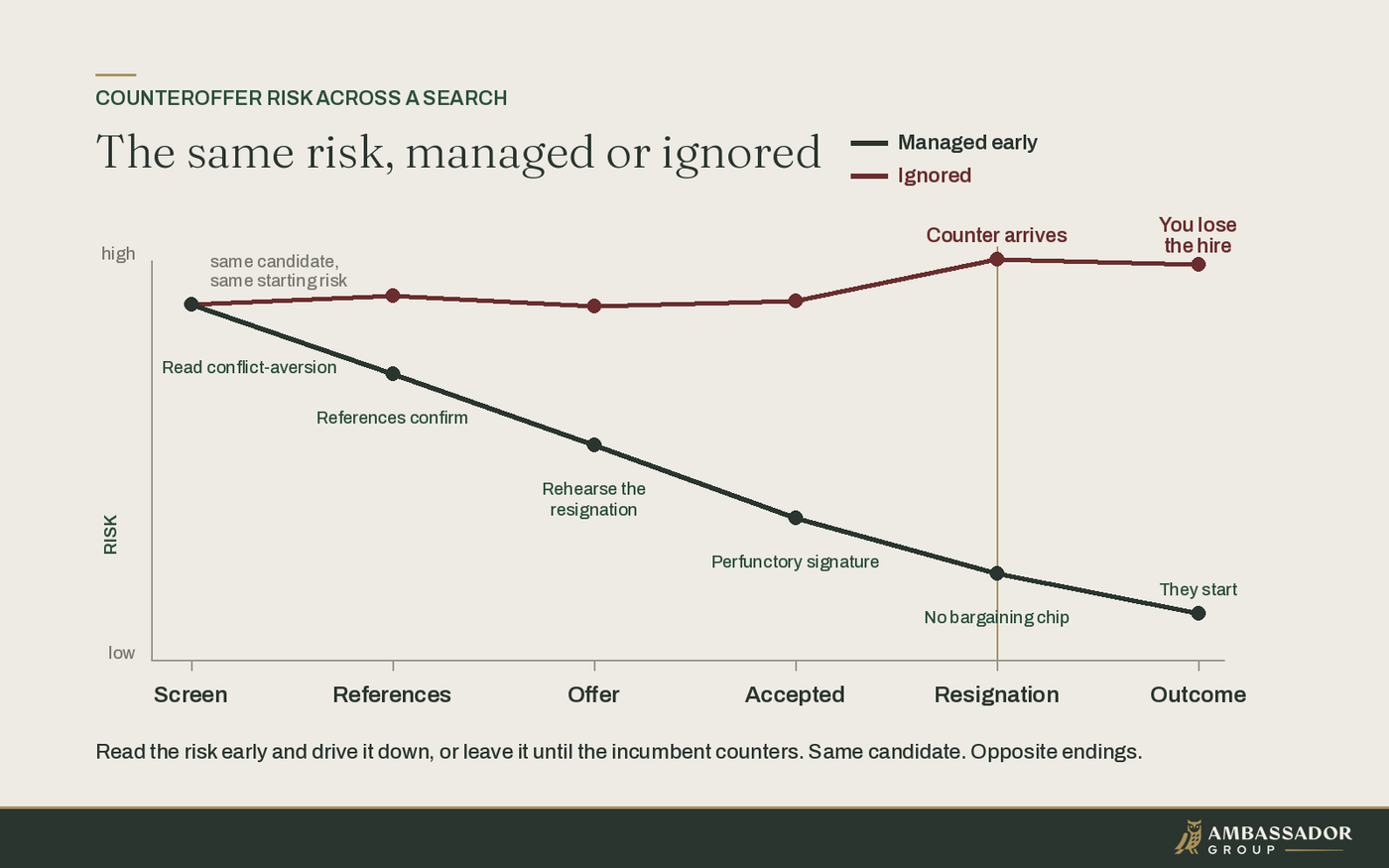
Two different things get called a counteroffer
The confusion starts with the word. Two very different events share the same name, and conflating them is how a good match dies at the finish line.
The first is the retention counter: your candidate’s current employer moving to keep them once they resign, or once they wave your offer around to force a raise. This is the risk. It is emotional triage, not structural change, and the case for declining it is well made elsewhere, so I won’t relitigate it here. Point your candidate to the five reasons to decline a counteroffer and let them own that decision.

The second is the candidate negotiating your offer. That one is healthy, expected, and coachable. It is not a threat, and treating it like one is a fast way to talk a good hire out of joining you.
I watched a candidate nearly lose himself in this exact confusion. A client had told him the offer was "a starting point." He took that to mean he was supposed to invent a counter, so he started building one, convinced he was doing what was asked. He wasn’t scheming. One loose sentence from the hiring side planted the whole idea. Before you react to the word, read which of the two you are in. Panic at a healthy negotiation and you manufacture the risk you were afraid of.
Read the person before you read the résumé
Some candidates were never going to reach for a counteroffer. Others were going to reach for one the day you met them. You can tell them apart early, and it has little to do with skill.
The tell is conflict-aversion, and one question surfaces it: what have they already done about their frustration with their current boss, and what was said? A candidate who has raised the hard thing, pushed on it, and gotten a real answer has shown they can hold a difficult conversation with the person who signs their checks. A candidate who is ready to interview, resign, and switch companies without ever once saying a word to their manager has told you exactly how they handle pressure. He is still worth pursuing. He is now a candidate you manage more closely from here forward.
The trait usually shows up twice, and the second signal is in the references. When people describe a candidate as someone who "needs to advocate more," "isn’t very pushy," or "could be more direct," they are forecasting the same behavior the screen surfaced. Read references as a behavior forecast, not only a competence check. Where both signals agree, you are looking at counteroffer risk. Carry that read all the way to the offer.
The candidate to brace for is not the schemer running your search to pry a counter out of their boss. That one is rare and obvious, and the fix is to stop. The one who costs you the hire is the pleasant, agreeable, inexperienced candidate who does not yet know that carrying a live offer back to their boss is a move with consequences. They think they are being transparent, even loyal. Nobody told them otherwise. That is the stretch where a good match dies quietly, precisely because nothing feels dangerous while it happens. The fishing signals worth catching early are the companion read to this one.

Rehearse the resignation before you make the offer
A counteroffer risk you have named is one you can manage. One you haven’t is a phone call you take on a Tuesday. For a candidate you have flagged, stand closer than you would to anyone else.
Rehearse the resignation before the offer goes out, not after. Walk the hardest version of that conversation once, in a low-stakes setting, so it is not brand new on the day it counts. Make the candidate say their own reasons for leaving out loud, in their own words. A reason a candidate owns is far harder for a boss to dissolve over lunch than a reason a recruiter handed them. There is a good resignation playbook to hand them for this.

The one instruction that prevents most of the damage: never let the resignation become a bargaining chip. Coach the candidate not to have the "I have another offer" conversation with their current employer at all. There are only two clean paths. Accept a good offer and resign, or work out the growth and comp issues with the current employer on their own terms, without wielding a competing number. Waving a competing number invites a counter and burns the bridge with you, the leader who just spent weeks investing in them.
Run the negotiation, don’t fear it
When it is the healthy kind, the candidate negotiating your offer, your job is to set the terms of a good negotiation, not to argue them out of having one.
Tell them plainly: you can negotiate anything, and the key is justifications. This is their career and a set of relationships they hope to keep for a long time, not a garage-sale haggle or a bidding war, and whoever justifies better wins. Make the candidate articulate the reason behind every ask. The exercise itself vents the pressure. "I want more money" becomes "here is why I am worth it," and the answer to that second question is the actual negotiation. There is more on this in why hiring is all negotiation.
Getting to yes is the easy part. Getting to a yes they will not relitigate later is the job. If they raise a number, still walk their full thought process, so all of the pressure vents in front of you. Pressure that does not vent gets relitigated later as "was that a mistake," which is exactly the doubt a retention counter feeds on. Steer without making anyone feel cornered.
Coach your own offer so you don’t invite a counter
The counteroffer risk is not only on the candidate’s side of the table. Some of it you author yourself.
Do not plant seeds. A leader who calls the offer "a starting point" invites a counter that was never needed. Make a strong, justified offer and present it as one. A tentative negotiator reads as low confidence, and a candidate feels that hesitation and indexes on it. Even a company that historically makes solid offers can create a scramble with one loose sentence at the worst possible moment. Get comp clarity early, well before the offer, so you can build a package that is clearly better on the whole, not on salary alone. The pre-offer checklist exists to keep this from becoming a last-minute scramble.
Signing the offer letter should be perfunctory. The decision was made before it arrived. If it isn’t, you skipped a step upstream. Be honest with yourself about the real probability rather than the optimism you can talk yourself into, and name the dark horses out loud: the quiet incumbent who has not tipped their hand, the other firm still lingering in the picture. A counteroffer you named in advance is a risk you managed. One you didn’t is a bad surprise you both wear.
The counteroffer that catches you off guard was almost always visible weeks before it arrived. The only question is whether you were reading.
The short version.
- What is counteroffer risk when you are hiring?
- It is the chance that a candidate you have offered accepts a retention counter from their current employer and stays put after resigning. The risk lives in the weeks before the offer, not in the offer letter — it is a behavior you can usually read early, not a bolt from the sky.
- Is a candidate negotiating my offer the same thing as a counteroffer?
- No, and conflating the two is how a good hire dies at the finish line. The retention counter — the current employer moving to keep them — is the risk. A candidate negotiating your offer is healthy, expected, and coachable; treat it like a threat and you can talk a good hire out of joining you.
- How do I spot counteroffer risk in a candidate early?
- The tell is conflict-aversion. Ask what the candidate has already done about their frustration with their current boss and what was said; someone who has never raised the hard thing is more likely to buckle when their employer pushes back. References echo it — phrases like "needs to advocate more" or "could be more direct" forecast the same behavior.
- Should a candidate use my offer to negotiate a raise from their current employer?
- No. Coach them never to have the "I have another offer" conversation with their current employer. Waving a competing number invites a counter and burns the bridge with you. The two clean paths are to accept a good offer and resign, or to work out growth and comp with the current employer without wielding a competing number.
- How do I avoid inviting a counteroffer myself?
- Do not plant seeds. Calling your offer "a starting point" invites a counter that was never needed. Make a strong, justified offer and present it as one, get comp clarity early so the package is clearly better on the whole, and rehearse the resignation with the candidate before the offer goes out. Signing the letter should be perfunctory, because the decision was made before it arrived.


