
The best construction safety manager interview questions test three things: whether the candidate builds safety ownership into superintendents and foremen or polices it alone, whether they manage to leading indicators or to the OSHA log, and whether they hold a line when the schedule pushes back. Ask each candidate to walk you through a site-specific safety plan they wrote, an incident they investigated to root cause, and a time they stopped work, then ask for the document behind each answer. That is the short version. The longer version starts with the person asking the questions. The quality of this hire is principally driven by you, the interviewer, not by the candidate. A strong safety manager can be read by a sharp interviewer and missed by a dull one. The questions are instruments. The discipline of listening is yours.
Most lists of safety manager questions test whether a candidate knows the regulations. Plenty of people can recite the fall protection trigger height and define a competent person. Very few can get a superintendent with 30 years in the trade to treat a pre-task plan as their own tool. That second skill is the job, and it is the one a question list never reaches.
Interview to the 3 places this role breaks down
A safety manager touches everything on a jobsite and controls almost none of it. They rarely sit in the line of authority over superintendents, foremen, or subcontractors. The role succeeds through influence, credibility, and systems, so it breaks in three places:
- Safety becomes one person's job. The program lives in the safety manager's truck. When they are on site, crews tie off and the paperwork is current. When they leave, the job runs the way it always ran, and the superintendents have learned that safety belongs to someone else.
- The numbers look good and the job is not safe. A clean OSHA log can mean a safe operation, or it can mean injuries go unreported, near misses never get written down, and someone is managing the program for the insurance renewal.
- They lose the production argument. When a PM or an owner pushes on schedule, a weak safety manager either folds or digs in on every point until the field routes around them. Both outcomes end with the safety manager out of the decisions that matter.
Every probe below comes from one of these. If a question does not help you predict how this person behaves at one of those three points, cut it.
The 6 accountabilities of the role
The map of the job, and the structure of the interview:
- The safety program and site-specific planning
- Hazard control in the field
- Turning field leaders into safety leaders
- Subcontractor safety
- Incidents, investigations, and regulators
- Measuring what matters
What follows is a small set of probes per accountability, each with what to listen for, how to tell a seasoned answer from a rehearsed one, where to follow up, and the evidence to ask for. Depth beats volume. A few questions you know how to read are worth more than forty you do not.
The safety program and site-specific planning
A written program is table stakes. Every company has a binder. What you are hiring for is the person who can turn a company program into a plan for one specific site, with its own access, its own high-hazard phases, and its own neighbors, and then get the field to use it.
"Walk me through the last site-specific safety plan you wrote. What made it specific to that site?"
- What you are listening for: whether the plan started from the job or from a template. A real site plan names the site's actual exposures: the excavation next to the occupied building, the crane swing over the sidewalk, the phase where three trades stack on one floor.
- Novice tell vs. seasoned tell: the novice describes the sections of the plan. The seasoned candidate describes the two or three hazards that drove it and what changed on site because of the plan.
- Follow-the-thread: ask who read it besides the safety manager. Ask what the superintendent changed in it. Ask when it was last updated, and what triggered the update.
- Evidence ask: the plan itself, redacted for the client's name. If they work in California, ask for an Injury and Illness Prevention Program they wrote or rebuilt, since California requires every employer to have one.
"If you inherited a written program nobody uses, what would you do in your first 90 days?"
- What you are listening for: sequence and restraint. The strong candidate learns how the field works before rewriting anything, finds the two or three gaps that carry the most risk, and fixes those first.
- Novice tell vs. seasoned tell: the novice rewrites the manual. The seasoned candidate walks every active job, talks with the superintendents, and starts with the practices that are already half working.
- Follow-the-thread: ask which part of a program they would leave alone. Ask how they would know at day 90 whether anything had changed in the field.
Hazard control in the field
This is where the role is visible on the deck. The question is whether the candidate controls hazards before the crew mobilizes, or finds them on an inspection walk after the work is in place.
"What is the highest-hazard activity on a typical project here, and how would you control it before the crew starts?"
- What you are listening for: planning that happens upstream of the work. Fall exposure, trenching and excavation, crane picks, and energized work all have controls that belong in the schedule and the sub's scope, well before anyone is on site.
- Novice tell vs. seasoned tell: the novice says they would inspect it closely. The seasoned candidate describes a pre-task plan built with the foreman, the competent person named in advance, and the equipment and access worked out at preconstruction.
- Follow-the-thread: ask who signs off before the work starts. Ask what happens when the plan meets the field and the conditions are different from the drawings.
- Evidence ask: a completed job hazard analysis or pre-task plan with the crew's sign-off, or a critical lift plan they reviewed.
"Tell me about a time a PM or an owner pushed back on a safety requirement because of the schedule. How did it end?"
- What you are listening for: the third breaking point, tested directly. You want someone who can hold a line without becoming the person the field works around. That takes knowing which requirements are fixed and which have more than one safe way to meet them.
- Novice tell vs. seasoned tell: the novice tells a story where they won by citing the regulation. The seasoned candidate tells you how they found a safe path that protected most of the schedule, and where they refused to move and why.
- Follow-the-thread: ask what they gave up. Ask whether that PM came to them earlier on the next job. A safety manager who gets invited into the planning earlier has won the larger argument.
- Red flag: a candidate who has never been overruled, or who describes every disagreement as the field not caring. Either they have not been in the hard conversations, or they do not hear the other side of them.
"Tell me about the last time you stopped work."
- What you are listening for: that they have done it, that they understood the cost, and what they fixed after. The stop is the easy part. The question is whether they fixed the condition that created the hazard, or only the hazard in front of them.
- Novice tell vs. seasoned tell: the novice speaks in slogans about safety coming first. The seasoned candidate names the condition, the cost in hours, the conversation with the superintendent, and the change that kept it from coming back.
- Follow-the-thread: ask who else on that site could have stopped the work, and why they had not. That answer tells you whether stop-work authority is real for the crew or only real for the safety manager.
Turning field leaders into safety leaders
This accountability maps to the first breaking point, and it is the one that separates a safety manager from a safety inspector. A company with one safety manager and eight active jobs cannot be safe through that person's presence. It can only be safe through its superintendents and foremen.
"How do you get a superintendent who sees safety as your job to take ownership of it?"
- What you are listening for: a method for building ownership, beyond enforcement. Coaching the superintendent to run the safety portion of the morning huddle, letting the foreman build the pre-task plan, and giving credit in public when the field catches its own hazard.
- Novice tell vs. seasoned tell: the novice describes write-ups and escalation to the superintendent's boss. The seasoned candidate describes a specific superintendent, what that person cared about, and how they connected safety to it.
- Follow-the-thread: ask what they do when the coaching does not work. Escalation has its place. You are listening for whether it is the first tool or the last one.
- Red flag: a candidate who describes the field as the problem, in general terms, more than once. They will be running a police force within six months.
"Who on your last job could have run the safety program for two weeks if you were out?"
- What you are listening for: whether they built a system or became one. A strong safety manager can name the superintendent or foreman who could have carried it, and explain how that person got there.
- Novice tell vs. seasoned tell: the novice says nobody, sometimes with pride. The seasoned candidate names people and tells you what they would still worry about.
- Evidence ask: a toolbox talk a foreman delivered that the candidate helped write, or the roster of competent persons they trained and designated.
Subcontractor safety
On a typical general contractor job, much of the workforce on site belongs to subcontractors. The safety manager's influence over them comes before the contract and through the contract. A weak one discovers a sub's program on the day of an incident.
"How do you decide whether a subcontractor is safe enough to work on the job?"
- What you are listening for: prequalification that goes past collecting documents. Experience modification rate, recordable rates, and a written program are the start. The strong candidate also checks who will run the sub's crew on site, and how the sub handled its last serious incident.
- Novice tell vs. seasoned tell: the novice describes a checklist. The seasoned candidate describes a scored judgment, and a time they recommended against a low bidder on safety grounds or attached conditions to the award.
- Follow-the-thread: ask what they do when the only sub who can perform the scope on schedule has a poor record. The honest answer involves conditions, oversight, and a decision made with the PM, rather than a flat yes or no.
- Evidence ask: a subcontractor prequalification scorecard they built or used, or a sub-specific safety requirement they wrote into a scope.
Incidents, investigations, and regulators
Every safety manager eventually gets the phone call. How they handle the hour after it, and the weeks after that, shows you what they believe causes incidents.
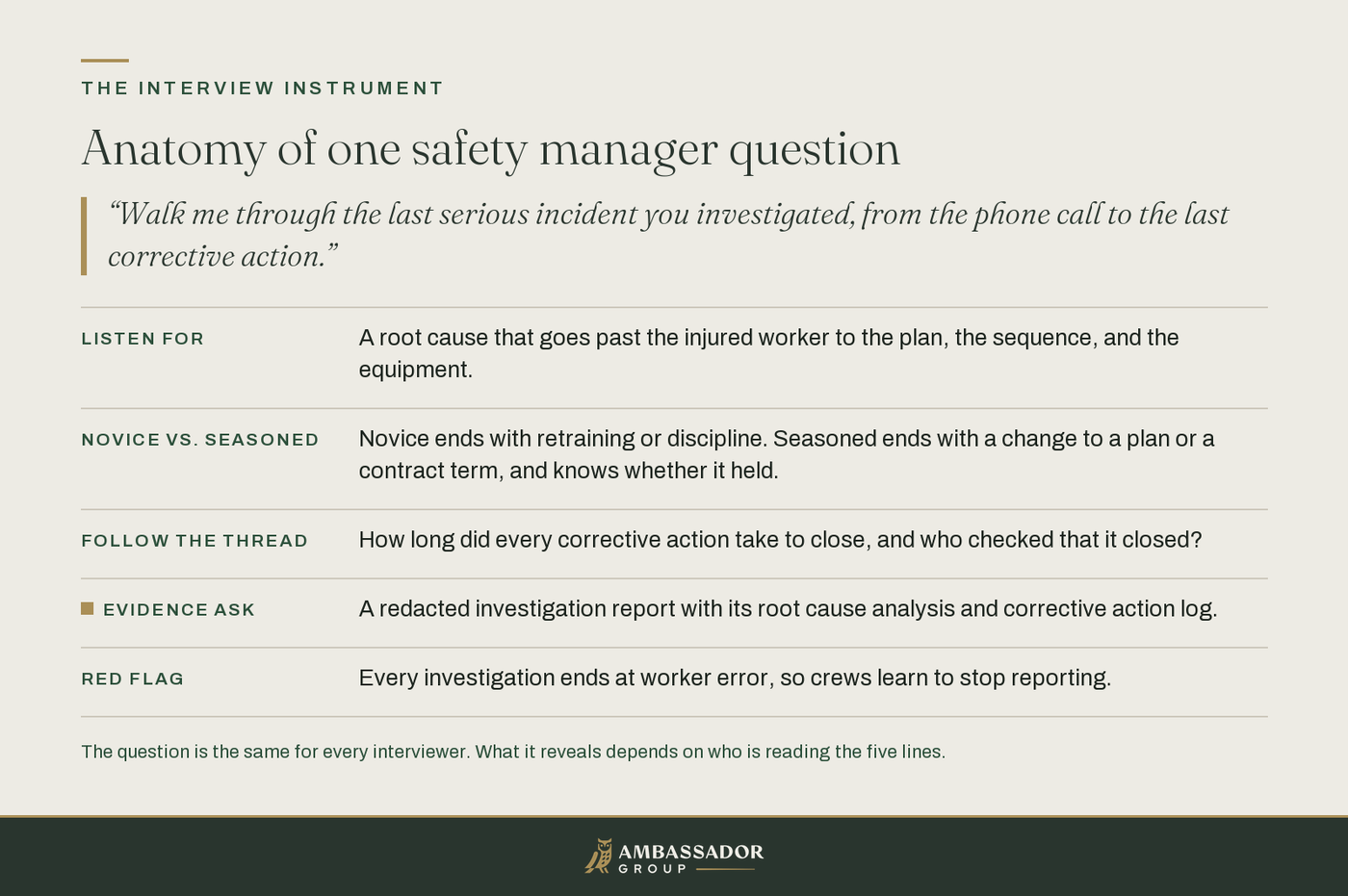
"Walk me through the last serious incident you investigated, from the phone call to the last corrective action."
- What you are listening for: a root cause that goes past the injured worker. "He did not follow procedure" is where an investigation starts. Why the procedure was hard to follow, why nobody stopped it, and what in the planning set it up is where it finishes.
- Novice tell vs. seasoned tell: the novice ends with retraining or discipline. The seasoned candidate ends with a change to a plan, a sequence, a piece of equipment, or a contract term, and can tell you whether the change held.
- Follow-the-thread: ask how they cared for the injured worker and the crew that saw it. Ask how long it took to close every corrective action, and who checked that they were closed.
- Evidence ask: a redacted incident investigation report with the root cause analysis and the corrective action log.
- Red flag: a candidate whose investigations consistently conclude with worker error. Crews who watch every investigation end in blame stop reporting injuries, which leads straight to the second breaking point.
"A compliance officer from OSHA shows up at the gate. What happens in the next hour?"
- What you are listening for: composure and a plan that already exists. The seasoned answer covers who gets called, how the opening conference runs, who accompanies the inspector on the walk, and how the company documents what the inspector documents.
- Novice tell vs. seasoned tell: the novice talks about stalling or cleaning up first. The seasoned candidate treats the inspection as a process with known steps, stays cooperative, and keeps the walk focused on the scope the inspector came for.
- Follow-the-thread: ask about the last citation they contested or settled, and what changed in the program afterward.
- Red flag: any answer that involves hiding conditions or coaching workers on what to say. That is a legal exposure, and it tells you how they will behave when your company has a bad day.
Measuring what matters
This accountability maps to the second breaking point. Lagging numbers like the recordable rate and the experience modification rate tell you how last year went, and insurers price them. Leading numbers tell you what is about to happen, and they are the only ones a safety manager can manage directly.
"What numbers do you report to leadership every month, and which one do you trust least?"
- What you are listening for: a mix of leading indicators (near-miss reports, observations, pre-task plan quality, how fast corrective actions close) and lagging ones, with a clear view of how each can mislead.
- Novice tell vs. seasoned tell: the novice reports the recordable rate and days without an incident. The seasoned candidate tells you that a rise in near-miss reports is often good news, because it means crews trust the system enough to use it.
- Follow-the-thread: ask how they would respond to a month with zero near-miss reports across every job. Ask what they would tell leadership if the numbers looked better than the job felt.
- Evidence ask: a monthly safety report or dashboard they produced for leadership, with the commentary they wrote alongside the numbers.
- Red flag: enthusiasm for a zero-injury bonus paid on the recordable rate. Crews learn to stay quiet when the bonus rides on the recordable rate, and a safety manager who has not seen that happen has not looked closely.
What the candidate asks you matters as much as how they answer
The interview runs both ways. A safety manager worth hiring has been hired before by a company that wanted a program on paper and a person to blame, and they are checking whether you are that company.
Listen for questions about authority and backing: whether a superintendent who stops work for a valid reason is supported or second-guessed, who the safety manager reports to, whether safety has a voice in preconstruction and sub selection, what the recordable and near-miss history looks like, and why the role is open. A candidate who asks only about the vehicle and the territory has not thought hard about the work. A candidate who presses on whether leadership will back an unpopular call is showing you the judgment you are trying to hire.
This part of the interview tests you too. If you cannot answer honestly where your company's safety culture is weak, you are asking the candidate to fix a problem you have not admitted to having. Answer straight. The match that lasts is the one where both sides saw clearly, and the job has to fit the candidate as much as the candidate fits the job.
Do not leave the interview without capturing it
Memory is a poor tool for a hiring decision. By the third candidate the first is a blur, and the most recent one feels strongest because they are the most recent. The fix is mechanical.
- Write your assessment before you talk to anyone. Each interviewer writes a read against the six accountabilities before the debrief. Written-first feedback keeps the loudest voice from anchoring everyone else.
- Tally the risk instead of averaging a feeling. For each accountability, decide whether you will fill the gap with this person as they are, engineer around it with the team you put around them, or decline to accept it. That is underwriting, and it is a cleaner decision than a thumbs up.
- Name what you did not assess. If you never got real evidence on incident investigation, write "did not assess." A column full of those is a verdict on your interview, and it tells you what the reference call has to cover.
- Decide against the role. The question is whether this person clears the bar for the job. Ranking them against two other candidates who may all fall short answers a different question.

Hire in 4K lays out the whole discipline: a scorecard, a structured interview, and a reference call in place of a gut call. This guide is one field application of it.
Hear the answer, then check your own hearing
A safety manager hire is easy to get wrong in a way that looks fine for a long time. A candidate who knows the regulations and runs a tidy inspection will keep your paperwork current, and the gap between the paperwork and the deck will stay invisible until someone gets hurt. The interview is where you find out which kind of safety manager you are talking to, and that depends on how carefully you listen.
The same instrument runs on every leadership role in the field. The construction superintendent interview questions test the person who owns safety culture on a single site, and the construction project manager interview questions and construction estimator interview questions apply it to the office side of the job. The Seven Levels of Interviewing Mastery lays out how the skill compounds, and Be the Lightning Rod makes the case that the outcome of this hire lands on you either way.

You already have the questions. What you hear in the answers is up to you.
The short version.
- What should a construction safety manager interview test?
- The three places the role breaks: safety turning into one person's job, good numbers on a job that is not safe, and losing the argument with the schedule. Build the interview around six accountabilities: the program and site-specific planning, hazard control in the field, developing field leaders, subcontractor safety, incidents and regulators, and measurement. Ask for the document behind every answer.
- What are the best interview questions for a construction safety manager?
- Ask the candidate to walk through the last site-specific safety plan they wrote, the last serious incident they investigated from the phone call to the last corrective action, and a time a PM or owner pushed back on a safety requirement because of the schedule. Then ask who could have run their program for two weeks if they were out, and which safety number they trust least.
- What red flags should I watch for when interviewing a safety manager?
- Investigations that always conclude with worker error, a candidate who has never been overruled or never stopped work, enthusiasm for a zero-injury bonus paid on the recordable rate, and any answer to an OSHA inspection that involves hiding conditions. Each one predicts a program that looks compliant on paper while crews stop reporting.
- How is a safety manager different from a safety coordinator or a safety director?
- Titles vary by company. In general, a safety coordinator inspects and runs daily safety activity on one or two sites, a safety manager owns the program and its field execution across the company's active work, and a safety director sets strategy across regions, insurance, and executive reporting. At a 25 to 200 person general contractor, the safety manager often carries parts of all three.
- What evidence should a safety manager candidate be able to show?
- A site-specific safety plan they wrote, a completed job hazard analysis with the crew's sign-off, a redacted incident investigation with its corrective action log, a subcontractor prequalification scorecard, and a monthly safety report they produced for leadership. Real documents from real jobs separate a practitioner from someone who can recite the regulations.


