
"What should we pay a PM?" "What is market rate for my skillset?" "My superintendent wants a raise, and we might need to find a new one."
Some version of those three questions comes up frequently, and they share one flaw. They treat pay as a number you look up instead of a decision you own.
There is no accurate answer to any of them without your specifics. What is your contract model, lump sum or cost-plus or unit pricing? What are your margins and your cash flow? Do you have reliable, high-performing teams, or are you covering for weak players? How do you measure leadership effectiveness and project outcomes? Without those, any salary recommendation is a guess, and a survey number is a guess with a decimal point.
Pay is also one of the clearest mirrors a leader ever looks into. A number copied off a salary survey reflects nothing back except the absence of a philosophy.
Asking the market is asking the wrong question
Asking what the market pays a superintendent is a little like asking the going rate for a two-by-four. For the board the question makes sense, because every board is supposed to be the same: same dimensions, same species, same grade, interchangeable on the rack.
People are the opposite. The closer you look at any one superintendent, the more distinct they become in temperament, contribution, and what drives them. A leader who cannot see that distinction cannot price the person in front of him, so he reaches for an average that was never about that person.
The data underneath the average is thinner than it looks, and it fails in specific, checkable ways.
It is not total compensation. Most surveys report base salary and omit bonuses, profit-sharing, 401(k) matching, healthcare, and the truck, tools, and technology allowances that make up real earnings in this industry.
It flattens the role. A project manager running two-million-dollar commercial jobs and one running fifty-million-dollar infrastructure work appear in the same average. So do a superintendent whose leadership holds a client relationship together and one who keeps things moving.
It lags, sometimes badly. By the time the data is collected, analyzed, and published, it is often six to eighteen months old. Inflation, labor shortages, and industry disruption all move faster than a compensation report.
The datasets are thin. There is no way to validate what people report about their own pay online, and if you look at what advertised figures rest on, it is sometimes two or three unverified datapoints.
It cannot see performance. Surveys do not distinguish a high performer from a low one. Your compensation model has to.
I sat down once and counted the ways open-source salary data misleads a hiring decision. I stopped at eighty, sorted into ten failure modes. No single line is the argument. The stack is.
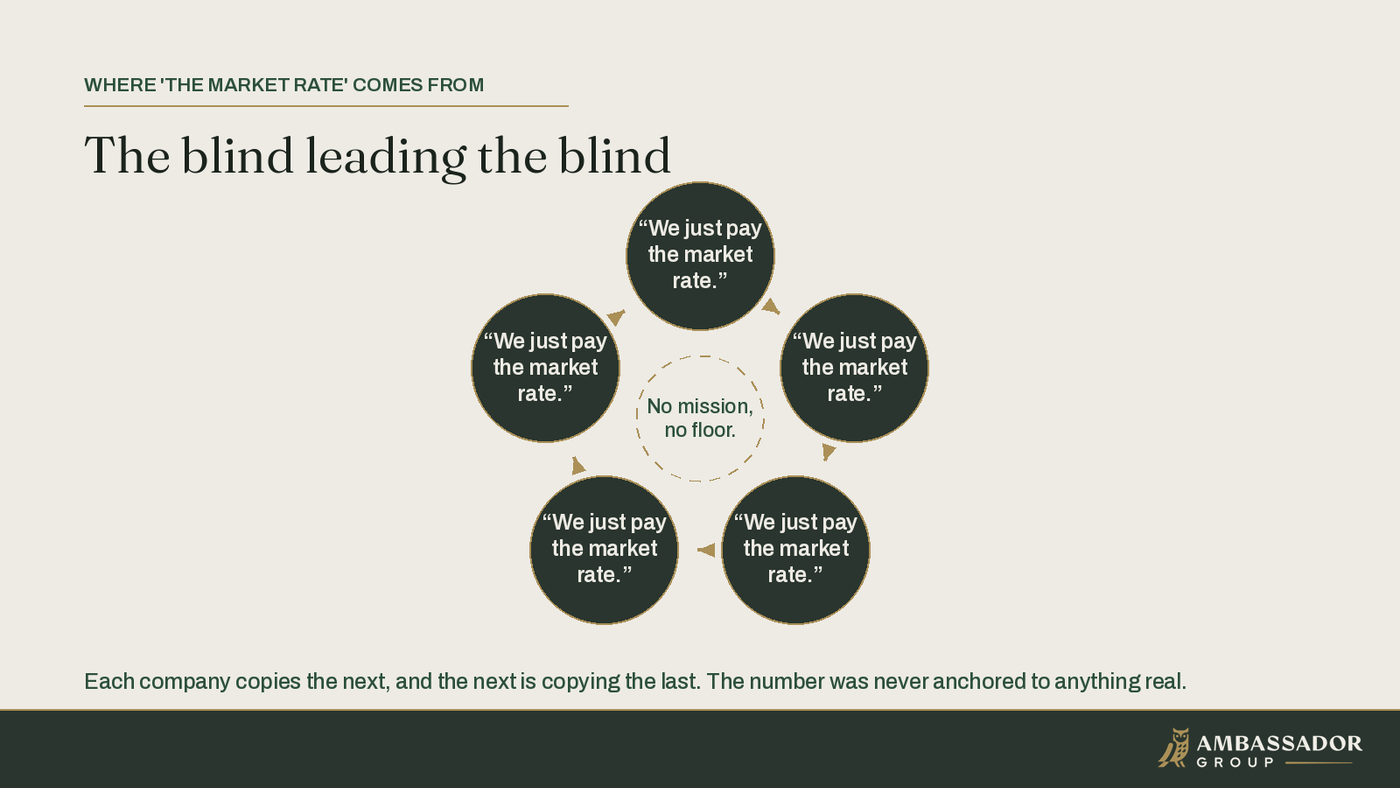
There is also something circular about the whole exercise. The market rate you are chasing is the number other companies landed on by chasing the market rate, and they were copying someone too. Everyone points at everyone else, and nobody points at their own mission or their own P&L. A survey can tell you what the crowd is doing. It cannot tell you what a person is worth to you.
Worse, outsourcing the decision signals something to your team: that you will compensate them at the level you are forced to, not the level they are worth. That message is retention poison.
Read survey data as a floor that informs your thinking. We publish the full account of how salary data lies, and we run our own compensation survey precisely because the public numbers are so weak. Use ours the same way: as a sanity check at the end, not an anchor at the start.
Marginal utility decides what a person is worth to you
Economists have a phrase worth borrowing. A bottle of water in the desert is worth far more than the same bottle in your kitchen, and a person of a given talent is worth more to some companies than to others.
I have no project that needs a superintendent today, so to me one is worth little. To you, on a large job with real margin at stake and a particular risk to guard against, the same person may be worth a great deal. Every factor that sets a fair number, the size of the job, the margin, the risk, the moment, lives inside your company.
The most honest place to start pricing a role is your own P&L. The pie is exactly as big as your numbers say, and you are sovereign over those numbers. You have access to the books. You know your profitability, your project financials, your targets, your KPIs, and the levers that defend or grow both margin and reputation. With complete access to your own financial reality, referring questions of pay to outside averages is a strange thing to do.
This is not abstract. On a recent search for a custom-home builder, the useful question was never what the market pays a senior project manager. The candidate's own stated range turned out to be a soft signal, shaped more by what he had accepted before than by what he could do. The real work was pricing the role against the builder's numbers and the value of this person on that specific project, then building an offer around his whole career and life rather than a survey midpoint. The number got easier to defend, and easier to say yes to, once it started from the business and the mission.
Mission is what pay hangs from
Most companies I see have never named what they are for, out loud. They build roughly similar projects, plenty of fine custom residential and solid commercial work, and the real reason any one of them gets up in the morning is rarely written down or carried through the company. Being the biggest or the best is a goal. The mission is the reason you want it.
What you believe so strongly that you would be punished to keep it: that is what you organize pay around.
Once the mission is clear the sequence is simple to say and hard to do.
Mission first. Then a small number of metrics tied tightly to that mission, kept few on purpose. Then, and only then, a glance at the market.
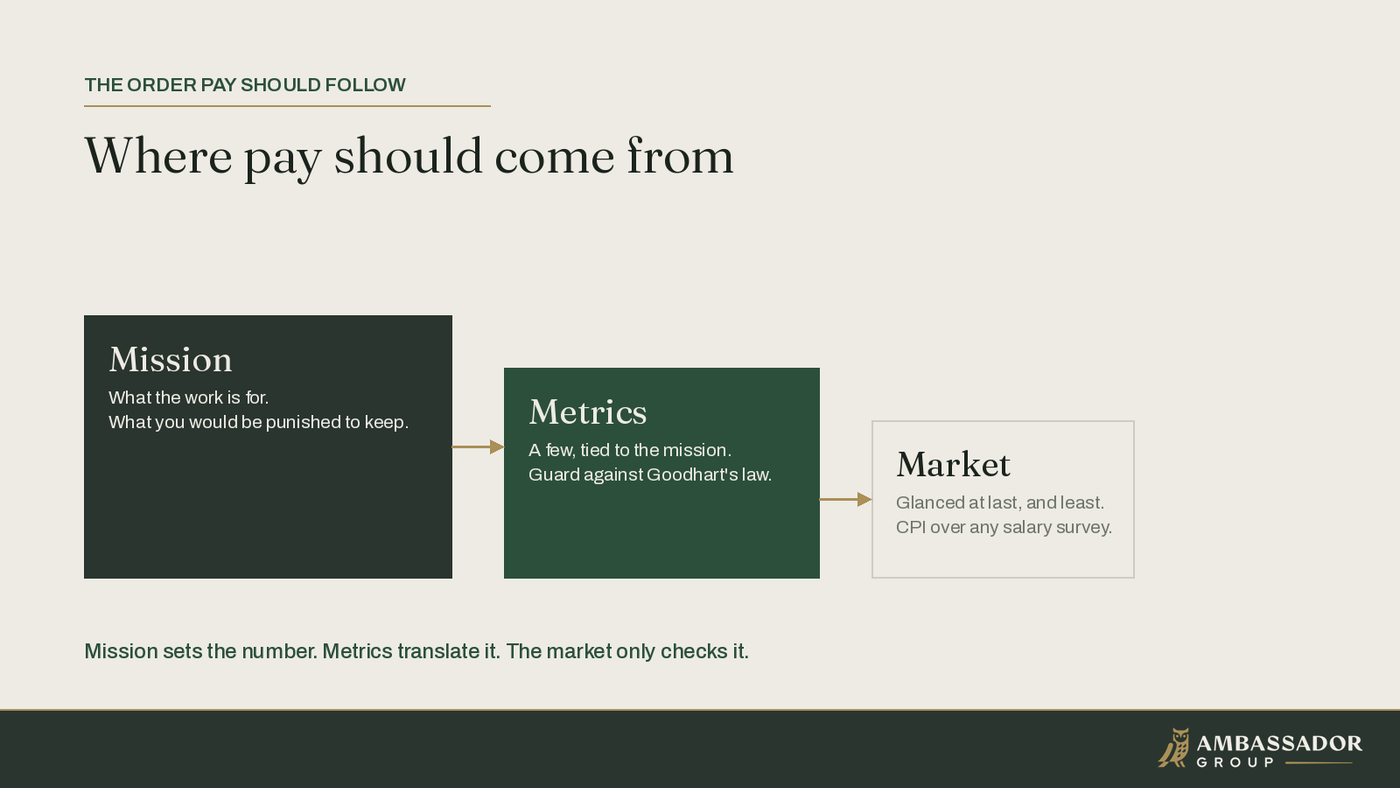
Keep the metrics few because of Goodhart's law: the moment a metric becomes the target it stops measuring what you wanted, and people start gaming the number instead of serving the mission. Align the measures to the mission and never let the measure become the point. And when you finally do look outward, the cost of living in the market you are staffing tells you more about what pay should be doing than any salary survey will.
One hundred percent pay for one hundred percent performance
The only fair deal between a company and its people is straightforward. Full pay for full performance. Anything less is exploitation. Anything more is charity.
Most construction companies cannot define what one hundred percent performance looks like, and that failure runs straight through every hire a leader makes. When you cannot say what good looks like, you cannot underwrite the people you bet on. You guess.
Without a clear standard you fall into three predictable dysfunctions.
Raises default to tenure and pressure. Not outcomes, not contribution, just time served or how loudly someone pushes.
Hiring negotiations devolve to gut, timing, and whoever has leverage. That usually works against the leader hiring under duress, which is exactly when speed matters most.
Compensation feels arbitrary to employees. Candidates sense no stable ethic guiding pay, so they go looking outside for proof of their worth: competing offers, matchmakers, market gossip to fuel inside conversations. The leader then negotiates from the back foot, without authority.
The uncomfortable part is why performance ambiguity survives. It survives because most companies do not have a system of belief sturdy enough to define performance against. Few leaders can point to a real mission, a set of values held tightly enough that they would accept a cost to stay true to them. Without that backbone performance becomes a moving target, shifting with projects, clients, and market conditions, because the company has no deeper structure than making money. And when money is the only value, performance stays illusory. It never settles into a rubric a leader can use to hire, manage, promote, and retain with conviction. James Clear put the mechanism in one line: you fall to the level of your systems.
I sit across from contractors who genuinely build at the highest levels of precision and quality, astonishing projects with eye-watering budgets. How many of them have written down what precision and quality mean for their builds? They want to hire people who specialize in precision and quality. Is the standard defined anywhere? No.
So how do they interview for it? How do they recognize it, promote it, manage for it, build company-wide accountability to it? The expensive answer is that they do not. Not conclusively.
The companies that win the next decade will not be the ones paying above market or competitive with industry averages. They will be the ones with the nerve to say four things out loud: this is what performance looks like here, this is what full performance earns here, this is how I will develop and measure and reward you as you grow, and I pay as much as I wisely can for performance aligned with the mission of this company.
Scarcity or abundance
At its core a compensation philosophy is a leadership philosophy, and the tell is which question you ask.
A scarcity leader anchors to the floor: what is the least we must pay? An abundance leader anchors to the ceiling: what is the most we can wisely pay for this level of performance?
One breeds suspicion and turnover. The other builds trust and staying power.
Abundance here is a discipline rather than generosity for its own sake. If you know your financials cold, you know exactly how far you can stretch compensation while protecting margin. You do not need to play defense with market averages. And paying wisely and abundantly usually costs less over time, because you cut turnover, prevent the underperformance that ambiguity produces, and build a culture competitors cannot buy with bonuses. Jim Collins made the related point in Good to Great: the right people do not need to be tightly managed or fired up, because the drive to produce good results is already there. Compensation clarity attracts those people and then keeps them.
The mindset difference is stark. Not "how much do I have to pay to keep them," but "how much do I get to pay this person for the value they generate." A leader who treats compensation as a burden loses conviction. A leader who treats it as an opportunity gains authority.
Define the outcomes, then track them in the open
Before you touch a number, get clear on what performance looks like in this role. Not hours worked. Not who talks most in meetings.
- What are the key results this person is responsible for?
- What metrics tell you whether they are succeeding?
- What does exceeding expectations mean here, specifically?
If you cannot answer those you are not ready to justify pay. You are guessing, and guessing is how resentment brews on a crew that can feel the inconsistency long before anyone names it. Those answers come from the same place your interview questions come from, which is a job description written around outcomes.

Once the outcomes are defined, track them where people can see them. Not to shame whoever is behind. To make the scoreboard visible. People do better work when they know where they stand, leaders make better decisions from data than from mood, and accountability becomes something real instead of something implied.
If a project manager's pay is partly tied to job margin and schedule accuracy, put those numbers in a shared dashboard. Review them on a rhythm. Mark the wins out loud. Ask honest questions when something dips. Transparency here is alignment, not surveillance.
Make the logic public, not the spreadsheet
If your compensation model is a black box, do not be surprised when people decide they are underpaid, or start behaving in ways that do not serve the business. The fix is to expose the logic rather than every line item.
Share what people need in order to understand the system: what roles exist and the performance each expects, how pay grows with performance and tenure, and how bonuses are earned rather than only when they land. Individual salaries can stay private. The reasoning should be easy to follow and hard to argue with.
Connecting pay to performance is the only thing that makes any of this survivable. Without that link, opening the books exposes your own inconsistencies, fuels comparison, and quietly drains morale.
When people see a clear path to growth and know which levers move them along it, they stop fixating on what others make and start focusing on doing better work.
It changes the hiring conversation too. When a candidate understands what performance is expected at each level of pay, the talk shifts from haggling over leverage to aligning around value. That is a career conversation rather than a garage sale.
The clarity matters more in a shifting market. Pay expectations now run higher than most companies plan for, and titles are not standardized: someone with four years of experience might carry a full project manager's load at one company and a senior project engineer's at another. That is exactly why performance clarity, and not tenure, has to anchor the conversation.
It also cuts both ways. When a candidate sees a thoughtful, organized interview process, their read on the opportunity rises, which often makes them more flexible on pay. How you run an interview is part of your compensation strategy whether you intend it to be or not.

Leave a clear lane for judgment, because not everything fits in a spreadsheet. Someone pulls off a save you never saw coming. Someone holds the culture together through a brutal stretch. Someone grows in ways no metric captures. The discipline is to use discretion to elevate genuine exceptions, never as a loophole to dodge your own framework or the hard conversation you would rather not have.
Four rules, then, and they are the whole system. Define success by outcomes rather than intentions. Track performance with a few relevant numbers. Make the model visible, so it never feels secret. Use discretion sparingly and always explain your reasoning.
If you cannot explain why someone earns what they earn, neither can they, and that gap is a fast track to disengagement.
Benchmark inside the person's lane
Tie compensation to the outcomes your projects live or die on, and never to metrics outside the person's authority. The benchmark has to sit inside the lane they drive.
- Superintendent: margin preservation on the project, change-order minimization, safety infractions at zero, satisfaction across the owner-architect-contractor team.
- Project manager: client satisfaction at or above nine out of ten, schedule variance within three percent, team turnover under five percent.
- Estimator: bid hit ratio at or above thirty-five percent, estimate-to-actual variance within two percent, complete win-loss debriefs on every bid.
Treat those as the shape of the thing rather than your numbers. The tolerances belong to your contract model and your margin profile.
Profit sharing is the version of this that pays in real time. Structured pools funded by the profit a team directly influences let pay flex quarterly or monthly, so cash follows success instead of hope. Two guardrails keep it honest. Stay inside the lane: a superintendent shares in project margin, not company-wide EBITDA, because you reward what someone can move. And show your math, publishing the formula so everyone can see exactly how performance converts to dollars.
Some leaders hide profit, worried it looks greedy. Profit is the oxygen that funds wages, safety, and growth. Say up front that profit is good for everyone, then open the books far enough for people to connect their own work to the bottom line. Engagement climbs when a person watches their decision move the number and then move their paycheck. John Doerr's version, in Measure What Matters: when people see that results drive rewards, engagement soars.
Respect is downstream of performance. Money is its clearest metric.
From tug-of-war to joint venture
Share the performance scorecard during hiring, before anyone has signed. Agree on a base plus a profit-share formula tied to controllable metrics. Then review results in your normal cadence meetings and let pay adjust on its own. The compensation conversation stops being a contest and becomes two people reading the same scoreboard.
Three objections come up every time.
"We don't track that data." Start with one metric per role. Your project software already holds it.
"We could overpay early." The pool only grows when project margin does.
"Won't this breed cutthroat behavior?" Tie part of the reward to collective wins like safety and client score, so collaboration is what pays.
A five-step start, if you want one: audit one live project for margin, schedule, and client feedback. Pick two high-impact, within-authority metrics per role. Draft a one-page profit-share policy. Pilot it with your next PM or superintendent hire. Debrief at ninety days, refine, then roll it out.
Structuring a superintendent's pay
Compensation for the role that carries the most jobsite risk deserves its own worked example, because this is where most companies get stuck.
The base
Flat salary by project size. Simple, predictable, and dangerous without recalibration. It works when your jobs are genuinely similar. Complexity, urban infill against rural ground-up, jurisdictional difficulty, and team size all skew the workload underneath a flat number. Tie salary bands to site variables and not just project dollar value.
Tiered salary by scope. Superintendents are not interchangeable. Some run one site, some float between several, some run high-risk work like hospital OSHPD or coastal excavation while others manage framing subs on a tract. A career ladder handles that: an assistant or field engineer tier, a site superintendent tier, and a senior, traveling, or multi-site tier. Build the bands so there is room to grow inside a tier and a visible path to the next one, and pressure-test every band against a compensation benchmark for your specific market rather than a national average.
Cost-of-living adjustment. If you staff projects in high-cost cities while your home base is cheaper, you need a geographic model, or local competitors will outpay you on proximity alone.
The bonus
Completion bonus with gates. A flat bonus for finishing the job rewards finishing. Set performance gates instead: timeline milestones, safety metrics, client satisfaction, documentation standards, closeout speed. Reward how they finish.
Margin-based bonus. Tie a bonus to gross margin only when the superintendent has genuine influence over cost containment through subs, change orders, and schedule slippage. Otherwise it breeds resentment. One builder tied bonuses to project margin and never showed the math; supers felt helpless when inflation or design changes wiped out their bonus. Switching to a quarterly scorecard on controllable metrics, schedule and safety and client satisfaction, raised both buy-in and retention.
Team-based incentive. Good superintendents build strong teams. A collective bonus shared with the PMs and APMs when the whole job hits its goals reduces the field-versus-office blame cycle.
Retention bonus. On long-cycle jobs running eighteen months or more, stagger retention bonuses at intervals. You cut mid-project turnover, which is the most expensive kind.
Choosing among them
Let the work decide. Tract or repetitive projects suit a tiered salary plus a team bonus. Custom or complex work suits a base plus a scorecard bonus. Projects under twelve months suit a completion bonus; eighteen months and over want retention layered in. With multiple superintendents you can run standard bands and peer benchmarking; with one, pay tracks risk, trust, and longevity more tightly. And let your biggest exposure pick the incentive: safety risk gets a safety bonus, turnover risk gets a tenure bonus, coordination risk gets a team bonus, margin risk gets profit share, but only with the math visible.
Then track it. Schedule accuracy, safety compliance, documentation discipline, team morale, client relationship health, relationships with neighbors and the jurisdiction, site presentation and sub coordination. Build that dashboard before turnover or litigation forces you to reconstruct it.
Three blind spots recur. Leaning on market comps, which are useful and lazy, and never explain why one job is worth more than another. Ignoring the real cost of turnover, which for a superintendent lost mid-job runs to months of recovery, damaged client trust, broken sub relationships, and culture cracks that spread. And one-size-fits-all packages, when some superintendents are chasing dollars while others want autonomy, loyalty, or a leadership track. Ask what someone values and build accordingly.
Compensation for this role is risk management. Superintendents are the front line against missed deadlines, safety violations, sub conflict, documentation gaps, and client frustration. When their pay lags, your risk climbs. You are not saving money. You are gambling it.
The raise conversation you dread was built upstream
The whole argument shows up in one familiar moment. A key person comes to you with an offer somewhere else for more money, and now you are pinched, mid-project, with a lot of inertia and a lot to lose. It feels like disloyalty.
Usually it is something quieter. The mission was never clear, the values were never named, and the path to earning more was never drawn, so the only instrument that person had for a raise conversation was an outside bid. They had to go find one because nobody ever handed them a map. I watch good people go shopping for an offer in order to stay at a company they would rather not leave, because their leadership never showed them how to grow in place.
And when the chain runs outward, the market sets your pay, your pay sets your pricing, your pricing sets your billing rate, and a survey you did not write is quietly running your business. A clear mission breaks that chain, because the number starts with what the work is for and what your own numbers can carry.
A clear model also turns the dreaded conversation into a good one. When someone asks for more, you have a rubric instead of a standoff: here is how you grow, here is what it takes, and I would like to see you get there. You can talk about merit together rather than haggle over who holds the upper hand. If you have overpaid or underpaid, the same rubric lets you correct it without making it personal, because you stop rewarding confidence and start rewarding contribution.
None of this lives on a spreadsheet. It lives in the culture, in every person being able to say the mission and mean it. That costs you time, energy, and steady communication, and you pay it for the life of the company. What you get back is a workforce whose interests genuinely overlap with the company's, and a firm that stops lurching between reactive raises and reactive hiring.
Compensation is a mirror. It shows your people what you value: short-term output or long-term trust, margin or morale. How you pay speaks louder than how you talk about paying.
You already own the numbers and the mission that should price the role. The survey never did. What is left is whether you make them legible enough that the people carrying your work can see exactly how they win when you do.
The short version.
- What should a construction project manager be paid?
- There is no accurate answer without your specifics: contract model, profit margins, cash flow, team strength, and how you measure leadership outcomes. Any salary number given without that context is a guess. Tie compensation to performance and profitability rather than chasing an external benchmark.
- Can I use salary survey data to set pay for a specific hire?
- Only as a floor that informs your thinking, never as a verdict. The survey number is someone else's blended average. It cannot see your project, your margin, your mission, or the cost of losing the person you already have.
- Why are market salary surveys unreliable for construction pay?
- They report base salary while omitting bonuses, profit-sharing, retirement matching, and truck or technology allowances. They are often six to eighteen months stale by publication. They flatten role differences, treating a PM on two-million-dollar commercial jobs the same as one on fifty-million-dollar infrastructure work. And many advertised figures rest on as few as two or three unvalidated datapoints.
- What does 100% pay for 100% performance mean?
- Full pay for full performance, which is the only fair deal between a company and its people. Anything less is exploitation and anything more is charity. Holding that line requires defining what full performance looks like, which is exactly what most construction companies have never done.
- How should industry leaders set compensation?
- From the inside out. Mission first, then a small number of metrics tied tightly to that mission, then the market as a sanity check. Anchor pay to performance connected to profitability, keep the structure simple, and pay as much as you wisely can, because you know your numbers better than any survey does.
- Should I reveal everyone's salary to be transparent about pay?
- No. Expose the logic, not every line item: what roles exist, the performance each expects, how pay grows with performance and tenure, and how bonuses are earned. The reasoning should be easy to follow and hard to argue with, even when individual salaries stay private.
- What metrics should performance pay tie to?
- Metrics inside the lane the person drives. For a superintendent, margin preservation, change-order minimization, zero safety infractions, and owner-architect-contractor satisfaction. For a project manager, client satisfaction, schedule variance, and team turnover. For an estimator, bid hit ratio, estimate-to-actual variance, and complete win-loss debriefs.
- How should a construction company structure superintendent pay?
- In parts that match the work. A base tied to project size, complexity, and site variables. Tiers that move with seniority and scope. Bonuses tied to outcomes the superintendent controls. Tiered salary plus team bonus suits repetitive tract work; base plus scorecard bonus suits custom or complex jobs; retention bonuses layer onto jobs running eighteen months or more.
- Should superintendent bonuses be tied to project margin?
- Only if the superintendent has real influence over cost containment through subs, change orders, and schedule slippage. Otherwise margin-based bonuses breed resentment. And if you share profits, you have to share the math.


