The one-page resume rule is the most over-applied piece of advice in any job search, and in construction it can quietly cost you the read. Your resume reflects you and no one else. It is the first honest account of your career a hiring leader holds, and when you compress it to satisfy a format rule, you hand them a thinner version of yourself than the truth would. A durable match depends on both sides representing themselves accurately from the first contact, and your resume is where you start keeping your half of that bargain.
The logic behind one page is fair. People scan a resume to decide whether they are interested, and a tight, well-ordered document respects their time. A recent graduate with one internship has no business stretching to two pages of white space and padding. So the instinct toward brevity is sound. The problem is treating a rule of thumb as a law that overrides the actual content of a career.
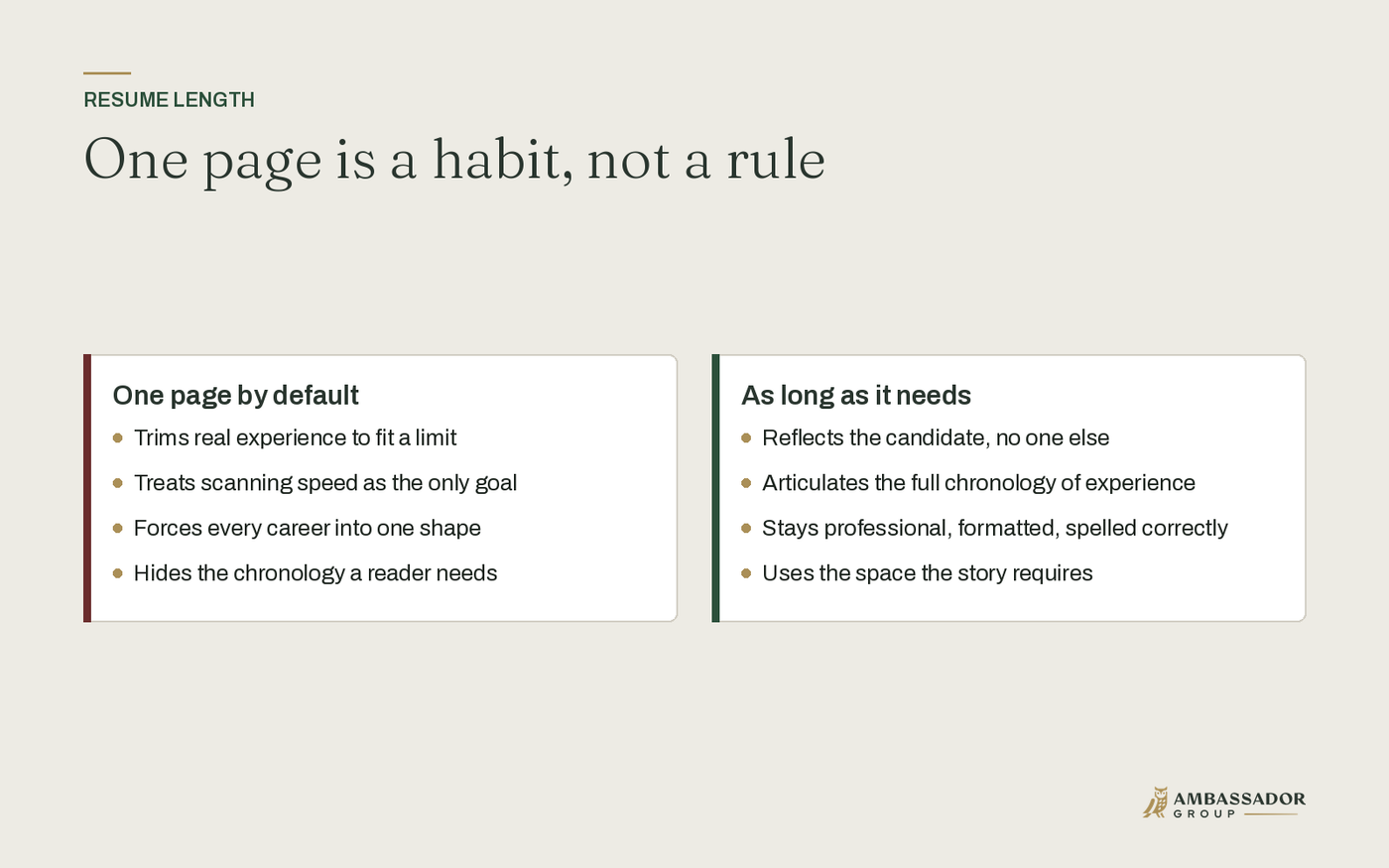
Let the work set the length
In construction, careers do not flatten neatly onto a single sheet. A superintendent who has run a dozen significant projects over twenty years cannot honestly tell that story in six bullet points and a stack of acronyms. Forcing it does not read as disciplined. It reads as missing, as if the most important parts of the record were left in a truck somewhere. The reader is trying to learn what you have built and at what scale, and a document engineered to hide most of that answer works against you.
Use the space the truth requires. Lay out your experience and your skills in the order they happened, clearly enough that a stranger can follow the arc of your career without calling you to fill in the gaps. If that takes one page, take one. If it takes two, take two. The test is never the page count. The test is whether the document communicates, accurately and completely, what you have done and what you are capable of doing next.
In construction, the project history earns the read
For most field and project leaders, the project list tells a hiring leader more than the job titles ever will. A leader scanning your resume wants the specifics: what you built, how large it was, what your role was on it, what the budget and schedule looked like, whether you were there at groundbreaking or parachuted in for the closeout. A separate, well-organized project history, with real numbers and real scope, often carries more weight than the chronology of employers.
Give a hiring leader the scope, the budget, the schedule, and your actual role on each project, and you have told them more than any title line could.
That section is also where length justifies itself. A page spent listing twelve projects with their dollar values and your responsibilities is a page that earns its place. A page spent restating the same generic responsibilities under four different employers is filler, and a sharp reader feels the difference immediately. The discipline is in making every line carry information a stranger needs.
Make it unmistakably yours, and make it clean
A resume that uses the space the truth requires still has to earn the read on every line. Spell everything correctly. Format it so the eye moves easily, with consistent dates, aligned columns, and headings a tired reader can follow at a glance. Length buys you nothing if the document is cluttered, inconsistent, or riddled with typos, because a hiring leader reads carelessness on a resume as a preview of how you will handle a submittal log or a closeout package, fairly or not.
Your resume is standing in for you in a conversation you are not in yet. Let it carry your professionalism the way you would carry yourself into a first meeting: complete, accurate, organized, and clearly the work of someone who takes their own record seriously. That impression is the first thing a leader is trying to form about you, and you control it entirely.
So stop asking how to cram your career onto one page and start asking whether the page you have communicates the truth. Write the resume your work genuinely requires, make it clean enough to respect the reader, and let its honest length tell a hiring leader exactly who is about to walk through the door.