You do not want every job you interview for, even the ones that turn you down. That is hard to feel in the moment a rejection lands, when the obvious read is that you fell short and someone else was better. But a good match depends on both sides deciding honestly, and a company declining you is one half of that honesty doing its work. Having watched close to a thousand candidates go through interviews, I can tell you that when a company decides you are not the right fit for a role, they are often right, and being right for them tends to mean it was right for you too.
Sit with that for a second, because it runs against the instinct. The decision to pass on you is usually a decision made for the organization: this role, this team, this leader, this stretch of the company's life. When a company makes a sound decision for itself, that same decision generally serves you, even when it stings. The interview is two parties figuring out together whether they belong in a working relationship, and either one of them concluding "no" is a legitimate, useful outcome.
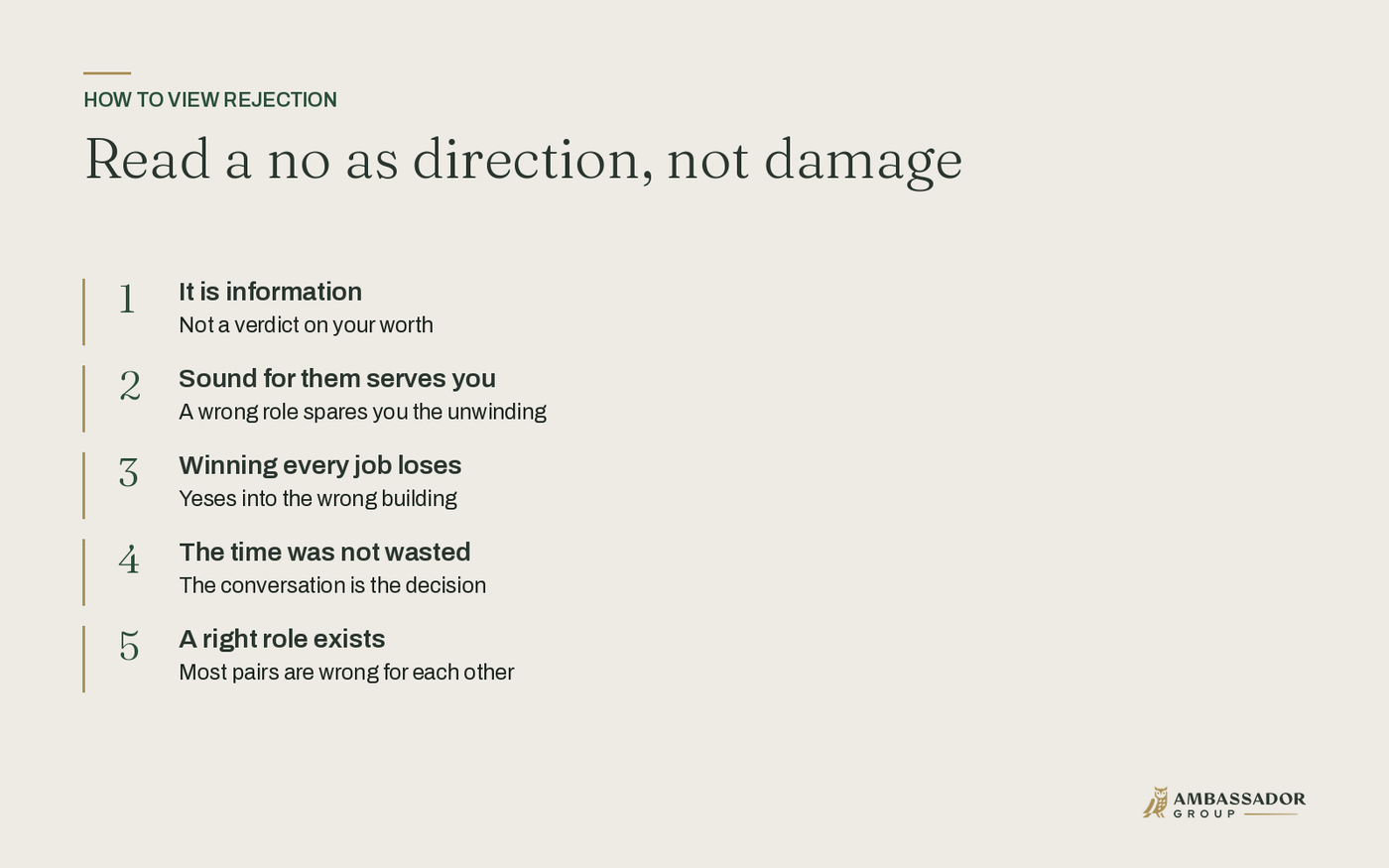
Imagine winning every interview
Run the opposite scenario. Suppose you got every job you ever interviewed for. You would land in roles you were not qualified for, roles that would bore you, roles inside cultures that grated on you by the second month. You would spend a year somewhere that was wrong from the start, slowly realizing it, and then have to begin again. A string of yeses is not a string of wins. Some of those yeses would be doors into the wrong building, and the rejection that closed one of them quietly spared you the unwinding.
That reframe matters because it moves the rejection out of the column marked "failure" and into the column marked "information." A company that knows itself well enough to say "this role would not suit you" is giving you data you could not easily get on your own. They have seen what the job demands and how their team runs day to day, and they decided the fit was off. Trusting that read, rather than treating it as a personal indictment, is closer to the truth of what happened.
A company telling you a role is not right is doing you a service, because the alternative is six wrong months you would both have to undo.
The time was not wasted
Some candidates regret the hours spent interviewing for a role they did not get, as if the whole exchange were a loss. Two things are worth holding onto here. First, consider how much time the company spent. There were usually several interviewers, which means the organization put in more cumulative hours than you did. Second, and more important, you cannot know whether a role is right without the conversation that reveals it. The interview is how you and the company decide together what is possible between you. There is no shortcut that skips the talking and still produces the answer.
Think of a friendship that eventually went sideways. You would not stand at the end of it and call every hour you invested a mistake, because the investment was how you arrived at the knowledge that the friendship had run its course. Interviews work the same way. The conversation is the decision, and the time it takes is the price of finding out clearly instead of guessing.
Carry it differently next time
So when the next no arrives, you get to choose how to read it. You can read it as one party, with information you did not have, deciding the fit was not there. That reading is both kinder and more accurate. There are many good candidates and many good companies, and most pairs are wrong for each other. A wrong pair is a flavor that belonged in a different dish.
None of this asks you to feel nothing. A rejection is allowed to disappoint you. The point is what you do with it afterward: whether you let it shrink your sense of yourself, or whether you treat it as the system working, steering you away from a role that would not have served you toward one that will. Your personality, your experience, the specific shape of your career: those are not diminished by a company that needed something else. There is a role suited to you, and the interviews that do not end in an offer are part of how you get there.
You decide what a rejection means about you, so read it as direction rather than damage and keep moving toward the match that fits.