When a company decides you are not the right fit, they are usually right. That is a hard sentence to sit with right after a rejection, but it is worth sitting with, because it reframes the whole experience. Having watched close to a thousand candidates go through interviews, the pattern is clear enough to say plainly: a hiring leader passing on you is most often making the best decision for the organization, and a good decision for the organization tends to be a good decision for you. Both you and the company own the outcome of a match, which means a no can be the system working in your favor. You walk away stung, but you also walk away from a role that was not built to hold you.
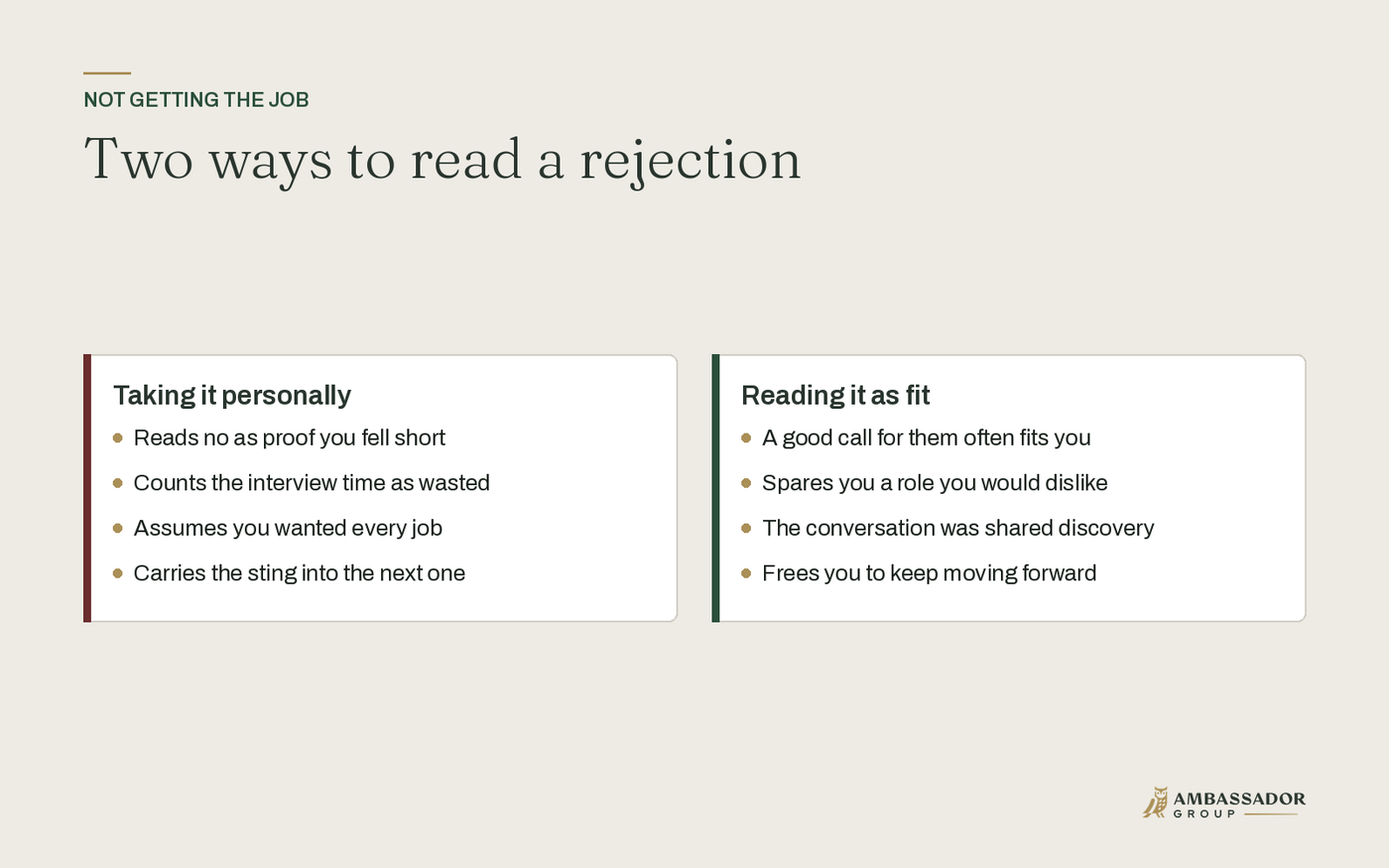
You do not want every job
Run the thought experiment all the way out. Imagine you got every job you ever interviewed for. You would land in positions you were not qualified for, roles that bored you, companies whose culture grated against yours within a month. The offers would pile up and so would the mismatches. A career built on never hearing no would be a career of constant wrong turns, each one costing you a year you cannot get back.
The rejection that feels like a verdict is closer to a filter, and the filter is protecting you as much as the company. A hiring leader has information you do not. They know what the team needs, where the gaps are, what kind of person thrives in their environment and what kind quietly burns out. When they decide you are not the fit, they are often seeing something true that you could not see from the outside. Take it as a data point about alignment, not a ruling on your worth.
A no from the right company is information about fit, and most of the time it is accurate. You did not lose the job. You avoided the wrong one.
The time was not wasted
Some people carry a second frustration past the rejection itself: regret over the hours they spent interviewing for a role they did not get. That regret rests on a mistake about what an interview is for. An interview is a conversation where two parties figure out together whether something is possible, not a transaction where you pay time and receive a job.
Two things are worth holding onto here. First, the company spent more time than you did, not less. There were usually several interviewers, often multiple conversations, plus the hours of review and discussion you never saw. They invested heavily in the same question you did, and they reached an answer. Second, you could not have reached that answer any other way. You have to have the conversation to learn whether the fit is real. There is no shortcut that delivers the verdict without the dialogue.
Think of it the way you would think of a friendship that ran its course. You do not look back and resent every hour you put into it, even when it ended in a place you regret. The time was how you found out. The friendship had to be lived before you could know whether it should go forward. Interviews work the same way. The hours were not a tax on a failed outcome. They were the only path to knowing.
What to carry into the next one
The reframe is useful only if it changes how you move next. Treat each interview as a mutual decision you are making, not a test you are hoping to pass. Pay attention to what you learn about the company, because that information is yours to keep regardless of whether an offer comes. Notice whether the work would have energized you or drained you, whether the leadership matched what you need, whether the culture felt like a place you would still want to be a year in. A no that spares you a bad fit has done you a quiet favor, and the candidate who can see that favor stays steadier through the next process.
It does not feel good to be passed over. That is real, and pretending otherwise helps no one. But the sting and the truth can sit side by side. You can feel the disappointment and still recognize that a thoughtful no protected you from a year of being in the wrong role. The feeling fades. The protection lasts.
There is a particular role out there suited to who you are, and the way you reach it is by letting the wrong ones go without taking them personally. You are good at what you do, you carry something a right-fit company will want, and the rejections along the way are part of how you arrive at the match that holds. Keep your read on alignment sharp, keep moving, and let each no point you closer to the yes that was built for you.