Two companies can post the same job title and be hiring for two different jobs. One needs a project manager who lives in the buyout, holds subcontractors to the contract, and protects margin line by line. The other needs a project manager who functions as a client-facing relationship manager, keeping the owner calm while the superintendent runs the work. Both write "Project Manager" in the ad. Both get qualified applicants. One of them makes a hire that fails, and the failure traces back to a definition that was never written down. A leader who has not named what the role truly owns cannot see whether the person across the table can carry it, which is the same blindness that sinks most hires before the first day on the job.
Key accountabilities are one of the least understood elements of building a job and hiring for it, and that gap is expensive precisely because it stays invisible. The title feels like shared language. It is not. The accountabilities underneath the title are where the real work lives, and they differ from one construction company to the next even when the buildings look identical.
The same title, a different job
I work in construction recruiting, and the pattern repeats across companies that deliver nearly the same product. A leader says he needs to hire a project manager. He runs the ad. Project managers apply. They interview well, because they are project managers and they have the stories to prove it. He makes the hire, and it does not work. The person was genuinely capable, though not capable of the specific things this organization quietly expected a PM to own.
Companies operate remarkably differently underneath similar org charts. At one firm the PM owns the schedule and the field reports to him. At another the superintendent owns the field and the PM is judged on cost and client trust. At a third the PM is expected to bring in the next job from a happy owner, which is a business-development accountability that never appears in the title. Each of these recognizes the responsibilities differently, sometimes formally in a document, more often informally in the unspoken expectations of whoever sits above the role. A candidate who excelled at one version walks into another and drowns, and everyone calls it a hiring miss when it was a definition miss.
Picture a PM who spent ten years at a hard-bid commercial shop, where the job was to win the buyout, ride the subcontractors, and defend the number against every change order. He was excellent at it. He joins a custom residential builder where the client is in the house every week, the scope shifts on a homeowner's whim, and the PM's actual accountability is keeping a demanding owner feeling heard while the budget moves. The same title, the opposite temperament required. He reads the owner's changes as threats to margin and starts fighting them, because that is what the job was the whole prior decade. Within a few months the client is unhappy, the builder is questioning the hire, and a capable person is being managed out of a role he was never told the truth about. Nobody lied to him. Nobody had defined the work clearly enough to tell him the truth in the first place.
A title tells you what someone has been called; key accountabilities tell you what they will be measured on, and only the second one predicts whether they succeed here.
Define the work before you judge the person
Once the key accountabilities are clearly named, the whole hiring process sharpens. You can write them out for the candidate so the conversation starts from reality instead of a label. You can build a question bank directly off them, which moves the interview past "were you a successful PM somewhere" to "do you have what it takes to deliver on these specific accountabilities for this organization." That is a far higher-definition conversation, and it is the one that separates a candidate's general competence from their fit for the actual job.
This is also where the leader's own clarity gets tested. Defining accountabilities forces you to answer questions you may have been avoiding: who owns margin here, who owns the client, who owns the schedule when it slips. If you cannot answer those cleanly, the candidate pool is rarely the problem. The role lives only as a feeling in your head, and a feeling cannot be interviewed against, set as an expectation, or measured later.
One definition runs the whole system
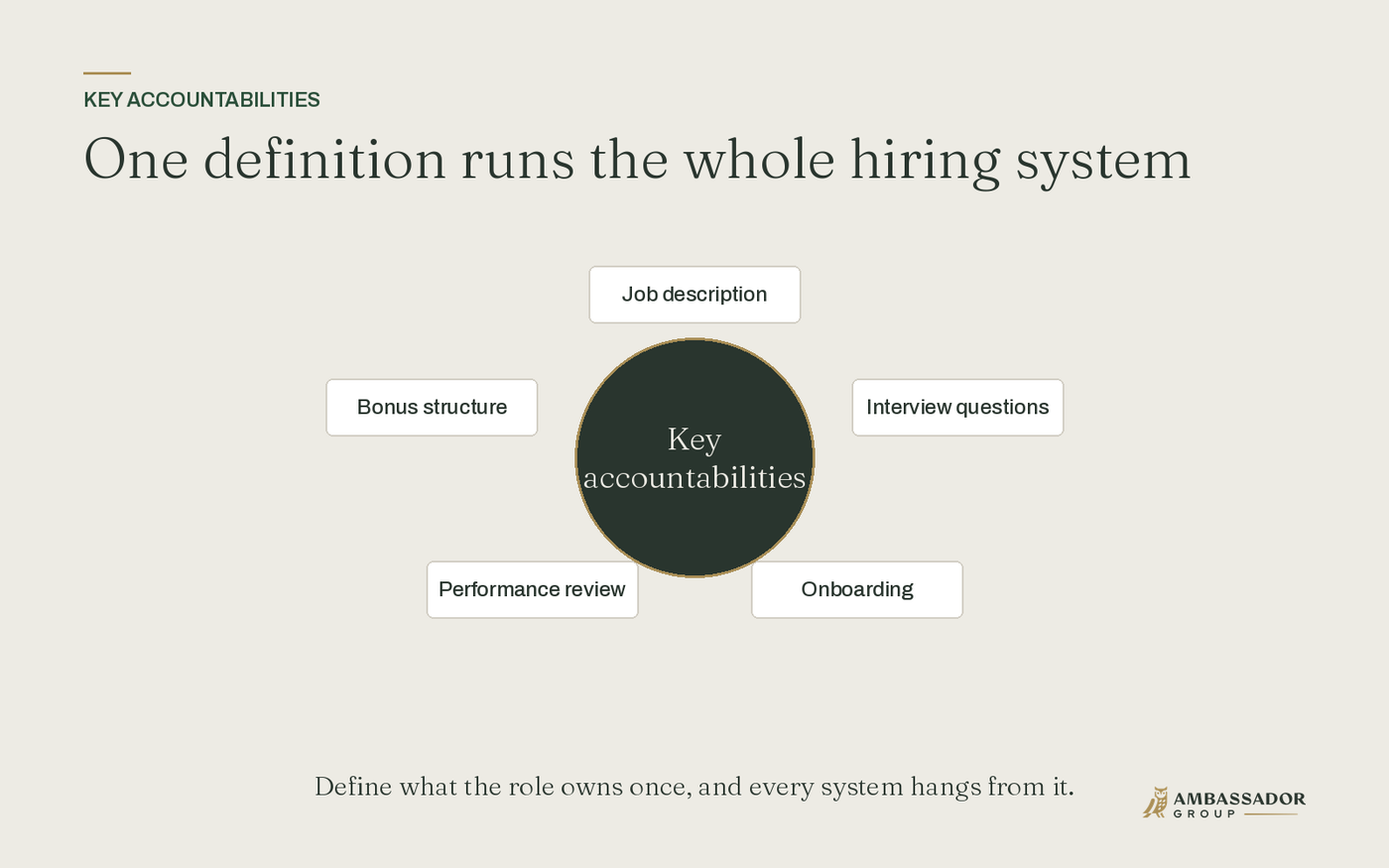
The payoff reaches well past the hire. Key accountabilities are how you set expectations with a new person on day one, so they know what they will be held responsible for managing rather than guessing for six months. They are how you run performance evaluations, because you are reviewing someone against the responsibilities you both agreed they own. They are how you structure a bonus, because you can reward delivery on the things that make the business work. They are how you write the job description in the first place. Define them once, with care, and they become the spine that the interview, the onboarding, the review, and the compensation all hang from.
Skip the definition and every one of those systems wobbles. The interview tests for the wrong things. Onboarding leaves the new hire to infer the job. The review measures gut feeling. The bonus rewards activity instead of outcome. All of it inherits the original vagueness, and the leader spends the next year managing symptoms.
So before the next search, sit with what the role genuinely owns in your organization, not what the title implies anywhere else. Write the key accountabilities down in plain words, then check every part of your process against them. The clearer you are about what this job is responsible for, the more accurately you will read the person who can carry it, and that clarity is entirely yours to build before anyone applies.