Asking what the market pays a superintendent is a little like asking the going rate for a 2x4. For a 2x4, the question makes sense, because every board is supposed to be the same: same dimensions, same species, same strength, interchangeable on the rack. People are the opposite. The closer you zoom in on any one superintendent, the more distinct they become in personality, contribution, and motivation, and the more absurd a single market rate becomes. A leader who cannot see that distinction cannot price the person in front of him, and a company that has never named what it is built around has nothing to anchor compensation to except a number someone else invented.
I have spent fifteen years in recruiting, thirteen of them in construction, and sat inside well over a thousand negotiations. The question I hear most is some version of what a company needs to pay to attract, hire, and retain A-players. It is a fair question. The trouble is the instinct behind it, which is to find the market rate and match it, treating compensation as a commodity price to be discovered rather than a relationship to be built.
The data you are anchoring to is thin
Aggregated salary data is far weaker than it looks. The numbers on the public sites are not verified or validated. They do not account for benefits, for the niche within construction, or for the difference between the Peninsula, San Francisco, and Sacramento. Look closely at how many of those averages get computed and you often find two or three data points behind a figure presented as gospel. That is a rumor with a decimal.
There is a deeper reason the market does not price people well. A share of Apple stock is identical to every other share and trades constantly, so its price finds itself quickly and honestly. A superintendent changes jobs once every several years. The market for that person is slow, infrequent, and illiquid, so it never becomes an efficient price-finding mechanism the way a stock exchange does. Leaning on that data in a real negotiation tends to offend the other party, and I have never once watched a candidate or a client negotiate against their own interest. When the average favors them, they cite it. When it does not, they dismiss it. So the survey was never the authority it pretended to be. It was a prop.
A commodity mindset trains commodity loyalty
When you treat a role as a commodity position and lead from that posture, you teach the people in it to think the same way. If they are as replaceable as a 2x4, then your company is every bit as replaceable to them. That is a dangerous trade on a four-year build staffed by genuinely talented people you cannot swap out on short notice.
The pattern surfaces in a familiar moment. A key person comes to you and says they have an offer somewhere else for more money, and now you are in a pinch, mid-project, with a lot of inertia and a lot to lose. It feels like disloyalty. Usually it is something quieter. The mission was never clear, the values were never clear, and the path to earning more was never drawn, so the only instrument the employee had for a raise conversation was an outside offer. They had to go find one because no one ever handed them a map. I run a firm that does this work, and I watch people go hunting for an outside bid in order to stay at a company they want to stay at, because their leadership never showed them how to grow there.
Mission is the anchor compensation hangs from
The way out is to price compensation against your own mission, values, and P&L instead of against the market's noise. Most companies I see have never done this out loud. They build roughly similar projects, a lot of fine custom residential and large commercial work, and yet the real reason any one of them gets up in the morning is rarely written down or carried through the company. Being the biggest or the best is not a mission. Why you want to be the best is the mission. What you believe so strongly that you are willing to be punished for it, that is the thing worth organizing pay around.
Ambassador Group's mission is to honor the God-endowed nobility of human beings by promoting durable relationships with meaningful work, so that clients and candidates can live happier and more abundant lives. Everything I do is subordinated to that. The point of naming it is that once it is clear, you can recognize who is advancing it and to what degree, and build real internal integrity into how people are paid.
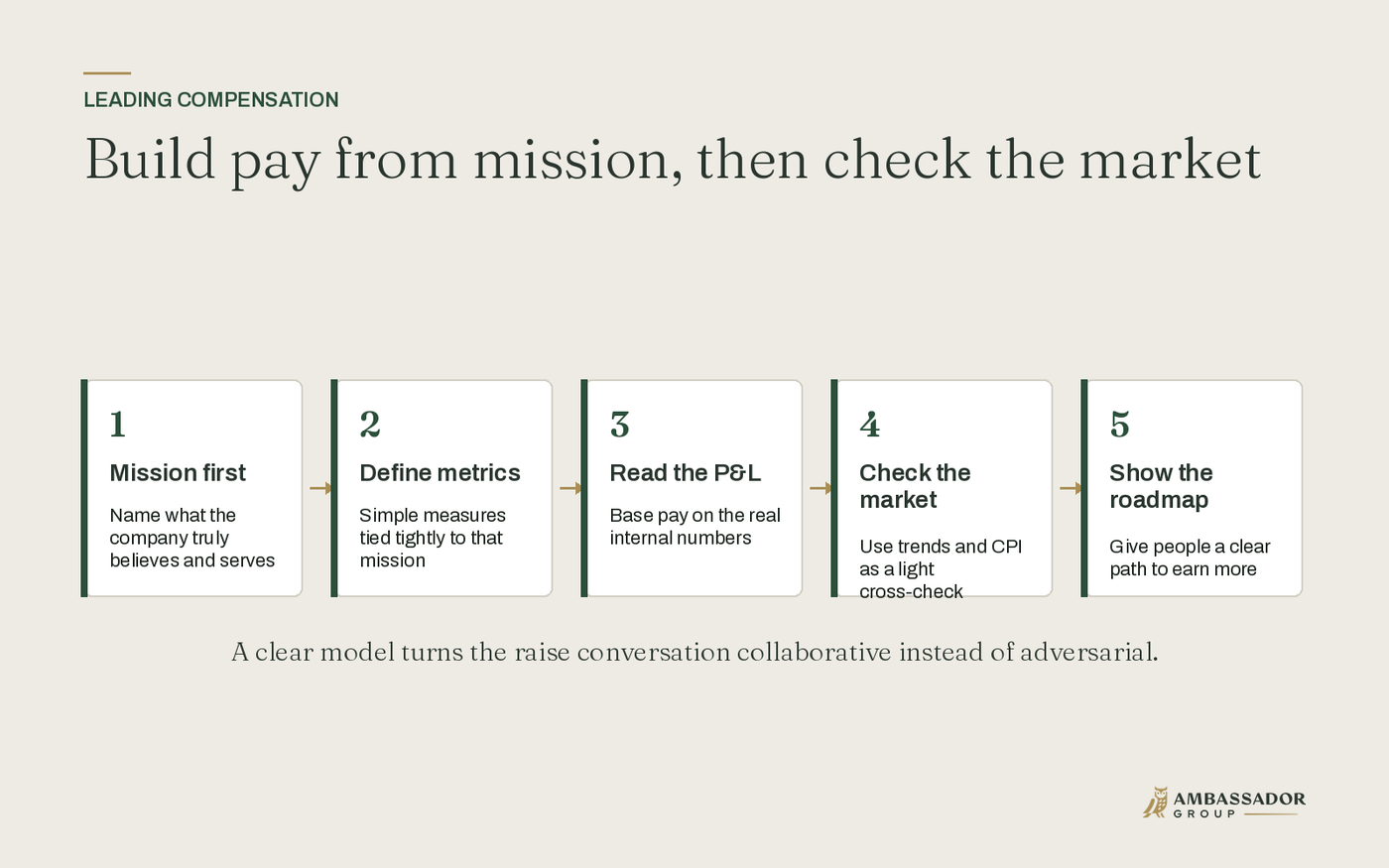
From there the sequence is simple to say and hard to do. Mission first. Then a small number of metrics tied tightly to that mission, kept simple on purpose. Watch for Goodhart's law: the moment a metric becomes the goal, it stops measuring what you wanted. Align metrics to mission, and never let the number become the point. Only after mission and metrics do you glance at the market, and even then CPI tells you more about what your compensation should be doing than any salary survey will.
Economists have a phrase worth borrowing here: marginal utility. A bottle of water in the Sahara is worth far more than the same bottle in your refrigerator, and a person of a given talent is worth more to some companies than to others. I have no need for a superintendent right now, so one is worth little to me. To you, on a large project with real profit at stake or a particular risk to guard against, the same person may be worth considerably more. The factors that decide what someone should be paid, the size of the project, the margin, the risk, the moment, live inside your company, not in an aggregate. The most honest place to start pricing a role is your own P&L. The pie is exactly as big as your numbers say, and you are sovereign over those numbers. Build pay from there and you can explain every dollar.
Most tenured employees have never been handed a rubric for what they are worth, so when they want clarity about their future they go looking for it somewhere else.
What you get for the harder road
Pay people as much as you wisely, sustainably, and justifiably can. That cuts against the reflex to get labor as cheap as possible, and it should. Losing a key person at the wrong moment costs schedule, culture, reputation, and client trust, so once you find that person, keeping them belongs near the top of the list.
A clear model turns the dreaded raise conversation into a good one. When someone asks for more, you have a rubric instead of a standoff: here is how you grow, here is what it takes, I would like to see you get there. You can have a collaborative conversation about merit rather than a defensive one about who has the upper hand. If you overpay or underpay, the same mission-aligned rubric lets you correct it without making it personal, because confidence stops being the heuristic and contribution becomes one.
None of this lives on a spreadsheet. It lives in the culture, in every person being able to say the mission and mean it. That work costs you time, energy, and constant communication, and you do it for the life of the company. The reward is a workforce whose interests genuinely overlap with the company's, and a firm that stops lurching between reactive raises and reactive hiring. You already own the numbers and the mission that should drive your pay; the next move is to make them legible enough that the people who carry your work can see exactly how they win when you do.