Picture a seven-lane highway with no lane markers and no turn signals. Cars moving fast, drivers guessing at each other's intentions, no agreement about who belongs where. The accidents are the predictable result of a road built without structure. That is what most team interviews look like from the inside, and the collisions show up later as a bad hire nobody can fully explain. A leader who cannot see his own process clearly cannot see the candidate clearly either, because the noise of an unstructured interview drowns out the signal he was trying to read.
The mechanism is diffusion of responsibility. When five people interview a candidate and each one is loosely assessing everything, you have assembled a team responsible for nothing. Everyone assumes someone else probed the gap. Everyone defers to the most senior voice in the debrief. The redundancy is real: three interviewers ask about the same project while no one tests how the person handles a schedule slipping under them. The blind spots are real too, and they are invisible by design, because no one was assigned to look.
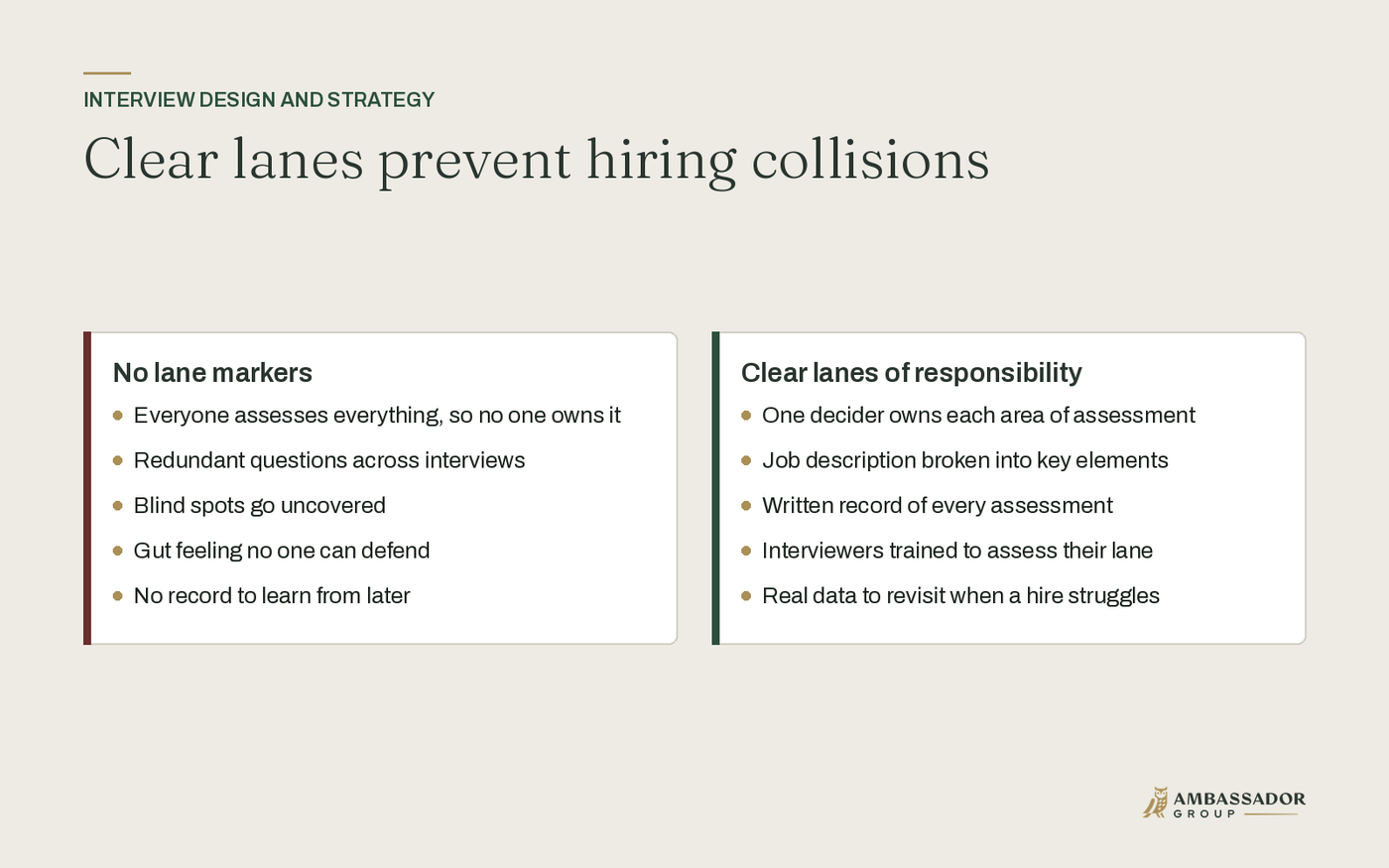
Draw the lanes before anyone drives
The fix starts with the job description, broken into its real elements. Strip the fluff most descriptions carry and name what genuinely has to be assessed for this role: safety leadership, budget discipline, the ability to manage a superintendent who outranks the new hire in field years, conflict under a compressed schedule. Then assign each element to a decider, one person accountable for the go or no-go call on that factor. That person owns the lane. They prepare for it, they probe it, and they answer for it in the debrief.
Accountability changes how an interviewer prepares. A person who knows they alone must defend a read on budget management cannot hide behind a group nod. They have to build real questions, the kind that put the candidate inside a specific scenario the company faces on its jobs, and watch how the thinking moves. Gut feeling stops being acceptable, because gut feeling cannot be defended to a table of colleagues who are waiting to hear why.
Write it down before you talk
The second discipline is a record. Each decider documents an assessment in their lane, in writing, before the team compares notes. The order matters more than it looks. Interviewers who talk first contaminate each other, and the loudest or most senior read becomes the group's read by gravity, not by accuracy. Independent written feedback collected before the conversation preserves the signal each person picked up on their own.
When the candidate you hired is not the candidate who showed up, the honest diagnosis is usually that the interview was run too loosely to know who was being hired in the first place.
That record pays off twice. It gives you real data to weigh at decision time instead of a blur of impressions. And if the hire struggles six months in, you have something to return to. You can set your written expectations against what unfolded and find the miss. Maybe the role needed more structure than anyone tested for. Maybe a decider read confidence as competence. Either way, you learn something you can carry into the next search, which is impossible when the only record is a fading memory of how the conversations felt.
Volume and variety are not the same as rigor
More touch points help, but only inside the lane structure. One leader I worked with kept a rule of ten touch points for every leadership hire: panel interviews, one-on-ones, coffee, dinner, a company event. The point was never to wear the candidate down. It was to see a person across enough contexts that the performance cannot hold. People can manage a single polished conversation. Almost no one can manage ten across formal and informal settings without the real patterns surfacing.
Variety without assignment is still chaos, though. Ten unstructured touch points produce ten overlapping impressions and the same diffusion problem at a larger scale. The value comes when each interviewer knows their lane across every one of those settings, watching their assigned factor in the panel, at dinner, and at the company event, then bringing one disciplined read to the table.
The lanes also let you watch the candidate against scenarios, which is where construction roles reveal themselves. A superintendent who interviews well in the abstract can still be the wrong person for a job that runs three concurrent pours with a thin labor pool. Put that scenario in front of them, owned by the decider responsible for field leadership, and you learn whether they sequence the work, protect the schedule, and manage the foreman who disagrees with them, or whether they freeze and reach for the owner. The interviewer who owns that lane is the only one preparing the scenario thoroughly enough to read the answer well, which is exactly why the assignment matters.
The weight of what you are deciding
Hold the weight of the decision in view. Friendships take years to reach the depth where two people would share real liability. A hiring team often tries to reach an equivalent level of trust, with millions of dollars of exposure riding on it, in a handful of hours. Treated casually, that is reckless. Treated with structure, it becomes a defensible process where each factor was assessed by someone accountable for it, written down before it could be swayed, and available to learn from later.
This kind of structure is open to anyone running a search, whether the work sits with a recruiter, a hiring manager, or HR. There is nothing proprietary about lanes, deciders, and independent records. The leader who takes team building this seriously is the one who gets aligned hires and gives candidates a fair, legible process in return, which is a better outcome for both sides of the table. Map your lanes before the next interview, decide who owns each one, and you turn a crowded highway into a road people can drive without colliding.