A job description is mostly a wish list until someone turns it into a set of decisions. I have watched interviews go well and go sideways for over a decade, and the pattern that separates them is rarely the quality of the candidate. It is whether the interviewing team walked in knowing what each person was responsible for assessing. A leader who has not done that work cannot see the candidate clearly, because the process itself is too blurry to hold a clear read. The tool I want to describe is a way to force that clarity early, by converting a vague description into lanes, deciders, and questions before anyone sits down.
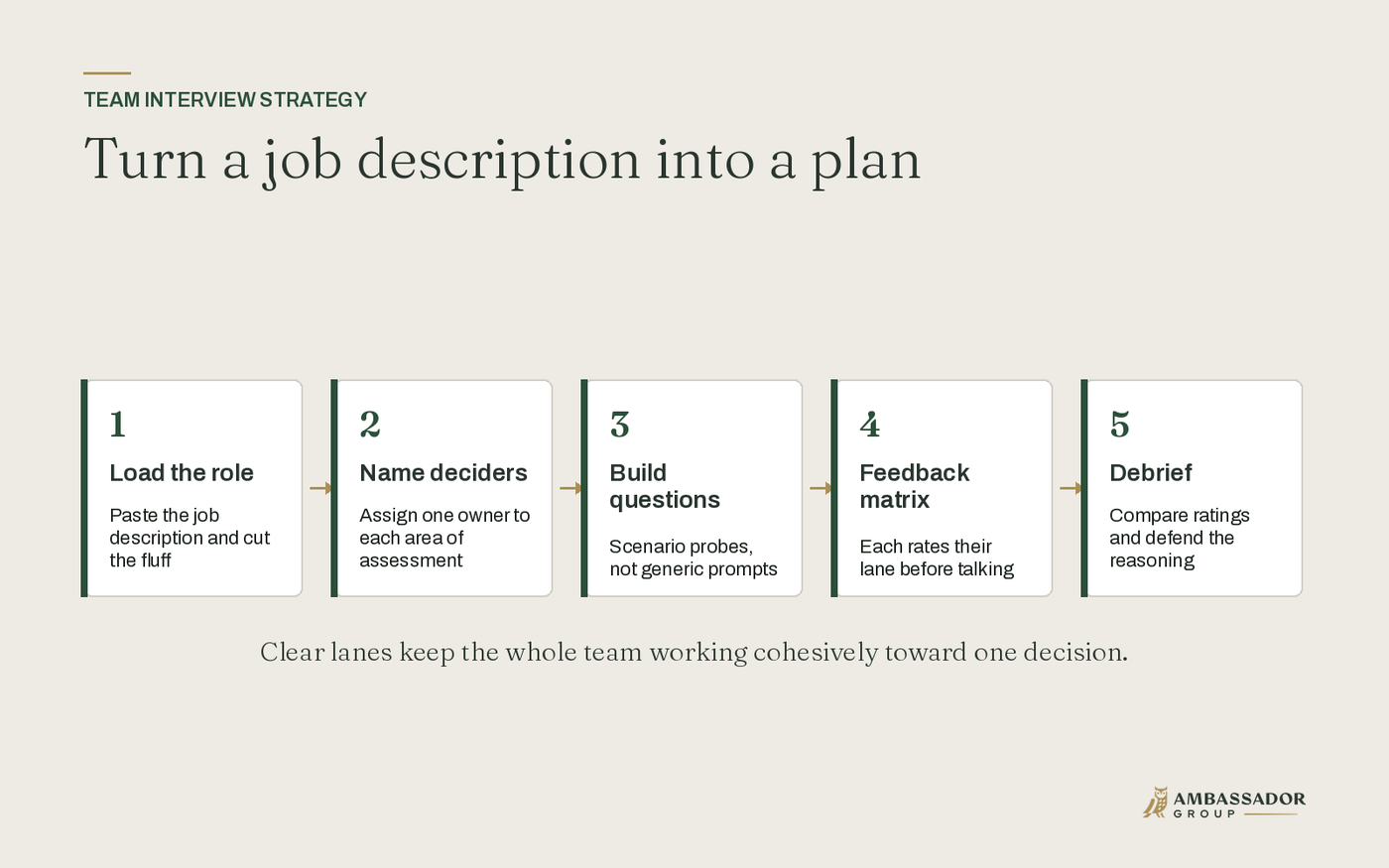
The first move is to cut the fluff. Most job descriptions are padded with aspirational language that tells you nothing about what to test. Feed the real description in, and the work is to extract the handful of responsibilities that genuinely have to be tested for a superintendent or a project manager to succeed here. That short list is the spine of the whole strategy. Everything downstream hangs on naming what matters.
Deciders, because shared responsibility is no responsibility
Once you have the responsibilities, assign each one to a person. Not loosely, and not in overlap. One decider per factor, accountable for the go or no-go call on that element. The reason is structural. A team where everyone is responsible for assessing everything is a team where no one is accountable for anything. Diffusion of responsibility is the quiet failure mode of large panels: five capable interviewers each assume someone else pressed on the gap, and the gap walks through unexamined.
Naming a decider for safety, another for team management, another for budget, another for leadership and problem-solving turns a crowd into a coordinated effort. Each person now owns a question they have to answer and defend. That ownership raises the quality of the preparation, because a decider who must explain a read on budget discipline cannot lean on a group nod. They have to come ready.
Questions are a starting line, not a script
A good strategy then proposes interview questions inside each lane, often a couple dozen across the team. Treat them as a floor. A generated question does not know your company, your projects, or the specific way a schedule tends to unravel on your jobs. The questions that earn real signal put the candidate inside a concrete scenario your company has lived: a subcontractor walking off, an owner change order at eighty percent complete, a foreman who will not adopt a new process. You want to watch the thinking move, not collect rehearsed answers.
A question list is most useful as scaffolding for a newer interviewer and as a prompt for a seasoned one to build the sharper question only they could write.
Walk into the interview with your questions preloaded. An interviewer trying to manage the relationship, navigate the conversation, and invent the next question all at once will do none of them well. The preparation is what frees you to be present and perceptive while the candidate is in front of you.
The strongest scenarios come from your own recent jobs, not a template. If a project manager position has to handle owner-driven changes late in a build, describe the real change you fought through last year and ask how they would have run it. Watch whether they think about the schedule impact, the subcontractor coordination, and the conversation with the owner, or whether they give a tidy answer that avoids the friction. The scenario the decider chooses is itself a measure of how well that person understands the role they are hiring for.
The feedback record is where accountability lives
The last piece, and the one most teams skip, is a simple feedback record. Each decider rates the candidate in their lane before anyone compares notes. A clean scale works: unqualified and worth moving on, qualified but needing training you would have to invest in, or fully qualified and ready to do the job with little support. Then leave real space for written reasoning, because the rating is only as good as the thinking behind it, and the decider will have to defend that thinking in the debrief.
The order is the whole point. Interviewers who talk before they record contaminate each other, and the most senior or most confident voice quietly becomes the group's verdict. Independent written feedback, captured first, preserves what each person saw. The debrief then becomes a real conversation: here is where I ranked this person, and here is why, lane by lane.
This record also does something most hiring processes never manage. It lets you measure the interviewers. Track how a person rated a candidate, and if that candidate is hired, compare the rating against how they performed on the job. Over time you can see who reads people well and who is still learning, and you can develop that skill on purpose. It is not unusual for experienced leaders to run this process once and discover they have more to learn about interviewing than they assumed, which is uncomfortable and exactly the point.
What the structure buys you
Run a search this way and the hire stops being a gut call you hope holds. You have a named factor for everything that matters, a person accountable for each one, independent reads collected before they could be swayed, and a record you can learn from whether the hire thrives or struggles. The candidate gets a fairer process too, assessed against explicit criteria instead of a vague impression, which gives both sides a more honest basis for the commitment.
None of this is locked away. The strategy is open to any leader, recruiter, or HR team that wants to raise the quality of their hiring, because better interviews produce better alignment, and alignment is a net positive for the candidate and the company alike. Take your next open role, turn the description into lanes and deciders before the first interview, and you give yourself a process you can stand behind.