When a hire fails, the autopsy almost always points at the candidate. They were not who you thought you were hiring. They could not run the schedule. They did not communicate with subs the way the job demanded. That story is comfortable because it puts the failure outside the building. The harder, more useful read is that the gap usually sits inside the interview process itself, and a leader who cannot examine his own process clearly will keep blaming the people who walk out of it. Owning the hire means owning the machine that produced it.
I have watched thousands of interviews and the failures that follow them, and the pattern is consistent. Teams that hire without a clear strategy can succeed for a long time on instinct and luck, which is exactly why the absence of a strategy goes unnoticed. The hires that work paper over the ones that do not, until a costly miss forces a reckoning that the team has no tools to perform.
Diffusion of responsibility is the silent risk
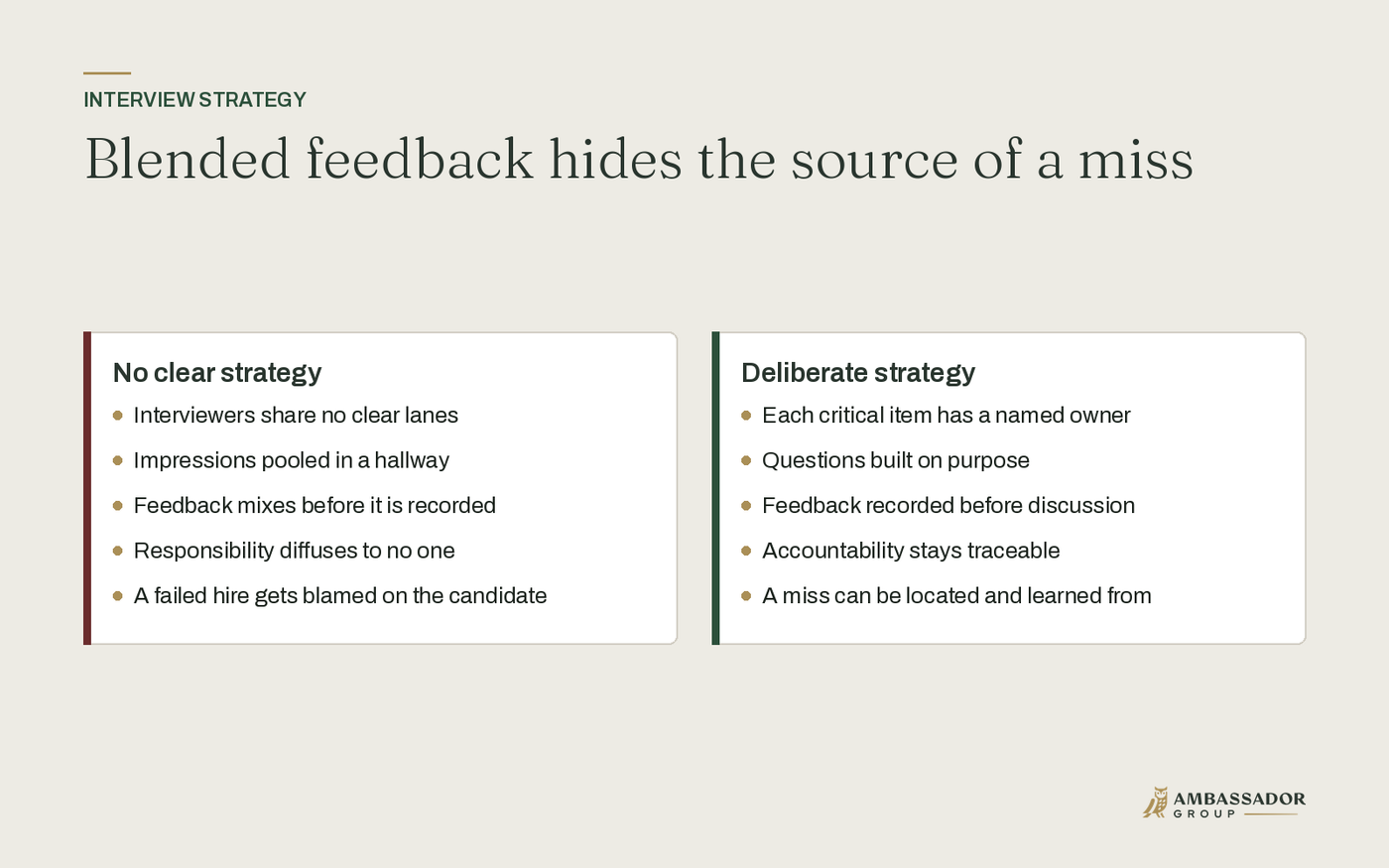
The core failure is structural. A typical interview loop sends four or five people to talk to a candidate with no clear lanes. Nobody owns assessing the schedule competency. Nobody owns the subcontractor relationships. Nobody owns verifying the parts of the job description that genuinely predict success. Everyone forms an impression, the impressions get pooled in a hallway conversation, and a decision emerges from the blend.
That blend feels like consensus. It is closer to an accident. When responsibility is shared by everyone, it is held by no one, and the diffusion means that no single person can be pointed to afterward and asked what they assessed and how. The interview produces a hire, but it produces no record of who was accountable for what, which means it produces nothing you can learn from.
Record before you discuss
One discipline changes more than any other: collect each interviewer's assessment before the interviewers talk to each other. The moment opinions mix, they contaminate. A confident voice in the debrief shifts the uncertain ones. A senior person's read becomes everyone's read. By the time the group reaches a verdict, the individual signals that should have been preserved have dissolved into a single agreeable narrative, and the narrative is usually kinder to the group than the facts deserve.
Recording feedback separately, in writing, before discussion, keeps each assessment honest and traceable. It also means that later, when something breaks, you can open the file and see exactly what each person believed and on what basis. Accountability in interviewing is rare precisely because most teams skip this step, and skipping it is a real strategic risk, not a procedural nicety.
An interview with no recorded ownership cannot be audited, and a process you cannot audit will teach you nothing the next time a hire goes wrong.
The autopsy you cannot perform
This is where the missing structure costs the most. A superintendent comes on, and three months in, a gap appears. They cannot run a look-ahead the way the work requires, or they struggle to communicate with subs, or the schedule slips in ways that trace back to something the interview should have caught.
A team that blended its perspectives has no way to find the source. There is no record of who was supposed to assess scheduling, no note of what was asked, no trace of where the read went wrong. So human nature does what it does. The problem migrates to the candidate, who gets blamed for being someone other than the team thought they were hiring. The team closes the case without ever examining its own work, and because the work was never examined, the same gap is waiting in the next search.
A team with recorded, owned assessments can perform a real autopsy. It can find the specific question that was never asked, the competency nobody was assigned to verify, the assumption that years of experience made someone a fit for how this company operates. That is the difference between a process that improves and one that repeats its mistakes with new faces.
Build the strategy on purpose
A clear interview strategy is not elaborate, but it has to be deliberate. It assigns lanes, so every critical item on the job description has a named owner who is accountable for the quality of that read. It builds questions on purpose rather than improvising them in the moment, so the interview tests what predicts performance in your operation. It runs a real prep so interviewers know what they are responsible for before they sit down. And it runs a debrief where feedback is collected individually and in writing before anyone compares notes.
The payoff is twofold. In the moment, you reduce the risk of importing someone whose experience looks right but whose operating habits do not fit how you build. After the fact, you gain the ability to reflect on a miss and locate it, which is the only way a hiring process gets better instead of merely older. Nobody should be able to enter your organization without a thorough vetting, and thorough does not happen by accident. It happens because someone designed the process to make it happen.
The leaders who build this discipline are the ones who can look at a failed hire and learn from it rather than litigate it. Design your interview strategy with lanes, deciders, and recorded feedback before your next search, and the next time a hire surprises you, you will know exactly where to look.