A philosopher with a master's degree and twenty years of operating experience left private equity in real estate to help match construction leaders into jobs. That sentence reads like a downgrade to most people, which tells you how badly the work is understood. Recruiting looks transactional from the outside: fetch a resume, fill a role, collect a fee. Underneath it runs something much larger, a current of human beings trying to build better lives, and the leader who treats hiring as a transaction is the leader who keeps mistaking the surface for the substance. Hiring is where a leader's philosophy and his respect for human dignity become visible, and that is true whether or not he ever names it.
I started this firm because I needed to make money. The deeper reasons arrived later, and they arrived through watching. My father ran a tree service and struggled with the people-leadership side of the business. I saw what that cost: his quality of life, the employees' quality of life, the quality of life under my own roof. That early lesson lodged somewhere and stayed. When the people side of a company is led well, the benefit radiates outward to every worker and every family attached to the place. When it is led poorly, the damage radiates the same way. Hiring sits at the headwaters of all of it.
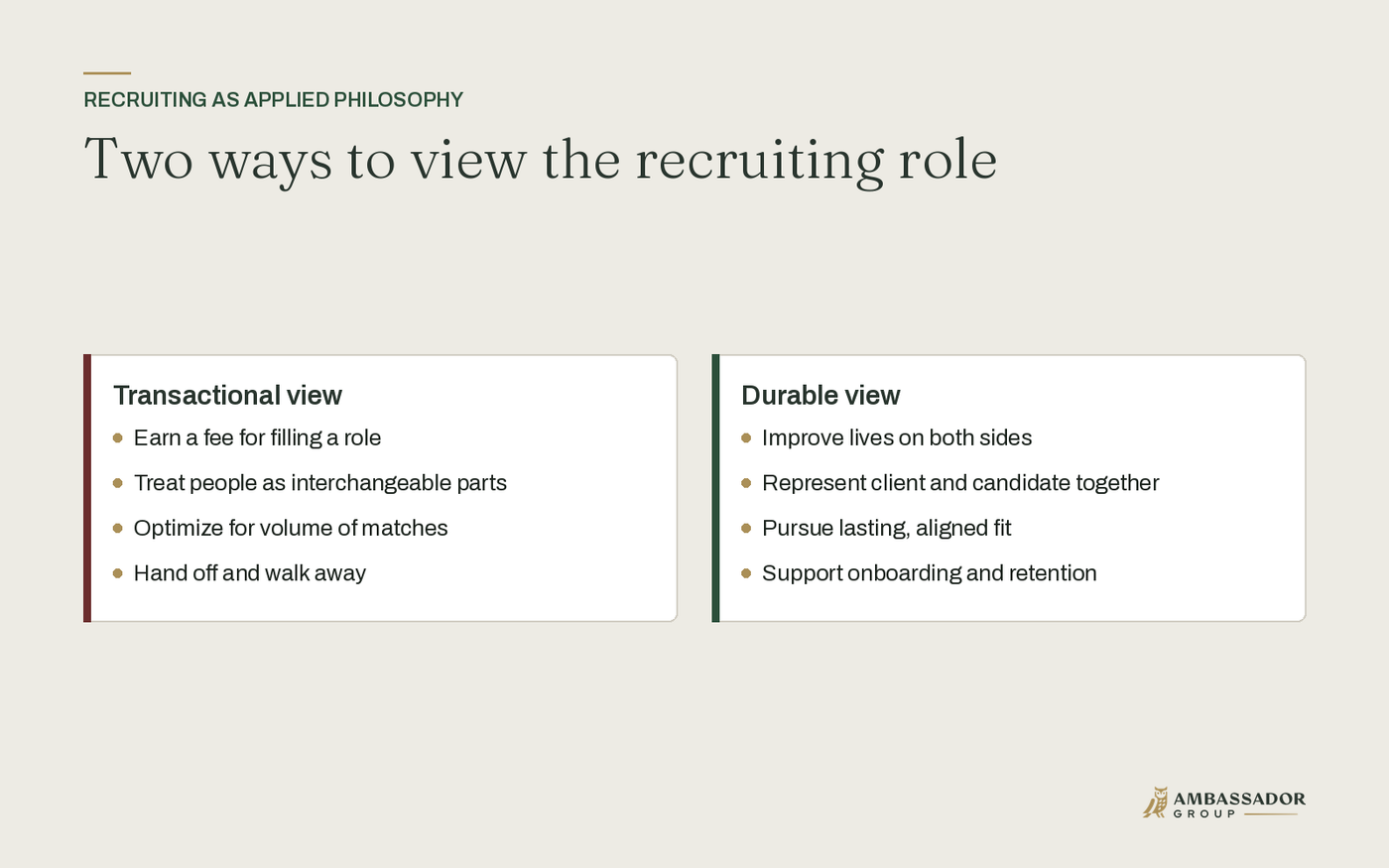
Recruiting is applied philosophy, whether the recruiter admits it or not
Most of the industry performs the function without examining it. A resume gets moved, a logistics chain gets coordinated, a generic screen gets applied, and the work calls itself done. What that performance misses is that every hire is a decision about a human being who is trying to improve his life, support a family, find work worth doing. Treat that decision as a fee-generating event and you flatten it into something it was never small enough to be.
You spend most of your waking life at work. For a lot of people that is a grim fact. It can also be an opportunity, if someone is paying attention to whether the work and the relationships around it are any good. That is the part of recruiting worth taking seriously: the chance to help a leader who needs to make a hire, and a person who needs a better job, find an arrangement that improves both their lives. A leader who understands his own hiring this way starts asking different questions, and the questions are the whole game.
The repetition is where the pattern lives
Most hiring leaders hire a handful of times a year. It is a tertiary duty layered on top of running a department or a company. They never accumulate enough repetitions to see the patterns, so the same predictable failures keep surprising them. Doing nothing but this, year after year, hundreds of hires deep, you start to see the structure underneath. The interview that was never deep enough. The offer that undershot the role. The onboarding that nobody ran. The leadership too distracted to stay attuned to what the new person needed most. Each of those is a risk factor sitting quietly, waiting to become a resignation.
The lesson that organizes everything else is risk mitigation across the entire arc, well beyond the search itself. Recruiting is one input. So is how the offer gets negotiated, how the deal gets structured to last, how the candidate gets onboarded, and how the leadership above him keeps the relationship alive in the year that follows. A leader who owns the outcome has to own that whole chain, because a strong candidate dropped into a broken process will fail like a weak one.
A hire is a relationship between humans, and humans are complicated, which is why you can do this work well and still never fully solve it.
Two customers, one relationship to protect
The word "ambassador" was chosen on purpose. An ambassador manages the interests and motivations of two parties at once. In a search there are two genuine customers: the company paying the fee and the candidate spending something equally real, his risk, his career trajectory, his opportunity cost. A leader who sees his own interests as flatly at odds with the person he is trying to hire is showing you something, and it is rarely good. That is the posture of someone who thinks a good deal is win-lose, who is trying to get the better of an exchange. Economics is not a zero-sum game. A committed working relationship, where the interests genuinely align, produces something larger than the sum of its parts.
This bilateral stance is also the most practical filter a leader can adopt. When you treat the candidate as a legitimate principal rather than a resource to be extracted, you stop selling a veneer and start surfacing the misalignment early, while it is cheap to act on. You tell the candidate the truth about where he would struggle. He tells you the truth about what he needs. The honest conversation either deepens the commitment or ends the process before either side has sunk a year into the wrong fit. Both outcomes are wins, which is exactly what the zero-sum mindset can never see.
You cannot swap a person like a part
A common error sounds reasonable: "Get me another superintendent," or "Find me another PM," as if the role were a uniformly sized component to be reordered. A factory line worker responsible for one repeated operation can be replaced close to one-for-one. A senior leader cannot. A visionary paired with an integrator forms a specific complementarity of strengths and weaknesses, and replacing either one changes the DNA of the whole team, even when the replacement is excellent. The new arrangement may work, but it works differently, because a healthy team is a functional whole and not a stack of interchangeable parts. This has serious implications for succession planning at senior levels, where leaders too often assume one capable person slots cleanly in for another.
It also has implications for self-awareness, which is the thread running through all of it. A visionary who never examines his own wiring tends to overfunction in his strengths and generate weaknesses in the organization without seeing it. The strengths cause the problems, and the leader cannot connect the symptom back to himself. A leader who can name where his own gifts run too large is the one who can hire complements instead of copies, and who can keep growing instead of hiring the same problem in a new face.
The honest version of this work honors the worth of the people on both sides of the hire by taking the decision as seriously as the lives it touches. Look at your own hiring before your next search and ask whether you have been treating it as a transaction or as the human decision it has always been, because the answer shapes every match you will ever make.