Your best superintendent updated his profile last Tuesday. He did not tell you, and he did not mean for you to know. He is not unhappy enough to quit on Friday, but he is curious enough to look, and curiosity is the first mile of a departure you will spend a year and a quarter-million dollars recovering from. A leader who cannot see his own team clearly cannot keep it, and retention turns out to be the same skill as hiring: the willingness to look honestly at the relationship before the cracks become a resignation letter.
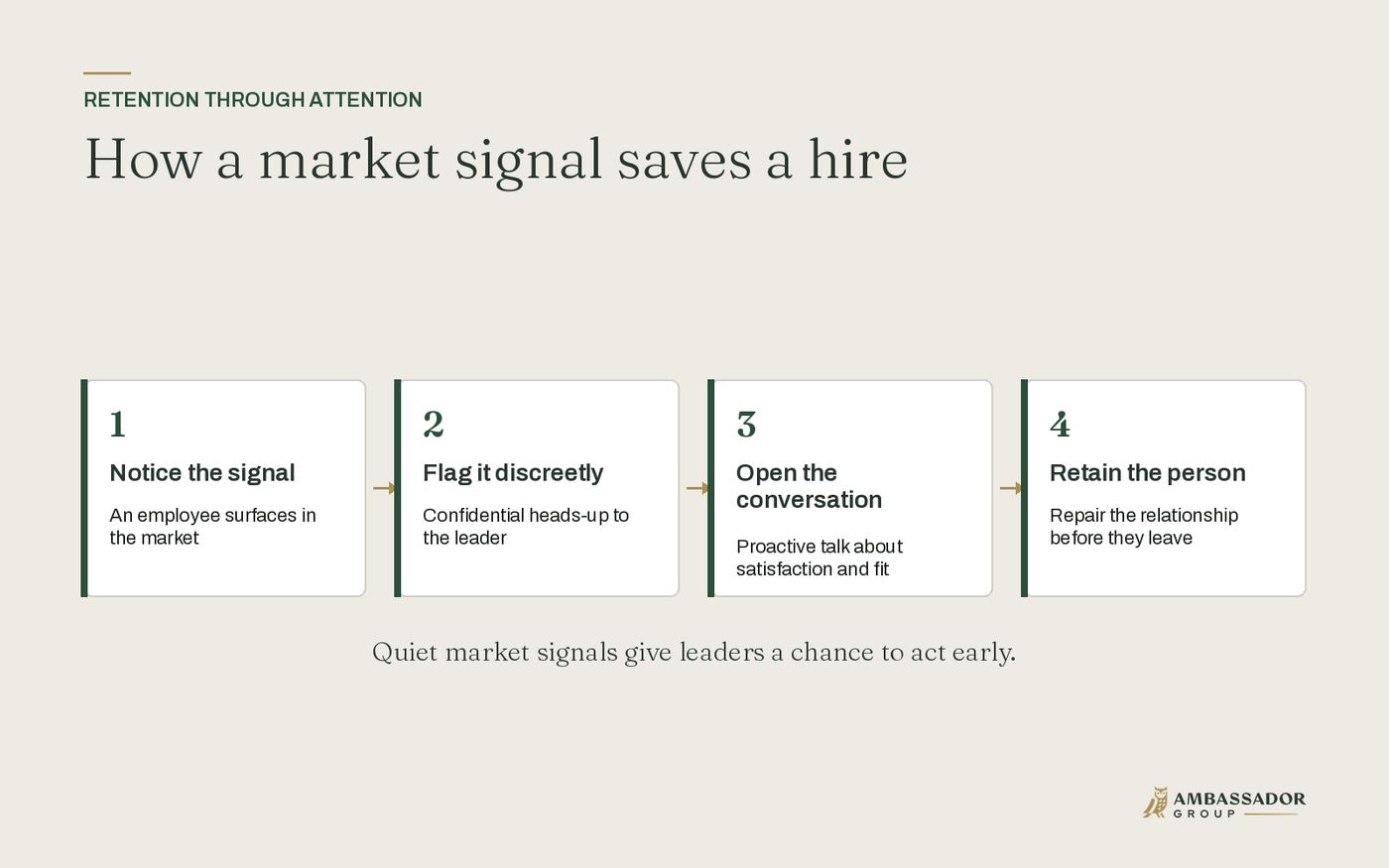
That visibility is hard to come by from inside the building. You see your people through the lens of the work in front of them, the project that is behind schedule, the change order that needs signing. What you do not see is the quiet signal that someone has started weighing options, because that signal almost never shows up in the office. It shows up in the market, where I spend my days. While I am out sourcing for one client, I sometimes recognize a name: a project manager or a field leader who already works for another client of mine, now visible in a way that suggests he is testing the water.
The signal lives outside your walls
A person rarely decides to leave in a single moment. The decision accretes. A missed conversation about growth, a comp number that has drifted below market, a sense that the leadership above him has stopped paying attention. By the time any of that reaches you as a formal complaint, the person has usually already done the emotional work of leaving. The resignation is the last event in a long sequence, not the first.
What makes this expensive is that the early sequence is legible to almost everyone except the employer. Recruiters see it. Competitors see it. The person's spouse sees it across the dinner table. The leader who would most benefit from knowing is the one structurally positioned to know last, because the employee has every incentive to keep the search quiet until it is real. That information gap is where good people slip away from companies that would have fixed the problem gladly, had anyone told them a problem existed.
When I notice one of these profiles, I let the leader know, discreetly and without naming a verdict. I am not reporting that the person is disloyal or that a departure is certain. I am handing over a piece of information the leader could not otherwise have obtained: this relationship may need attention. What happens next is entirely the leader's to own.
A warning is only as good as the conversation it triggers
The information itself changes nothing. A leader who learns that a key person is restless and responds with suspicion, surveillance, or a defensive counteroffer will accelerate the outcome he fears. The signal is an invitation to do the thing he should have been doing all along: sit down with the person and ask, honestly, whether the role still fits the life.
Those conversations are uncomfortable precisely because they require self-awareness. To ask an employee whether he is satisfied is to risk hearing that he is not, and to hear that the cause is something you control. Maybe the growth path you promised two years ago never materialized. Maybe the comp structure rewards tenure over contribution and your strongest contributor has noticed. Maybe the project he is running is a grind nobody chose to fix. A leader who can hear those answers without flinching can usually repair the relationship. A leader who cannot will treat the warning as a betrayal and lose the person twice: once in spirit, then on paper.
The early signal is a gift, because the alternative is learning the relationship was broken on the day the resignation lands on your desk.
The repair is rarely dramatic. Often it is a candid conversation about where the person wants to go and whether this company can take him there. Sometimes it is a comp adjustment that should have happened a cycle earlier. Sometimes it is plain attention, the leader signaling that the person is seen and valued, which for a senior field or office leader is worth more than most owners assume. The fix matches the cause, and the cause only becomes visible when someone is willing to look.
Retention is a leadership discipline, not a perk
Construction leaders tend to treat retention as a function of pay and ping-pong tables, the surface stuff that benefits committees argue over. The durable version sits much deeper. People stay where they are led well, where the work is meaningful, where they can see a future, and where someone in authority is paying enough attention to notice when their satisfaction starts to dip. Those are the daily practice of a leader who understands that every person on the team is a relationship to be maintained, not an asset to be assumed.
This is the same muscle that makes someone good at hiring. The leader who can read a candidate accurately, who can name what his company is and what it needs, who can have an honest conversation about fit, is the same leader who can sit across from a restless veteran and ask the right question. Self-awareness is the instrument in both cases. When it is sharp, you catch the drift early. When it is dull, you find out at the exit interview, and exit interviews are where companies collect lessons they could have used six months sooner.
There is a hard ceiling on what any outside party can do here. I can hand a leader the early signal. I can name that a relationship looks like it needs attention. What I cannot do is have the conversation, repair the trust, or fix the comp structure. Those belong to the person in charge, and they always have. The warning only matters if it lands with someone willing to act on it.
So the question is not whether your best people are looking. Some of them always are, quietly, the way capable people stay aware of their options. The question is whether you have built the kind of attention into your leadership that catches the drift while it is still a conversation rather than a countersign. Look at your strongest field and office leaders before someone else does, and ask whether you have given them a reason to stay that they could not find anywhere else.