Michael C., president of Cello & Maudru, remembers the early calls as a nuisance. A recruiter kept ringing, and like most leaders he had been trained to hold recruiters at arm's length, to keep his guard up and assume the contact was about someone else's interest, not his. What changed was not persistence alone. It was the moment he spent enough time in conversation to realize the person on the other end was watching out for his company, not working him. That shift is the whole lesson of the Cello & Maudru story, and it points straight at the thesis: hiring is where a leader's respect for the people involved becomes visible, and a process that earns a guarded leader's trust does it by being honest enough to be seen through.
Cello & Maudru is not a builder of cookie-cutter work. They take on custom residential, ground-up and renovation, alongside commercial projects in the winery and hospitality world, the kind of demanding architecture that calls for collaboration and design sense rather than repetition. They describe their projects as almost sculptural, and that self-knowledge matters more to hiring than it first appears. A company that knows precisely what it is can finally measure who fits it.
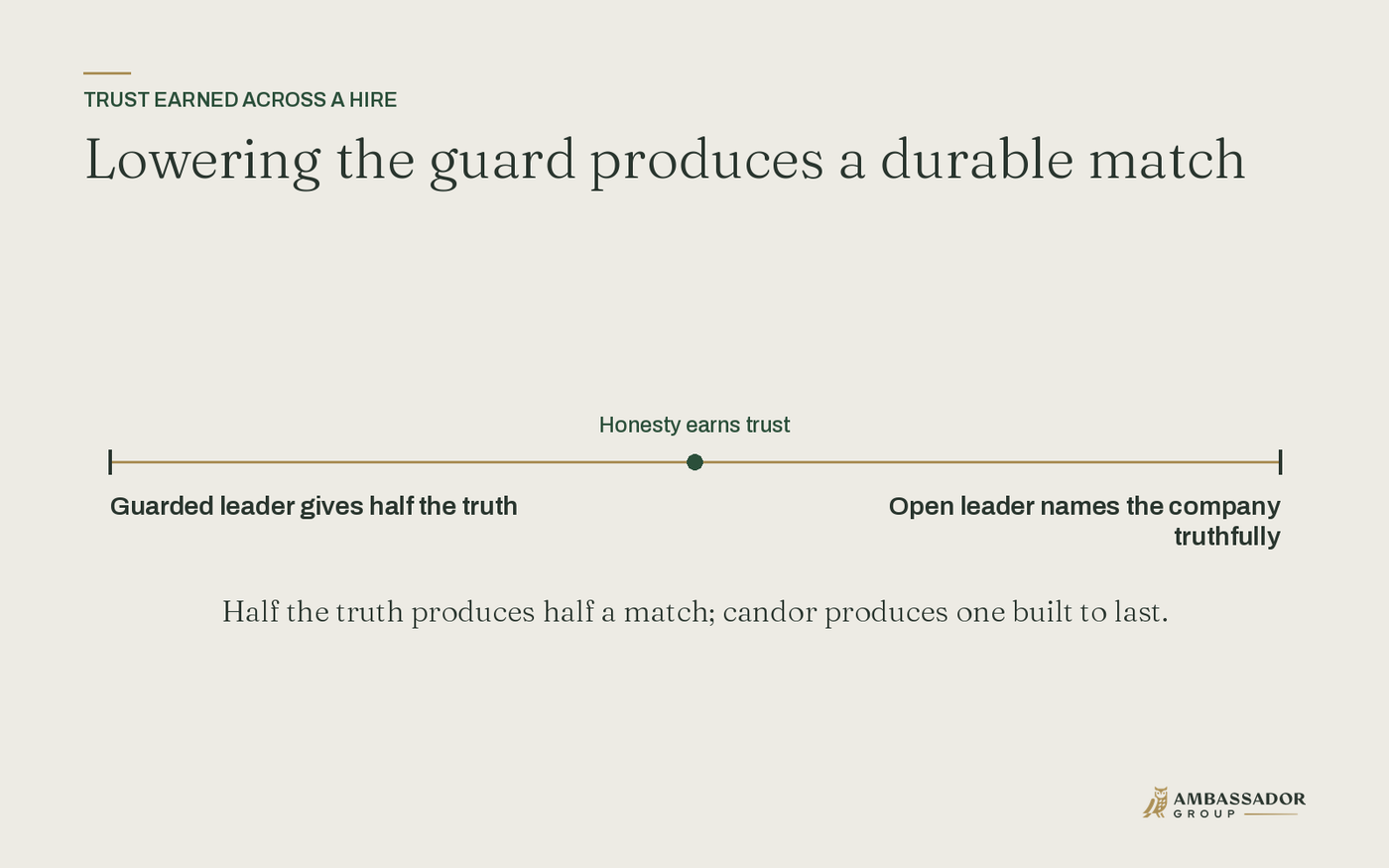
The guard comes down when the process goes deeper
Most leaders keep their guard up with recruiters because the typical interaction does not earn transparency. They feel they cannot be fully open, so they are not, and the search runs on half the truth. Michael's experience ran the other way. The collaboration felt less like hiring a vendor and more like working as one company, open enough that he could put his real requirements on the table.
That openness is what let the work go a step deeper than the resume. Cello & Maudru's hiring goal is unusually demanding: they want the offer a candidate accepts to be the last offer that person ever takes. Reaching that bar requires more than confirming a skill set. It requires knowing whether the individual wants to be at the company, whether they bring something distinct, whether their wiring suits a shop that builds sculptural work under real design pressure. None of that surfaces through a guarded conversation. It surfaces when the company can speak plainly about who it is and trust that the search is listening.
A guarded leader gives you half the truth, and half the truth produces half a match.
Serving two sides at once
What Michael came to value was that the work was not aimed at one party. When a candidate is matched to Cello & Maudru, the search is trying to make the right match for the candidate and the right match for Cello & Maudru at the same time. Those are the two halves of a durable relationship, and treating them as one job is what makes the result hold.
The clearest illustration is the business development leader Cello & Maudru brought on. He had been working for a competitor in the residential space, a near-perfect fit on paper for what the company wanted, and he was firmly opposed to leaving. Rather than push past his objections, the search worked through them. It surfaced every hurdle he saw in his own mind and addressed them one at a time, persistently but with a clear read on what the opportunity genuinely offered him, including possibilities he had not yet considered for himself. He later reflected that the process understood, better than he did at the time, what he would have lost by staying put.
That is bilateral representation doing its real work. The candidate was not sold a position. He was helped to see his own situation in higher resolution, to recognize that the flexibility and the growth he wanted were available, and to commit with eyes open. He described the experience as confidence-boosting, a reminder that strong companies are looking for good people. A match built that way rests on the candidate's informed commitment, which is the kind that survives the years after the offer.
Truth about candidates, memory across searches
Two more habits show why Cello & Maudru kept coming back across many years. First, when candidates were introduced, the search told the truth about them: the genuine strengths, the honest weaknesses, where a person would excel and where they would need to grow. A leader cannot judge fit against a polished veneer. He can judge it against an honest read, and honesty about a candidate's limits is a form of respect for both the candidate and the company considering them.
Second, the relationship accumulated reference points. Over years of working together, Michael built a shared memory of which matches went well and which did not, and that history became a tool. When something about a new candidate did not feel right, he could place the feeling: this reminds me of a situation that did not work out, or this resembles one that did. A long relationship turns past searches into judgment a leader can put to work, which is something no single transaction can give him.
The business development leader who came over credits the company and its people for the decision, and notes that the recruiter stayed in the background the whole way, steady and present without crowding the moment. The takeaway for any guarded leader is direct: lower the guard far enough to let a search know your company truthfully, demand honesty about every candidate in return, and you give yourself the one thing a transaction never will, a match built to last and the judgment to recognize the next one.