Everyone has a finite amount of time on earth, and a large share of it gets spent at work. That single fact changes how a hire should be weighed. Spending a life inside work that does not matter is a quiet tragedy, and a leader who treats a job as a slot to be filled rather than a meaningful share of someone's one life is reading the whole exchange too small. A leader who cannot see what work means to a person cannot see the person clearly, and the hire becomes a transaction when it should have been the start of something durable.
The phrase that gets repeated is that it is only a job. That phrase is a lie people tell themselves. A job is your life. It is your impact, your relationships, your sense of satisfaction, your sense of being of value to other people. The hours do not pause being your life because a clock is running and a paycheck is attached. They are still the hours. What a leader decides to make of them, and what a candidate decides to give to them, is the actual stake in any hire worth taking seriously.
Meaningful work is not a perk; it is the structure
It is tempting to file meaning under culture, somewhere near the snacks and the offsite. That misplaces it. Meaning is structural. It is what determines whether a talented superintendent stays through the hard middle of a four-year build or starts taking calls from your competitors in month nine. When the work connects to something a person can be proud of, they absorb stress through competence and conviction. When it does not, they absorb the same stress through cortisol, and that runs out.
Construction makes this vivid because the product is real. A person can stand in front of a finished building and know they made it. A custom home that a family will live in for thirty years, a hospital wing, a structure that shapes a street, these are real, standing things a person can point to. The leader who connects a project manager to that reality, who keeps the work tied to the people it serves and the craft it demands, is handing that person a reason that outlasts any single bad week. The leader who reduces the same work to units shipped and margins hit has stripped out the only fuel that survives adversity.
You hire for rough seas, and meaning is what holds
There is an old line that if a person's why is strong enough, they can endure almost any how. That belongs at the center of hiring, because you never hire for smooth seas. You hire for the rough ones. There will be problems in the future. The entire industry is a stress-absorption machine and a complexity-absorption machine, and the people inside a construction company spend their days metabolizing that stress on the company's behalf.
So the question underneath a hire runs past whether someone can do the job on a calm day. It is what will carry them through the day the schedule collapses, the owner changes the program, and two key people are out. Skill matters there, but skill alone gets brittle under sustained pressure. A person who sees their work as meaningful, who believes the thing being built matters and that their part in it matters, has a deeper reservoir to draw from. The leader who has done the work to make the mission real, and who can articulate it without sounding like a slogan, is the one who can offer that reservoir honestly.
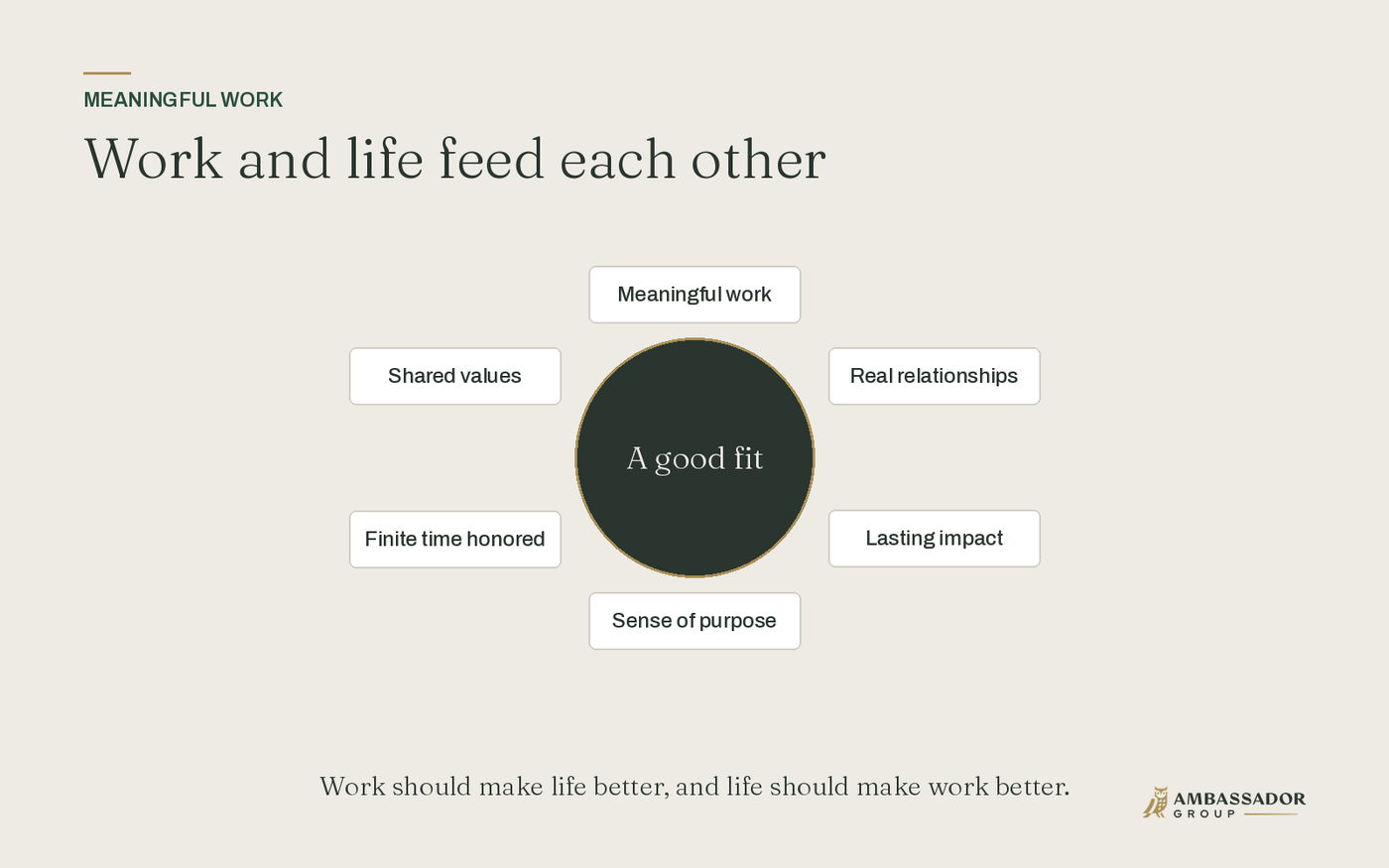
Your work should make your life better, and your life should make your work better, and a hire built on that exchange holds where a hire built on convenience comes apart.
The match is bilateral, and meaning is the test of it
A durable hire is not one party selling and the other buying. Both sides own the outcome. The leader is responsible for offering work that genuinely matters and a relationship worth keeping. The candidate is responsible for being honest about what they want from their work and their life, and whether this particular mission is one they can give themselves to. When either side fakes that, the match looks fine for a quarter and frays after.
This is why honest self-representation belongs on both sides of the table. A company that pretends its work is more meaningful than it is will lose the person the moment reality arrives. A candidate who pretends to care about a mission they are indifferent to will drift, and the leader who hired the performance instead of the person will spend a year wondering what changed. The meaningful match depends on two parties telling the truth about what they need, then choosing each other with their eyes open. That is what makes a commitment informed, and informed commitment is what makes it last.
Bringing the right people to the right work
The work worth doing here is introducing people who are looking for meaningful work and meaningful relationships to companies looking for the same thing, and giving them a real format for building the relationship rather than a transaction to complete. That is a different posture than filling a role. Filling a role optimizes for speed. Building a match optimizes for whether two parties will still be glad they found each other in three years.
For a construction leader, the practical version of this is concrete. Before the next search, get clear on why your company's work matters beyond the revenue it produces, and clear enough that you could say it to a candidate and have it land as true rather than rehearsed. Then interview for whether the person across the table is moved by that same thing, not only whether their resume checks out. The resume tells you what they have done. The conversation about meaning tells you whether they will still be doing it, and doing it well, after the offer's shine has worn off and the real work has begun.
None of this is soft. It is the most practical lever a leader has, because retention, culture, and performance all run downstream of whether people believe their work matters. A team that does meaningful work with people they respect will outlast and outperform a team assembled for convenience, every time the seas get rough. You decide which kind of work you are offering and which kind of match you are building, and that decision shapes far more of your company's future than the next negotiation ever will.